Home Blog Page 998

2026 Kia EV4 unveiled at New York Auto Show

0


play

The regulatory climate surrounding EVs might be in flux, but Kia is pressing forward with an aggressive expansion of its electric vehicle offerings regardless. And why not? Kia doesn’t seem to need government help building appealing EVs such as the big new EV9 three-row SUV, sporty EV6 crossover or forthcoming EV5 compact SUV. Next to be flushed down the product pipeline — er, zapped across the wire? The super affordable (and small) EV3 SUV, though it might not make it stateside, and these, the all-new 2026 EV4 sedan and hatchback models.

The EV4 made its official debut at what Kia is calling its “2025 EV Day,” an EV-focused event in Spain, with the U.S.-spec version landing at the 2025 New York auto show. And while we were also shown the EV4 hatchback, we’ll pop your balloon up front: Only the sedan is coming here in early 2026 . The bigger news, however, is the expected price: Kia suggests the EV4 sedan will cost about $37,000 bucks when it lands stateside — and it made no carve-out for the $7,500 EV tax credit in that price, which we’re taking to mean $37,000 will be the MSRP. Any government incentives would just be gravy on top, if they’re still around in a year, of course…

Trust us, it’s mostly conventional

In case you’re staggered by the EV4’s wild, concept-car looks, allow us to ground you somewhat with its (actual) size. The EV4 is a compact car, though it’s notably smaller than the Ioniq 6 electric sedan built by Kia’s corporate cousin, Hyundai, measuring a few inches shorter in length, about an inch narrower, and half an inch shorter in height, with a significant 5.1-inches-shorter wheelbase. This does not mean the EV4 is “small,” though — it simply places it in line with conventional compact cars you’re familiar with, namely the Honda Civic and Toyota Corolla, as well as Kia’s own gas-fed K4.

Another differentiator? The EV4 is front-wheel drive, with a single front-mounted motor spinning out 150 kW of power (that’s 201 hp); the Ioniq 6 is offered in both single- and dual-motor (all-wheel drive) configurations, but the two-wheel-drive version has its more powerful (225 hp) motor mounted arrears, driving the rear wheels. Other than their arrangement beneath the EV4’s bodywork, the primary electric components — drive motor, battery, etc. — are shared with other E-GMP platform cars, including the Ioniq 6, Kia’s own EV6 and EV9 and others.

In America, the EV4 will come in three trim levels to start: EV4 Light, EV4 Wind and EV4 GT-Line. The Light model comes with the smaller of the EV4’s two battery options, a 58.3-kWh unit good for a claimed 235 miles of range.

The larger 81.4-kWh unit comes with the EV4 Wind and EV4 GT-Line models. Range estimates for the GT-Line (which also rides on larger 19-inch wheels than the Light or Wind, both of which use more modest 17-inchers) are TBD, for now, but Kia says the Wind, with its large battery and normal-sized wheels, should deliver 330 miles of range, best of the EV4 bunch.

With either battery, the EV4 utilizes a 400-volt setup, a step down from the Ioniq 6’s 800-volt architecture; this impacts charging times, if only slightly. The EV4 Light can be DC fast-charged from 10 to 80 percent in 29 minutes, while the big-battery Wind and GT-Line need 31 minutes. Equivalent Ioniq 6s can do the same deed in as little as 18 minutes. Interestingly, the EV4 Light’s battery pack is smaller than the equivalent Ioniq 6’s, while its bigger pack is larger, though the Ioniq 6 still beats the EV4 either way — small-battery 6s are good for 240 miles on the low end while big-battery models net 361 on the high end.

But that stuff’s boring — look at it!

When the EV4 goes on sale next year, unless another automaker debuts a wilder-looking compact car, the EV4 will be the show-stealer in its segment. It even makes the Hyundai Ioniq 6, itself a vaguely Porsche-esque design with lots of crazy aerodynamic add-ons and wings — recently jazzed up for 2026, too — look normal. A Tesla Model 3 will fast become automotive wallpaper. After first seeing the EV4 in photos, we thought it seemed interesting, if a little awkwardly detailed. In person, the EV4 tries stealing the glances of everyone nearby with its angularity, snub-nose posture, and wide-set vertical LED lighting. We bet Cadillac designers are eating their hearts out right now — that’s how successful the EV4’s tall headlights are.

Approach the EV4 from the front, and those LED slashes placed way out at the corners and the stubby, plunging hood make the car seem very wide. Walk around to the sides, and the Kia seems to stretch on and on — a clever visual trick of the tapered rear end, since, again, the EV4 is about the same size as a Civic. There is still a lot going on in the details, with intersecting cut lines, odd mixes of body-color and black-painted elements — especially around the roof — but the effect is more successful here than on Kia’s conventionally powered K4 sedan, which is essentially this EV’s gas-fed analogue.

While some might lament the hatchback’s exclusion from the U.S. market (for now), we think the sedan wears this styling better. The hatch is over eight inches shorter than the sedan, with all of that chopped from behind its rear wheels. As such, it suffers a severe case of pancake butt, and its T-shaped taillights seem ripped off the newest Chevy SUVs. And the sedan’s long booty affords it a roomy boot, er, trunk — while the hatch’s stunted length leaves its cargo hold relatively shallow front-to-back, though of course there is more vertical space than in the sedan. Eyeballing the two cargo areas, they seem about the same in size, just with the sedan’s laid down and the hatch’s standing upright. The hatchback also loses the EV4 sedan’s more interesting double-bubble roof spoiler — yes, the four-door has winglets over the rear glass! — and width-emphasizing vertical taillights. Kia also claims the sedan wears the more slippery shape, slick enough for a super low 0.23 drag coefficient.

Clever parts sharing

While in Spain to meet the EV4, Kia let us loose on local roads in the new EV3 — which we previously drove in Korea — giving us a great opportunity to preview the EV4’s cabin, as the two models share a lot. The centerpiece is a pair of 12.3-inch digital displays sandwiching a vertical 5-inch screen for climate controls, combined into one unit and perched atop the dashboard. It’s the same as the gear installed in the EV3 (and a host of other recent Kia products), and it both looks great and works well (aside from the smaller HVAC screen’s visual blockage by the steering wheel rim). But peer closely at the photos of the EV4’s cabin here, then check out the EV3’s — and you’ll notice a lot of the same bits, just arranged on a slightly different canvas of door panels and dashboard components.

Perhaps because all of these pieces look and operate so well, you won’t notice or care that they also appear in other Kias. In fact, you’ll appreciate the economies of scale they bring to the EV4’s price tag, which Kia is claiming will be around $37,000 to start when it goes on sale here in America. With no mention of asterisks like “with the $7,500 EV tax credit included,” we’re taking that to mean the actual MSRP will be $37,000 and up. That’s mega affordable for an EV in this class, with this much style. Hyundai’s Ioniq 6 costs a little more, as does Tesla’s Model 3 (though it qualifies for the tax credit, for now). We’re genuinely excited to drive this EV4, and to see whether Kia eventually adds a second motor to the mix. Hey, it showed off the car in regular and sportier-looking GT-Line trim, though for now that GT-Line gets no extra performance, and we’d love to see the EV6 GT’s 576-hp dual-motor arrangement in this smaller, lighter and even wilder-looking EV4.

Photos by MotorTrend


Source link

Luigi Mangione pleads not guilty in federal court to murdering healthcare CEO | New York

0


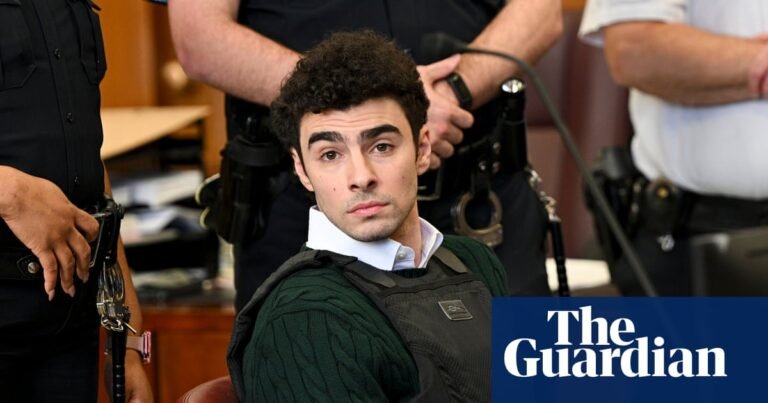
Luigi Mangione on Friday pleaded not guilty to Manhattan federal court charges that he stalked and murdered the UnitedHealthcare chief executive, Brian Thompson, late last year.

Mangione, 26, walked into court just before 1pm. He was wearing tan jail garb with a white long-sleeved undershirt. He spoke with his lawyers, who sat alongside him, and at one point appeared to smile; he could be seen flipping through papers on the table.

Judge Margaret M Garnett asked Mangione to stand, and Mangione confirmed to the justice that he had seen a copy of this indictment and had had enough time to discuss it with his lawyers.

Garnett asked Mangione his plea. Mangione said: “Not guilty.”

Mangione could face the death penalty in a case that shocked America for the killing of a top business executive on New York’s streets but also triggered an outpouring of anger against the country’s for-profit healthcare industry.

As with previous proceedings, throngs of supporters of Mangione queued up outside to secure a much-coveted seat in court. Many sported medical masks or sunglasses, or both, and were reticent about speaking to media but did attack the healthcare system.

“I am a chronically ill person. I live in chronic pain,” one woman said in explaining why she was at court. She said that she had never been in “that much medical debt” compared to others, but “when I say not that much I mean like $30,000.”

Even if it were proved that Mangione killed Thompson, she said, she believed his guilt embodies an ethical grey area. The healthcare industry kills thousands and Thompson was one man, she said. “One life [versus] like a thousand lives, that moral dilemma,” she said.

When asked about the announcement prosecutors would seek the death penalty, she said: “It’s state-sanctioned murder.

“He’s a political prisoner – school shooters don’t get that.”

As those waiting in line chatted among themselves, an LCD-screen truck, displaying support of Mangione, repeatedly drove by the courthouse. One image featured a photo of Mangione smiling that read: “END THE DEATH PENALTY NOW.” The intelligence whistleblower Chelsea Manning was also among those in line.

Mangione’s arraignment comes months after his arrest for allegedly gunning down Thompson outside a New York hotel on 4 December. He was apprehended on 9 December at a McDonald’s in Altoona, Pennsylvania, after a restaurant worker purportedly recognized him from law enforcement advisories and tipped off police.

In federal court, Mangione faces stalking, murder through use of a firearm, and firearms offense charges. Mangione is also charged with a host of murder and firearms counts in New York state court.

Pennsylvania state prosecutors are also pursuing a case against him related to alleged weapons possession and false identification. He has also maintained his innocence in the state cases.

While Mangione was already staring down the prospect of life imprisonment following his arrest, Donald Trump’s attorney general, Pam Bondi, raised the stakes several weeks ago by announcing that she was directing prosecutors to seek the death penalty.

Bondi called Thompson’s killing “a premeditated, cold-blooded assassination that shocked America”. She stated that her decision was in keeping with “President Trump’s agenda to stop violent crime and Make America Safe Again”.

In court, Garnett cautioned prosecutors against making inflammatory statements. She urged them to abide by local court rules that bar attorneys from making “public commentary that could impede Mr Mangione’s right to a fair trial” and to pick a fair jury.

“I’m specifically directing the government to convey my directive to Mr Clayton,” Garnett said, referring to acting Manhattan federal prosecutor Jay Clayton. The judge also directed that prosecutors “request that he convey the same to Attorney General Bondi” and her associates.

The last time federal prosecutors in Manhattan pursued the death penalty was in the case of Sayfullo Saipov, an Islamist extremist who murdered eight people in a truck attack.

During the penalty phase of Saipov’s trial, jurors could not unanimously decide on whether to impose a death sentence, resulting in him being automatically sentenced to life in prison without the chance of parole.

Gregory Germain, a professor of law at Syracuse University’s College of Law, previously told the Guardian that nearly all recent federal death penalty cases took place during Trump’s first term.

Germain said he believed that Trump’s justice department would not agree to an deal in which Mangione pleaded guilty in exchange for a life sentence.

“He has political reasons, wanting to seem ‘tough on crime’ by supporting the death penalty,” Germain said.

Karen Friedman Agnifilo, Mangione’s lead defense attorney, raised several constitutional points during the proceeding. She said there was a “handshake deal” forged between Manhattan prosecutors and Biden’s justice department, under which his state case would be tried first.

But now that federal prosecutors are seeking the death penalty, Friedman Agnifilo said they would fight this plan.

“It’s partly scheduling, your honor, but it’s also constitutional issues [that] are going to be impacted if we are forced to try that case first,” she said.

Friedman Agnifilo also alleged in court that authorities had been listening in on Mangione’s privileged communications.

“We were just informed by the state court prosecutors that they were eavesdropping on all of Mr Mangione’s calls,” she said. “They were listening to his attorney calls and all of his other calls going on. They said it was inadvertent that they were listening to a call between Mr Mangione and me.”

Friedman Agnifilo asked the judge to put a directive in place to prevent this from happening again. Garnett asked the prosecutor Dominic Gentile about the alleged recording.

Gentile said this was “the very first we’ve heard of this situation” and that such would not be “normal practice”.

Garnett told Gentile that she wanted prosecutors to file a letter within seven days outlining what they knew about the recording.


Source link

Why the next round of Iran-US nuclear talks may be tougher

0


Abu Dhabi, UAE
CNN
 — 

The United States and Iran have begun a third round of nuclear talks, entering what experts describe as a more difficult phase of technical negotiations this weekend as Washington lays out its conditions.

US Secretary of State Marco Rubio said Wednesday that the US does not envision Iran enriching its own nuclear material, but rather importing the nuclear fuel – uranium – needed for a civilian energy program. Iran has repeatedly stated that its right to enrich uranium is non-negotiable.

Both the US and Iran have described previous talks as positive, despite President Donald Trump’s threat of US and Israeli military strikes against Iranian nuclear sites should Tehran fail to accept a deal.

But Saturday’s talks may prove more complex, as they are set to involve negotiations on the details of Iran’s nuclear program, an area where Tehran and Washington remain sharply divided.

Here’s what we know.

A nuclear deal was reached in 2015 between Iran and world powers, including the US, under which Iran had agreed to limit its nuclear program in exchange for the lifting of sanctions that have crippled its economy.

Formally known as the Joint Comprehensive Plan of Action (JCPOA), the 2015 deal allowed Iran to enrich uranium at a level that ensured that its nuclear program would be exclusively peaceful.

That agreement was abandoned by Trump in 2018 during his first presidential term. Iran retaliated by advancing its uranium enrichment up to 60% purity, closer to the roughly 90% level that is needed to make a bomb.

Iran insists its nuclear program remains peaceful.

Last month, Trump sent a letter to Iran’s Supreme Leader Ayatollah Ali Khamenei proposing negotiations on a new nuclear deal, making it clear that Iran had a two-month deadline to agree to a new deal, a source familiar with the letter’s contents told CNN.

What does Trump want and what are the key issues?

The president has said that he wants a “stronger” deal with Iran than the one reached in 2015 under the Obama administration, but US officials have flip-flopped on their demands over the past month.

In its bid to prevent Iran from developing a nuclear weapon, it remains unclear whether the US is demanding a full dismantling of its nuclear program – including its civilian energy component – or whether it would allow such a program if Iran abandons domestic uranium enrichment.

This month, Steve Witkoff, Trump’s envoy to the Iran talks, said there’s no need for Iran to enrich uranium beyond what is needed for a nuclear energy program. He stopped short of demanding that Iran stop enriching uranium altogether or dismantle its nuclear program.

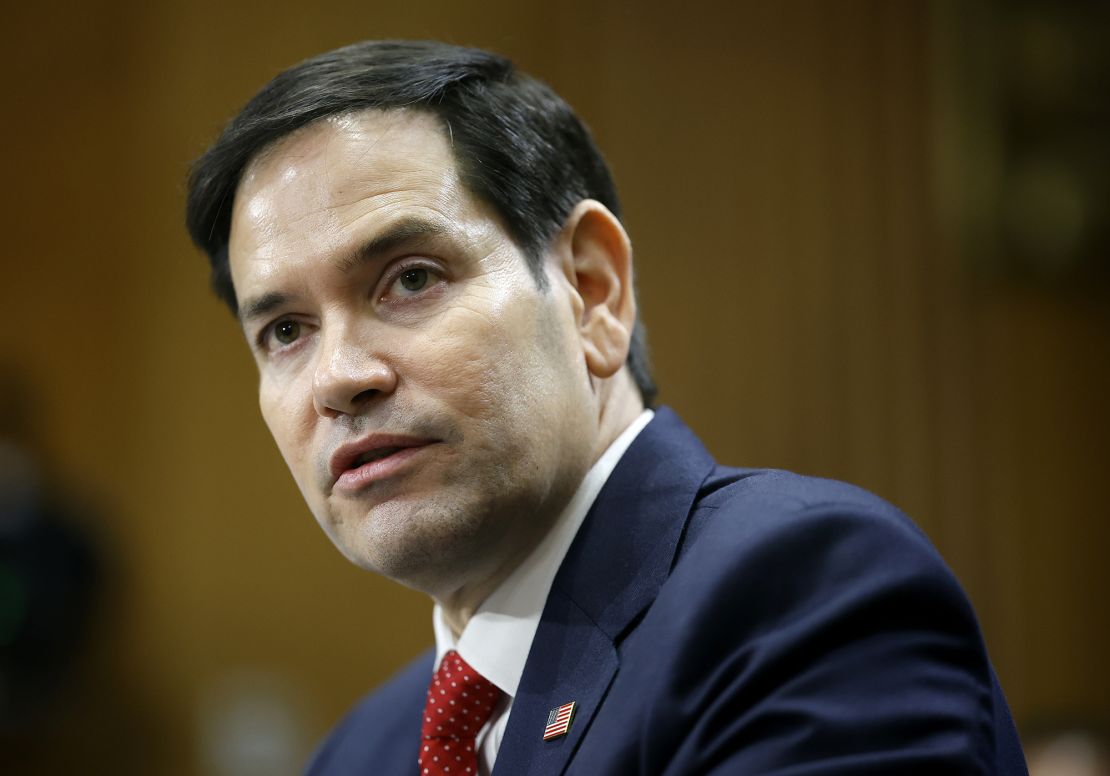
US Secretary of State Marco Rubio testifies during his Senate Foreign Relations confirmation hearing at Dirksen Senate Office Building in Washington, DC on January 15.

He reversed his position a day later in a statement on X in which he said any final deal with Iran would require it to “stop and eliminate its nuclear enrichment and weaponization program.”

US Defense Secretary Pete Hegseth meanwhile has called on Tehran to fully dismantle its nuclear program.

Then, in an interview on Wednesday, Rubio said that Iran could have a civilian nuclear program but it would have to import the nuclear fuel needed rather than produce it domestically.

“There’s a pathway to a civil, peaceful nuclear program if they want one,” Rubio told The Free Press. “But if they insist on enriching (uranium), then they will be the only country in the world that doesn’t have a ‘weapons program,’ but is enriching. And so, I think that’s problematic.”

While most countries that enrich uranium domestically also have a nuclear weapons program, others don’t. Brazil, for instance, enriches some uranium domestically for its energy program, according to World Nuclear Association. Meanwhile, the British-German-Dutch nuclear fuel consortium Urenco operates enrichment plants in Germany and The Netherlands, neither of which has nuclear weapons. Those countries, like Iran, are party to the United Nations’ Treaty on the Non-Proliferation of Nuclear Weapons (NPT), which aims to prevent the spread of nuclear weapons.

Last week, US Energy Secretary Chris Wright told The New York Times in Saudi Arabia that Riyadh and Washington were on a “pathway” to reaching an agreement that could see the kingdom enrich uranium.

“The issue is control of sensitive technology. Are there solutions to that that involve enrichment here in Saudi Arabia? Yes,” he said.

Iran has doubled down on its right to enrich uranium and has accused the Trump administration of sending mixed signals.

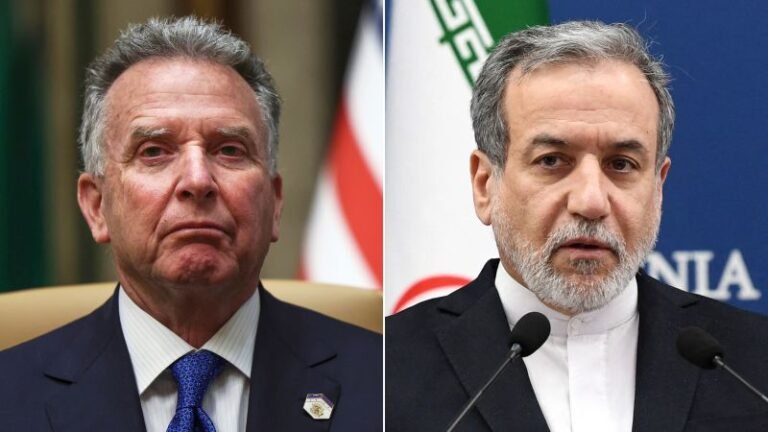
“Iran’s enrichment (program) is a real and genuine matter, and we are ready to build trust regarding potential concerns, but the issue of enrichment is non-negotiable,” Foreign Minister Abbas Araghchi, who is representing Iran at the nuclear talks, was cited as saying by the state-run Iranian broadcaster Press TV.

Tehran has laid out its “red lines” in talks, including “threatening language” by the Trump administration and “excessive demands regarding Iran’s nuclear program.” The US must also refrain from raising issues relating to Iran’s defense industry, Iranian media said, likely referring to its ballistic missile program, which the US’ Middle Eastern allies see as a threat to their security.

Meanwhile, Iran’s highest leadership has approached the talks with extreme caution. In his first comments on the issue, Khamenei said that Tehran was “neither overly optimistic nor overly pessimistic” about the negotiations with the US.

The Islamic Republic has also tried to present a potential nuclear deal as beneficial to the US. This week, Araghchi touted the possibility of US companies playing a role in Iran’s nuclear energy program, promising “tens of billions of dollars in potential contracts.”

Alongside high-level talks between Araghchi and Witkoff Saturday, technical teams will begin to hammer out the details of a potential agreement.

Michael Anton, the State Department’s head of policy planning, will head the technical team from the US side, spokesperson Tammy Bruce said on Thursday.

The team will consist of roughly 12 working-level experts from various US government agencies and discuss more granular details about a path to a new nuclear agreement, such as potential sanctions relief and limitations on Iran’s nuclear program, a source familiar told CNN.

Technical talks are “challenging” as they will try to address issues that were not pursued in the 2015 deal, said Trita Parsi, executive vice president of the Washington DC-based Quincy Institute. “This requires technical expertise to make sure these different ideas actually can become feasible.”

As well as the issue of enrichment, complications may emerge if “poison pills” are introduced, including a demand to fully dismantle Iran’s nuclear program, “Libya-style,” as Israel has pushed for, he added.

Iranian Foreign Minister Abbas Araghchi and his team members take part in negotiations with the US, in Rome, Italy on April 19.

Libya in 2003 dismantled its nuclear program in the hopes of ushering in a new era of relations with the US after its two-decade oil embargo on Moammar Gadhafi’s regime.

After relinquishing its nuclear program, Libya descended into civil war following a 2011 NATO-backed uprising that toppled Gadhafi’s regime and led to his killing. Iranian officials have long warned that a similar deal would be rejected from the outset.

Another hurdle could surface if the US demands that restrictions on Iran’s nuclear program “be in perpetuity,” Parsi said. “Meaning, this would not be like normal arms control agreements, (where) restrictions are time-limited and over time expire.”

The 2015 deal had an expiration date, ending in October 2025 unless otherwise decided by the United Nations Security Council.

When he pulled out of the deal in 2018, Trump lambasted the agreement’s 10-year time limit, saying that even “if Iran fully complies, the regime can still be on the verge of a nuclear breakout in just a short period of time.”

Parsi said there may be an opportunity to extend the timeline. “But anything that pushes toward infinitive and in perpetuity restrictions is very likely going to fail, and perhaps by design.”

Where does Israel stand?

Israel has been among the staunchest advocates for Iran to fully dismantle its nuclear program so it can never acquire a nuclear bomb.

Sources familiar with the matter had previously told CNN that news of the US-Iran nuclear talks were “certainly not” to Israel’s liking, and it remains unclear if Netanyahu was given advance notice of the negotiations or if he was consulted.

The only deal that Netanyahu would view as acceptable is a Libya-style nuclear deal.

The New York Times reported last week that Trump had waved Israel off striking Iran’s nuclear sites as soon as next month to let talks with Tehran play out. The Israeli Prime Minister’s Office did not deny the veracity of the article, instead asserting that Israel’s actions have delayed Iran’s nuclear program.

Responding to the report, Trump said: “I wouldn’t say waved off,” but “I’m not in a rush to do it because I think that Iran has a chance to have a great country and to live happily without death.”


Source link

Jewish senators accuse Trump of exploiting antisemitism to target universities | Antisemitism

0


Five Jewish Democratic senators have sent a strongly worded letter to Donald Trump condemning his administration’s “assault on universities” and questioning whether actions taken against higher education institutions are truly aimed at combating antisemitism.

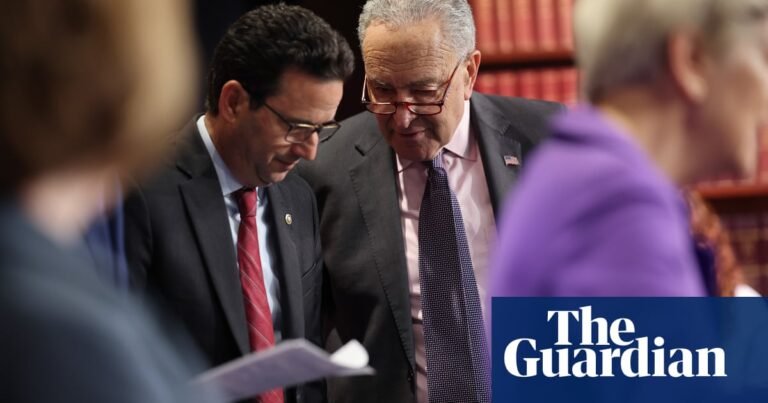
The letter – signed by Chuck Schumer, Senate minority leader, and senators Jacky Rosen, Richard Blumenthal, Adam Schiff and Brian Schatz – accuses the administration of using “a real crisis as a pretext to attack people and institutions who do not agree with you”.

“We are extremely troubled and disturbed by your broad and extra-legal attacks against universities and higher education institutions as well as members of their communities, which seem to go far beyond combating antisemitism,” write the senators, who devote much of their attention to the freezing of $2bn in federal funding for Harvard University.

Some Jewish advocacy leaders welcomed the senators’ intervention.

“It’s good news that these senators are standing up to the hypocrisy of this White House,” said Hadar Susskind, president and CEO of New Jewish Narrative. “President Trump is exploiting very real concerns about antisemitism as a foil for his attacks on universities.”

An open letter last updated 20 April from 800 Jewish professors, scholars and students similarly admonished the Trump administration for targeting Columbia University and threatening other schools, saying that “the cuts did nothing to protect Jews, and in fact, could be used to target them”.

While the letter primarily focuses on funding cuts and financial penalties, it only makes a passing reference to the visa revocations and Trump’s deportation campaign that have upended the lives of international students across the country, and the senators do not specifically condemn the detention of students.

Their questions come amid a widening immigration crackdown that has affected more than 1,100 students at 174 colleges and universities who have had their visas revoked or legal status terminated since late March, according to an Associated Press review.

Many affected students have never been charged with crimes. In one case, a Tufts University doctoral candidate, Rümeysa Öztürk, was handcuffed by federal agents on a Massachusetts street, shrieking in fear as shown in widely circulated surveillance footage. The former Columbia University graduate student Mahmoud Khalil and current student Mohsen Mahdawi, both permanent residents, are fighting deportation after being arrested in March and April, respectively.

Twelve national Jewish organizations, including J Street and T’ruah, condemned the Trump administration’s detention of Khalil in March, warning that using antisemitism as justification for suppressing political dissent threatens both Jewish safety and democracy.

More than 200 Israeli academics similarly signed an open letter last week accusing Trump of “fostering anti-Jewish sentiment” by targeting students and “weaponizing Jewish students’ safety as grounds to silence, harass, suspend, punish, or deport pro-Palestinian members of US academia.”

The Trump administration has defended its actions, claiming in some high-profile cases that students were “engaged in activities in support of Hamas” without providing specific evidence. A state department post on Facebook in March warned: “We continuously check visa holders to ensure they follow all US laws and immigration rules – and we will revoke their visas and deport them if they don’t.”

Susskind said Jews should be skeptical of the administration’s rhetoric on antisemitism.

“American Jews are not fools. We’ve watched Trump cozy up to antisemites for years. We see Jew haters serving in prominent roles in this administration,” Susskind added.

The senators requested answers to a list of questions by 30 April, including details on the criteria used to target specific institutions and an explanation for the 50% reduction in staff at the Department of Education’s office of civil rights.

Legal challenges to the visa revocations have seen mixed results, with federal judges in several states issuing temporary restraining orders in some cases while denying similar requests in others.

“This Senate letter is an important move to unmask Trump’s cynicism,” Susskind said. “We need to see more such efforts, otherwise the costs – in terms of free speech and the safety of Jews – will only mushroom.”


Source link

Donald Trump posts about Shedeur Sanders NFL draft fall, blasts owners

0


play

Presidents have their fingers on the pulse of everything – world affairs, financial markets, pop culture issues, legislation and yes, even the NFL draft.

Before Day 2 of the 2025 NFL Draft kicked off, President Donald Trump weighed in on the debate surrounding Colorado quarterback Shedeur Sanders.

The president posted on Truth Social in support of the Colorado prospect and son of Deion Sanders, questioning if NFL owners are “stupid” for passing on him.

“What is wrong with NFL owners, are they STUPID?” Trump wrote. “Deion Sanders was a great college football player, and was even greater in the NFL. He’s also a very good coach, streetwise and smart! Therefore, Shedeur, his quarterback son, has PHENOMENAL GENES, and is all set for Greatness. He should be “picked” IMMEDIATELY by a team that wants to WIN. Good luck Shedeur, and say hello to your wonderful father!”

The takes have been coming fast and furious since the draft began Thursday night. Sanders was previously considered to be in the debate with Cam Ward for the draft’s best quarterback.

When Round 1 ended, Sanders wasn’t even No. 2 after the Pittsburgh Steelers passed on him and the New York Giants selected Ole Miss’ Jaxson Dart.

Sanders’ wait extends into Round 2, with the chance he could continue tumbling down the board. ESPN’s Adam Schefter reported that Louisville quarterback Tyler Shough could come off the board before Sanders.

It remains to be seen what landing spot will emerge for the quarterback, which has become a controversial evaluation in draft circles.

ESPN’s Mel Kiper Jr. continues to hold steady in his belief that Sanders is the best quarterback in the class. Others don’t see the allure of what they deem a limited prospect without a high ceiling.

“We all didn’t expect this, of course, but I feel like with God, anything possible, everything possible,” Sanders told his draft party on Thursday night. “I don’t feel like this happened, you know, for no reason. All of this is, of course, fuel to the fire. Under no circumstances we all know shouldn’t have happened, but we understand we on to bigger and better things. Tomorrow’s the day. We going to be happy regardless. Legendary.”

Time will tell where Sanders ends up, but there aren’t many that can receive a presidential endorsement quite like that. At the very least, he has some fans in high places.


Source link

NFL draft: Cam Ward goes No. 1 overall and Shedeur Sanders slides out of the first round

0


Jay Berwanger poses for a photo in 1934.

The NFL draft is broadcast live on television every year as millions tune in and hundreds of thousands more attend in person to revel in the hoopla of it all.

It’s a far cry from the event’s humble beginnings, when the player picked first didn’t even know it was happening and soon walked away from the game without ever earning a cent.

Two-hundred-fifty-seven players will be drafted this week in Green Bay, Wisconsin, and anyone chosen in the first round – which begins at 8 p.m. ET on Thursday – will be set for life with guaranteed multi-million-dollar contracts. It was all very different in the first year of the draft back in 1936 when just 81 players were selected through nine rounds in the inaugural draft.

There was little doubt that University of Chicago halfback Jay Berwanger would go first that year. At 6-foot tall and 195 pounds, the standout player of his class had just received the first ever Heisman Trophy and been named as the Chicago Tribune’s Big 10 player of the year.

The Hartford Courant described the first draft as “no gala, more like a penny-ante poker game. Nine cigar-puffing, mogul wannabees, some of whom were paying their players with IOUs, stubbornly trying to salvage their dream of professional football.”

Berwanger told the Courant in 1994 that he was oblivious to the draft at the Ritz-Carlton Hotel in Philadelphia.

“I found out I was drafted by reading it in the newspaper,” he said, “I didn’t even know the draft was going on.”

Philadelphia Eagles owner Bert Bell had persuaded his peers to formalize a draft in order to cease the expensive and “self-defeating” bidding wars for college players and he’d proposed that teams should choose players in reverse order from the previous season’s standings. That meant the worst team, Bell’s own 2-9 Eagles, went first and chose Berwanger, quickly dealing his rights to the Chicago Bears. The Eagles didn’t think they’d be able to afford Berwanger’s salary demands, and the Bears owner and coach George Halas soon realized he didn’t have enough money, either.

According to the Courant, the two met in the lobby of a downtown hotel in Chicago.

“He asked what I wanted,” Berwanger recalled, “and I had my tongue in my cheek. I told him, $25,000 for two years. He looked at my date and said, `Nice to have met you; have a nice time tonight.’ And that was the end of it.”

• Read more


Source link

AI framework tackles LLM agent instability

0


Researchers have introduced RAGEN, an AI framework designed to counter LLM agent instability when handling complex situations.

Training these AI agents presents significant hurdles, particularly when decisions span multiple steps and involve unpredictable feedback from the environment. While reinforcement learning (RL) has shown promise in static tasks like solving maths problems or generating code, its application to dynamic, multi-turn agent training has been less explored.   

Addressing this gap, a collaborative team from institutions including Northwestern University, Stanford University, Microsoft, and New York University has proposed StarPO (State-Thinking-Actions-Reward Policy Optimisation).

StarPO offers a generalised approach for training agents at the trajectory level (i.e. it optimises the entire sequence of interactions, not just individual actions.)

Accompanying this is RAGEN, a modular system built to implement StarPO. This enables the training and evaluation of LLM agents, particularly focusing on their reasoning capabilities under RL. RAGEN provides the necessary infrastructure for rollouts, reward assignment, and optimisation within multi-turn, stochastic (randomly determined) environments.

Minimalist environments, maximum insight

To isolate the core learning challenges from confounding factors like extensive pre-existing knowledge or task-specific engineering, the researchers tested LLMs using RAGEN in three deliberately minimalistic, controllable symbolic gaming environments:   

  1. Bandit: A single-turn, stochastic task testing risk-sensitive symbolic reasoning. The agent chooses between options (like ‘Phoenix’ or ‘Dragon’ arms) with different, initially unknown, reward profiles.
  2. Sokoban: A multi-turn, deterministic puzzle requiring foresight and planning, as actions (pushing boxes) are irreversible.
  3. Frozen Lake: A multi-turn, stochastic grid navigation task where movement attempts can randomly fail, demanding planning under uncertainty.

These environments allow for clear analysis of how agents learn decision-making policies purely through interaction.   

Key findings: Stability, rollouts, and reasoning

The study yielded three significant findings concerning the training of self-evolving LLM agents:

The ‘Echo Trap’ and the need for stability

A recurring problem observed during multi-turn RL training was dubbed the “Echo Trap”. Agents would initially improve but then suffer performance collapse, overfitting to locally rewarded reasoning patterns. 

This was marked by collapsing reward variance, falling entropy (a measure of randomness/exploration), and sudden spikes in gradients (indicating training instability). Early signs included drops in reward standard deviation and output entropy.   

To combat this, the team developed StarPO-S, a stabilised version of the framework. StarPO-S incorporates:   

  • Variance-based trajectory filtering: Focusing training on task instances where the agent’s behaviour shows higher uncertainty (higher reward variance), discarding low-variance, less informative rollouts. This improved stability and efficiency.   
  • Critic incorporation: Using methods like PPO (Proximal Policy Optimisation), which employ a ‘critic’ to estimate value, generally showed better stability than critic-free methods like GRPO (Group Relative Policy Optimisation) in most tests.   
  • Decoupled clipping and KL removal: Techniques adapted from other research (DAPO) involving asymmetric clipping (allowing more aggressive learning from positive rewards) and removing KL divergence penalties (encouraging exploration) further boosted stability and performance.   

StarPO-S consistently delayed collapse and improved final task performance compared to vanilla StarPO.   

Rollout quality is crucial

The characteristics of the ‘rollouts’ (simulated interaction trajectories used for training) significantly impact learning. Key factors identified include:   

  • Task diversity: Training with a diverse set of initial states (prompts), but with multiple responses generated per prompt, aids generalisation. The sweet spot seemed to be moderate diversity enabling contrast between different outcomes in similar scenarios.   
  • Interaction granularity: Allowing multiple actions per turn (around 5-6 proved optimal) enables better planning within a fixed turn limit, without introducing the noise associated with excessively long action sequences.   
  • Rollout frequency: Using fresh, up-to-date rollouts that reflect the agent’s current policy is vital. More frequent sampling (approaching an ‘online’ setting) leads to faster convergence and better generalisation by reducing policy-data mismatch.

Maintaining freshness, alongside appropriate action budgets and task diversity, is key for stable training.   

Reasoning requires careful reward design

Simply prompting models to ‘think’ doesn’t guarantee meaningful reasoning emerges, especially in multi-turn tasks. The study found:

  • Reasoning traces helped generalisation in the simpler, single-turn Bandit task, even when symbolic cues conflicted with rewards.   
  • In multi-turn tasks like Sokoban, reasoning benefits were limited, and the length of ‘thinking’ segments consistently declined during training. Agents often regressed to direct action selection or produced “hallucinated reasoning” if rewards only tracked task success, revealing a “mismatch between thoughts and environment states.”

This suggests that standard trajectory-level rewards (often sparse and outcome-based) are insufficient. 

“Without fine-grained, reasoning-aware reward signals, agent reasoning hardly emerge[s] through multi-turn RL.”

The researchers propose that future work should explore rewards that explicitly evaluate the quality of intermediate reasoning steps, perhaps using format-based penalties or rewarding explanation quality, rather than just final outcomes.   

RAGEN and StarPO: A step towards self-evolving AI

The RAGEN system and StarPO framework represent a step towards training LLM agents that can reason and adapt through interaction in complex, unpredictable environments.

This research highlights the unique stability challenges posed by multi-turn RL and offers concrete strategies – like StarPO-S’s filtering and stabilisation techniques – to mitigate them. It also underscores the critical role of rollout generation strategies and the need for more sophisticated reward mechanisms to cultivate genuine reasoning, rather than superficial strategies or hallucinations.

While acknowledging limitations – including the need to test on larger models and optimise for domains without easily verifiable rewards – the work opens “a scalable and principled path for building AI systems” in areas demanding complex interaction and verifiable outcomes, such as theorem proving, software engineering, and scientific discovery.

(Image by Gerd Altmann)

See also: How does AI judge? Anthropic studies the values of Claude

Want to learn more about AI and big data from industry leaders? Check out AI & Big Data Expo taking place in Amsterdam, California, and London. The comprehensive event is co-located with other leading events including Intelligent Automation Conference, BlockX, Digital Transformation Week, and Cyber Security & Cloud Expo.

Explore other upcoming enterprise technology events and webinars powered by TechForge here.


Source link

A pause in NIH funding leaves these Alzheimer’s studies in limbo: ‘This is alarming’

0


CNN
 — 

Zahydie Burgos Ribot and her husband, Francisco Rios, are checking items off their travel bucket list and spending quality time together before Francisco will no longer be able to travel – and before his brain forgets.

The Florida-based couple recently crossed Alaska off the list. Their next trip will be to Niagara Falls.

“We have a whole schedule,” Ribot said. “We’re choosing to live every single day with a lot of intention.”

That’s because they know that Rios’ window to easily create new memories is closing. About three years ago, at age 46, he was diagnosed with early-onset Alzheimer’s disease.

Although Rios has been doing well on a new treatment he receives through a clinical trial, Ribot is increasingly afraid that the study could be hindered by cuts to federal funding of biomedical research.

The Trump administration has been conducting a restructuring of the US Department of Health and Human Services as well as a review of funding, resulting in the abrupt cancellation of hundreds of research grants under the National Institutes of Health and many others left in limbo, waiting for a decision on whether their funding will be renewed.

In March, 14 of 35 Alzheimer’s Disease Research Centers had their funding halted by the NIH as the administration stopped $65 million in funding for research, according to Democratic lawmakers.

“NIH paused funding for 14 research grants across several universities. It is important to note that this action was not a reflection of the quality or significance of the research, including the critical work being done in Alzheimer’s disease,” HHS spokesperson Andrew Nixon said in an email Thursday. “Instead, the pause was a necessary step in response to compliance issues related to grant proposals that included language pertaining to DEI, as well as concerns regarding antisemitism.”

Nixon said that the NIH is “committed to advancing groundbreaking research in Alzheimer’s disease. However, we also have a responsibility to ensure that all grant proposals align with the established policies, including ensuring that language used in these proposals reflects NIH’s commitment to non-discriminatory, merit-based research practices,” he said. “The responsibility for removing any non-compliant language lies with the institutions, and we encourage them to make necessary changes so these important Alzheimer’s studies will resume.”

Ribot called the funding pauses alarming.

“This is alarming, because these are critical data that inform not only prognosis but inform trajectory of the disease and inform future treatments,” Ribot said.

Rios also has been following these developments and remains worried about his future.

“He just asked me, ‘Am I going to continue getting the trial?’ But he was crying and literally ripping the skin off his fingers because of the anxiety,” Ribot said. “He knows what’s at stake. He is aware. He wants to continue the medication.”

Rios has been participating in a clinical trial conducted by Washington University in St. Louis in which he has been receiving the Alzheimer’s drug Leqembi paired with an experimental therapy called E2814, given as intravenous infusions, to help slow his Alzheimer’s symptoms.

Ribot credits the trial with helping curb Rios’ memory loss and cognitive decline.

Before Rios was diagnosed, he began to emotionally withdraw and disconnect from loved ones. He even got lost while driving to a routine doctor’s appointment about 10 minutes from their home, Ribot said.

She initially thought he was showing signs of depression. But Rios’ doctor realized that something else was happening in his brain and referred him to the Young-Onset Dementias Clinic at Johns Hopkins in Baltimore.

“They ran more tests, and they ran the genetic testing, and that’s when we had the final confirmation that it was Alzheimer’s,” Ribot said.

If funding for Rios’ clinical trial is curtailed, she said, not only could he and the other participants lose access to the medications that they hope are giving them more time to live normally, the development of other impactful Alzheimer’s treatments could be delayed.

About a dozen Alzheimer’s disease research centers are still waiting for their federal funding to be renewed, said Dr. Michael Greicius, professor of neurology and neurological sciences at the Stanford University School of Medicine, whose Alzheimer’s center is among those awaiting a decision.

“Our five-year renewal was reviewed in October. Normally, we would have gotten a decision probably around February,” he said, adding that research funding for his team at the Stanford Alzheimer’s Disease Research Center ran out about three weeks ago.

“It seems like we’re moving towards renewal, but it’s very hard to read the tea leaves, and that makes it really challenging when you’re thinking about projects you’d like to undertake or hiring new research coordinators, for example,” he said.

Greicius and his colleagues had to hold off on starting research projects because they didn’t know whether there will be funding coming in, he said.

The uncertainty around funding baffles him.

“It’s hard to imagine a less political topic than Alzheimer’s disease. I mean, it affects people from red states and blue states and purple states. It’s so common. Almost everyone either has a relative in their family or at least has a friend who has a relative that’s been affected by Alzheimer’s disease,” Greicius said.

“It still seems like the easiest-to-agree-upon target for federally funded research, and yet it’s not at all clear that this progress is going to continue,” he said. “That, for me, is a large part of the frustration – just the uncertainty of it all.”

Preventive neurologist Dr. Richard Isaacson, founder of one of the first Alzheimer’s prevention clinics in the United States, is also waiting to see whether his federal grants will be renewed.

“We’re somewhere between limbo and purgatory,” he said.

Isaacson, who directs research at the Institute for Neurodegenerative Diseases in Florida, has developed free online software called RetainYourBrain, which aims to democratize access to brain health care. Users input their risk factors for Alzheimer’s and receive a personalized risk assessment, as well as personalized recommendations and time-sensitive reminders on how to improve their brain health.

But without continued funding, “it may never be released to the public,” Isaacson said.

Supporters of the funding cuts argue that the nation should reduce “wasteful spending” and prioritize efficiency.

“With the government wanting to cut back on spending money, I get it. But Alzheimer’s is one of the most expensive diseases to our health care system,” Isaacson said.

It’s estimated that nearly 1 in every 6 Medicare dollars was spent on someone with the disease last year, according to the Alzheimer’s Association, and the average per-person Medicare spending for older adults with Alzheimer’s is estimated to be 2.8 times higher than average per-person spending for all other seniors.

“I feel that cutting Alzheimer’s research that may save money over time, and doing it rapidly, is a bad investment,” Isaacson said.

While some studies are waiting to see if they’ll continue, some studies have already had to take steps to shut down.

When the NIH canceled grants in March related to diversity, equity and inclusion, or DEI, some Alzheimer’s studies were swept up in the consequences.

Federal funding for a multiyear study at the University of California, Davis’ Alzheimer’s Disease Research Center was abruptly terminated. This led the center’s co-director, Dr. Charles DeCarli, to issue an appeal and fight to have the grant fully reinstated.

“The appeal had to be done within 30 days, and in the meantime, we had to shut down the study. So while I was working on the appeal, my team was doing all the things that closing a study needs to involve, which is hundreds of hours of work, notifying the 33 sites in this study,” he said.

DeCarli’s appeal was successful. He won that battle but is still recovering from the turmoil.

“It was a very challenging month in my life,” DeCarli said. “It just seems to me that the only reason that this was terminated is because it includes the word ‘diverse’ in the title.”

The study, titled “The Clinical Significance of Incidental White Matter Lesions on MRI Amongst a Diverse Population with Cognitive Complaints (INDEED),” involves examining the effect that white matter injury in the brain and vascular issues may have on cognitive performance as well as health outcomes. The research was being funded by the NIH’s National Institute of Neurological Disorders and Stroke.

Up to 25% of people who develop dementia later in life may have some type of vascular contributing factor to their disease, and DeCarli said his study could help “lay out the foundation” for diagnostic tests and treatments for them.

“When these studies are terminated, an opportunity is lost to advance science,” he said.

Other studies may face similar threats to funding. According to a policy notice issued Monday, the NIH said it will begin pulling medical research funding from universities with diversity and inclusion programs and any boycotts of Israeli companies.

The agency “reserves the right to terminate financial assistance awards and recover all funds” if grant recipients do not comply with federal guidelines barring diversity and equity research and “prohibited boycotts,” the notice said.

The policy applies to “domestic recipients of new, renewal, supplement, or continuation awards that are issued on or after” April 21, according to the notice.

Separately, the Washington-based nonprofit UsAgainstAlzheimer’s has been tracking previously terminated grants and the funding cuts at the NIH that took place in March and earlier this month, and it warns that some cuts could stall the progress being made to find a cure for Alzheimer’s disease.

“In the last 10 years, there have been groundbreaking advances in Alzheimer’s disease research, in understanding where the disease comes from, and understanding how to diagnose the disease, and ultimately in how to treat the disease. But we don’t have a cure yet,” said Russ Paulsen, chief operating officer at UsAgainstAlzheimer’s.

“In looking through the list of grants that have been affected, it appears to cut across prevention, diagnosis, treatment and ultimately seeking a cure, as well as understanding the basics of the disease to start with,” he said. “We’ve made huge progress, and now is not the time to take our foot off the accelerator.”

In the meantime, Ribot and Rios are trying to keep their heads up. They are keeping an eye on any new developments in research funding cuts while continuing to focus on their travel bucket list.

“While he’s here and we’re here, we’re living our life. We are finding joy. Even when we cry, we laugh. Even when we are in despair, we have hope,” Ribot said.

“I’m not going to romanticize this disease, because that’s not it – but there’s still purpose and meaning and joy,” she said. “We’re not going to let this disease rob us of our present.”


Source link

Book Excerpt: “Personhood: The New Civil War over Reproduction,” by Mary Ziegler

0


In the summer of 2022, a conservative supermajority of the United States Supreme Court overturned Roe v. Wade, the famed 1973 decision recognizing a right to choose abortion. Many Americans struggled to understand how something they considered a fundamental right could simply be wiped away. Still others were terrified that the Court’s decision in Dobbs v. Jackson Women’s Health Organization would make pregnancy in the United States more dangerous than it already was. For abortion foes, of course, Dobbs brought a very different kind of news. Reporters described the decision as a stunning win for the American right, a sign of American abortion opponents’ strength and the conservative legal movement’s savvy.

Almost three years later, it’s no surprise that progressives haven’t given up the fight for reproductive rights. Despite Republicans’ strong performance in 2024, ballot initiatives on the topic continue to succeed (with seven out of ten passing in the last election alone). Cases in federal and state court continue to question the adequacy of abortion bans when women’s life or health is threatened, or defend the religious liberty of doctors or patients to pursue abortion under certain circumstances.

But it’s become increasingly obvious that the end of Roe wasn’t enough for abortion opponents either. They are pushing to defund Planned Parenthood, eliminate access to mifepristone, a drug used in more than half of all abortions, and use the Comstock Act, a nineteenth-century obscenity law, as an abortion ban, and all of that is just the beginning. That’s because the reversal of Roe was never the U.S. antiabortion movement’s ultimate goal. From its inception in the 1960s, it has always been a fetal-personhood movement.

Fetal personhood can mean different things in various faith traditions. Bioethicists or philosophers who use the term often mean something quite different too. In U.S. politics, fetal personhood is most significantly a claim about the meaning of the nation’s Constitution: that a fetus is a separate, unique human individual from the moment of fertilization, and second, that because of that biological and moral uniqueness, the Constitution gives (or at least should give) that individual rights.

Neither of these claims has anything like universal support. Polling, for example, suggests that Americans hold a variety of views about when human life begins. Majorities support the idea of a right to choose abortion. As important, there have always been disagreements about what it means to recognize personhood. Does recognizing personhood mean the United States has to criminalize most or even all abortions? What about IVF? And how can the rights of fetal persons be balanced against those of other persons, including pregnant women?

Throughout the past half century, even abortion opponents have disagreed about how to guarantee fetal equality. But there has been no difference of opinion among abortion foes on the importance of securing personhood, whether through a constitutional amendment or a judicial decision. The fight for it has become one of the major American political mobilizations of the past fifty years.

• • •

Abortion opponents are gearing up for the next Roe — a fight that will unfold over decades that has every chance to reshape the experience of infertility and pregnancy for Americans across the country. Antiabortion leaders argue today that the framers of the Fourteenth Amendment, which guarantees rights to due process and equal protection under the law, meant the word person in that part of the Constitution to apply from the moment of conception. As a result, argue these right-to-lifers, liberal laws on abortion or even IVF are unconstitutional.

These originalist arguments for constitutional fetal personhood are spreading in conservative legal circles. And yet the fight for constitutional fetal rights began relatively recently. The antiabortion movement of the nineteenth century championed the idea that human life begins at conception. But the physicians who led the campaign to criminalize abortion throughout pregnancy made arguments about biology and morality, not the Constitution. The men who wrote the Fourteenth Amendment said nothing about abortion in their debates. And state lawmakers criminalizing abortion in the late nineteenth century said nothing to suggest they felt constitutionally obligated to act.

The real forerunners of today’s conservative antiabortion originalists got active in the 196os. At the time, a growing group of reformers argued that existing criminal bans had deeply unequal effects. While wealthier women could access safe therapeutic procedures, low-income patients, many of them patients of color, still induced their own abortions and suffered comparably high rates of maternal morbidity and mortality. Reformers pointed to these deaths and injuries in demanding new exceptions to criminal laws. Antiabortion lawyers, theologians, and activists first replied that the exceptions were unnecessary or immoral. When these claims were unavailing, abortion opponents argued that reform itself was unconstitutional — and that the word person in the Constitution applied the moment an egg was fertilized.

Fetal-personhood politics took shape at a time when the constitutional law of equal protection was in flux. Following a series of decisions, including the landmark desegregation ruling in Brown v. Board of Education (1954), race became the classic “suspect classification,” and the Supreme Court scrutinized laws that distinguished people on that basis. As the battle over abortion reform continued, competing ideas about equality multiplied — in the context of abortion and well beyond it. While the lawyers of the National Association for the Advancement of Colored People sought to enforce Brown’s desegregation mandate in the courts, local Black leaders sought to increase the number of Black teachers, improve the quality of schools in Black neighborhoods, and achieve socioeconomic equality. The National Organization for Women, founded in 1966 to demand “a fully equal partnership of the sexes,” called for the legalization of abortion in 1967. Ideas of equality developed by the women’s movement and civil rights movement were complex and varied but shared a focus on the legacy left behind by past injustice.

Rather than defining their cause by reference to religion or gender politics, antiabortion activists more often argued that the legalization of abortion threatened to make the unborn more marginalized than any group in America. The courts, in interpreting the Equal Protection Clause, had begun pointing to the fallout a group faced from years of discrimination. Antiabortion activists, by contrast, believed that American law and culture had long defended the unborn child. But a lack of historic prejudice struck the antiabortion leaders of the 1960s as of at most secondary importance: physical dependence and weakness, not past injustice or present political powerlessness, should be the central concern of the Equal Protection Clause.

As the decade continued, the reform movement largely gave way to a fight to repeal all criminal abortion laws. Feminist activists and other proponents of repeal contended that both old abortion bans and new attempts to write fetal rights into the law involved sex discrimination because they reflected damaging stereotypes about sex and denied women even medically needed care. Antiabortion groups responded by echoing ideas articulated by those challenging affirmative action programs or judicial integration orders. White moderates, anxious about the rise of the Black power movement, the spread of violent resistance in the South, and unrest in urban centers across the country, called for a different approach to civil rights they claimed would lower the political temperature. Rather than addressing the history of racial subordination, these advocates argued that affirmative action programs or even educational programs about race were the problem, not the solution. And these scholars and activists reasoned that the Constitution banned not subordination but categorization: creating programs that grouped people by racial identity without honoring their individuality.

As they formed single-issue groups in the late 1960s and early 1970s, abortion opponents claimed that the fight for fetal personhood combatted the same kind of insidious classification. True equality was not about membership in a marginalized group, they argued. What mattered was the failure to treat anyone, including an unborn child, as a unique individual, and that, antiabortion activists argued, was precisely what the repeal of abortion laws accomplished by categorizing the fetus based on residence in the womb.

Nevertheless, members of the antiabortion movement remained divided about the relationship of personhood to other equality struggles of the day, from the fight for new civil-rights legislation to the struggle to end sex discrimination through ratification of a federal Equal Rights Amendment. The good news was that personhood was vague. It still is today, and that is part of why it has remained so resonant for sometimes-fractious activists and organizations: the idea is fluid enough to allow activists who disagreed about the meaning of equality to fight for the same cause.

In other countries, recognizing fetal personhood isn’t always synonymous with the criminalization of abortion either. That was true for some in the antiabortion movement too. After the Supreme Court decided Roe v. Wade in 1973, the movement hardly gave up on the idea of fetal personhood, instead writing it into various constitutional amendments that the GOP called the Human Life Amendment. Proposals for this kind of personhood amendment were a central part of the Republican platform in 2024, when they were replaced with coded references to the idea that the Constitution already recognized personhood.

When the idea of a fetal personhood amendment seemed more realistic, in the 1970s, abortion opponents debated how the idea would be enforced. Would recognizing personhood mean that states and the federal government would have to do more to support pregnant women, or even new parents? Would recognizing personhood mean that states couldn’t allow for abortion exceptions for rape or incest, or even the life of the mother? And would women have to face punishment for abortion if they were prosecuted for the homicides of other people?

By the mid-1980s, it became clear that a personhood constitutional amendment wasn’t going anywhere. Instead of disappearing, though, personhood arguments only went underground. At a time when the Republican Party had declared a new war on crime, with mandatory minimum sentences, new private prisons, and calls to crack down on drug offenses, antiabortion leaders updated their vision of personhood, painting the fetus as a victim of violent crime, and arguing that justice required not more support for pregnant patients but harsher penalties for anyone who wronged an unborn child. The movement championed new laws criminalizing fetal homicide and championed prosecutions of women who used drugs during pregnancy.

The antiabortion movement also changed its approach to the Constitution to accommodate new conservative allies. Before the 1980s, neither political party had consistently aligned with the antiabortion movement, but Ronald Reagan changed that. Not long after his election, the Federalist Society began to create a powerful network for conservative lawyers, judges, and professors. Leading figures in the Federalist Society advocated for originalism, a method of constitutional interpretation that revolved around what its proponents described as the original intent of the Constitution’s framers or, later, the original public meaning of its text. Christian conservatives and single-issue antiabortion activists borrowed from originalism but did not always warmly embrace it. Some were unsure that originalist interpretations would deliver the victories they sought. Others wanted to incorporate traditions, including Christian ones, that predated the founding — or look to evidence from decades long after the Constitution’s ratification.

These antiabortion activists and their allies therefore looked to other judicial approaches, suggesting that courts should protect rights under the Fourteenth Amendment only if they were deeply rooted in unchanging national traditions.

In the 1990s, antiabortion leaders defined themselves as champions of equality for both women and the unborn, portraying both as victims of an industry as well funded and unscrupulous as “Big Tobacco.” The antiabortion movement advocated for “right-to-know” laws that transformed arguments for fetal rights into information wrongly denied women considering abortion. Defining both women and fetuses as victims helped the antiabortion movement to soften its image at a time when the murder of doctors made headlines — and when those doctors’ attackers claimed that they had justifiably used force to protect the lives of fetal persons. In the 2000s and 2010s, ideas of equality for the fetus also shaped and reflected conversations about whether conservative Christians suffered from or perpetuated discrimination, what defined religious liberty, and what it meant to recognize rights for major corporations.

Remarkably, calls for fetal personhood captivated many on the American right for more than half a century, from the passage of the Civil Rights Act to the decision of Roe to the demise of abortion rights and the ascendancy of new bans. Personhood has this hold on the American imagination because social conservatives, too, have seen themselves as champions of equality, committed to eradicating discrimination in the United States, and because they have offered quite different ideas about what equality is and how it can be achieved. In the pursuit of equal justice for the fetus, antiabortion groups aren’t just talking about abortion. They’re also drawing on debates about race, reverse discrimination, and affirmative action, about criminal justice, victim’s rights, and the welfare state, about consumer protection and sex discrimination, and about religious liberty and corporate power.

Those championing fetal personhood have already succeeded in eliminating what many viewed as a fundamental right. In the next fifty years, the movement’s quest for personhood could have even further-reaching effects. We saw that last year when the Alabama Supreme Court declared embryos to be children for the purpose of the state’s law on the wrongful death of minors. The ruling temporarily put a halt to IVF in the state and supercharged conservative opposition to IVF. Prominent antiabortion groups, from the Heritage Foundation to Students for Life, have launched new campaigns against IVF. Some seek to require that IVF users be genetically related to the embryos they create — an idea reflected in Project 2025 that would functionally exclude same-sex couples. Others could rule out the destruction or even indefinite storage of embryos that abortion foes view as rights-holding personhood. This fight has already influenced the Southern Baptist Convention, a powerhouse in evangelical America, that passed a resolution calling for IVF restrictions last year.

We also see the effects of the brewing fight over personhood in a series of bills this session about whether states that ban abortion should treat it as murder and authorize the punishment of women. The more realistic the recognition of personhood becomes, the more divided the movement has become about whether it is logically consistent to recognize personhood and allow exceptions — or exempt women from punishment.

But if history teaches us anything about personhood, it is that there is nothing inevitable about the turn we have taken in this country, one in which Americans equate fetal protection with criminal punishment. Polls have sometimes shown that a cohort of Americans believe that life begins at conception, and that fetal life has value, while opposing laws criminalizing abortion or IVF. There is nothing inherently contradictory or strange about this position, even if our politics make little room for Americans who think this way. It is more important than ever to think through what it means to value life, in the womb and for people who are pregnant — and to make sense of whether equality really requires punishment rather than support for the woman carrying a fetal life. That’s because regardless of what we mean by personhood — and whose rights or humanity it might erase — the truth is that fights over reproduction in the United States are just getting started. And the meaning of equality well beyond the context of abortion is on the line.

Mary Ziegler is the Martin Luther King Jr. Professor of Law at the University of California, Davis School of Law. Her new book, “Personhood: The New Civil War over Reproduction,” is now available.

Suggested Citation: Mary Ziegler, Book Excerpt: “Personhood: The New Civil War over Reproduction,” by Mary Ziegler, Sᴛᴀᴛᴇ Cᴏᴜʀᴛ Rᴇᴘᴏʀᴛ(Apr. 24, 2025), https://statecourtreport.org/our-work/analysis-opinion/book-excerpt-personhood-new-civil-war-over-reproduction-mary-ziegler


Source link

This Social Security rule may boost checks for workers after claiming

0


It’s not always the case that working while collecting Social Security benefits results in a bigger benefit. At least not right away.

play

Your Social Security benefit isn’t set in stone once you start collecting benefits.

There are a lot of ways your benefit could change. Most seniors are familiar with the annual COLA, which increases benefits across the board to adjust for inflation each year. Some are also aware how different factors could affect your Social Security benefits.

Most of the rules regarding impacts on your monthly benefits check are straightforward and spelled out for seniors. But sometimes you need to read between the lines and find the hidden rules that could lead to a significant change in benefits.

Such is the case for those who continue to work in their 60s and beyond even as they collect benefits. There are multiple rules that apply, but one hidden rule could mean a bigger benefit for some.

You might see a reduction in benefits at first, but it’s only temporary

It’s not always the case that working while collecting Social Security benefits results in a bigger benefit. At least not right away. That’s due to a rule called the Social Security earnings test.

The earnings test applies to anyone collecting Social Security who hasn’t yet reached their full retirement age. That’s age 67 for anyone born in 1960 or later, and a few months earlier for those born in 1958 or 1959. The test looks at your earned income for the year. If you earn over a certain threshold, the Social Security Administration will start withholding some of your benefit.

In any year before you reach full retirement age, the earnings threshold is low and the SSA will reduce your annual Social Security benefit by $1 for every $2 you earn above it. The threshold is significantly higher for the year you reach full retirement age, and the reduction is only $1 for every $3 above the threshold. For 2025, those thresholds are $23,400 and $62,160.

It’s possible you could wipe out your entire benefit if you earn well above those thresholds. But the impact is temporary, and the government will adjust your benefit to make up for the withheld benefits once you reach full retirement age. That can result in a bigger benefit in and of itself, as you basically end up deferring benefits until you really need them later in retirement.

But working in retirement can have a much bigger impact on your benefits that’s not explicitly spelled out in the Social Security rules.

The hidden rule that could lead to a bigger benefit

If you dive into how the government calculates your Social Security benefit, you’ll notice a tiny detail that many tend to gloss over.

The Social Security Administration uses your average indexed monthly earnings, or AIME, as the basis for your benefit calculation. What that means is it takes your entire earnings history dating all the way back to your first job and adjusts each one for inflation. It then selects the highest 35 years from your entire career, and it calculates the average. That number, divided by 12 (the number of months in a year), is your AIME.

But here’s the detail that often goes missed. The “index” for that calculation is tied to the year you turn 60. The Social Security Administration doesn’t keep adjusting those past earnings upward after that year. Instead, seniors get an annual COLA, which adjusts their calculated benefit for inflation. Note, the COLA applies to every person eligible for Social Security whether they’ve started collecting benefits or not.

But if you keep working after age 60, you’ll likely receive an increase in pay due to inflation. That makes it more likely you’ll replace one of your previous 35 highest-earning years with a new number. And when that happens, the Social Security Administration will recalculate your benefit and start paying you a bigger check.

The impact can be significant for anyone, even high earners. In fact, if you want the maximum possible Social Security benefit for your age, you’ll need to continue working indefinitely.

While the well-known Social Security rules like the earnings test might discourage people from working after claiming benefits, digging into the details shows just how beneficial it can be for a lot of seniors.

The Motley Fool has a disclosure policy.

The Motley Fool is a USA TODAY content partner offering financial news, analysis and commentary designed to help people take control of their financial lives. Its content is produced independently of USA TODAY.

The $22,924 Social Security bonus most retirees completely overlook

Offer from the Motley Fool: If you’re like most Americans, you’re a few years (or more) behind on your retirement savings. But a handful of little-known “Social Security secrets”could help ensure a boost in your retirement income.

One easy trick could pay you as much as $22,924 more… each year! Once you learn how to maximize your Social Security benefits, we think you could retire confidently with the peace of mind we’re all after. JoinStock Advisorto learn more about these strategies.

View the “Social Security secrets” »


Source link

US food delivery app DoorDash offers to buy UK rival Deliveroo for $3.6bn | Business

0


DoorDash is offering to buy its UK-based rival Deliveroo for $3.6bn (£2.7bn), Deliveroo said on Friday.

Deliveroo said that its board was in talks with DoorDash over the offer and that a firm offer had not been made, according to statement sent to the Guardian. Should a firm offer of £1.80 ($2.40) a share be made, Deliveroo said, “it would be minded to recommend such an offer to Deliveroo shareholders.

“There can be no certainty that any firm offer for Deliveroo will be made. At this time, shareholders are advised to take no action in respect to the possible offer,” the company said in a statement.

The company gave DoorDash until 23 May to give a firm offer, according to Reuters.

DoorDash is currently the largest food delivery app in the United States, with 42 million monthly active users in 2024 and $10.7bn in revenue in 2024. The San Francisco-based company was founded in 2012 and has a presence in more than 25 countries.

In 2021, DoorDash acquired the Finnish delivery company Wolt for €7bn, or what was $8.1bn at the time, in stock.

Deliveroo, which is based in London, was founded in 2013 and is the second largest food delivery app in the UK. The company said that it averaged 7.1 million active users in 2024 with £2.07bn in revenue.

Both DoorDash and Deliveroo have, in recent years, tried to expand their user base by getting into grocery deliveries and making non-food deliveries.

In an interview with Fortune in February, DoorDash’s CEO, Tony Xu, said that the company’s presence feels like “a speck of dust”.

skip past newsletter promotion

“We’re really only addressing a couple of problems with first-party delivery and first-party ordering,” Xu said. “If you think about how do you become a digital powerhouse, you’re going to have to do more than that.”


Source link

Claims of anti-Catholic bias could sway Supreme Court in major case

0


Six of the nine Supreme Court justices are practicing Catholics and a seventh was raised Catholic.

play

  • The Supreme Court is deciding whether the Catholic Church can run the nation’s first religious charter school.
  • The dioceses say Oklahoma’s ban on using public funds to support sectarian institutions is rooted in anti-Catholic bias.
  • The Supreme Court has been receptive to similar arguments in other cases about taxpayer dollars flowing to religious schools.

WASHINGTON – The Catholic education that the church wants to offer Oklahoma children through the state’s public charter school program is likely familiar to the Supreme Court.

Most of the justices who will decide the fate of the nation’s first proposed religious charter school in the coming weeks attended Catholic schools growing up.

That fact could play a role in how they handle what could be a blockbuster case April 30 as the Catholic dioceses hoping to run the school present an argument that may also resonate with the seven of the nine justices who were raised Catholic.

As part of their case, the dioceses say Oklahoma’s ban on using public funds to support sectarian institutions is rooted in anti-Catholic bias.

“When Oklahoma joined the Union in 1907, nativist Anti-Catholic bigotry pervaded public discourse, particularly surrounding schools,” lawyers for St. Isidore of Seville Catholic Virtual School told the Supreme Court in court documents. 

The state constitution’s insistence that public schools be “free from sectarian control,” they say, stems from a 19th-century movement that led to multiple states blocking religious schools from receiving taxpayer dollars.

The U.S. Congress in 1876 considered – but failed to adopt – Rep. James Blaine’s proposed amendment to prevent state tax money from supporting public schools. Many states, however, individually passed restrictions – dubbed “Baby Blaines.”

While anti-Catholic rhetoric ran high in the debate about the federal amendment, it’s wrong to castigate all state provisions as remnants of anti-Catholic animus, according to Steven Green, director of the Center for Religion, Law & Democracy at Willamette University in Oregon.

Green, an expert on the Blaine Amendment, has written that the principle of withholding public funding from religious institutions predates the 19th-century influx of Catholic immigrants that drove discrimination.

But the anti-Catholic explanation has resonated with the Supreme Court before.

Thomas attacks ‘shameful pedigree’

When the court, in 2000, said states could make loans to religious schools, Justice Clarence Thomas wrote that “hostility to aid to pervasively sectarian schools has a shameful pedigree that we do not hesitate to disavow.” 

In 2020, Chief Justice John Roberts denounced the Blaine Amendment and “many of its state counterparts” when the court’s conservative majority ruled 5-4 that states offering scholarships to students in private schools cannot exclude religious schools from such programs.

To drive home that point, Justice Samuel Alito wrote an 11-page concurring opinion devoted to the Blaine Amendment and anti-Catholic bias. He included an 1871 editorial cartoon from Harper’s Weekly that he said depicts Catholic priests as crocodiles slithering hungrily toward American children as a public school crumbles in the background.

Oklahoma AG: anti-Catholic bias not behind state ban

Oklahoma Attorney General Gentner Drummond, who is defending the state Supreme Court’s decision that religious charter schools violate the state and federal constitutions, takes that history head-on.

Drummond opened his written argument by condemning “the Blaine Amendments and the invidious anti-Catholic bias that motivated them.”

But Oklahoma’s constitution, he wrote, cannot be smeared with the same stain.

He cited statements from state supreme court justices that Oklahoma’s founders took their cues not from Blaine, but from Thomas Jefferson, who authored Virginia’s 1786 law establishing religious freedom.

Jefferson and fellow founding father James Madison thought government financial support for religion would infringe on “religious liberty and rights of conscience.”

Historians point to Native Americans’ concerns about ‘Christianization’ campaign

And a group of 18 historians and legal scholars, including Green, have weighed in, offering another explanation for what motivated the ban.

Oklahoma’s no-funding provision was partly a response to the government’s treatment of Native American children, they told the Supreme Court.

After many Native Americans were forcibly relocated to Oklahoma in the 19th century, their children were forced to attend boarding schools run by Protestant and Catholic organizations as part of a “Christianization” campaign.

Native American leaders were delegates in 1907 to the state’s constitutional convention. The constitutional provision prohibiting public funds from being used for sectarian purposes echoed language drafted by Native Americans, the historians and legal scholars said.

“The Oklahoma framers sought to ensure that citizens of their new State, including its Native residents, could enjoy religious freedom after decades of religious repression through religious re-education,” they wrote. “The Blaine Amendment’s history has no bearing on Oklahoma’s no-funding provision and says nothing about the State’s charter-school law.”

The Catholic Church’s appeal − St. Isidore of Seville Catholic Virtual School v. Drummond − is one of three religious rights cases the Supreme Court is deciding in the coming weeks. The justices seem likely to side with the Catholic charitable organization and Catholic parents involved in the other two.

Decisions in all three are expected by summer.  


Source link

English schools left to subsidise infants’ free meals after 3p funding increase, say leaders | School meals

0


Primary schools in England will be forced to subsidise free school meals for infants from their own budgets after the government’s “pitiful” 3p increase in funding, according to school leaders.

The Department for Education announced that its funding for universal infant free school meals would rise from £2.58 to £2.61 per child in September, with the 3p rise well below expected inflation and wage increases facing schools.

Joseph Howes, the chair of the End Child Poverty coalition and chief executive of the children’s charity Buttle UK, said: “A 3p increase to cover the cost of school meals, which are not even available to all primary-aged children, let alone all poorer children, is just not good enough.”

Paul Whiteman, the general secretary of the National Association of Head Teachers, said the existing rate was already below the estimated £3.16 a day it costs schools in England to provide a hot meal.

“This disappointing below-inflation increase will still leave many schools having to subsidise free school meals from budgets already seriously stretched after years of real-terms funding cuts under previous governments,” Whiteman said.

“Suppliers sometimes pass on increased costs of producing meals and school leaders are caught between a rock and a hard place. They don’t want to compromise on the quality of food provided, but that may mean having to cut spending on other things which may affect children’s learning.

“We urge the government to look carefully at the actual costs of providing meals and make sure these are fully covered in the funding schools receive.”

The lunches are provided to all children in reception, year 1 and year 2 classes in state primary schools, meaning a typical school with 90 pupils in the three year groups will receive an extra £2.70 a day.

The 1.2% increase is well below the 3% annual rise in food prices recorded in March by the Office for National Statistics, while pay rises of 3% or more are expected for catering staff, alongside increases in the minimum wage and national insurance contributions.

Universal infant free school meals were introduced under the Conservative-Liberal Democrat coalition government in 2014, with schools receiving £2.30 per child.

Since then funding increases have been below inflation: by 2023, when the rate was £2.41, the Institute for Fiscal Studies estimated it had lost 16% of its value.

Munira Wilson, the Liberal Democrats’ spokesperson for education, children and families, said: “Labour are serving our children crumbs. An increase of just a few pennies is pitiful given the current financial pressures and shows that the government has its priorities totally scrambled.”

A study by the Child Poverty Action Group concluded: “Despite some shortcomings we find that the policy has yielded significant benefits for children, including children from disadvantaged backgrounds, and [the policy] deserves the support of those who campaign against child poverty.”

A DfE spokesperson said: “This government is mission-driven to break the unfair link between background and opportunity, and we have already taken action to tackle the challenges felt by families who are struggling.

“We have tripled our investment in free breakfast clubs to over £30m, with 750 early adopter schools offering free meals and childcare from this month, ensuring children are ready to learn.

“We are also continuing to fund free lunches for over 3 million pupils, while taking tough decisions to fix the foundations of the economy, deliver growth and rebuild Britain.”


Source link

Pope Francis’ funeral Mass underway at the Vatican before crowds of mourners

0


Vatican City
CNN
 — 

The funeral of the pope is underway in Vatican City, where throngs of mourners have gathered to give a final send-off to Francis, who will be remembered as a champion of migrants and the poor, and for his efforts to reshape the Catholic Church.

Attendees waited in silence for the service to start, before breaking out in applause as the coffin was brought out in solemn procession from St. Peter’s Basilica just after 10 a.m. (4 a.m. ET).

His funeral Mass is being held on the steps of the basilica, one of the Catholic Church’s most important sites, with more than 50 world leaders and 11 reigning monarchs in attendance. They include US President Donald Trump, and former President Joe Biden, Argentine President Javier Milei, Italian Prime Minister Giorgia Meloni and Philippine President Ferdinand Marcos Jr., head of the largest Catholic nation in Asia. Ukraine’s President Volodymyr Zelensky is also present.

About 200,000 people are participating in the funeral service in St. Peter’s Square, according to the Vatican. Authorities have prepared for a million more to line the 6-kilometer (3.7-mile) procession route from Vatican City through Rome to the Basilica di Santa Maria Maggiore, where they will hope to see the pope’s modest coffin as it travels to his final resting place.

Many more of the world’s 1.4 billion Catholics are watching the funeral for the first Latin American pope on TV.

Pope Francis died at the age of 88 after suffering a stroke on Easter Monday, just one day after he appeared in the same square to offer a blessing to the faithful at the high point of the Christian calendar.

In the days that followed, about 250,000 mourners came to pay their final respects as his body lay in state inside St. Peter’s Basilica. His coffin was officially sealed on Friday night in a liturgical rite led by the Cardinal Camerlengo Kevin Farrell, the acting head of the church.

As sunlight gleamed off the massive travertine columns of St. Peter’s Square on Saturday morning, the funeral Mass opened with the chant, sung in Latin: “Eternal rest grant unto him, O Lord, and let perpetual light shine upon him.”

A Bible reading will be given in English, and a “Prayer of the Faithful” will be offered up in multiple other languages, including French, Arabic, Portuguese, Polish, German and for the first time, Mandarin, fitting for a pope who sought to reach out to followers in all parts of the globe.

In keeping with tradition, the Mass will include a homily and communion and end with a final commendation and farewell. Francis approved the order of the day for Saturday back in June 2024.

Members of the clergy walk ahead of the funeral Mass of Pope Francis in St. Peter's Square at the Vatican, April 26, 2025.

Some elements have been pared back, as Francis had sought to “simplify and adapt” proceedings, so that the papal funeral is “that of a pastor and disciple of Christ, and not of a powerful person in this world,” according to Vatican officials.

Francis, who chose his name in honor of St. Francis of Assisi, with his commitment to poverty, peace and nature, also wanted to reflect his own dedication to the homeless and disadvantaged in the day’s events.

He believed “the poor have a privileged place in the heart of God,” a Holy See statement said. “For this reason, a group of poor and needy people will be present on the steps leading to the papal Basilica di Santa Maria Maggiore to pay their last respects to Pope Francis before the burial of his coffin.”

They will be the last members of the public to see his wooden coffin, after it’s driven slowly through the streets of Rome – past tourist highlights like the Piazza Venezia and the ancient Colosseum – in his final procession.

Francis will be the first pope in more than three centuries to be buried at Santa Maria Maggiore, with the interment taking place away from the public eye.

He was a pope of many firsts – the first Latin American pontiff, the first of the Jesuit order and the first modern-day pope born outside of Europe.

Elected in 2013 as an outsider candidate from Argentina, Francis went on to usher in progressive reforms, including the promotion of women’s roles in the church.

But his 12-year leadership was not without criticism. He took some important steps to address the Catholic Church’s clerical sexual abuse scandals, but campaigners and survivors say there is still much more to do.

Faithful pay their respects to the body of Pope Francis on the day before his funeral in St. Peter's Square.
Nuns attend Pope Francis' lying in state on Friday in St. Peter's Basilica.

Divisions within the Church over same-sex relationships also persisted throughout his papacy. When asked about his position on sexual orientation, the pope famously said, “Who am I to judge?” but also reaffirmed the Church’s position that homosexuality is considered sinful.

And his record was disparaged by some of the more conservative cardinals and members of the Church.

Francis issued a rebuke of the Trump administration’s immigration policy earlier this year, and criticized Vice President JD Vance’s use of theology to defend its approach. Vance was one of the last people to meet with the pope, in a brief encounter on Easter Sunday.

The next pope will be chosen by cardinals from around the world in conclave, a closed-door process that may see a battle play out between those who want to continue Pope Francis’ progressive path and those who want to reverse it.

Candela Rodríguez, a university exchange student studying in Rome but from Seville, Spain, told CNN she hoped the next pope would be “similar to Francisco and not extravagant. And close to the people, as he was.”

Pope Francis “did a good job of bringing religion closer to young people… he was very progressive and tried to make the Church closer to everyone,” the 21-year-old said, adding that she felt “very fortunate” to be in Rome for the funeral.

Catholics throughout the world have differing opinions, but many believers gathered in Vatican City this week told CNN that they are proud of Francis’ record.

“The pope did a lot to put marginalized people first,” said Federico Burlón, from Argentina, as he waited to enter the colonnade of St. Peter’s Square early on Saturday.

“It’s very sad, but it’s a celebration of his life. And I hope the next pope will continue his way of turning the Church back to poor people.”

“He was a very simple man, who loved other people,” said Sister Luisa, a nun from Munich. “We feel very blessed, but also deep sorrow.”

CNN’s Christopher Lamb, Antonia Mortensen, Barbie Latza Nadeau, Lauren Said-Moorhouse, Sophie Tanno and James Frater contributed to this report.


Source link

Best and worst states for remote work in 2025, revealed

0


play

Remote work is getting harder to find.  

Only 13% of American workers remain fully remote in early 2025, and another 26% have hybrid jobs, according to the academic clearinghouse WFH Research. Both figures are down from their pandemic peaks. 

And with President Donald Trump ordering many federal workers back to the office, the numbers may be slipping further in the months to come.  

If you are in the shrinking population of Americans who are still allowed to work remotely, then you still have the luxury of dreaming about the ideal place to live. 

Workplace experts say remote work will endure. While many companies will follow the lead of the federal return-to-office mandate, working from home has gained acceptance across much of the American workforce, especially in various combinations with onsite work. 

“Remote work’s not going away. It’s evolving,” said  Chip Lupo, a writer and analyst at WalletHub, the personal finance site. “What we’re seeing is somewhat more of a hybrid model.” 

WalletHub has a new list of best and worst states for working from home, based on a dozen metrics, ranging from internet access to the square footage of average homes to the availability of backyard pools.  

What qualities distinguish a state as a haven for remote workers?  

“Obviously, home size is key,” Lupo said. “You also want to be in an area where you have reliable internet.” 

Here’s how WalletHub did the math: 

Work environment: The analysis considered how many workers in a state already work from home, and how many are in occupations conducive to remote work. Household internet access and cybersecurity are factors.  

Living environment: WalletHub looked at electricity costs, internet costs and access. The report examined both home size and household size, and the share of homes with swimming pools, among other items. 

Here are the best (and worst) states for remote work

Here are profiles of the three best states for remote work, according to the WalletHub analysis. 

Delaware 

The First State ranks first as a site for remote work, with a score of 67.3 out of a possible 100 points.  

Delaware has the third-lowest internet costs in the nation, and it ranks 9th in broadband access. Delaware ranks fifth for average home size, at 2,277 square feet. Nearly 97% of the state’s population could potentially work from home. 

Utah 

This state, with a score of 67 out of 100, has the lowest electricity prices in the nation, reasonable internet costs, and the fourth-highest share of homes with broadband access. 

Utah also has the biggest homes in America, an average of 2,800 square feet. Remote workers won’t feel cooped up. 

Maryland 

This mid-Atlantic state ranks third for remote work, with a score of 66.5. It has some of the cheapest internet prices in America, and strong broadband access. Homes are relatively large, averaging over 2,200 square feet. 

Maryland already ranks fourth for its current share (17%) of remote workers, behind the District of Columbia, Colorado and Washington State.  

Here is the rest of the top 10: 

  • District of Columbia (66.4) 
  • New Jersey (64.8) 
  • Connecticut (63.4) 
  • Pennsylvania (62.6) 
  • Massachusetts (62.3) 
  • Washington State (61.8) 
  • New Hampshire (60.1) 

The states that rank lowest in work-from-home appeal, Alaska, Montana and Wyoming, put the “remote” in remote work. Not coincidentally, they also rank as the states with the lowest population density. Arkansas and West Virginia round out the bottom five. 

What is the future of remote work? 

It’s fun to fantasize about moving halfway across the country for a remote-work dream home. But what if your employer calls you back in? 

WalletHub asked some remote-work experts to forecast the future of telework. 

“There will be a leveling off of remote and hybrid work, but it is here to stay,” said Danny Twilley, a researcher at West Virginia University’s Brad and Alys Smith Outdoor Economic Development Collaborative.  

The gradual retreat from telework “presents a valuable opportunity for companies that continue to offer remote work to differentiate themselves from the competition,” said Anyi Ma, an assistant professor of management at the University of Wisconsin-Madison. “These companies now have the chance to attract and hire the most talented employees who prefer remote work.” 


Source link

Pope Francis wanted a ‘small’ funeral. He’s getting fighter jets.

0


Security experts say the operation to secure the pope’s funeral in front of St. Peter’s Basilica in Vatican City will be anything but uncomplicated and straightforward.

play

LONDON — Pope Francis specified in his last wishes he wanted a “simple” funeral “without particular decoration.” This was in keeping with his aim during his papacy to eschew formalities and bring the Roman Catholic Church closer to the people.

Security experts, however, say the operation to secure the pope’s funeral in front of St. Peter’s Basilica in Vatican City will be anything but uncomplicated and straightforward. It will be attended by dozens of religious and political leaders from around the world, including President Donald Trump, and thousands of ordinary worshipers.

“This is what I would call a ‘Grade A’ event,” said Dai Davies, a former divisional commander in Britain’s Metropolitan Police and Head of Royal Protection. Davies’ job was to keep the country’s royal family, including the late Queen Elizabeth II, safe.

“The queen’s funeral, the king’s coronation, the Olympics, President Donald Trump’s inauguration − the pope’s funeral is at that level,” he said. “You really only need one element for things to go awry, whether that’s someone in the crowd who hates Trump and what he’s doing to Ukraine to anything that’s happening in the Middle East, from public disorder to crowd control because a lot of people may be hysterical with grief.”

Matteo Piantedosi, Italy’s interior minister, told local media authorities are working on the assumption that about 200 high-profile visitors and their delegations will attend the funeral on April 26, along with a crowd of up to 200,000 well-wishers.

Pope Francis, like all popes for the last 500 years, was protected by 135 so-called Swiss Guards, whose striped blue, red and yellow uniforms paired with a feather-topped black helmet belie their elite training in counterintelligence, close-quarters combat and bomb disposal. According to the Corriere della Sera daily newspaper, they are getting substantial backup for the funeral in the form of a tight security ring around the world’s smallest country − Vatican City measures just 0.19 square miles − comprised of snipers with high-powered rifles on rooftops and specialist soldiers toting anti-drone bazookas that can disable unauthorized UAVs with radio waves.

Rome’s police chief, Marcello Fulvi, has said roughly 8,000 security agents will be on hand, including 2,000 uniformed police officers and another 1,400 plain-clothes ones who will patrol the basilica and other surrounding and nearby areas. Crowd barriers have been erected inside and outside the basilica. NATO fighter jets will enforce a no-fly zone. Anti-aircraft missiles and navy warships are on stand-by.

“It’s going to be a complex one, on par with anything I’ve experienced in half a century of security,” said Davies. “Don’t forget there’s also going to be a multitude of protection officers from countries bringing their own people.”

The ability to instantly and reliably communicate with the potentially hundreds of security teams on the ground protecting each world leader is critical, said Steven Ricciardi, a former Secret Service agent who now directs executive security for Minneapolis-based Corporate Security Advisors.

To make it run seamlessly, each country’s security team will have a specific person or team within the funeral security that they connect with, he said.

Protecting power and telecommunication infrastructure – making sure the lights stay on and cell phones work – is an invisible but critical component. “They’ll have people monitoring and managing all of that to prevent sabotage,” said Ty Richmond, president of Allied Universal, a California-based major events security firm.

The election of a pope can be interrupted, not stopped

The pope’s funeral will end when his wooden coffin is taken in procession from St. Peter’s Basilica to the Basilica of Saint Mary Major, the church in Rome where he will be buried. He is upending papal tradition by not being laid to rest in the Vatican grottoes beneath St Peter’s. But the security operation does not end there.

Attention will quickly turn to the conclave, which is the process when the Vatican’s College of Cardinals convenes to elect the next bishop of Rome − the new pope.

In medieval times, cardinals could take years to elect a new pope. Conclaves are much shorter now. Pope Francis was elected the day after the conclave began in 2013. A conclave typically begins 15 to 20 days after the death of a pope. If needed, voting takes place in a series of rounds until a clear winner emerges.

Jeffrey Guhin, a professor of religion and culture at the University of California, Los Angeles, said the election of a new pope can be interrupted, but it cannot be stopped.

He said the ceremonies and structure of the papal transition are such that even if the unthinkable were to happen, and there were to be a death among the cardinals, or of the newly-elected pope, another could and would be chosen.

“There will be a different pope, but there will still be a pope,” Guhin said.

One person who knows something about that, at least his imagination does, is Robert Harris. His novel, “The Conclave,” was turned into a movie starring actors Ralph Fiennes and Isabella Rossellini. In the book, a series of terrorist attacks take place on Catholic institutions during the conclave. One bomb explodes near enough to the Sistine Chapel where the cardinals are meeting that windows are blow in and glass and plaster rain down on the assembly.

“It’s all there laid out in the rules,” he said. “They just continue voting and it’s not supposed to be suspended. Outside events are not meant to impinge on it at all.”

Harris said he included the scene in his book not because he’d come across any research when writing his novel that conclaves had been scenes of violence.

“I just wanted a dramatic event that would shake up the story. No more than that.”

Pope’s funeral: the challenges

Richard Broadhurst is a former senior British police officer who was in charge of security for the Summer Olympics in London in 2012. He also handled security for the royal wedding of William and Kate − now the Prince and Princess of Wales − in 2011.

Broadhurst said one aspect, perhaps an obvious one, that works in the favor of those handling the security operation for the funeral is that the pontiff himself will be safe. (Two attempted attacks on Pope Francis, including one by a suicide bomber, were foiled during a trip to Iraq in 2021, he wrote in his 2025 autobiography. Pope John Paul II survived an assassination attempt in 1981. The would-be assassin was a Turkish national. Some researchers say his motivations remain unclear.)

“He’s not a living target. That makes it a bit easier,” he said. “Having said that, it’s a big event, and there are people out there who, if it suits their purpose, might seek to disrupt it if they believe they can use that oxygen for their publicity.”

Broadhurst said the fact that the funeral has been called on relatively short notice is a mixed bag in terms of security threats. He said those looking to do harm may not have had ample time to prepare an operation, while organizers, even though they face a myriad of last-minute logistical and technological challenges, will have a funeral plan with every conceivable detail and potential threat long worked out.

One trick often used by security personnel is to manipulate the environment to make it less easy to get a clear shot at attendees, said Ricciardi.

“You can have them arrive into tents, or underground through service tunnels. That can alleviate line-of-sight issues,” he said.

Other possibilities include bringing in potted trees and plants, or parking busses and large vehicles in strategic places. “You want to take away the possiblity of any long-range shot,” he said.

Broadhurst noted before she died, he had a copy of the funeral plan for Queen Elizabeth II tucked away in his safe for a decade. It was codenamed “London Bridge.”

He said the biggest security issue facing the pope’s funeral may turn out to be the number of VIPs, in particular the “Trump entourage” – the size of the U.S. presidential convoy. He will be accompanied by his wife, first lady Melania Trump.

“It’s always big, and difficult, when the U.S. president is on the move,” he said.

Others dignitaries expected to attend include United Nations Secretary General António Guterres, French President Emmanuel Macron and Ukrainian President Volodymyr Zelenskyy, as well as Britain’s prime minister and Prince William. Former President Joe Biden and first lady Jill Biden also will be there.

“Poor old pope,” added Davies, who protected Britain’s royal family.

“He wanted a ‘small’ funeral. He’s not getting one.”


Source link

Trendlines: Everything about the NFL draft is trending up

0


CNN
 — 

Welcome to Trendlines, your weekly installment of what’s trending up and what’s trending down in sports.

Let’s talk about the media landscape for a second. Media is fractured in ways it hasn’t been since before radio. You have a million different things you can watch or follow at any given time.

That’s what makes the NFL so incredible. Not only do millions tune in to watch their team’s games, and also nationally televised games of other teams … but even their draft has become a primetime event.

Many are going to sit around this over the draft’s three days to watch players they’ve never heard of before get selected out of college to join an NFL franchise.

And so, on a weekend where college kids wearing suits and taking photos while holding up new jerseys will steal thunder from the NBA playoffs, pretty much everything is trending up for the NFL draft.

Trending Up:

Draft viewership: Up 7.6 million from 2007

When I say millions of people watch the draft, I mean many millions. Last year, more than 12 million people watched the first night of the NFL draft. It was higher rated than the series finale of the CBS hit “Young Sheldon.”

It didn’t used to be that way. When the NFL first started tracking the number of viewers (not just households) in 2007, fewer than 5 million tuned into the first day of the NFL draft.

Even the final day of the draft (featuring the final rounds) managed to pull in nearly 3 million viewers last year. The opening round of the NHL playoffs are averaging less than a million this season.

More than 53 million people watched some portion of the draft in total. Woof. Quite an achievement given the NFL draft was only first broadcast in 1980.

Trending Up:

Pick #1’s salary: Up 86% from 2007

It’s not just viewership that is up: It’s the salaries too.

NFL rookie salaries are dictated by a wage scale – first implemented in 2011 as part of the league’s collective bargaining agreement.

The top pick in the draft gets paid handsomely. The 2024 No. 1 overall pick, quarterback Caleb Williams, pulls in nearly an average of $10 million in guaranteed salary per year from the Chicago Bears on his rookie contract, according to Spotrac, a website that tracks player contracts.

The salary for Cam Ward, the No. 1 overall pick this year, is projected to have a contract worth more than Williams.

Back in 2007, before the wage scale was in place, quarterback JaMarcus Russell yanked in a little more than $5 million per year in guaranteed salary from the then-Oakland Raiders.

Still, I think the argument could be made that the Bears got a steal. The top average NFL quarterbacks this year rake in more than $50 million. It was closer to $10 million in 2007. Cowboys quarterback Dak Prescott makes, on average, $60 million per year!

This means the salary gap between getting a top quarterback in the draft and what he will make down the line has grown exponentially.

Trending Up:

Days on TV: Up 1 since 2007

Perhaps there is no bigger sign that the draft is a big deal than its length. The draft used to be just two days.

Then in 2010, the NFL got the idea to give the first round its own day. You can’t argue with the results in terms of ratings. Of course, it’s a bit crazy that something as seemingly mundane as the draft gets televised over three days.

This means we now have to wait a whole extra day to find out who the final pick (dubbed “Mr. Irrelevant”) is.

Yet, I’ll find myself watching at least a little portion of the draft.


Source link

US may have millions more measles cases over next 25 years if childhood vaccination rates continue to decline, study says

0


CNN
 — 

Measles could become endemic in the United States if routine childhood vaccination rates continue to decline, with up to 51 million illnesses over a 25-year period, according to a new study.

Although the disease is endemic in some other countries – meaning it happens regularly within an area or community – it was declared eliminated in the US in 2000 because of vaccination efforts with the highly effective measles-mumps-rubella (MMR) vaccine.

More than 900 measles cases have been recorded in the US this year, according to a CNN tally using data from state health departments and the US Centers for Disease Control and Prevention. In the quarter decade since measles was declared eliminated in the US, there has been only one other year with more cases.

More than half of US states have reported at least one case this year, but the vast majority have been linked with an outbreak centered on an area of West Texas with a large unvaccinated population. Three people – two children and one adult – have died, all of whom were unvaccinated.

The new model, published Thursday in the journal JAMA, looks at the potential spread of the disease in the US over 25 years based on different vaccination levels calculated using data from 2004-23.

The researchers – from Stanford, Baylor, Rice and Texas A&M universities – estimate current state-by-state vaccination coverage for measles at 87.7% to 95.6%.

Because measles is so contagious, experts say the only way to prevent outbreaks is if at least 95% of a community has received two doses of the MMR vaccine. After this rate was maintained for a decade, though, coverage dipped during the Covid-19 pandemic and has yet to recover. The measles vaccination rate fell to 92.7% for kindergartners in the 2023-24 school year, according to data from the CDC.

At current vaccination rates, the model predicts that the disease would become endemic in the US within 25 years.

If the vaccination rate declines 10%, the US would see 11.1 million cases of measles over this period.

If current trends were reversed and there was a 5% increase in the number of people getting the MMR vaccine, however, there would be only 5,800 measles cases over 25 years.

The model showed that other vaccine-preventable diseases shouldn’t become endemic in the US at current levels of vaccination. If, however, routine childhood vaccination falls 50%, it predicts 51.2 million measles cases over a 25-year period, 9.9 million cases of rubella, 4.3 million cases of poliomyelitis and 197 cases of diphtheria. With such a steep decline in vaccinations, these diseases would cause 10.3 million hospitalizations and 159,000 deaths.

“These findings support the need to continue routine childhood vaccination at high coverage to prevent resurgence of vaccine-preventable infectious diseases in the US,” the researchers wrote.

One of the limitations of the study is that it doesn’t take into account that vaccination rates can fluctuate from community to community. Essentially, each state gets its own bucket, noted Dr. Mujeeb Basit, a modeling expert on disease spread who wasn’t involved with the new research.

“But the problem with that is, you’re comparing Texas to a smaller state like Rhode Island. So it’s not a homogenous distribution by size, so the accuracy of the numbers will fluctuate,” said Basit, a professor at UT Southwestern Medical Center in Dallas.

But he said the issue is computationally difficult, and the researchers took a “really nice approach.”

Research like this is important, he said, because it shows clearly that if vaccination trends continue, the US could experience continuous measles outbreaks that would have a cascading effect on the health system.

“Hopefully, it will get people to think,” he said – and to act, getting protection through vaccination.


Source link

Federal Workers Have Scant Job Protection in the Constitution

0


President Donald Trump’s hyperaggressive use of executive power in the first months of his presidency has sent many on the left seeking refuge in the Constitution. Commentators have pointed out the ways his actions are at odds with our founding principles, and advocates have filed more than one hundred cases challenging the constitutionality of moves like dismantling the U.S. Agency for International Development, abolishing birthright citizenship, and targeting sanctuary cities.

But when it comes to the administration’s firing of thousands of federal employees, the Constitution may offer only limited recourse, if any. As currently written, it does not explicitly mention civil service — and there is little reason to believe that a majority of the current Supreme Court would be willing to read into it any job protections for federal workers beyond the bare minimum of due process.

The framers wrote the Constitution in 1787. At the time, a large, professional, and apolitical civil service serving a country of 340 million people was far from their minds. They could not have imagined fifteen cabinet agencies, several other executive agencies, numerous independent agencies, and over two million employees. They thus gave the president the sole power to appoint “Officers of the United States,” subject to senate confirmation, with the proviso that Congress could by law vest the appointment of “Inferior Officers” in the president alone or in the “Heads of Departments.” 

Over time, the federal government grew immensely, and the need for a professional and apolitical federal civil service became clear. Congress’s passage of the watershed Pendleton Act of 1883 established a merit-based system of hiring civil servants. The Progressive Era saw the further growth of government agencies, sometimes referred to as the “fourth branch” of government, that could bring a more apolitical expertise to bear in solving the nation’s problems. The New Deal took the administrative state to new heights, and the post–Cold War security state increased the need for a large cadre of civil servants to ensure the country’s military and foreign policy might. 

Several additional milestones for the federal workforce followed the Pendleton Act. In 1962, President John F. Kennedy first recognized the right of federal employees to bargain collectively. In 1978, Congress passed the Civil Service Reform Act, which established two key independent agencies: the Merit Systems Protection Board, a quasi-judicial body through which aggrieved civil servants can litigate complaints about violations of civil service protections, and the Federal Labor Relations Authority, which handles disputes between agencies and their employee unions. The establishment of the latter gave Congress’s imprimatur to federal employee unionization, which previously had only been recognized by Kennedy’s order. In addition, with the passage of the Civil Rights Act of 1964, agencies proceeded to set up offices for processing internal employee discrimination complaints.

This is the system that the Trump administration is eviscerating by laying off thousands of longtime employees at cabinet agencies like the Department of Education and the Department of Health and Human Services, attempting to reclassify thousands of employees as political appointees who do not receive civil service protection through “Schedule F,” and ignoring collective-bargaining agreements with federal unions — to list just a few recent moves. Adhering to the extreme “unitary executive theory,” Trump claims that these actions flow from his authority over everything and everybody in the executive branch. He asserts the authority to ignore or cancel any check on his power within the branch, even if established by Congress.

With the Republican-led Congress currently submitting passively to Trump’s overreach, many people understandably hope that the courts will be the last bulwark against a president arrogating power. And indeed there have been a couple of bright spots. Some federal district courts have enjoined firings or ordered fired employees reinstated. But these victories are temporary, tentative, and based primarily on statutes that Trump is challenging fiercely. 

Americans never amended the Constitution to accommodate our more modern understanding of what the executive branch should look like. Instead, we took for granted that presidents would generally respect legislative checks on their authority and that a pragmatic judiciary would read the Constitution as a living document, willing to accommodate the growth of the administrative state and the modernization of the executive branch. The current Supreme Court, however, has shown its willingness to abandon this accommodating approach and may validate many of Trump’s claims of absolute power within the executive branch.

Unlike the federal government, many states have updated their constitutions to reflect a desire for a qualified public workforce with sufficient job protections. Hawaii, Louisiana, and Michigan, for instance, all establish in their constitutions a nonpolitical civil service. Louisiana’s constitution (article X) goes into great detail about the positions that receive civil service protection, as well as the commissions to hear complaints about violations of merit protection and processes for employees to protect themselves. Employees routinely avail themselves of these protections through litigation. In some states, such as Georgia, the constitution merely authorizes a classified system without laying out details; the state’s supreme court has held that the legislature can move some government positions out of civil service protection. Nonetheless, the contrast with the federal system is still stark: the court approved changes to the state civil service system that were implemented by law rather than by executive fiat.

Several states go further than just providing civil service protection and expressly recognize a right to collectively bargain, including for public employees. Such provisions ensure that a governor cannot claim that a particular collective bargaining agreement is unconstitutional. What do all these states have in common? Their constitutions, or at least the specific provisions in question, were enacted far more recently than 1787.

Congress and the states could have amended the Constitution to expressly incorporate some of the changes that had happened on the ground. But due to the immense difficulty of amending the Constitution, they did not bother. In the absence of a president so aggressively attempting to dismantle executive branch checks on his power and a judiciary so receptive to such aggression, they may not have seen much of a need to do so at the time. With the Trump administration going after the federal workforce with its current ferocity and a Supreme Court more open to such expansive assertions of presidential power, however, it is now clearly regrettable that, unlike states, the nation never updated the Constitution in these crucial respects.

Paul Diller is a professor at Willamette University College of Law.

Suggested Citation: Paul Diller, Federal Workers Have Scant Job Protection in the Constitution, Sᴛᴀᴛᴇ Cᴏᴜʀᴛ Rᴇᴘᴏʀᴛ (Apr. 25, 2025), https://statecourtreport.org/our-work/analysis-opinion/federal-workers-have-scant-job-protection-constitution


Source link

Pittsburgh Steelers’ first-round draft pick loses mother hours after being selected

0


CNN
 — 

The day commissioner Roger Goodell called his name as the newest member of the NFL will always carry mixed emotions for Derrick Harmon.

Just hours after being selected by the Pittsburgh Steelers with the 21st pick in the 2025 NFL draft Thursday night, his mother, Tiffany Saine, died at a Michigan hospital, according to multiple media reports.

The Steelers later confirmed the news.

In a phone interview with Pittsburgh media from the Detroit suburb Farmington Hills just minutes after being drafted, the defensive tackle out of Oregon shared that he was about to go see his mother at the hospital and share the happy news.

“It was a little bittersweet. My mom wasn’t with me, she’s at the hospital right now on life support,” the 21-year-old said, per CNN affiliate WPXI.

“After I get off the phone with you guys, I’m going to head straight to the hospital and tell her her son got drafted,” Harmon added, appearing to become emotional.

Saine passed away shortly after that visit, according to Pittsburgh Post-Gazette writer Gerry Dulac.

“On behalf of the entire Pittsburgh Steelers organization, I extend our deepest condolences to Derrick Harmon and his family during this difficult time,” team president Art Rooney II said in a statement Friday.

“Though we are excited to select Derrick in the first round of the NFL Draft, our hearts are heavy as we mourn the death of his mother, Tiffany Saine. We will support Derrick and his family however we can as he navigates this period of grief. In times like this, we hope Derrick finds comfort in the love and support from the organization and Steelers fans around the world.”

During Harmon’s freshman year at Michigan State, Seine had a stroke that left her paralyzed on the left side of her body, Harmon told ESPN in an interview ahead of the draft.

Prior to that, she underwent numerous brain surgeries during his childhood, Harmon said.

Derrick Harmon's mom died just hours after he was drafted. He revealed just after being drafted that she was on life support at the hospital and passed away shortly after that.

As Harmon continued to develop as a football player, the Detroit native chose to stay close to home, playing three years for the Michigan State Spartans.

Saine, who Harmon described as his “rock,” was instrumental in encouraging her son to make the 2,000-mile journey across the country to pursue his football dreams at the University of Oregon.

“We had a discussion and she told me every decision I had made up until this point was for her, and it’s time to make a decision for myself,” Harmon told ESPN.

Even though he was on the other side of the country, Saine remained in the forefront for Harmon. Before Oregon’s appearance in the Rose Bowl last season, Harmon revealed that his biggest purchase using his NIL money was buying a van for his mother and her wheelchair.

Going into the draft, Harmon credited his mother for his success.

“She’s the reason why I’m here,” Harmon said to ESPN. “She’s the one that did everything for me to get to this point. I love you, mom. Everything I do is for you. I’m forever grateful.”

In his one year with Oregon, Harmon started all 14 games for the Ducks and was a consensus second-team all-American.

Harmon led all FBS interior defensive linemen with 55 total pressures in 2024, while tallying 10.5 tackles for loss, 5 sacks and 45 total tackles. Harmon also forced two fumbles and had two fumble recoveries.

“He has Steeler DNA,” Pittsburgh head coach Mike Tomlin said Thursday night after drafting Harmon.

“For us, it starts inside and up front and this is a guy that’s capable of dominating that space versus the run and the pass, and so we’re really excited about having him.”

Harmon was scheduled to be introduced by the Steelers in Pittsburgh on Friday, but that press conference has since been delayed.


Source link