Home Blog Page 186

Brooklyn’s phone-free parties are full of ritual. I went to one.

0

NEW YORK — The alcohol is flowing, the music is blaring, and partygoers are writhing against each other on the dance floor.

I reached into the back pocket of my jeans to capture the moment with my phone, but noticed that the spot was empty.

I’m at a phone-free party in Brooklyn, and it’s not at all what I expected.

The party’s flyer promised immersive art, rituals and DJ sets, as well as “a celebration of social life as it should be, free from the shackles of greedy technology platforms.”

By the time you reach the unmarked door in Brooklyn’s East Williamsburg neighborhood, you can already hear house music pulsing from the walls. Inside, I handed my phone to the host and placed it in a cubicle with dozens of others. Instead, I carry a clunky old-fashioned microphone, notepad, and pencil.

I’m 24 years old, attending a party for the first time, and about to go offline with no escape.

Expansion of Gen Z’s phone-free movement

“Who found out about this on Instagram?” exclaims host Nick Plante earlier in the night.

No one raises their hand.

Because to know about these somewhat underground parties, you have to be familiar with them, albeit offline.

Partygoers say they learned about tonight’s event through word of mouth and event newsletters like Nonsense NYC and Red Calendar. Another girl came by herself that afternoon after seeing the party on a flyer on the sidewalk.

These partygoers are part of a growing movement of young people tired of technology controlling them. There are people in their 20s who use flip phones, and influencers who simply post online about their love for analog bags and Danphones. In October, a group led by Gen Z took over Tompkins Square Park in New York and held a “Delete Day” dedicated to helping young people escape their smartphones.

For Plante, 25, and co-host Kyle Burns, 27, the party is a natural extension of that idea.

“You can’t just hand someone a self-help book,” says Plante. “You can’t tell someone to block some apps or chain their iPhone to a wall when what people really want is to be supported by a community of people.”

Event organizers hope the party will be a respite from the fear of filming a viral video, an unspoken concern that haunts young people on a night out. And they aren’t alone.

More than 1,600 people signed up for Andrew Yang’s phone-free party, and hundreds attended influencer Katherine Goetze’s phone-free Y2K retrospective party in Los Angeles in October. In recent years, Brooklyn and Queens nightclub hotspots Modere, Elsewhere, House of Yes, Basement, Signal, and Refuge have adopted policies that require stickers on cell phone cameras or ban the use of cell phones on the dance floor.

And after attending this party, I’m starting to understand its appeal.

At first, I’m stuck with the friend I convinced to come with me. Without a cell phone, you feel like you’ve lost your safety net. But without the option to scroll or see your friends’ locations, conversations with strangers start to feel easier. Do you have that fear you had on a long night out that some boring video or photo will be posted online or sent to a group chat? It’ll go away.

It’s as if the invisible walls of society have been lowered and everyone is on the same playing field.

“It definitely feels different,” said Paul Herson, 31, who usually parties on his smartphone. “I’m so proud of being able to just hang out and be around people I don’t know without having reflexes.”

The party then begins their turn.

As the couple made out in the corner of the room, a partygoer cut through the music with a megaphone. He introduces himself as part of a startup called “Justice AI” and tells a story about a fictional company obsessed with maximizing shareholder value and collecting user data.

He pointed to the back of the room where there was a ladder, a drill, and a pile of cardboard.

“A data center is being built in Bushwick!” someone proclaims.

Soon, volunteers are patrolling the crowd, looking for hair and bits of personal information, as if building a dataset in real time. Some people say that you can get rich by investing.

This bit is intentionally silly and is clearly meant to mock the narratives that pop up about AI companies and their founders. This nonsense has been a theme throughout the night, but the joke lands because it’s a parody of the same system and surveillance that so many here are trying to escape from.

Sonya Saidakova, a 23-year-old partygoer, helps pour drinks with names like “Shareholder Doné” white wine and “Big Brother” beer. She says she switched to using a flip phone a year ago. When she first gave up her smartphone, she felt “incredibly lonely.”

But now she knows more than 30 people in New York who have done the same thing.

“I feel like this is how I want to interact with the world and people,” Saydakova says.

“Our zeitgeist has reached breaking point.”

Around 11pm someone directed me outside to the patio.

A girl in Dr. Martens, a white chiffon scarf and a plaid coat leads us into a somatic ritual.

We place our hands on our hearts.

“This is the first technology we ever owned,” she says. “Breathe in, breathe out.”

Things get funkier as the night progresses.

In a subsequent activity, children are asked to imagine their lives not dominated by technology and shout out their answers as they walk in a circle.

What would happen if we all laughed? (Laughter ensues.) What if we were all upside down? (I lean forward and touch my toes.) What if no one was hungry? What if we could all be free? What happens if we all stain? What would happen if we all said “Aaaaa!”? What would happen if we all howled at the moon?

we howl. The person in the middle of the circle blows bubbles, and the other person plays the harmonica. We take the soil in our hands and plant the seeds in the pot. This is a symbolic act that gives form to your wishes.

If I didn’t know, I’d think he was at a séance by now.

But by the end of the night, the big picture, strange rituals and all, started to come into view. I talked to more strangers at this party than I had in the past month combined.

The event’s grand finale returns to the dance floor just before 1 a.m., as the crowd smashes the cardboard data center into piles of debris and duct tape.

I planned to stay for an hour or two. When you ask someone what time it is, they are shocked to learn that it’s almost 2 a.m.

When you get back outside, you’ll check your texts, scroll through Instagram, and feel a rush of dopamine. But for a little while longer, I’m in a version of the world where nothing outside of social norms exists.

Hosts and partygoers know this technology-free mindset won’t catch on everywhere. But they want to incorporate some of it into their daily lives.

Telo.haus, the warehouse that hosted the party, stopped posting on Instagram in favor of publishing a newsletter about the event, and other groups posted flyers around town. Plante publishes a low-tech newsletter. Barnes sends the event list to a friend. Saydakova works on a collective for artists.

“I think our zeitgeist has reached a breaking point where we don’t want this technology anymore,” Saidakova says. “The desire is there, the tools are there, but people lack the vision to realize how they want to structure their lives.”

Most of us here, including myself, don’t plan on giving up our phones anytime soon.

But this party gave me a glimpse of what my social life would be like if we were less tied to our devices. At the very least, it made me question my relationship with technology.

As I ride the L train back to Manhattan, it feels like that’s the point.

Rachel Hale’s role covering youth mental health for USA TODAY is supported by a partnership with Pivotal and Journalism Funding Partners. Funders do not provide editorial input. Contact her at rhale@usatoday.com. @rachleighhale With X.

IHOP uses ‘Chicken Banana’ song as inspiration for new menu

0

play

IHOP has launched a new menu inspired by a song trending on social media that combines bananas with crispy chicken strips and the company’s signature pancakes.

The price of the new menu “Chicken & Banana Pancakes” varies depending on the store. The meal includes four buttermilk crispy chicken strips and three banana pancakes topped with banana slices.

This meal is based on Crazy Music Channel’s “Chicken Banana” song released in February 2025. The dance track, which consists of just a few lyrics, has been viewed more than 200 million times on YouTube as of late April. The song has also been streamed over 55 million times on Spotify.

IHOP shared on its website, “You heard this song. Now let’s eat.” Picks come with the customer’s choice of sauce, including honey mustard, buttermilk ranch, and IHOP sauce.

IHOP said in an email to USA TODAY that the song “has become a punch line, beat, and meme used in cooking content, comedy skits, dance videos, and more.” The chain also said the promotion will run until May 31st.

The company added, “IHOP asked the obvious question: What if we didn’t tell the joke…what if it was successful?”

USA TODAY reached out to the creators of Crazy Music Channel to get their thoughts on the song’s virality and IHOP’s latest menu addition, but have not heard back.

Pancakes inspired by the viral “Chicken Banana” video and song

In the “Chicken Banana” video, a chicken first appears, but when the artist chants “Chicken, Banana,” the two fuse together, merging the bodies of the chicken and banana. The video also features a chicken DJ bopping its head to the beat and a chicken driving a truck while the song plays.

Michel Petre, CEO of MTM Music, the label that licensed the song, told Box that the hit’s creators wanted to make people laugh.

“Let’s put chicken and banana together,” he told the outlet.

The song was then shared on multiple social media platforms, including a dance video on TikTok. From parents playfully dancing their babies to Bluey’s AI video to “old gays” giving their own performances, “Chicken Banana” has reached a younger, more mature audience.

The Mississippi Clarion Ledger, part of the USA TODAY Network, reports that the song was also added to Fortnite as a jam track, or song that players can play at the Fortnite Festival.

Okay, but what exactly does “chicken banana” mean?

According to the Mississippi Clarion-Ledger, “chicken banana” has more than one simple meaning. Young people who use this phrase often say it as a stand-in for a question, whether or not it makes sense.

“Like the popular ‘six-seven,’ it has turned into a slang phrase that doesn’t actually mean anything,” media outlet SheKnows explained.

“Six-seven” (sometimes stylized as 6-7 or 67) was Dictionary.com’s 2025 Word of the Year. It became widely popular among Generation Alpha and Generation Z.

Usually children say this while raising one hand and lowering the other hand, palms facing up. The up and down movement gives the appearance of weighing two objects.

Again, no one can say exactly what that means. It mostly depends on what the user wants, but it’s often just a stupid interjection.

This story has been updated with additional information.

Saleen Martin is a reporter on USA TODAY’s Trends team. She is from Norfolk, Virginia – 757. Please send your email to: sdmartin@usatoday.com.

Rep. Sheila Chafferas McCormick resigns from Congress amid scandal

0


“Rather than engage in these political games, I have chosen to stand down,” he said in a statement, accusing his colleagues of a “witch hunt.”

play

WASHINGTON – A lawmaker accused of stealing $5 million in federal disaster relief funds abruptly resigned on April 21 amid increased bipartisan scrutiny, intense ethics investigation and criminal charges.

Democratic Rep. Sheila Cherfils McCormick, who represents southeast Florida, became the third lawmaker to resign in just a week without risking expulsion.

Her announcement fits with the broader moral cleansing that is plaguing Congress after the April 13 expulsion of two male members, Rep. Eric Swalwell and Rep. Tony Gonzalez, over accusations of sexual misconduct.

Charfilas-McCormick’s resignation came minutes before a House Ethics Committee hearing. The committee concluded last week that the congressman had committed more than 20 ethics violations after a two-year investigation into his conduct.

In a statement, she derided the committee for what she called a “witch hunt” and denied any wrongdoing.

“I cannot stand by and watch as my due process rights are trampled upon and my reputation tarnished,” she said. “Rather than play these political games, I chose to leave and dedicate my time to fighting for my neighbors in Florida’s 20th District.”

Many House Democrats refrained from expressing support for Chafferas McCormick in the wake of the ethics report, a significant sign that her days on Capitol Hill were likely coming to an end.

“This process worked out in a way because she’s no longer a member of Congress,” Rep. Suhas Subrahmanyam, D-Virginia, told reporters after the news broke. “We hope to speed things up even more in the future.”

Charfilas McCormick’s departure will give House Republicans a temporary political cushion against the narrow vote margin. But they may soon lose their scandal as well. Another Florida lawmaker, Republican Rep. Cory Mills, is facing calls from within his own party to leave Congress over a series of scandals, including allegations of financial fraud and an investigation into past domestic violence. Rep. Nancy Mace (R-South Carolina) has vowed to introduce a resolution in the House to expel Mills.

“Another loss,” Mace wrote on social media after Charfilas McCormick resigned. “One more thing.”

This story has been updated to add new information.

Zachary Schermele is a Congressional reporter for USA TODAY. You can email us at zschermele@usatoday.com. Follow him on X at @ZachSchermele and on Bluesky at @zachschermele.bsky.social..

Family speaks more about Shamar Elkins after Louisiana shooting

0

play

In the wake of a mass shooting in Louisiana that left eight children dead and two women fighting for their lives, their loved ones are coming forward to tell more about the events that led to the tragedy that tore apart families and communities.

“It’s just unbelievable,” relative Francine Monro Brown told USA TODAY. “The Pugh family is a gospel-believing, church-going family. They’re a singing family.”

Interviews by USA TODAY and other news outlets with family members and some of the victims of suspected shooter Shamar Elkins revealed that while the children appeared to be doing well and excelling in school, their father may have been plagued by “dark thoughts.”

Brown, a cousin of Elkins’ wife, recalled how Elkins recently took his children to church.

“And they were wearing really cute clothes. They were all wearing similar clothes,” Brown said. “The Pugh family is a happy family. They’re a happy family. We don’t know what happened…I’m asking the public for prayers. For the children and the Elkins family.”

Here’s what you need to know about the assault that left eight children dead.

What do we know about Elkins?

Shreveport authorities described the April 19 shooting as a domestic violence incident, saying Elkins shot and killed seven children and their cousin, as well as the children’s mother and another woman. Elkins married Shanequa Pugh in April 2024, according to court records. Another woman, Christina Snow, sued Elkins for child support and was awarded joint custody of their child, Sariah, in 2017, court records show. Among those killed in the shooting was 11-year-old Thalia.

Elkins served in the Louisiana Army National Guard from 2013 to 2020 as a signals systems specialist and fire support specialist, Army officials told USA TODAY. He was never deployed. He was working for United Parcel Service at the time of the shooting, the company confirmed.

He had previously pleaded guilty to unlawful use of a weapon and received a suspended sentence, according to court records.

Family members spoke to news outlets to provide further details about Elkins’ mental state.

Crystal Brown, a cousin of one of the women injured in the shooting, told The Associated Press that Elkins and his wife are estranged and were scheduled to appear in court on April 20, the day after the shooting.

Elkins’ stepfather, Marcus Jackson, told the New York Times that in a phone call on Easter Sunday, Elkins’ stepson told him his wife wanted a divorce. Elkins wanted to take his own life and was plagued by “dark thoughts,” Jackson told the paper.

“I told him, ‘You can win anything, I don’t care what you’re going through, you can win,'” Jackson told the magazine. “I remember then he said, “Some people never come back from demons.”

Who are the eight children who were killed?

The Caddo Parish Coroner’s Office has identified the eight children killed in the April 19 shooting. Seven of the children were Elkin’s children and one was a cousin, officials said. The children were:

  • Jayla Elkins, 3 years old
  • Sheila Elkins, 5 years old
  • Kayla Pugh, 6 years old
  • Layla Pugh, 7 years old
  • Markedon Pugh, 10 years old
  • Thalia Snow, 11 years old
  • Kedarion Snow, 6
  • Braylon Snow, 5

Local residents mourn slain children at candlelight vigil

“A tragedy happened just 30 feet away yesterday, and so many people are coming today to pray and share their feelings with the family,” Shreveport Police Chief Wayne Smith said, as reported by the Shreveport Times, part of the USA TODAY Network.

On the night of April 20, local residents gathered for a vigil to remember the victims near the crime scene, where tape was still hanging.

Brown, a cousin of the suspect’s wife, said so many people came out to support her family, including some she wasn’t expecting.

“I really want things to get better. I know great people make great communities, and I think we can be great too,” Brown said, recalling the time when her cousins ​​were playing in the garden.

How did the Louisiana shooting happen?

The shootings occurred at two homes in Shreveport, authorities said. At the first home, a woman and her child fled to the roof, where the mother called 911, Shreveport Police Chief Wayne Smith said. The two escaped by jumping from the roof, but the child was injured.

The caller told police around 5:58 a.m. that Elkins “shot everyone in the house,” adding that nine people lived there.

A few minutes later, another woman called and said her boyfriend had shot her and taken her three children.

After the shooting, Elkins stole a car at gunpoint and officers chased him to Bossier City, where they engaged in a shootout. Elkins was pronounced dead, but it is still under investigation to determine whether he was shot by police or himself. The injured people at the vacation home and the child were not found in Elkins’ car.

A total of eight children were killed in the shooting. Two women, including Elkins’ wife, were seriously injured in the shooting. One child who escaped through the roof was injured.

Data shows shrinkflation is driving up food prices

0

play

Your grocery bill continues to increase, but you may not realize that some food packages are getting smaller at the same time.

A new analysis by Investors Observer tracked the prices and package sizes of America’s most popular grocery brands from 2020 to 2026.

The financial technology company found that the average family of four now spends $741 more per year on the exact same groceries than they did in 2020, with $41 of that increase coming from reduced package sizes.

This is called shrinkflation, and it’s when brands not only raise prices, but also reduce the amount of product they put in the same package, hoping consumers won’t notice.

“No one is surprised by rising prices these days, but the problem with shrinkflation is that it’s largely silent,” said Sam Bourge, senior analyst at Investors Observer. “When gas prices go up, when rent goes up, you clearly see it. But in this case, you don’t realize when you start paying too much even when it’s cheap. The people who are going to be hit the hardest are the people who can least afford it.”

Some of the survey results

∎ In 2021, a 15.5-ounce bag of Nacho Cheese Doritos cost $4.79. In 2022, the same bag will cost $5.99. In 2023, the price remained the same, but the bag capacity was reduced to 14.5 ounces. Current price is $6.69.

∎ In 2022, a 24-ounce box of Kellogg’s Frosted Flakes Breakfast Cereal cost $3.98. By 2024, the same family-sized box will be reduced to 21.7 ounces and cost $5.48. In 2025, the price fell 9% to $4.98, but the size remained at 21.7 oz.

∎ M&M prices rose steadily from 2020 to 2023. In 2024, candy maker Mars reduced its bag size from 19.2 ounces to 18.08 ounces as prices continued to rise. By 2026, the price of a bag of M&M’s will increase from $4.99 in 2020 to $9.49.

“It’s much harder to notice changes in size than changes in price,” Burgi says.

methodology

InvestorsObserver’s findings are based on retail shelf price and net weight in ounces collected for each product from Wayback Machine snapshots of product and category pages at Target.com and Walmart.com.

Current retail prices were collected from Target.com and Walmart.com in February. Annual purchase frequency for a family of four is derived from national per capita consumption data for four people.

One product, four sizes and prices

Investors Observer says Coca-Cola tells the most complete shrinkflation story in its analysis because it sells the same drink in four sizes and at four prices.

The price of a 2-liter bottle of Coke was $1.89 in 2020 and now costs $2.79, an increase of 48% in six years.

A 12-pack of cans, which most American households have access to, has jumped from $4.89 to $8.89, an 82% increase since 2020.

However, mini cans of Coke are the most expensive option. Coca-Cola has been aggressively promoting its 7.5-ounce “portion control” format in recent years, touting it as a smarter, healthier option.

A consumer who buys a 10-pack of mini cans for $6.99 pays 126% more per ounce than a shopper who buys a 2-liter bottle.

In January 2026, Coca-Cola expanded its individually wrapped mini cans to convenience stores nationwide.

The mini cans retail for $1.29 each, which equates to 12.5 cents per ounce. Compare this to 3 cents per ounce for a 2-liter bottle.

“The simplest advice I can give to Coca-Cola drinkers right now is to buy two liters,” Burgi said. “Our data shows this is the most valuable format, and that gap will only widen in 2020 and beyond.”

Brands that have not scaled back their products

Ben & Jerry’s Ice Cream is one of the brands that hasn’t altered its packaging. From 2020 to 2026, the price per pint increased by 10.7% from $4.69 to $5.19.

Bryers and Haagen-Dazs also did not scale back their products, ending 2026 with prices 11% and 17% higher, respectively, than in 2020, according to Investors Observer.

“There were no retrenchments or two-tiered strategies, just modest and transparent price increases that roughly tracked inflation,” the report said.

“This is important because it proves that the shrinkflation strategy was a choice rather than a necessity,” Burgi said. “If rising costs had forced brands to reduce their packaging, every brand would have done it. They didn’t. Some brands toed the line. That is, brands that didn’t make a conscious decision to reduce the amount they offered to consumers without telling them.”

Reporter Marcia Greenwood handles general assignments and has an interest in retail news. Send your story tips to mgreenwo@rocheste.gannett.com. Follow her on X @MarciaGreenwood.

Words spoken by four former presidents ahead of America’s 250th anniversary

0

play

As the nation prepares to celebrate its 250th anniversary, the four living former U.S. presidents remain hopeful for the future.

In a recent interview with Today host Jenna Bush Hager, former Presidents George W. Bush, Joe Biden, Barack Obama and Bill Clinton reflected on their time in the Oval Office and each shared messages for the nation ahead of America’s 250th anniversary. Each former president shared their hopes for the future of their country.

Bush Hager, 44, is the daughter of former President George W. Bush and former first lady Laura Bush. She and her sister Barbara Pierce Bush lived in the White House during their father’s presidency from 2001 to 2009.

Here’s what each former president told Bush Hager ahead of America 250.

What did each former president say about America’s 250th anniversary?

In each of his interviews, Bush Hager asked former presidents if they had a message they wanted to convey to the American people ahead of the anniversary. Each said:

joe biden

“We are the most unique country in the world,” Biden said. “We truly believe that democracy depends on the provisions of the Constitution. We believe that all people are created equal, and we act and we do well.”

barack obama

“Remember what’s best about us, the fundamental principles on which this country was founded: We don’t have rulers, we don’t have kings, we don’t have princes, we don’t have atrocities. We have a people,” Obama said in an interview. “If we hold true to that idea, if we hold true to that idea, if we are mindful of our responsibilities and obligations, if we understand that our people have the opportunity for self-government, if we extend respect and consideration to our fellow citizens even when we disagree, and if we understand that part of this democratic project is to sort out our differences in peaceful and lawful ways, I am confident that we will be able to operate just as well for another 250 years.”

George W. Bush

“Consider yourself lucky to be a part of this great country,” Mr. Bush told his daughter. “Study our history to better understand what the future holds and become citizens, not bystanders. That means not only participating in the process, but also loving your neighbors as you would like to be loved. One of the beauties of this country is that thousands of people volunteer every day to help those in need. They often go unnoticed, but they make a big difference one person at a time. I hope people look back at our history, recognize that we are an imperfect nation trying to become more perfect, and be optimistic about the future of this country. ”

bill clinton

“This country will survive on process, freedom of speech, freedom to vote, freedom of political action as much as it will survive on specific issues,” Clinton said. “As it is now, compromise is essential.”

How to watch interviews with former presidents

The interview was broadcast live on “Today” on Tuesday morning, April 21st. The interview is currently available on the Today website.

When was the interview with the former president conducted?

President Bush conducted the interview while former presidents were in Philadelphia on Saturday, April 18, to participate in a History Channel event called History Talks.

Contributor: Michelle Del Rey, USA TODAY

Greta Cross is USA TODAY’s national trends reporter. Story ideas? Email her at gcross@usatoday.com.

Morning nap may be a sign of health problems in older adults, study finds

0

play

For older adults, napping may be a warning sign of underlying health conditions or deteriorating health conditions, according to a new study.

In the study, published April 20 in JAMA Network Open, researchers found that morning naps and longer and more frequent naps were associated with increased all-cause mortality among adults with an average age of 81 years.

The study, led by researchers at Massachusetts General Brigham and Rush University Medical Center, used data from more than 1,300 adults ages 56 and older over a period of about 19 years.

The authors write, “While short naps have an immediate effect on reducing fatigue and increasing alertness, excessive napping in later life is associated with negative health outcomes, including neurodegeneration, cardiovascular disease, and even increased morbidity.”

The authors say that while previous findings relied on self-reported napping habits and omitted indicators such as napping duration and frequency, the latest study is one of the first to show an association between napping patterns objectively measured via wearable devices and mortality rates.

The findings suggest that “tracking napping patterns for early detection of health conditions has immense clinical value,” the authors added, but noted that this is a correlation, not causation.

“Excessive napping is likely indicative of an underlying medical condition, chronic disease, sleep disorder, or circadian dysregulation,” said lead author Chenlu Gao, a researcher in the Department of Anesthesiology at Massachusetts General Brigham University. “Having found a strong correlation between napping patterns and mortality, we can make the case for implementing wearable nap assessments to predict health status and prevent further decline.”

Mug launches “Brotain”, a combination of root beer and protein shake

0

play

Magroot beer joins the chat in case the “brothers” can’t get enough protein.

On April 21st, Mag Root Beer introduced Brotein, a unique new take on the trending “Protein Max” culture. Made with Mag Zero Sugar Root Beer and Vanilla Protein Shake, this beverage is a unique interpretation of a root beer float.

San Francisco 49ers tight end George Kittle is the face of Mag Brotain, appearing in a comedy commercial promoting the new drink at the gym.

“As a professional athlete, I keep track of my protein, but I’m also a long-time Magroot beer fan and will never give up my float,” Kittle said in a news release. “Magbrotein is the best of both worlds. The stupidest thing about this is that I didn’t do this sooner.”

Interested in taking a sip? Here’s what you need to know about Mug’s new “Brotein” beverage.

What is Mug’s new broth drink?

Mag Root Beer’s new broth drink combines Mag Zero Sugar Root Beer with a vanilla protein shake.

What is MagBrotain Bundle?

While Bros allows you to make this drink at home, Mug offers its own broth bundles that can be purchased online. In addition to Mag Zero Sugar Root Beer and Vanilla Protein Shake, the bundle includes a branded duffel bag, shaker bottle and tank top, according to a news release.

How do I purchase a Mug Brotein bundle?

The MagBrotain bundle will be available on Walmart.com starting Wednesday, April 22nd, and in the TikTok Shop starting Tuesday, April 28th, according to a news release.

Don’t worry if the bundle is sold out. Some materials are still available. Mag Zero Sugar Root Beer and Vanilla Protein Shake will be available for purchase directly at Kroger and Albertsons, as well as online at Walmart.com and Instacart, according to a news release.

What is “Proteinmaxxing” and why is it so popular?

Proteinmaxxing, a social media trend that encourages increased protein intake, has been circulating online for several months and has been featured by various brands and restaurant chains. Starbucks, Dunkin’, Chipotle, and Subway are just a few that have added protein-focused products to their menus.

This trend aligns with U.S. Secretary of Health and Human Services Robert F. Kennedy Jr.’s desire to “end the protein wars” and update the long-standing food pyramid to put protein intake at the top. Under Kennedy’s new guidance, adults should consume between 1.2 and 1.6g per kg of body weight per day, up from the long-standing minimum of 0.8g/kg.

Contributor: Mary Walrath-Holdridge, USA TODAY

Greta Cross is USA TODAY’s national trends reporter. Story ideas? Email her at gcross@usatoday.com.

Tucker Carlson regrets supporting Donald Trump

0


Tucker Carlson expressed regret for supporting Donald Trump, calling the Iran war “absolutely disgusting and evil” and a “display of low character” on the president’s part.

play

Tucker Carlson expressed regret for helping Trump become president for a second term.

The right-wing commentator and ousted Fox News host has become increasingly critical of President Donald Trump in recent years, particularly regarding the Trump administration’s war with Iran. Carlson, 56, said he and fellow Republicans are “involved” in Operation Epic Fury, which Carlson called “absolutely disgusting and evil.”

“You and I and others who supported him, you wrote speeches for him, I campaigned for him, so we definitely have a hand in this,” he said during a conversation with his brother Buckley Carlson, a former Republican speechwriter, on the Monday, April 20 episode of “The Tucker Carlson Show.” “It’s not enough to just say, ‘I changed my mind,’ or, ‘Oh, this is bad, I’m not going to do it anymore.’ It’s a very small thing, but in a very real sense, you and I and millions of people like us are like the reason this is happening right now. ”

In response to a request for comment, the White House pointed to Trump’s April 9 Truth social post in which he criticized Tucker Carlson and other conservative commentators who have broken with Trump over the war, including Megyn Kelly, Candace Owens and Alex Jones, as “low IQ” and “stupid people.”

Carlson told his brother, who wrote a speech for Trump in 2015, that the current situation is “a time to wrestle with our own conscience.”

“We’re going to suffer from that for a long time,” he said. “That’s going to happen. And I want to say I’m sorry for misleading people. It wasn’t intentional. That’s all I can say.”

Similar regrets were expressed in the comments on the episode, which has been viewed more than 500,000 times, with viewers citing the war, the president’s relationship with Israel, the response to Charlie Kirk’s assassination, and the response to the Epstein file as breaking points.

“The question is, what is this?” Carlson asked. “Was this always the plan? I don’t want to be a conspiracy theorist, but there were definitely signs of low character. I knew it.”

Although Mr. Tucker supported Mr. Trump in the 2024 election, he most notably fell out with Mr. Trump in 2025, when he and other MAGA figures cited his 2024 White House campaign promise to “prevent World War III” and press for the U.S. military to stay out of the Israeli-Iranian conflict. At the time, the former Fox News host accused President Trump of being “complicit in an act of war” in a newsletter.

Trump fired back at Carlson while answering questions from reporters. President Trump said, “I don’t know what Tucker Carlson is saying. I want him to get on the TV networks and talk about it so people can listen.”

Then in 2023, when Carlson still had a show on Fox News, reports emerged that he and other hosts privately criticized Trump’s claims of election fraud after the 2020 election. On Jan. 6, 2021, the day a pro-Trump mob stormed the U.S. Capitol as Congress was about to certify the election results, Carlson texted producers that Trump was “a demonic force, a destroyer. But he’s not going to destroy us.”

Contributor: Francesca Chambers, USA TODAY

Ossoff’s office to investigate how data centers raise fees

0

play

Georgia Sen. Jon Ossoff is investigating how AI data centers will impact Georgia customers and is asking the Federal Energy Regulatory Commission for help.

Ossoff, who is running for re-election in the Peach State, wrote a letter Monday to FERC Chair Laura Sweat with questions for the FERC chair as Georgia prepares to increase power generation.

More than $4.5 billion has been invested in AI-related ventures in Georgia since 2019, Ossoff said. But as the grid gets ready to handle more computing power, who will bear the brunt of the costs?

Ossoff says electricity costs are rising

Ossoff said the Georgia Public Service Commission in December approved a 9,885-megawatt increase for Georgia Power to “serve new large-scale customers such as data centers.”

Many are concerned about how this increased capacity will be financed, including the possibility that the cost will be passed on to Georgia Power customers.

“Georgians are struggling with prohibitively high electricity rates. The Georgia Public Service Commission says most of the new energy coming online through recently approved power generation agreements will be delivered to new large customers such as data centers. Without proper safeguards, the increased prices and capital costs of increased generation could be passed on to Georgia households,” Ossoff wrote.

In his letter, Ossoff asks the Federal Energy Regulatory Commission to answer other cost-related enforcement questions.

Mr. Ossoff asked four questions. How does FERC evaluate companies’ commitment to bear their own cost increases? What steps does FERC take to improve energy load forecasting? What does FERC do when energy production is higher than expected? How does FERC participate in the rulemaking process?

Ossoff asked for answers by June 1.

The letter was released after companies including Amazon, Google, Meta, Microsoft, OpenAI, Oracle, and xAI signed a Ratepayer Protection Pledge with the Trump administration in March to prevent the increased costs of data center development from being passed on to Americans. The pledge requires companies to “negotiate individual rate structures with utility companies and state governments” and agree to pay for additional infrastructure “regardless of whether or not they use electricity.”

Georgia could become an AI “powerhouse”

Atlanta already ranks fourth in the world for established data center markets, behind all of Virginia, Phoenix, Arizona, and Dallas, Texas.

Power availability, land availability, price, and power costs will all impact how well these cities can support AI data centers.

Georgia ranks 13th in the nation for AI-related capital flows, according to a December report from the American Edge Project.

The group found 368 projects that contributed $4.6 billion in venture capital, ranging from financial technology in Atlanta to a statewide cybersecurity ecosystem.

The state is listed as an “infrastructure powerhouse,” but that distinction has not been without opposition.

In Georgia, the report identified 16 bills that could threaten data center construction, many in early stages.

Democrats running for governor want AI development to slow down

In a recent televised debate between Democratic candidates running in the gubernatorial primary, all three people eligible to participate in the event said they supported some form of moratorium on new AI work in Georgia until regulations caught up.

Jeff Duncan, a former Republican lieutenant governor and now a Democratic candidate, said he would urge the Legislature to leave the decision up to local communities, saying some areas want to host the center while others are opposed. He also said it could help remove infrastructure costs from consumers and make data centers more efficient, such as with closed-loop water systems. A special use permit could be granted by the state, he said.

Former Atlanta Mayor Keisha Lance Bottoms said the state moved “too quickly with data centers” and residents are concerned about rising utility bills, even though they generally support new centers. Bottoms supports a moratorium on new development to better assess how the state can manage data center construction. She supports a complete moratorium on them until more stakeholders and experts come to the table.

Michael Thurmond, a longtime politician and DeKalb County CEO, said he respects local communities and their wishes for the data center, but said the governor has a clear role to play. He will ensure that data incentives are beneficial to ratepayers and that infrastructure costs are borne by businesses, not the state.

Eileen Wright is an Atlanta Connect reporter on USA Today’s Deep South Connect team, covering Georgia’s midterm elections. X Find her at @IreneEWright or email her at ismith@usatodayco.com.

Why the 4% rule may fail some retirees

0


This general guidance may no longer work.

play

When you make sacrifices to build your retirement savings, you want that money to last. That’s why it’s important to carefully manage withdrawals from your IRA or 401(k).

For decades, financial planners have relied on a common rule of thumb for managing retirement nest eggs: the 4% rule. The 4% rule involves withdrawing 4% of your savings in the first year of retirement and adjusting subsequent withdrawals for inflation.

For example, let’s say you retire with a $1 million IRA. Using the 4% rule, you would withdraw $40,000 in your first year of retirement. You will then increase your withdrawals as needed to accommodate rising costs of living. If you follow that guideline, your nest egg will likely last for 30 years.

On paper, the 4% rule sounds like a good plan. In reality, this may not be the case.

Calculations may change as returns decline

One of the biggest challenges to the 4% rule is the changing interest rate environment. Current bond yields as well as future bond yields may not be sufficient to sustain a 4% withdrawal rate on an ongoing basis.

The 4% rule also assumes a fairly even mix of stocks and bonds in your retirement portfolio. An overly conservative asset mix can lead to lower returns that cannot support a 4% withdrawal rate.

On the other hand, a stock-heavy portfolio may allow for larger withdrawals and improve your quality of life in retirement. by only Withdrawing 4% may limit yourself.

A series of return risks could lead to breaking the rules early.

Another problem with the 4% rule has to do with the set of return risks. If the market takes a downturn early on, when retirement withdrawals are just beginning, sticking to a 4% interest rate could put your portfolio at risk of premature depletion.

Of course, this risk does not only exist at the beginning of retirement. It’s an ongoing risk. However, if you sell assets at a loss to generate retirement income, it will be difficult for your portfolio to recover. If that happens early on, you run the risk of depleting your savings.

Expenses are not always flat

The 4% rule assumes that your expenses are the same each year, excluding inflation. But your spending patterns can be very different in the early years of retirement than they are later on.

Let’s say you retire at age 65. While your health is strong, you may decide to travel frequently for the next five years. However, once you reach your 70s, you may decide to slow down and spend significantly less.

Following the 4% rule can keep your withdrawal rate low early in retirement, even though you can afford to take large distributions knowing that they will go down later. It could mean missing out on a big experience.

Longevity is also a risk factor

The 4% rule was designed around a 30-year period. However, these days people are generally living longer. When you combine this with early retirement, the 4% rule becomes even more risky.

You can also take a more flexible approach

All in all, the 4% rule isn’t a bad starting point for managing your retirement accounts. But rather than locking yourself into a single rule, it may be wiser to take a more flexible approach to managing your nest egg.

That may mean adjusting spending upwards in the early stages of retirement to maximize health outcomes. It could also mean spending more when the market is strong and spending less when the market is turbulent.

Also, consider different sources of income. If you have Social Security, a pension, and part-time income, you may not need to tap your portfolio as much as 4% each year.

Overall, the 4% rule is easy to understand and provides a useful starting point for managing your retirement nest egg. But that doesn’t mean it’s right for everyone. And it may not be optimal for you.

Treat the 4% rule as a starting point for managing your savings. From there, we make tweaks based on changing needs and market conditions.

The actual ideal withdrawal rate may be 4%, but this is not always the case. And it’s okay to have a strategy that allows you to do that.

The Motley Fool has a disclosure policy.

The Motley Fool is a USA TODAY content partner providing financial news, analysis and commentary designed to help people take control of their financial lives. Its content is produced independently of USA TODAY.

The $23,760 Social Security bonus that most retirees completely overlook

Offers from the Motley Fool: If you’re like most Americans, you’re several years (or more) behind on your retirement savings. However, there are only a few that are not well known. “Secrets of Social Security” It may help ensure that you increase your retirement income.

One Easy Trick Could Pay You Up to $23,760…Every year! By learning how to make the most of your Social Security benefits, we think you can retire confidently with the peace of mind we all desire. participate stock advisor To learn more about these strategies,

See “Secrets of Social Security” »

Quinton Aaron details shocking stroke and wife’s discovery

0


Quinton Aaron, best known for his role in the 2009 sports drama The Blind Side, suffered a near-fatal stroke in January.

play

Quinton Aaron, who suffered a near-fatal stroke earlier this year, said the health scare opened his eyes in many ways.

Aaron, best known for playing NFL veteran Michael Oher in the 2009 sports drama The Blind Side, was hospitalized in January after suffering a fall at his home. The medical ordeal left the 41-year-old actor on life support.

In an interview with ABC News published on Monday, April 20, Aaron spoke for the first time and opened up about his life and recovery journey since his stroke, including some shocking facts about his marriage to wife Margarita DeLeon.

“The whole time we were together, she talked about being divorced for over 10 years,” Aaron told ABC News correspondent Steve Osunsami. “She even told the person we were marrying, ‘Yes, we have all the paperwork. We’ll email you the divorce decree.'”

However, during Aaron’s hospital stay, DeLeon said he was informed by his family that he was still married to another man and could not make medical decisions for him.

“That’s what ultimately led to the doctors removing her from my life,” Aaron said. “If I had the chance to do it all over again, I would have done better due diligence. I definitely would have done a lot more research.”

DeLeon disputed Aaron’s account in a separate interview with ABC News, saying he had no idea the divorce had not been finalized. The woman’s ex-spouse, who filed for divorce in February, also told ABC News that she had no knowledge of the couple’s remaining marital status.

Quinton Aaron opens up about recovery prospects after stroke

When it comes to recovery, Aaron doesn’t count himself.

The actor is undergoing physical therapy at an Atlanta hospital and is working on regaining his ability to walk.

“Doctors expected it could take months, a year, up to a year,” Aaron said in an interview with ABC News. “And I said, ‘I don’t insist on that deadline. I’m going to walk a lot faster than you think.’ You know, that’s how I believe…between me, my faith, and my relationship with God.”

Looking back, Aaron said the experience made him pay more attention to his body and physical health.

“I started paying attention to my body,” Aaron said. “Years later, I realized that it was very disrespectful to me, so I ignored it.”

Contributors: Taijuan Moorman and Anna Kaufman, USA TODAY

McDonald’s $3 menu now has new meal deals. Here’s what you can get

0

play

McDonald’s is now offering more budget-friendly snacks with the launch of new value menu items and meal deals.

McDonald’s announced in a news release earlier this month that the latest offer, available starting April 21 at participating restaurants nationwide, includes all menu items priced under $3 on each menu item.

The fresh menu includes a $4 breakfast discount, as well as lunch and dinner discounts starting at $5.

The deal is an expansion of McDonald’s existing MacValue menu, which was first launched in early 2025. Apart from this, McDonald’s also already offers Extra Value Meal menu items with breakfast, lunch and dinner options.

Here’s what you need to know about McDonald’s options.

Check out new McDonald’s MacValue items, including menu items under $3

Here is an overview of the new MacValue products:

  • Menus under $3
  • $4 Breakfast Meal Discount
    • Sausage McMuffin or Sausage Biscuit with Hash Browns and Small McCafé Premium Roast Coffee
  • Lunch and dinner meals are a great deal for $5 or $6
    • McChicken Meal Deals are $5, McDouble Meal Deals are $6 – each comes with 4 McNuggets, small fries and a small soft drink

What’s on McDonald’s menu for under $3?

At least 10 items on McDonald’s $3 or less menu will be available throughout the day, the chain said.

For breakfast, you can order a Sausage McMuffin, Sausage Biscuit, Sausage Burrito, Hash Browns, or Medium McCafé Premium Roast Coffee from our menu for under $3.

If you’re looking for lunch or dinner, you can order the following from the menu: McChicken, McDouble, 4-piece Chicken McNuggets, small fries, and a medium soft drink.

Throughout the year, McDonald’s has announced that it will spotlight a selection of popular menu items priced under $3, further lowering prices. First, a Sausage McMuffin will cost $1.50 and a McDouble will cost $2.50.

How to get McDonald’s new value items

From April 21st, value menus and value meal menus for breakfast, lunch, and dinner have been introduced.

Melina Khan is USA TODAY’s national trends reporter. X Keep up with her at @melinakh and on Instagram @bymelinakhan.

Onion’s bid for Alex Jones’ Infowars awaits Texas judge’s ruling

0

play

A Texas judge will soon consider whether satirical site The Onion can buy Alex Jones’ far-right media company Infowars.

This comes after Jones was sued for defamation by the family of the 2012 Sandy Hook Elementary School shooting, and the family was awarded a $1.3 billion judgment against Jones, USA TODAY reported. This is also The Onion’s second attempt to acquire Infowars with the aim of turning it into a parody website.

Here’s what you need to know about this deal and how it got here.

Why should Alex Jones sell Infowars?

In 2022, Jones was convicted in a defamation lawsuit brought by the families of the 2012 Sandy Hook Elementary School shooting, which killed six adults and 20 children. He repeatedly falsely claimed that the massacre was a “hoax” staged as part of a government conspiracy to confiscate guns from Americans.

As a result, the judge ordered Jones to pay a $1.3 billion judgment to the family. In 2024, a U.S. bankruptcy court placed Infowars’ parent company, Free Speech Systems, in the hands of a court-appointed receiver and ruled that the company’s assets would be used to pay the judgment.

Why did The Onion’s first bid for Infowars fail?

When the satirical news site first went up for sale in December 2024, it was the first to be sold at a court-ordered Infowars auction.

However, a U.S. bankruptcy judge blocked the sale, saying the bankruptcy auction did not yield the best bid.

But a year later, on Wednesday, August 13, 2025, a Texas judge ruled that Infowars could be put up for sale again, clearing the way for The Onion to make another bid.

What is the new deal between The Onion and Intowars?

The deal does not mean The Onion owns Infowars, but instead receives a temporary license to the intellectual property of Free Speech Systems, Infowars’ parent company.

KOUW reported that documents filed in state court show that the deal requires The Onion to pay $81,000 a month to license the Infowars.com domain and brand name.

What’s next for The Onion, Infowars?

The proposed deal is expected to be approved or rejected by Texas Judge Maya Guerra Gamble in Austin.

Ben Collins, CEO of Onion’s parent company Global Tetrahedron, told The Associated Press that the deal could close around April 30.

Mateo Rosiles is a Texas Connect reporter for USA TODAY and local Texas newspapers. Do you have any news tips for him? Email him: mrosiles@usatodayco.com.

Nancy Sinatra slams President Trump for posting Frank Sinatra’s ‘My Way’ video

0

play

President Donald Trump appears to be a fan of Frank Sinatra. However, the legendary singer’s eldest daughter Nancy Sinatra is not a fan of his.

The “These Boots Are Made for Walking” singer noted that President Trump posted a video on Truth Social on Saturday, April 18, of his late father singing his hit song “My Way.”

“This is blasphemy,” Sinatra, 85, said in an April 19 X post about President Trump’s use of his father’s performance.

When another X user asked Ms. Sinatra if there was anything she could do, she replied, “Unfortunately no. Only the publisher can do anything.”

Sinatra’s feelings didn’t seem to change over the next few days, and on April 20, he reposted another user’s post about the issue, writing, “This is so disgusting. “I would never have allowed him to use or say his lyrics. Sinatra was a man of honor who didn’t have to lie about who he really was just because he was the greatest. Trump is a loser.”

Why did President Trump post a video of Frank Sinatra singing “My Way”?

It’s unclear why President Trump posted the Frank Sinatra clip, as he didn’t write a caption or give any further context.

President Trump’s post came amid ongoing negotiations with Iran to end the war that began on February 28, about two months ago. President Trump and the Iranian government agreed to a temporary two-week ceasefire on April 8, following continued tensions and the deaths of 13 military personnel.

These negotiations appear to be at an impasse, as President Trump wrote in a post on Truth Social on Sunday, April 19th, “We are proposing a very fair and reasonable DEAL. We hope you accept it, because if you don’t, the United States will destroy every power plant and every bridge in Iran.”

Trump ended his post by saying, “No more Mr. Nice Guy!”

Who was the first person to sing “My Way”?

Although Sinatra’s rendition of “My Way” became famous and was nominated for Best Contemporary Vocal Performance at the 12th Annual Grammy Awards in 1970, he did not originate the song.

The original version of “My Way” is the French song “Comme d’Abitude”, previously performed (and co-written) by Jacques Leveaux. Canadian-American singer-songwriter Paul Anka, also known as the composer of “She’s a Lady,” wrote the English version of “My Way” in 1969.

Nancy Sinatra wrote “Truth” in an April 19th X post in response to another user who wrote, “Anka wrote the English lyrics to the music of the 1967 French song Comme d’Abitude, composed by Jacques Revaux with lyrics by Claude Francois and Gilles Thibault. Anka’s lyrics are completely different from the original French.”

Frank Sinatra was scheduled to release “My Way” in early 1969. Anka, now 84, said in a Facebook post that he wrote lyrics for Sinatra when he was only 25.

This is the single most powerful predictor of graduate employment

0

play

It’s true that jobs beget jobs, according to research from job site ZipRecruiter.

Studies have shown that work experience often predicts whether a college graduate will find a job outside of school. ZipRecruiter surveyed 1,500 students who graduated last year and 1,500 students who will graduate this year between January 30 and March 16 and found that working while in college makes graduates more than twice as likely to get a job (81% vs. 40%).

The report says competition among graduates is increasing as the job market slows and the proportion of entry-level positions shrinks. Knowing what makes graduates stand out to employers can have a big impact on landing a job, the report says.

“In tougher markets, results are not random,” ZipRecruiter said. “Increased competition for entry-level positions means employers can be more selective about who they hire for those positions. Our data shows that the single strongest predictor of employment after graduation is whether a student worked in any capacity during college. Experience requires experience.”

A system for accumulating practical experience

Research shows that work experience not only helps graduates get jobs, but it can also shorten the time it takes to get a job.

“The benefits of work experience are even greater,” the paper said. “Working while in school builds your resume, but more importantly, it speeds up your overall job search timeline.”

Employers will expect you to have some training when considering them for an entry-level position. So they’re looking at whether they have someone who can “do the job and keep it,” said Corey Stahl, senior economist at job site Indeed. “If you work, come to work every day, and do a good job, companies see that as a signal that you are a potentially good worker.”

Indeed analyzed 3,000 job openings over the past three months in 2025 and found that business operations skills are the most sought after. The top business operational skills companies are looking for most are customer service (37.1%) and management skills (35.8%), the magazine said.

Yes, jobs checking IDs in the campus library, organizing and filing documents in the office, answering phones and working in the mall are all important, Stahle said. “It’s a daily thing to get a feel for how the business works and how the job works, experience that and communicate that to your employer,” he said.

According to ZipRecruiter, kids who work while in college are more likely to start looking for a job before graduation (73% vs. 43%) and twice as likely to have a job plan in place before graduation (20% vs. 12%). Part of this is networking, the recruitment platform says. Almost 88% of new hires said networking was important to securing their first job, according to the report.

“Our message to currently enrolled students is simple: whether it’s a part-time job, active participation in a student organization with tangible results, or maintaining connections with industry, professional involvement does double duty: it builds their network.” and Their careers start faster,” ZipRecruiter said.

Does the type of degree matter?

The type of degree you have earned may also be important when looking for a job. According to ZipRecruiter, liberal arts majors are the most likely to be disappointed with their job prospects. Many of them “would have been better off pursuing a more scientific or quantitative field,” the report said.

Almost 17% of students majoring in English, literature and journalism waited more than six months to get a job, according to the survey. These graduates also accepted salaries that were, on average, 30% lower than expected.

In contrast, nearly one-third of nursing graduates had secured a job before receiving their diploma, ZipRecruiter said. It also said the median highest wage was $70,000, meaning they earned 16.7% more than expected.

What if a graduate doesn’t find a job right away?

According to ZipRecruiter, nearly half (48.5%) of 2026 graduates and 56.3% of 2025 graduates are already considering going to school as an alternative to a traditional job.

“Graduate school may be acting as a hedge against a tough market, as graduates seek to buy time before entering the traditional workforce,” the report said.

But some experts said the decision should be carefully considered. As school costs continue to rise, people need to weigh the long-term benefits against the short-term costs.

“Ultimately, goals and aspirations are long-term and can be repaid over decades (by going back to school),” Stahle said. “The best-case scenario is that you get a job and your employer pays for you to go back to learn other skills.”

Medora Lee is USA TODAY’s money, markets and personal finance reporter. Please contact us at mjlee@usatoday.com. Subscribe to our free Daily Money newsletter for personal finance tips and business news every Monday through Friday.

Tariff Refund, Trump Bible of Daily Briefing

0

Welcome to the daily briefing. This morning’s breaking news is:

nicole farato Here we are looking for a good night’s sleep. From tariff refunds to today’s Virginia special election, here’s the news you need to know on Tuesday. Plus, the devil is back. And yes, she wears Prada.

Will I be able to get my customs duties back?

As of Tuesday, a portal was opened to initiate refunds to businesses that paid import duties. The payment comes after the Supreme Court ordered the government to make the payment earlier this year.

The refund system, known as CAPE, consolidates refunds and allows importers to receive one electronic payment with interest where applicable, rather than processing refunds for each entry.

Several importers told Reuters they were concerned about the durability of the new declaration system.

“There are no tickets going on sale for Taylor Swift,” said Jay Foreman, CEO of Basic Fun, which is seeking a $7 million refund, but with so many companies seeking refunds at the same time, “we don’t know if the portal will crash.”

Meanwhile, shoppers who paid more for imported goods are unlikely to get their money back.

More news you need to know right now

  • U.S. embassy employee dies in drug raid in Chihuahua. Two U.S. embassy employees were killed in a car crash following a drug raid in northern Mexico.
  • Shreveport is looking for answers. Authorities in Louisiana are trying to piece together information about why a gunman opened fire Sunday, killing eight children, in the nation’s worst mass shooting since January 2024.
  • Top apple: Tim Cook is stepping down as CEO and will be replaced by John Tarnas, senior vice president of hardware engineering.

movie

“The devil” is back

Everybody wants to be them: Runway Magazine’s intimidating fictional staff gathered in New York City on Monday to celebrate fashion and film in the debut of “The Devil Wears Prada 2.”

health and wellness

The truth about “biohacking”

Today is the era of “biohackers”. What does that mean exactly? Imagine a biohacker as someone who collects large amounts of health data about themselves, separate from the care they receive from their doctors, in an attempt to extend their lifespan. But that’s not all.

before you go

Have feedback about the daily briefing? Email Nicole at NFallert@usatoday.com.

Where do golfers go after LIV?

0

play

Two-time major champion Bryson DeChambeau is exploring options other than LIV Golf on the circuit as he faces an uncertain future.

DeChambeau remains one of golf’s biggest stars, and the value he brings to the LIV Tour cannot be underestimated. His social media following, including a YouTube channel that attracts millions of viewers, has been a big boon for LIV Golf in recent years. However, reports say DeChambeau has already started looking elsewhere as the circuit faces questions about its future.

DeChambeau’s return bid is skyrocketing as he is playing in the final year of his contract with LIV. In addition, the PGA is also considering options for supporting the return of former LIV golfers.

Is DeChambeau really looking elsewhere than LIV?

That’s right, according to a reporter for The Athletic. The report indicates that DeChambeau and his team actually spent a significant portion of the Masters weekend “meeting with the organization to discuss possible options should he choose to leave LIV.”

And DeChambeau seems completely attached to that decision. The offer to re-sign with LIV Golf has reportedly increased to $500 million. That said, DeChambeau played in LIV’s most recent tournament in Mexico City this past weekend, where fans spotted DeChambeau smiling alongside LIV CEO Scott O’Neal on the first fairway, so perhaps his departure is an exaggeration.

Either way, DeChambeau and LIV’s futures are definitely in limbo. The Saudi Public Investment Fund has supported LIV Golf’s inflows for years, but it did not mention the company in its April 14 news release announcing its 2026-2030 strategic vision.

What happens if DeChambeau tries to return to the PGA Tour?

If DeChambeau returns, there are multiple paths forward. Just this year, former LIV golfers Brooks Koepka and Patrick Reed took different approaches to their comebacks.

Koepka accelerated the final year of his contract with LIV to apply to return to the PGA Tour. This led to the PGA creating a Returning Membership Program, which prevented Koepka from receiving equity from the Player Equity Program for the next five years (2026-2030).

Meanwhile, Reed last played in a LIV Golf tournament on August 24 of last year, and will be eligible to re-enter the PGA Tour as a non-member as early as August 25, 2026. Additionally, Reed’s participation in any event on the DP World Tour does not improve his standing on the PGA Tour.

PGA CEO Brian Rolup talked about potential avenues for player return beyond what we’ve seen with Koepka and Reed. Additionally, Rolup told The Athletic that the Returning Member Program that helped Koepka return was a one-time deal with a three-week grace period before making a decision. No other golfer jumped at the opportunity.

That means even if DeChambeau decides he wants to return to the PGA, he’s unlikely to follow in the footsteps of Koepka and Reed.

Increasing insurance needs and costs limit options for cancer survivors

0

play

It’s been nearly four years since doctors declared Mariel Santos McLeod free of colon cancer, but she still doesn’t feel free from the burden of medical bills.

McLeod, who lives near Charleston, South Carolina, is still paying off the costs of chemotherapy she received after her diagnosis in 2017. She now also faces an onslaught of out-of-pocket costs for follow-up and care, including regular visits to a pulmonologist and allergist.

McLeod, 45, said she has already spent $2,500 in the first two months of this year and owes another $1,300 for a colonoscopy in January. This is on top of the $895 monthly premium for her health insurance plan, which covers her family of six.

These costs allowed Ms. McLeod to make other care assignments. For example, she has been experiencing severe chest pain since February, but has been putting off getting a CT scan or seeing a cardiologist.

“We’re having to pick and choose what we really need to prioritize,” said McLeod, director of strategic programs and partnerships at Cancer Hope Network, a nonprofit organization that supports cancer patients. Even in that role, she struggles to overcome the financial aftermath of surviving her illness.

The cost of post-cancer treatment often “holds us hostage,” she says.

McLeod is one of about 19 million cancer survivors in the United States, many of whom still require prescriptions, doctor visits and treatments to monitor their condition and deal with post-treatment side effects. According to the American Cancer Society Cancer Action Network, of more than 1,200 cancer patients and survivors surveyed in 2024, about 47% had medical debt, and nearly half said they owed more than $5,000.

But health policy researchers and patient advocates say the experiences of cancer survivors reveal the limits of the Trump administration’s plan to lower premiums and that it may not help patients who face high medical costs each year. The proposal focuses on increasing the availability of high-out-of-pocket health insurance, which has low monthly payments but requires patients to pay thousands of dollars out of pocket before coverage begins.

Additionally, the administration has supported giving insurance companies more latitude to sell plans that are not compliant with the Affordable Care Act. Such plans could prohibit participation by people with pre-existing health conditions, such as those diagnosed with cancer, and exclude essential benefits that ACA plans must cover.

The administration did not respond to requests for comment on how the proposal would affect cancer survivors. But proponents argue that in general, people will have more flexibility to customize their coverage and will have more options for plans with lower monthly fees.

Michael Cannon, director of health policy research at the Cato Institute, a libertarian think tank, believes that if health plans are exempted from the ACA’s regulations, patients will have better control over their spending and will be able to choose the types of care they receive. For example, a cancer survivor may choose a plan that includes cancer treatment but not maternity care.

Jennifer Hawk, associate policy principal at the American Cancer Society’s Cancer Action Network, said history has shown that coverage is not that simple, especially for people with pre-existing conditions. Before the ACA, when health plans could “pick and choose” enrollees based on pre-existing conditions, those who needed the most expensive treatments often had trouble finding coverage, she said.

“They’re not going to pick on cancer survivors,” Hawk said of health insurance companies.

The same goes for Veronica Panagiotou, who said in September 2013 that her private insurance company refused to cover her because of her high BMI. Two months later, the 25-year-old uninsured graduate student was diagnosed with non-Hodgkin’s lymphoma. The hospital treated her and “sent me all the bills,” she recalled.

In January 2014, Panagiotou was able to purchase one of the first ACA plans to go into effect. This included chemotherapy and immunotherapy treatments, imaging tests, medications, hospitalization, weekly blood draws, transfusions, and emergency room visits.

Today, Panagiotou, 37, is cancer-free and works as director of advocacy and programs at Cancer Nation, a nonprofit advocacy group. Although she has coverage through her employer, Panagiotou said the costs associated with her treatment weigh on her life decisions.

“Every time I make a choice, I think about cancer,” she said.

Chris Bond, a spokesman for AHIP, a major health insurance trade group, said its members are working to improve access to insurance. But that can be difficult if doctors and drug companies are raising prices, he said. Bond said health plans are “trying to protect Americans from the full impact of these rising costs.”

Applications to the Lymphoma Research Foundation’s Patient Assistance Fund have increased 10% this year, CEO Megan Gutierrez said. “This trend suggests that financial safety nets, where they exist, are under strain,” she said. Brian Blades, president of the Republican-leaning think tank Paragon Health Institute, said rising prices are affecting everyone, regardless of the type of health insurance they have. “The biggest challenge for cancer patients is not the type of coverage,” he says. “That’s the fundamental cost of care.”

Blaise noted that President Donald Trump has focused on lowering drug prices as a potential benefit for cancer survivors. The Medicare Drug Price Negotiation Program, established by the Inflation Control Act of 2022, required the Department of Health and Human Services to negotiate prices on certain high-cost drugs to lower prices in the federal health insurance program for people age 65 and older. According to KFF, drugs to treat breast cancer, prostate cancer and kidney cancer are already on that list.

But Hoku worries that efforts to weaken the ACA’s protections and funding for marketplace programs will limit options for cancer survivors (who, she says, tend to “cling on to insurance for life”), especially when changing jobs or jobs.

Erin Jones, a 31-year-old food policy researcher in Fort Collins, Colorado, was diagnosed with Hodgkin lymphoma at a young age and is now cancer-free, but still sees two oncologists, visits a high-risk breast clinic, and undergoes annual breast MRIs. Jones has health insurance through the university where she works, but said she recently postponed enrolling in a doctoral program, in part due to uncertainty about affordability.

“I don’t have the freedom to easily do what I want because I’m always worried about health insurance,” she said.

According to a study published in 2020, costs associated with cancer survival, such as monitoring for recurrence and treating side effects, are expected to reach $246 billion by 2030, up from $183 billion in 2015.

According to the American Cancer Society, advances in both cancer detection and treatment have resulted in a higher percentage of people surviving five years or more after diagnosis. According to estimates, the number of survivors is expected to increase to more than 22 million by 2035.

Despite these advances, the cost of treatment could gain attention, said Ezekiel Emanuel, co-director of the Institute for Healthcare Transformation at the University of Pennsylvania and a former health policy adviser to former President Barack Obama.

Emanuel, the oncologist, said he has seen patients make difficult decisions about whether to delay or skip post-cancer treatment as a result.

“Even if we win, it looks like we won’t be able to have a celebration,” he said.

Are you struggling to pay for health insurance? Have you decided to forego coverage? click here Contact KFF Health News to share your story.

KFF Health News is a national newsroom that produces in-depth journalism on health issues and is one of our core operating programs. KFF — An independent source for health policy research, polling, and journalism.

President Trump boasts of success in ibogaine treatment clinical trial in Texas

0

play

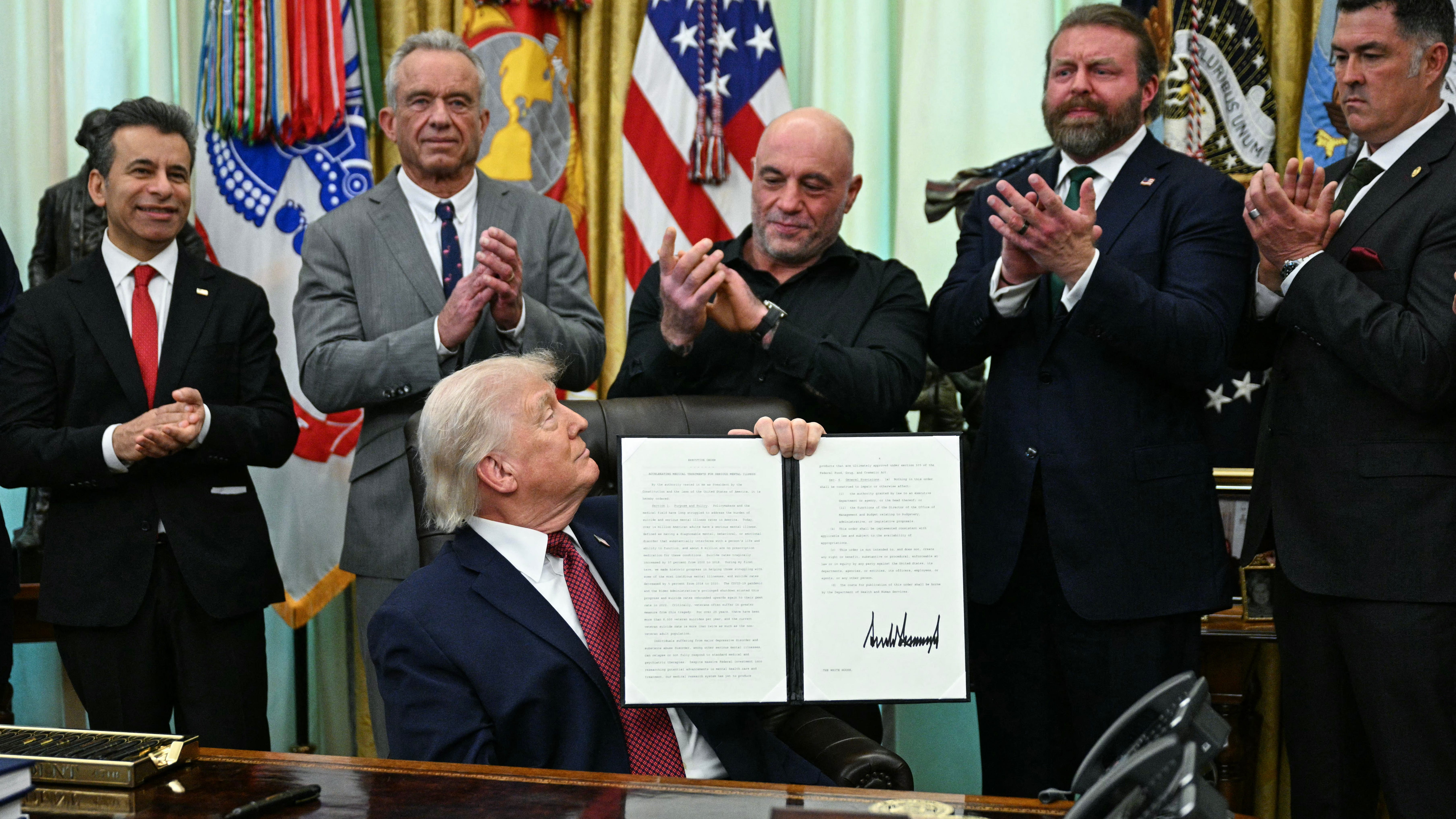
Last weekend, US President Donald Trump signed an executive order accelerating research into psychedelics to treat veterans.

USA TODAY reported that Trump’s signing followed a call from podcast host Joe Rogan, who asked Trump to investigate how drugs help veterans battling suicide and depression.

But in Texas, the state legislature is already looking to invest in clinical trials of the hallucinogen, with Lt. Gov. Dan Patrick and House Speaker Dustrin Burrows announcing a $50 million state investment in research into the drug.

This led some to wonder what exactly ibogaine is and what President Trump’s executive order means for Texans.

What is ibogaine?

Ibogaine is derived from the roots of Tabernante iboga, a shrub native to Central Africa. And it’s illegal in the US.

However, when combined with magnesium, it can help reduce PTSD, anxiety, and depression, and improve function in veterans with traumatic brain injuries, according to Stanford Medicine.

What has Texas done to invest in ibogaine research?

On March 31, Texas leaders announced the creation of a $50 million clinical trial program after the Texas Health and Human Services Commission determined that no drug companies would be willing to help develop a drug for FDA approval.

Prior to this announcement, the Texas Legislature passed Senate Bill 2308 and the governor signed it. The bill created a pathway for universities, hospitals, and drug developers to work together to conduct clinical trials of Ibogaine for FDA approval.

The bill also appropriated $50 million to support this effort.

How will President Trump’s ibogaine executive order affect Texans?

As reported by USA Today, the order directs the FDA to expedite research into psychedelics, including ibogaine, which can help treat severe mental illness and depression, while also setting a course to accelerate research into the drug.

The order also allocated $50 million for each state to research the drug.

With this additional incentive, it remains to be seen when clinical trials for ibogaine will begin in Texas.

Mateo Rosiles is a Texas Connect reporter for USA TODAY and local Texas newspapers. Do you have any news tips for him? Email him: mrosiles@usatodayco.com.