A traveler with cerebral palsy said his wheelchair was damaged by airline staff despite safer alternatives being available.

Air travel accessibility issues for passengers with disabilities
Airlines mishandle thousands of mobility devices each year, raising concerns about accessibility in air travel.
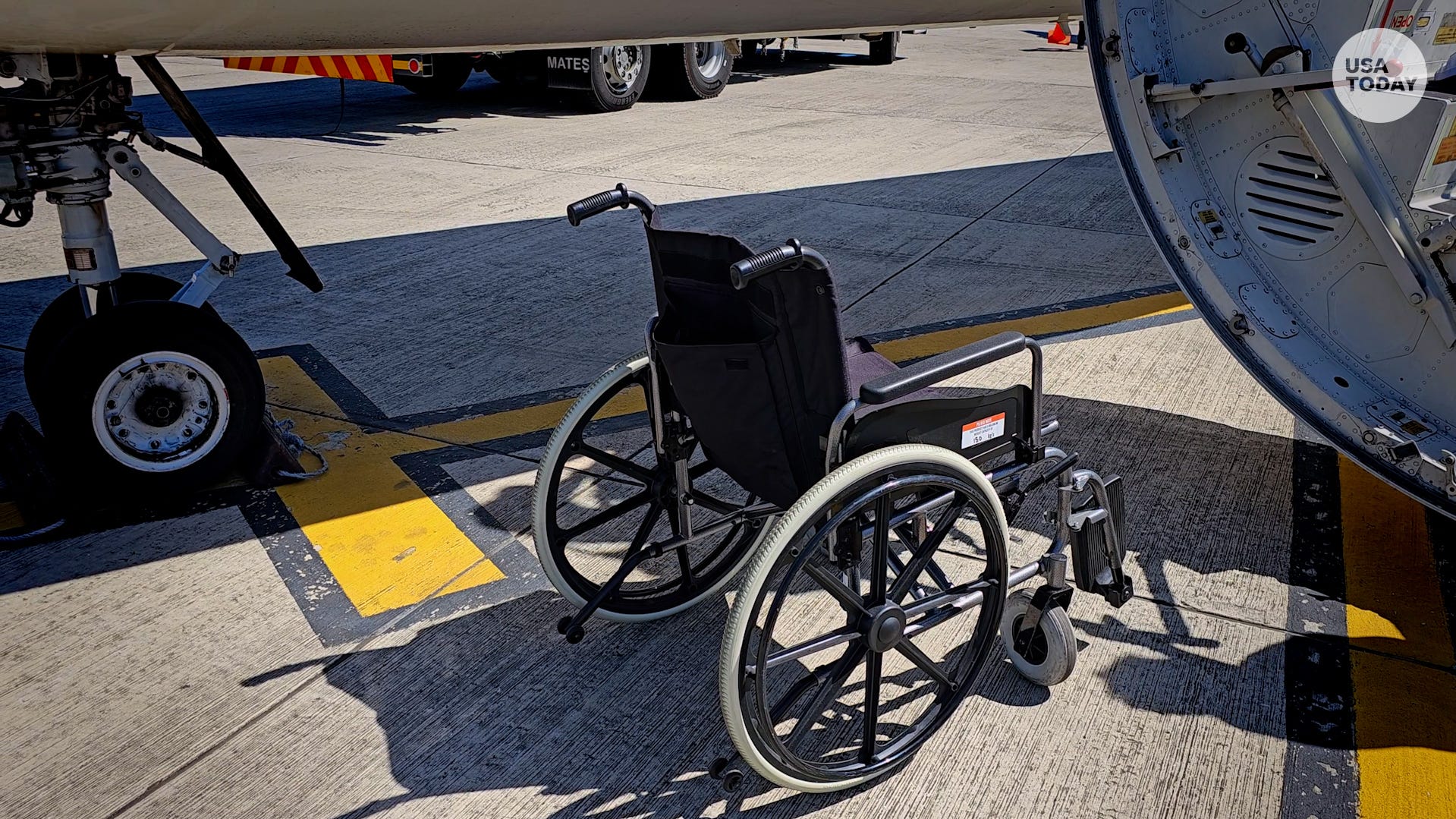
- A man’s custom-built power wheelchair broke when American Airlines staff forced it through a cargo door that was too small.
- The passenger and his partner spent nearly 12 hours at the airport arranging emergency repairs.
- On the return flight, the airline admitted the chairs didn’t fit and rerouted the couple on another aircraft.
John Krieger’s wheelchair broke on an American Airlines flight from Detroit to Phoenix, but it didn’t have to break and the problem didn’t occur on the return trip.
“This problem could have been solved if someone had looked at my chair and said, ‘This can’t go through the door,'” Krieger told USA TODAY. “They have other solutions that say, ‘Oh, this doesn’t fit.’ Instead of stuffing it into a hole.”
Krieger, 41, was on vacation in Phoenix with his partner, Amy Fry, on March 5. He said that when he got off the plane, he was immediately told that his chair was damaged.
“We’re waiting for my chair on the jet bridge, and the ground agent who brought me the chair said, ‘I had to tilt the chair back a little bit,'” Krieger said. He didn’t know what that meant, but he soon found out.
“The chair didn’t move. It was leaning a lot further back than it was supposed to, so it didn’t move,” he said. “These chairs are designed to automatically stop if you sit in the wrong position as a safety measure to prevent users from falling into dangerous positions.”
Krieger has cerebral palsy and relies on a custom-built power wheelchair to get around. After learning of the damage, he and Fry ended up spending nearly 12 hours at the Phoenix airport waiting for temporary repairs.
Eventually, a technician recommended by Krieger’s regular repair shop in Michigan was able to get the chair back into service, but not fully functional. Still, it was enough to get Krieger and Frye out of the airport.
“Four of the six chairs are working, enough to enjoy your vacation, but they are not working properly,” Kreiger said.
It wasn’t until they flew home on March 14 that they fully realized what had happened.
“When you load the plane, it’s the same type of plane that you went there with, so you’re like, ‘Oh, let’s go home. It’s not going to break down this time,'” Krieger said. “When I got on the plane, it was delayed, and then it was delayed again, I looked at my partner Amy and said, ‘I guess I’m the only one delaying the flight.'”
But after about 45 minutes, he and Frye were asked to exit the plane. It turns out his chair couldn’t fit through the cargo door.
“John and I looked at the cargo door earlier. Boeing 737 statistics, data can be found on the Internet. You can look at the dimensions. And I measured his chair,” Fry said. “The manager said, ‘Technically, it should fit based on the numbers, but because of the conveyor belt, it’s taking up a significant portion of the 6 inches of the cargo door.'”
A previous baggage handler bent the chair beyond its design limits to get it onto a flight to Phoenix.
In the end, Krieger and Frye had to reroute through Charlotte on a different type of plane to safely handle the chairs.
“If they had treated this accessibility equipment the way it was supposed to be treated and asked the right questions about dimensions, it would have been very unnecessary,” Fry said.
“We know how important mobility devices are to our customers, and we regret Mr. Krieger’s experience. Our team has reached out directly to Mr. Krieger to apologize and get his wheelchair repaired as soon as possible,” American Airlines spokeswoman Gianna Urgo said in a statement. “Given the inconvenience this situation has caused, we have also provided an act of goodwill.”
Krieger said American Airlines distributed $400 worth of vouchers to Krieger and Frye.
For Kreiger, the lack of active support was the most frustrating part.
“We’ve improved our training and are now able to tell people with disabilities, ‘This is inappropriate. We have to change the route because of XYZ,'” he said. “that’s ok.”
Frye said she hopes airlines treat Kreiger and other passengers with disabilities with more dignity in the future.
“We need to treat people’s medical devices the same way we treat people,” she said. “This is part of John’s livelihood, this is how he interacts with the world.”
How common is airline wheelchair damage?
In fact, U.S. airlines showed significant improvement in wheelchair breakage rates in 2025 compared to 2024, but there is still work to be done.
According to the Department of Transportation, the 10 largest U.S. airlines and their subsidiaries transported 907,259 wheelchairs and other mobility devices in 2025, and the Department received 9,910 reports of mishandling (a rate of 1.09%). For comparison, carriers mishandled 1.26% of the mobility devices they transported in 2024.
Zach Wichter is a travel reporter and writes the Cruising Altitude column for USA TODAY. He is based in New York and can be reached at zwichter@usatoday.com.


