Home Blog Page 458

What you need to know about Venezuelan President Nicolas Maduro

0

play

The Trump administration continues to escalate its threats against the South American country and its president, accusing its government of drug trafficking and terrorism after bipartisan lawmakers announced an investigation into a military attack on a suspected drug smuggling boat in Venezuela.

Venezuelan leader Nicolas Maduro publicly disputed the Trump administration’s claims.

Since September, the U.S. military has attacked nearly 20 ships in international waters, killing 83 people. President Donald Trump said the airstrikes were aimed at stopping domestic human traffickers in addition to reported drug smugglers.

Following reports that the military attacked a ship in the Caribbean on September 2, U.S. lawmakers are considering how the administration’s actions might reflect on the situation. The attack killed two survivors clinging to the boat’s wreckage.

So who is Venezuelan President Nicolas Maduro? Here’s what you need to know about this politician under surveillance by the US government.

Who is Nicolas Maduro?

Nicolas Maduro, 63, is the president of Venezuela and has led the oil-rich country since 2013. He was born in Caracas, the country’s capital.

He married Cilia Flores in 2013, and they were often photographed together at political events.

Maduro has a 35-year-old son, Nicolas Maduro (Junior) Guerra, with his first wife Adriana Guerra Angulo.

Maduro heads the United Socialist Party of Venezuela, a left-wing political group seen by some as undemocratic.

Even though Mr. Maduro remains in power, Venezuelan opposition leaders, as well as people around the world, insist that Mr. Maduro has lost the 2024 presidential election.

Nicolas Maduro’s rise to power

Maduro worked as a bodyguard and bus driver in the 1980s, according to a previous report by USA TODAY. He also belonged to the Caracas Metro System Transit Union.

He is the hand-picked successor to former socialist leader Hugo Chávez, who died of cancer in 2013.

Maduro’s relationship with the late Chavez began in the 1990s, when the current president helped secure the release of Chavez from prison for his anti-government activities, including reporting on a coup aimed at ousting then-president Carlos Andrés Perez.

Maduro later gained a place in Chavez’s inner circle by supporting Chavez’s 1998 presidential campaign and “promising to give poor Venezuelans a larger share of the economic pie controlled by the country’s wealthy ruling elite.”

Before becoming the country’s top leader, he served as the country’s foreign minister and vice president.

When was Nicolas Madaro reelected?

President Maduro has served as president for three terms.

In July 2024, the country’s government-controlled electoral commission declared that Mr. Maduro had won the election and retained his seat.

Although the government opposition claimed that candidate Edmundo Gonzalez won the election, Venezuela’s Supreme Court upheld Maduro on August 22.

What is Nicolas Maduro being accused of?

Mr. Trump himself has claimed that President Maduro is involved in trafficking illegal drugs into the United States as head of the Cartel de los Soles, which the US State Department has designated as a foreign terrorist organization.

President Trump issued a warning over the weekend to avoid flying over Venezuela. President Trump has already hinted at a ground attack into the country, after telling the US military on Thanksgiving that military operations would soon include a ground attack.

President Trump’s attack came in the wake of the indictment in 2020 of President Maduro and his top officials for their alleged involvement in a drug-trafficking conspiracy.

Venezuela’s president has denied any links to the illegal drug trade, a move that led to protests in Caracas last month.

In a statement over the weekend, The Venezuelan government condemned Trump’s comments, calling them a “colonialist threat” to the South American country’s sovereignty and a violation of international law.

A government statement said Trump’s post “represents a hostile, unilateral and arbitrary act inconsistent with the principles of international law.”

The United States already has aircraft carriers, guided missile destroyers, and special operations ships near Venezuela. About 12,000 troops are stationed in the area, USA TODAY reported earlier this week.

The White House told USA TODAY on October 27 that the administration’s policy is “maximum pressure” on the Maduro regime, and that “there are no negotiations that could benefit the regime.”

Contributors: Eduardo Cueva and Phillip M. Bailey, USA TODAY

Natalie Neisa Alland is a senior reporter at USA TODAY. Contact her at nalund@usatoday.com and follow her at X @nataliealund

What is Chronic Fatigue Syndrome? What is CFS?

0

play

It’s normal to feel tired after a busy week, a bad night’s sleep, or a lingering cold. However, for some people, the feeling of fatigue persists even with rest. It will be a constant and helpful companion with which you can rebuild your daily life.

These people may have trouble concentrating at work, keeping up with social commitments, and may even find it difficult to perform basic tasks without feeling drained. For them, fatigue is more than just fatigue. This is a severe system-wide shutdown that does not respond to coffee, naps, or willpower.

This often misunderstood condition, known as chronic fatigue syndrome, is a complex disease that researchers are only beginning to fully understand.

Here we explain what it is, why it occurs, and how people diagnosed with it can find relief.

What is chronic fatigue syndrome?

Chronic fatigue syndrome (CFS), also known as myalgic encephalomyelitis (ME), is a long-term, multisystem disease characterized by deep, persistent fatigue that does not improve with rest and is severe enough to interfere with daily life. “The core of this disease manifests as severe, disabling fatigue that lasts for six months or more,” says Dr. Hector Bonilla, a clinical professor of medicine and infectious disease expert at Stanford Health Care.

According to the Centers for Disease Control and Prevention, as many as 3.3 million people in the United States suffer from the condition, but many go undiagnosed because CFS is often misunderstood or confused with other health problems.

Another difficulty in diagnosis is that the symptoms of CFS overlap with conditions such as depression, hypothyroidism, fibromyalgia, anemia, autoimmune diseases, and sleep apnea. Often these other causes must also be ruled out. Additionally, there are no blood tests or biomarker tests for CFS, so clinicians must rely on a patient’s detailed medical history, symptom patterns and pre-established clinical criteria, Bonilla said.

A characteristic symptom of CFS is “post-exercise malaise,” a delayed decline in energy and function that occurs after minimal physical or mental activity, Bonilla notes. People describe this crash as feeling flu-like, heaviness, cognitive fog, or completely depleted, and it often takes several days or more to recover. Other common symptoms of CFS include “dizziness, muscle and joint pain, lack of sleep, and memory problems,” says Dr. Neha Vyas, a family medicine physician at the Cleveland Clinic. “Sometimes we also see exercise intolerance and decreased peak oxygen consumption.”

Many patients also experience autonomic nervous system problems, such as increased heart rate when standing.

What causes chronic fatigue syndrome?

Although the exact cause of CFS remains unknown, research increasingly points to a combination of biological triggers and chronic dysregulation in multiple body systems. “More than 60% of patients mention a previous infectious process that triggered their illness,” Bonilla says. Such infections commonly include the Epstein-Barr virus, influenza, or more recently, coronavirus disease (COVID-19). “Herpesviruses, enteroviruses and retroviruses are also thought to be involved in this condition,” Professor Vyas added.

These viruses and infections can cause CFS by disrupting immune signaling, energy metabolism, and autonomic nervous system function, and persisting long after the initial illness has subsided, Bonilla said.

Genetic predisposition may also play a role, Vyas said, as studies have shown that people with a family history of autoimmune or immune-related diseases may be at higher risk of developing CFS. Hormone imbalances, particularly those related to cortisol control, have also been observed, but researchers have not yet determined whether these are the cause or effect of the symptoms.

Some people also develop CFS after physical trauma, significant stress, or environmental exposure, suggesting there may be other routes by which the condition develops.

How is CFS treated?

There is currently no cure for CFS, but effective management can significantly improve quality of life. Because symptoms can vary widely, “treatment focuses on managing symptoms, improving sleep quality, addressing pain and cognitive symptoms, and finding ways to improve daily functioning,” Vyas says.

Medical treatment may include medications to manage pain, sleep disturbances, dizziness, and depression, as well as treatment for related conditions such as POTS and allergies. Specifically, some patients may benefit from low-dose naltrexone, antihistamines, or targeted antivirals and immunomodulatory treatments, but the evidence is mixed and expert supervision is required.

Cognitive support strategies such as memory aids and occupational therapy can also be helpful in daily life. Bonilla points out that nutritional guidance is also common, such as eating more whole foods, lean proteins, and anti-inflammatory fruits and vegetables while cutting back on processed foods and added sugars, which can worsen inflammation and cause low energy.

One of the most important interventions at home is pacing, Bonilla explains. This approach involves carefully tracking your energy levels, recognizing early signs of overexertion, and balancing rest and activity to avoid causing a crash. Gentle stretching, hydration, and a sleep-stabilizing routine may also reduce symptoms, but strenuous exercise can worsen post-exercise fatigue and is usually not recommended.

Many patients also find relief from symptoms through mindfulness practices, breathing techniques, relaxation techniques, or support groups that provide emotional and practical guidance.

Bonilla said doctors can adjust recommendations for a particular patient, rule out other illnesses and adjust testing and treatment needs.

Vyas said that while CFS is “a complex and difficult disease that we are still learning,” many people diagnosed with CFS learn how to manage their symptoms more effectively over time. And with new research and growing awareness, there is real hope that better treatments and clearer answers are on the horizon.

Latest 2025 Bath & Body Works Candle Day sales and prices.

0

play

Black Friday and Cyber ​​Monday may be over, but don’t put away your wallets just yet. Billed as the most anticipated event of the year, Bath & Body Works’ annual Candle Day continues this week, giving candle lovers the chance to stock up on their favorite candles and win limited-edition drops and new fragrances.

According to Bath & Body Works (BBW), fans can expect an “annual tradition” during the season, “coming together for early warning, transportation strategies, and the excitement of first sniff.”

The brand said Candle Day is “one of the biggest shopping events of the year, attracting millions of shoppers across our stores, website and app.”

“The scale is staggering,” BBW said. “The three-wick candles sold end-to-end during Candle Day 2024 would span approximately 1,700 miles, approximately the distance from the southern tip of Florida to Portland, Maine.”

Betsy Schumacher, Bath & Body Works’ chief merchandising officer, said Candle Day is a “cherished tradition” that “customers count down to every year.”

“This is the ultimate Bath & Body Works shopping event and a moment to deliver what we do best: high-quality three-wick candles made with innovation and artistry, along with new fragrances and special surprises designed to give consumers exactly what they want,” said Schumacher.

Here’s what you need to know about Candle Day this year.

When is Bath & Body Works Candle Day 2025?

The 14th annual Bath & Body Works Candle Day begins online Thursday, Dec. 4 at 10 p.m., and in-store Friday, Dec. 5, through Sunday, Dec. 7, 2025.

How much does a Candle Day Bath & Body Works candle cost?

During Candle Day weekend, all three-wick candles will be on sale for this year’s lowest price of $9.95. This is a huge discount from the regular price of $26.95 to $29.95.

How many Bath & Body Works candles will be sold on Candle Day 2025?

BBW says more than 180 candles will be on sale over Candle Day weekend, with “the perfect scent for every mood and moment.”

The brand has partnered with world-renowned perfumers and top fragrance houses to develop its popular three-wick candle.

“Each candle is meticulously developed to provide a rich, consistent scent experience from first ignition to final burn, creating the ultimate home fragrance that combines science and artistry,” says BBW.

Dana Schmidt, a perfumer at Swiss-based flavor and fragrance maker Givaudan, who developed Bath & Body Works’ Glazed Cherry and Sugared Waffle Cone scent, told USA TODAY that her candles were months in the making. Mr. Schmidt explained the work of a gourmand. Fruit scents can be an incredible challenge as there are specific expectations and standards that must be met.

“You can’t play with anything we all already know and love,” Schmidt said, explaining that developing food-flavored candles “can take months.”

“You can’t fool the consumer,” Schmidt added.

MANE perfumer Octavia Jordan, who has developed multiple fragrances for BBWs over the years, told USA TODAY that she is excited to see the return of the “smoked vanilla” scent she created nearly a decade ago. According to a BBW spokesperson, this scent is one of the most requested on Candle Day, even though it hasn’t been on the market for several years. Jordan also developed Fresh Balsam, another favorite of the candle company.

Jordan believes the scent, which blends woody, smoky notes with sandalwood and a hint of spiciness and vanilla, is a hit because it “brings back all kinds of memories during winter and the holidays.” The perfumers added that the vanilla used in the candles is sustainably sourced from Madagascar, which enhances the scent.

Need breaking news? Check out the all-new PLAY hub with puzzles, games, and more!

Bath & Body Works 2025 Candle Day Exclusive Drops, Holiday Favorites, and Best Sellers

Bath & Body Works’ 2025 Candle Day assortment includes mixes of fan favorites like Fresh Balsam and Winter Candy Apple, new releases like Butterscotch Swirl and Rum Rum Reindeer, and Candle Day-themed three-wick candles in limited edition packaging.

Candle Day 2025 will feature over 50 drops featuring exclusive 3-wick candles, including:

The 2025 lineup is as follows:

new

  • Neapolitan ice cream
  • gummy candy
  • glazed cherry
  • butterscotch swirl
  • sugar waffle cone
  • hot fudge drizzle
  • coffee & donuts
  • chips & salsa
  • Pizza & Lunch
  • popcorn & slushie
  • ram ram reindeer
  • christmas road trip

limited edition

  • Holiday Dill Light: Get inspired by quirky holiday traditions and join the ultimate holiday hunt with limited edition pickle candles.

from storage

Requested by the brand’s millions of loyal members, these scents are back for a limited time.

  • smoked vanilla
  • brown sugar and figs
  • snow day
  • blueberry sugar
  • vanilla snowflake
  • moonlight path

fan favorite

How to buy Bath & Body Works candles on Candle Day 2025

Customers can purchase exclusive Candle Day products online, via the Bath & Body Works app, and in-store. This year’s sale begins online on Thursday, December 4th at 10pm ET and continues in stores on Friday, December 5th.

Bath & Body Works stores will open at 6 a.m. local time on Friday, December 5, in time for Candle Day. Find your nearest store here.

How many Bath & Body Works candles can I buy for Candle Day?

A BBW spokesperson confirmed to USA TODAY that there is a limit of 24 candles available for purchase on Candle Day.

Saman Shafiq is a trending news reporter for USA TODAY. Contact her at sshafiq@gannett.com and follow X and Instagram @saman_shafiq7.

A winter storm dumps snow across the East Coast. Check out today’s forecast.

0

play

The first winter storm of the season is expected to arrive in New England and the Mid-Atlantic region on Dec. 2, bringing dangerous road conditions with “heavy snow and significant icing,” forecasters said.

In total, more than 45 million Americans were under winter weather warnings in the Northeast, Mid-Atlantic, and West. States from Kentucky and North Carolina to New York, Massachusetts and Maine were subject to the advisory. Winter storm warnings were issued for about 5 million people in parts of New York, Vermont, New Hampshire, Massachusetts and Maine.

A snowstorm system that is dumping a wintry mix on the Ohio Valley is moving into the Appalachians and the mid-Atlantic, and the snowstorm is moving from the upper Ohio Valley to the Great Lakes and into interior New England, the National Weather Service announced.

The storm is expected to produce heavy snowfall of more than 1 inch per hour on December 2, the weather service said. Snow amounts could approach or exceed a foot in some places, and freezing rain could make roads icy and slippery in some places.

Another round of wintry weather blanketed parts of the Midwest, bringing mountain snow to the Rocky Mountains and icy conditions to eastern Washington, northern Idaho, and parts of Montana and Wyoming.

The winter weather arrived days after the storm dumped a foot of snow on parts of the Midwest and angered post-Thanksgiving travelers in cities like Chicago.

“Winter storms will hit the Midwest and Great Lakes this week, potentially creating more travel headaches,” said Dan DePodwin, AccuWeather’s vice president of forecasting operations.

How much snow does it snow?

Parts of New England and the northern Mid-Atlantic are expected to receive 5 to 10 inches of snow on December 2, with some areas expected to receive more than a foot of snow, the weather service said.

Freezing rain in the south-central Appalachians could cause 0.1 to 0.2 inches of ice to form on roads, forecasters said. Bridges and overpasses are especially at risk from ice.

A second winter storm is expected to form over the weekend, bringing the potential for more snow to the Ohio Valley, Great Lakes and parts of the Northeast, AccuWeather said.

More winter weather expected to arrive by midweek

According to AccuWeather, states in the Midwest, Ohio Valley and Great Lakes region are expected to experience a cold front from Canada on the night of Dec. 3 and into Dec. 4, resulting in temperatures 15 to 20 degrees below normal for this time of year.

Temperatures in Minneapolis and Chicago are expected to be in the teens, but will feel closer to the single digits, the paper said.

““This front could be accompanied by squalls, which could cause rapid visibility declines, quickly cover roads and make travel dangerous,” Depodwin said.

AccuWeather reports that more arctic air from the displacement of the polar vortex, a huge circular region of cold air high in the atmosphere that usually rotates above the North Pole, will flow in in the coming weeks.

Contributor: Doyle Rice, USA TODAY

Landmark lawsuit that expanded speech rights over private property

0

Forty-five years ago this month, the New Jersey Supreme Court handed down a landmark free speech decision, affirming that the state’s constitution’s protections for the right to expression are stronger than those guaranteed by the First Amendment.

In that case, State vs. Schmidtthe Garden State Supreme Court ruled that under New Jersey’s 1947 Constitution, an individual’s right to expression on private property open to public use (in this case, Princeton University) cannot be unreasonably restricted. In response, the U.S. Supreme Court took a different path, gradually narrowing and eventually overturning its initial ruling in a trilogy of private shopping center cases from 1968 to 1976 that held that individuals had a First Amendment right to protest on such premises. schmidtThe bold departure from “lockstep” federal standards has consequences for speech rights far beyond New Jersey’s borders, drawing on precedents in multiple states and even foreign countries.

Arrest in Princeton

The story began on April 5, 1978, when 26-year-old Chris Schmidt, a member of the fringe American Labor Party, was arrested by campus police officers for trespassing at Princeton University as a “disabled person.” He was distributing and selling political literature related to the upcoming Newark mayoral election outside his undergraduate dormitory and cafeteria. At the same time, Mr. Schmidt was running for Trenton City Council on the Labor Party ticket, although he was not a student at the university.

Princeton University rules at the time prohibited nonmembers of the university community from soliciting on campus for political, religious, or charitable purposes without the sponsorship of a campus-based organization and the permission of the dean of students. In contrast, the university allowed students, faculty and staff to do so without administrative approval. Schmidt was not invited or authorized to participate in the April 5 event. But he was certainly aware of Princeton University’s policies. In a previous incident, university officials warned Schmidt that he could be subject to disciplinary action if he solicited without permission.

After his arrest, Schmidt was taken before Princeton Borough Municipal Court Judge Philip Kirchman, who found him guilty of trespassing under state law in October 1978, and sentenced him to a $15 fine and $10 in court costs. However, Kirchman said he still has a degree of skepticism about the idea that “Princeton University, a private university committed to freedom of expression, fulfilled its promise by under the guise of restricting the orderly expression of ideas, by prosecuting Schmidt.”

At this stage in his case, Schmidt had not raised any significant state constitutional challenges to the university’s policies. Such discussions were likely “an afterthought,” Kirchman said. state court report In a recent interview. But there were already signs that Schmidt’s case was unusual for the district court, he said. For one thing, Mr. Schmidt has a high First Amendment challenge, and Mr. Kirchman ordered a press conference to address what he described in an interview as a “serious constitutional issue.” Kirchman recalled that there were also many observers at the proceedings, indicating extraordinary interest from the public. But Schmidt appeared distracted and oblivious to “the beauty of this moment,” Kirchman said.

“State Act” Principle and Judicial Federalism

The following year, when the case reached the New Jersey Supreme Court after a series of unsuccessful appeals, Schmidt reversed course and filed a claim under federal and federal law. and State constitution.

First, it argued that Princeton’s policies limit First Amendment rights because it treats nonstudents and students differently. Schmidt likened Princeton to a privately owned “corporate city,” a quasi-public entity that functioned like a local government and thus qualified as a “state actor,” and was limited by the First Amendment. 1946s Marsh vs. Alabamathe U.S. Supreme Court clarified that a corporate city that performs all municipal services cannot prohibit nonresidents from distributing religious materials on its sidewalks. This principle is similarly binding on Princeton, Schmidt declared.

Second, Mr. Schmidt argued that Princeton was violating his rights under New Jersey’s constitutional provisions that guarantee protections for freedom of speech, assembly, and petition, and that these provisions can be interpreted more liberally than the federal version. This shift toward state constitutions reflects a growing recognition that state bills of rights can be uniquely interpreted by state high courts to “go beyond” the minimum “floor” mandated by the U.S. Constitution, and thus afford a greater degree of protection than their federal analogs. (June 1980, just months before the New Jersey Supreme Court decision) schmidtthe U.S. Supreme Court has Pruneyard Shopping Center v. Robins State charters (in this case, California) provide broader protections for individual liberty than national charters. in the same way as schmidt, prune yard It concerned state-level rights to free speech on private property. )

The university has hired Nicholas Katzenbach, a former U.S. attorney general and member of its board of trustees, to represent it in the New Jersey Supreme Court. Princeton University argued in its participant brief that “intrinsic” “academic freedom” and “an ancient tradition of self-government” require private universities to be given the power to decide who to exclude from their properties. From Princeton University’s perspective, leaving the contours of campus access for non-students up to the state judiciary would be an inappropriate overreach.

During three hours of oral arguments in February 1980, Princeton University focused its argument on the autonomy granted to private organizations under the federal Constitution. So Katzenbach only mentioned the state’s constitutional claims in his prepared remarks in passing. “Appellants argue that the New Jersey Constitution provides broader rights than the federal Constitution and that it should be construed to limit not only governmental power but also private power,” he said. “I don’t think it gives you broader rights than the First Amendment, but it probably does.”

watershed verdict

In November of the same year, the New Jersey Supreme Court unanimously vacated Schmidt’s conviction. The 7-0 opinion was rooted in state constitutional protections. “Under the circumstances revealed by the record, it is difficult to conclude that Princeton University, as a private institution, is directly subject to the limitations of the First Amendment,” the court said. However, it continued, state law “can uniquely provide a basis for protecting individual rights of speech and assembly,” and the state constitution provides a “compelling alternative basis for relief.”

To explain how the New Jersey Constitution is more protective of the right to express private property open to public use than the U.S. Constitution, the court focused on the differences in text between the First Amendment and the state equivalent clause in Article 1, Sections 6 and 18 of the New Jersey Charter.

While the language of the First Amendment was negatively worded as a restriction on government interference in the means of expression: “Congress shall make no law abridging the freedom of speech or of the press, or the right of the people peaceably to assemble,” the language of the New Jersey Constitution was positively worded and individual-oriented. Article 1, Section 6 provides: “Everyone shall be free to speak, write, and express his feelings on any subject; no law shall be enacted abridging or abridging the freedom of speech or of the press.” On the other hand, Article 1, Section 18 stipulates that “the people have the right to freely assemble and consult in the common interest, to make their opinions known to representatives, and to petition for a redress of grievances.”

“Part of the basis for finding extraordinary vitality in the New Jersey Constitution with respect to the rights of individual speech and assembly lies in the language used,” the court declared. The report noted that the state constitution’s affirmative recognition of these freedoms demonstrates the framers’ clear intent to protect these rights “to a broader extent.” Furthermore, the clause restricts not only government action but also “unreasonable oppressive actions by private entities, which have a constitutional obligation not to infringe on the exercise of individual freedom in the name of public use of property,” such as Princeton University.

After setting out the proper “constitutional context,” the court turned to the question at hand: whether the state constitution’s speech and assembly guarantees applied to Schmidt’s distribution of political materials on Princeton’s campus. The court recognized that “the core of the issue” was “the need to balance the legitimate interests of private property with individual freedoms of speech and assembly within the constitutional framework.”

The court explained that, on a “moderate scale,” the parallel rights incorporated in Article 1, Sections 6 and 18 would become more important in private property as it became more open to the public. Therefore, private institutions like Princeton, whose campus facilities and sponsored events are regularly available for public visits, had a greater obligation to ensure that the expression rights of their guests were not violated, as Schmidt did. The court concluded that the university’s unreasonable interference with Ms. Schmidt’s right to self-expression and permitting her on-campus solicitation subject to reasonable “time, place, and manner” conditions were, in fact, “fully consistent” with the university’s professed educational interest in promoting the diverse exchange of ideas.

schmidtthe aftermath of

of schmidt But the story didn’t end there. The university appealed the New Jersey Supreme Court’s decision to the U.S. Supreme Court, alleging that it violated the university’s rights under the First, Fifth, and Fourteenth Amendments. A federal court agreed to hear the case and issued an 8-0 decision in January 1982. by the court The opinion dismissed the appeal as invalid because the university revised its solicitation rules after the incident. Just four days later, a vindicated but compliant Chris Schmidt returned to Princeton’s campus, no longer under threat of arrest.

schmidt‘s legacy continues in New Jersey, where the state Supreme Court continues to stretch the state constitution’s speech protections. For example, in 1994, New Jersey Coalition Against Middle East War vs. JMB Realty Co., Ltd.the court relied on schmidt To preserve privately owned regional shopping centers (alternative commercial forums or “downtown business districts” in highly suburbanized states), flyer sellers cannot be eliminated. in 2012 Mazda Brook Commons Homeowners Association v. Kernthe court deployed schmidt Overrides the ban on political signs in apartment building windows. schmidt It has also been cited as an influential model by courts in 23 states and Puerto Rico, including Colorado, Massachusetts, Oregon, Pennsylvania, and Washington. And New Zealand courts are also looking to the case for guidance in developing their own jurisprudence.

• • •

schmidt This vividly illustrates how state charters serve as independent guardians of our right to expression. State constitutions and courts remain an important “double security” for ensuring the preservation of individual rights and freedoms in the federal system.

Henry Hsiao is an undergraduate student at Princeton University.

Recommended citation: Henry Hsiao, Landmark lawsuit that expanded speech rights over private propertySᴛᴀᴛᴇ Cᴏᴜʀᴛ Rᴇᴘᴏʀᴛ (November 25, 2025), https://statecourtreport.org/our-work/analysis-opinion/landmark-case-extended-speech-rights-private-property

AT&T data breach settlement claim deadline extended. How to file.

0

play

The deadline to claim the $177 million AT&T class action settlement is approaching.

AT&T has agreed to a settlement to resolve lawsuits alleging it failed to protect customer information and led to two separate data breaches last year.

In the first incident on March 30, 2024, AT&T announced that customer information, including addresses, Social Security numbers, and passcodes, was published on the dark web, according to the settlement website.

In the second incident, on July 12, 2024, AT&T announced that customer call and text records were illegally downloaded.

In an earlier statement to USA TODAY, AT&T said it is “committed to protecting our customers’ data and ensuring their continued trust in us.”

“While we deny the allegations in the lawsuit that we are responsible for these criminal acts, we have agreed to this settlement to avoid the expense and uncertainty of prolonged litigation,” the statement said.

Here’s what you need to know about settlements.

When is the deadline to file a claim?

The deadline to submit claims is Thursday, December 18th. Online forms must be submitted by that date. Requests sent by mail must be postmarked.

This deadline has been updated from the original November 18 deadline.

How to file a claim in the AT&T settlement

AT&T customers eligible for the settlement can submit claims online at www.telecomdatasettlement.com.

Claims may also be mailed to AT&T Data Incident Settlementc/o Kroll Settlement Administration LLCP.O. Box 5324 New York, NY 10150-5324.

Who is eligible to file a claim in AT&T’s data breach settlement?

There are two settlement classes, or groups of eligible customers, who can file claims.

  • The first class is AT&T customers affected by the March 30, 2024 data breach.
  • The second class is AT&T customers affected by the July 12, 2024 data breach.
  • Some customers may be eligible for membership in both classes.

The breach is believed to have affected more than 7 million people who had AT&T accounts in 2024 and more than 65 million people who had AT&T accounts between 2019 and 2024, according to the complaint and AT&T’s 2024 statement.

Customers who are unsure whether their payment is included should call 833-890-4930.

How much money will eligible AT&T customers receive?

Eligible claimants can receive up to several thousand dollars, depending on which settlement class they belong to. Customers affected by both data breaches could receive up to $7,500, according to the settlement website.

  • Customers affected by the March 30, 2024 data breach:
    • Up to $5,000 with cash payment option for documented losses. This means you will need to provide documentation of your loss.
    • or Tier 1 or Tier 2 cash payments:
      • Anyone whose Social Security number was included in the March 30 data breach can file a claim against Tier 1.
      • Customers whose data did not include social security numbers in the March 30 breach can apply for Tier 2.
      • Tier 1 payouts are 5 times more than Tier 2.
  • Customers affected by the July 12, 2024 data breach:
    • Up to $2,500 with documented loss cash payment option
    • or Tier 3 cash payment:
      • Administrative costs and a portion of the settlement after a claim is issued.

Melina Khan is USA TODAY’s national trends reporter. Contact her at melina.khan@usatoday.com.

Al Gore urges Democrats to send ‘shockwaves’ to Tennessee race

0

play

WASHINGTON – Former Vice President Al Gore made a rare return to the campaign trail with an impassioned appeal to Tennesseans to vote for Democrat Aftin Behn in Tennessee’s 7th Congressional special election.

“I’ve never seen political trends change so quickly and so dramatically as they have in this election,” said Gore, a former senator from Tennessee, as Mr. Behn looks to score a landslide victory in the race against Republican Matt Van Epps in a solidly red district.

“I think the reasons are clear,” Gore said at a virtual rally for Behn on the eve of the Dec. 2 election. “It’s unbelievable because while Tennesseans are seeing rising food prices and rising health care costs, Donald Trump is building golden banquet halls and lining his own pockets. It’s unbelievable. This is the most corrupt administration in history.”

President Donald Trump won Tennessee’s 7th Congressional District, which includes 14 Middle Tennessee counties and part of Nashville, by a 22 percentage point margin in the 2024 election. But the Democratic Party’s strength as a minority party, combined with President Trump’s slumping poll numbers, made Van Epps’ race to replace retiring Rep. Mark Greene (R-Tenn.) a close one. In an effort to avert disaster, President Trump jumped into the campaign trail urging his supporters to vote for Van Epps.

Gore, who famously lost his home state of Tennessee in the 2000 presidential election, said Congressional Republicans were “enabling” Trump’s “reckless and dangerous” actions.

“We already have too many despicable cowards in Congress, and the last thing we need is another coward in Congress,” Gore said. “Your vote in this election can send not just a message, but a shockwave that truly changes the direction of our country.”

New York Democratic Rep. Alexandria Ocasio-Cortez, a national star for progressives, also tripped over Mr. Behn during a virtual rally. Behn welcomed the support, even though Republicans have tried to paint her as far left and labeled her “Tennessee AOC.”

“The very fact that we’re here today and this race is so close is a testament to how the American people are feeling at this moment,” Ocasio-Cortez said. “I truly believe that we are at a time when people are recognizing more and more that our struggle is not between left and right, but between top and bottom. It’s about all of us as working Americans.”

Mr. Gore has stepped back from electoral politics since losing the 2000 election to former President George W. Bush, declining to attend the last two in-person Democratic National Conventions in 2024 and 2016. Instead, Gore has become a global environmental leader in the fight against climate change.

“You know, Tennessee has done things like this before, when the spotlight of history was on us,” Gore said, pointing to Tennessee’s securing the final vote to ratify the 19th Amendment, giving women the right to vote, and the Volunteer State’s role in the civil rights movement. “Tennessee has proven time and time again that we can answer the call of democracy.

“If you elect Mr. Aftin, you will be able to say with your vote that you helped put this country back on the right track,” Gore said.

X Contact Joey Garrison at @joeygarrison.

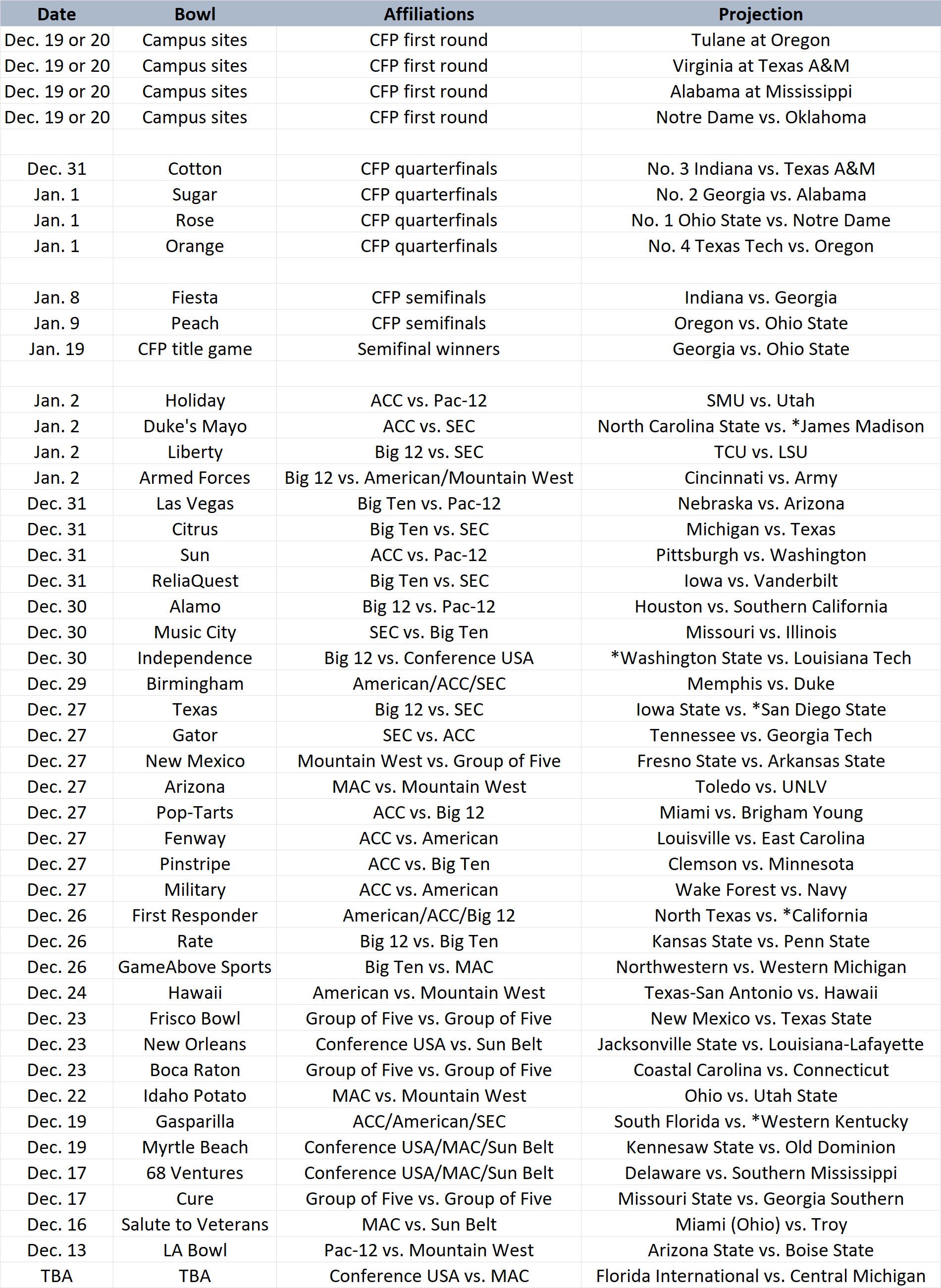
CFP’s College Football Bowl Predictions, Postseason Lineup

0

play

  • Eighty-two teams qualified for the college football postseason, including two teams moving to the top division.
  • This weekend’s conference championship games will determine the final bowl matchups and College Football Playoff participants.
  • Several teams, including Alabama and Notre Dame, face uncertainty regarding their final bowl standings.

We know of 82 teams participating in the college football postseason. What we don’t know is where they will play in the College Football Playoff race entering the final weekend of the regular season.

The remaining questions revolve around conference championship games featuring playoff contenders, including the American and Sun Belt games that will determine the division’s Group 5 representatives.

It looks like 8-9 teams are fixed. Tuesday’s playoff rankings may revise this view, but it’s safe to assume that Ohio State, Indiana, Georgia, Texas Tech, Oregon, Mississippi State, Texas A&M and Oklahoma State are locked in. Notre Dame looks strong coming into the season, but that could change after the final weekend.

The fun begins with Alabama, which was ranked No. 10 by the committee last week. Should the Crimson Tide, currently in the final at-large spot, be eliminated by losing to Georgia in the SEC title game? The nature of the loss will also play a role, as will the outcome between Texas Tech and Brigham Young in the Big 12 title game. If the Cougars defeat the Red Raiders, they will qualify and will likely defeat Alabama, which has lost three games. Even if BYU loses, the Crimson Tide could be eliminated as Miami, Utah and Vanderbilt sit behind the Cougars.

The winner of North Texas and Tulane will play, but the second contender from Group 5 could shake things up. If James Madison wins the Sun Belt, the five-loss Dukes could earn a spot if they win the ACC title game against Virginia.

Further into the postseason, there were exactly 82 teams that achieved the six wins required for bowl eligibility. Two of those players are from transition teams at Missouri State and Delaware, which were not allowed to participate in the postseason unless spots became available. Bears and Blue Hens fans, welcome to the party.

Note: Not all conferences meet their bowl quotas. Asterisks represent alternative picks. Legacy Pac-12 schools in other conferences will honor existing Pac-12 bowl contracts through the 2025 season.

History gives investors dire warnings about overvalued stocks.

0


Even if things seem too good to be true on Wall Street, history shows that they probably are.

For most of the past 16 years, the U.S. stock market has been on a roll. Other than the five-week coronavirus crash and the nearly nine-month 2022 bear market, investors have been immersed in a secular bull market.

This year, we’ve seen the broad-based S&P 500, the growth-driving Nasdaq Composite, and the iconic Dow Jones Industrial Average all rise to multiple all-time highs. These gains have been driven by advances in artificial intelligence, expectations for future interest rate cuts by the Federal Reserve (lower interest rates lower borrowing costs for companies and can act as a catalyst for hiring, innovation, and merger and acquisition activity), and better-than-expected corporate profits.

The stock market may have its limits, but history offers two different perspectives. Over the past century, stocks have delivered some of the highest average annual returns of any asset class, but these gains haven’t come without hiccups along the way.

As the S&P 500, Nasdaq Composite and Dow Jones Industrial Average rise to unprecedented levels, stock valuations are set to follow suit.

Wall Street appears to be heading into the new year with the second-highest stock market in history, but history is giving investors dire warnings about what’s to come.

The stock market has only gone up once since 1871

Before we proceed, let’s add an important modifier. There are no data points, indicators, or correlated events that can guarantee what an individual stock or stock index will do in the short term. If something like this existed, all investors would use it to predict the future.

Nevertheless, history has a way of rhyming on Wall Street. Some correlated events in history have a good track record of predicting the future of the S&P 500, Nasdaq, and Dow Jones.

Ratings are usually completely subjective. What you think is overpriced may be seen as a bargain by another investor. Every investor has their own process of valuing stocks, which leads to an unpredictable market.

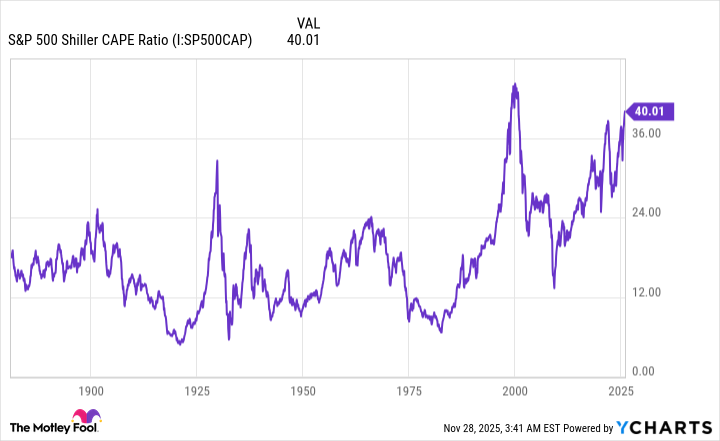
But there is one metric that leaves little room for debate. That is the Shiller price-to-earnings (P/E) ratio for the S&P 500, also known as the cyclically adjusted P/E ratio (CAPE ratio).

What makes the Shiller P/E ratio so valuable from a valuation perspective is that it is based on average inflation-adjusted returns over the past 10 years. While the traditional P/E ratio, which is based on earnings per share over the past 12 months, can easily change due to shock events or economic downturns, the Shiller P/E ratio remains useful during these events.

S&P 500 Shiller CAPE Ratio Chart

S&P 500 Shiller CAPE Ratio data by YCharts.

Although the Shiller PER was not formally introduced until the late 1980s, it has been backtested as far back as January 1871. The average multiple for the past 155 years is 17.31x.

However, as you may have noticed from the chart above, the S&P 500’s Shiller P/E ratio has been higher for most of the past 30 years than its average over the last 155 years or so. This has to do with the mainstream adoption of the Internet, which broke down the information barrier that existed between Wall Street and Main Street in the mid-1990s. Additionally, interest rates fell to historic lows in the 2010s and early 2020s, prompting investors to put money into growth stocks.

As of November 26th close, the S&P 500’s Shiller P/E was 40.20x, a stone’s throw from the current bull market’s late October peak of 41.20x. This is the third time since 1871 that a Shiller P/E high of 40 has been observed, peaking at 44.19 in December 1999 and rising several hundredths above 40 just before the 2022 bear market took shape, but only the sixth time in nearly 155 years that it has exceeded 30 during a sustained bull market. This is where historical precedent becomes important.

The S&P 500, Nasdaq Composite, and Dow Jones Industrial Average all fell between 20% and 89%, following the previous five instances in which the Shiller P/E exceeded 30. The 89% drop in the Dow during the height of the Great Depression is somewhat of an anomaly, but after the dot-com bubble burst, the S&P 500 and Nasdaq fell 49% and 78%, respectively.

Based solely on what history tells us, whether Wall Street’s major stock indexes will survive an elevator down is a matter of “when,” not “if.”

Wall Street’s moment of panic could create a generational buying opportunity for patient investors

Most investors aren’t sold on the idea that the S&P 500, Nasdaq, or Dow Jones will lose more than 20% of their value. Emotions often take the lead when red arrows rule the roost, so it’s not uncommon for these downward movements to occur quickly (i.e., elevator-down declines).

But bear markets and stock market crashes have the potential to create generational buying opportunities for investors with a long-term mindset.

As I pointed out earlier, getting from point A to point B on Wall Street doesn’t happen in a straight line. Stock market corrections, bear markets, and even worrisome crash events are normal, healthy, and inevitable aspects of the investment cycle. No matter what the Federal Reserve or the U.S. government does, nothing can prevent the stock market from occasionally experiencing this.

However, there is a notable difference in the average duration of economic downturns on Wall Street and in bull markets.

As the S&P 500 officially enters a new bull market in June 2023, Bespoke Investment Group researchers have published a dataset on X (formerly Twitter) that compares the length of all S&P 500 bull and bear markets from the beginning of the Great Depression (September 1929) through June 2023.

At one end of the spectrum, the average S&P 500 bear market resolved in 286 calendar days (equivalent to about 9.5 months). Furthermore, none of the 27 bear markets documented during this period lasted more than 630 calendar days.

By comparison, a typical S&P 500 bull market lasts 1,011 calendar days, or about 3.5 times longer than the average bear market. Additionally, about half of all S&P 500 bull markets have lasted longer than the longest bear market since the Great Depression.

While there is no way to know in advance when a stock market downturn will begin, how long it will last, or where the bottom will be, history has proven the clear benefits of jumping in during a significant stock market decline and trusting the passage of time as your ally.

Sean Williams has no position in any stocks mentioned. The Motley Fool has no position in any stocks mentioned. The Motley Fool has a disclosure policy.

The Motley Fool is a USA TODAY content partner providing financial news, analysis and commentary designed to help people take control of their financial lives. Its content is produced independently of USA TODAY.

Should I invest $1,000 in the S&P 500 Index right now?

Offers from the Motley Fool: Before purchasing stocks in the S&P 500 index, consider the following:

of Motley Fool Stock Advisor Our analyst team has identified what they believe Best 10 stocks What investors should buy right now…and the S&P 500 index wasn’t among them. These 10 stocks have the potential to generate impressive returns over the next few years.

when to think about it Netflix This list was created on December 17, 2004…if you invested $1,000 at the time of recommendation. you have $580,171!* or when Nvidia This list was created on April 15, 2005…if you invested $1,000 at the time of recommendation. you have $1,084,986!*

Now, the important thing to note is that stock advisor The total average return was 1,004%, representing market-beating performance compared to 194 years.% for the S&P 500. Join to get the latest Top 10 list, don’t miss out stock advisor.

See 10 stocks »

*Stock Advisor returns as of November 24, 2025

President Trump calls ‘affordability’ a ‘Democrat fraud’ in promoting lower costs

0


Trump said the tariffs were generating billions of dollars from countries such as Japan and South Korea that “were exploiting us.”

WASHINGTON – President Donald Trump opened his ninth Cabinet meeting by criticizing Democrats for complaining about inflation after falling prices for things like gasoline and groceries.

“The word affordable is a Democratic fraud,” President Trump said. “The word affordable is a Democratic fraud.”

At the beginning of a cabinet meeting on December 2, he criticized the lack of coverage of his accomplishments. He continued to criticize Federal Reserve Chairman Jerome Powell for not lowering interest rates more quickly to stimulate the economy.

“We have a tough bull,” Trump said. “We’re going to make an announcement early next year about someone taking control of the Fed.”

President Trump offered Treasury Secretary Scott Bessent the job, but said he wanted to stay on.

“We’re doing great, sir, and it’s a great team to be a part of,” Bessent said.

President Trump also boasted that billions of dollars are being generated from around the world through tariffs on imports from around the world. He drew laughter by refusing to reveal the names of countries that were “defrauding us” such as South Korea and Japan.

“We’re making a lot of money because of tariffs,” Trump said. “They’ve been fooling us for years.” Follow the USA TODAY News team for live updates.

Hegseth’s business card had the wrong title.

Defense Secretary Pete Hegseth has had a tough few days as the U.S. military’s operations against suspected drug smuggling come under increased scrutiny.

So the misspelling of a business card at Tuesday’s cabinet meeting may be the least of his concerns. The title “SSECRETARY” is written on the business card.

-Zack Anderson

“Well done,” Trump told Hegseth.

President Trump has asked Defense Secretary Pete Hegseth for his first Cabinet report amid mounting criticism of military leaders over the alleged attack on a drug smuggling ship.

Lawmakers said they would review the military’s anti-drug operations after reports the United States carried out a second deadly attack on a ship in the Caribbean, killing two survivors clinging to the wreckage.

According to the Washington Post, the additional strikes came after Secretary of Defense Pete Hegseth gave verbal instructions to “kill them all.” Mr Hegseth said the report was “fabricated”. White House press secretary Caroline Levitt said in a Dec. 1 press conference that Adm. Frank M. Bradley had ordered the second strike and was “fully authorized to do so.”

“Mr. Trump always supports us,” Hegseth said on Dec. 2, adding, “We always support commanders who make decisions in difficult situations, and we have done so in this case and in all of these attacks. They made decisions and made sure to protect the American people. They did the right thing.”

After Hegseth finished his speech, President Trump said, “Well done.”

-Zack Anderson, Francesca Chambers

Trump claims peace prize: “I should win the Nobel Prize”

Donald Trump still dreams of winning the Nobel Prize. During the Cabinet meeting, the President brought up the prestigious Peace Prize awarded this year to Venezuela’s opposition leader.

President Trump has said he wants to quickly resolve the war between Russia and Ukraine, but said he deserves an award for the conflict he has already ended.

“Every war should have a Nobel Prize, but I don’t want to be greedy,” he said.

—francesca chambers

President Trump touts record amid growing backlash

Amid mounting opposition to a second term ahead of next year’s midterm elections, President Trump extended and defended his policies at the beginning of his ninth Cabinet meeting.

The Democratic Party performed well in this year’s elections despite simmering dissatisfaction with the economy under the Trump administration, which saw its approval rating decline in public opinion polls.

Trump touted his moves on drug prices, tariffs and other issues as the midterm elections turn into a referendum on the president.

Today’s special House election in Tennessee is being watched as a further sign of how voters feel about Mr. Trump, after Democrats swept states such as New Jersey, Virginia and Pennsylvania in the November election.

-Zack Anderson

President Trump lamented the killing of National Guard trooper Sarah Beckstrom, who was shot and killed on November 24, and said he had spoken to her parents, who were “devastated.”

“Those words were devastating,” Trump said. “They will be devastated for the rest of their lives.

Trump added: “She seemed like the perfect human being.”

Another Guard member, Andrew Wolf, continues to recover from the shooting.

President Trump suggested that murder suspects are angry that crime numbers in Washington, D.C., are decreasing.

“I think this madman was mad that we were so competent,” Trump said.

–Bert Jansen

George Clooney has no interest in retiring: ‘I can still hang in there’

0


The star revisits the death of his acting life and career in the meta Netflix film ‘Jay Kelly’.

play

  • George Clooney reflects on his acting career and the death of his career on Netflix’s “Jay Kelly.”
  • The Noah Baumbach movie, about a movie star who ponders whether fame comes at the expense of his personal life, will stream on December 5th.
  • “I don’t have to work and it’s a good place to be,” the 64-year-old star told USA TODAY. “When we do that, we want to be able to make sure it’s for the right reasons.”

When Billy Crudup met George Clooney 15 years ago, the aura was real.

“It was very clear: he george clooney “He truly understands the space he occupies and finds incredible comfort in it,” Crudup says of his co-star in the Netflix drama “Jay Kelly” (in select theaters, available Dec. 5).

But flash back some 40 years and Clooney has changed a lot. The man has bombed auditions, including one day after a Francis Ford Coppola reading where Clooney’s agent told him he thought the “Godfather” director was drunk. Unlike the star of Jay Kelly, who achieved A-list status early in his career with a chance first audition, Clooney didn’t find fame until he was 33 as the star of the 1990s medical drama ER.

“It’s too late to make it in Hollywood,” Clooney says. “I’ve failed so many times. I had done 13 pilots and seven TV series before ER, so my trajectory was completely different.

“For me, it’s been a long journey. I probably went to 100 auditions before I got my first paid job. So there’s a lot of rejection, but rejection helps. The more you do it, the tougher your skin gets.”

Clooney plays Jay Kelly, an aging movie legend who, in the twilight of his professional life, realizes that he has been putting his work before his loved ones. This movie is very meta in that it follows the actors. Director Noah Baumbach tailored the film to suit Jay, a native of Clooney’s home state of Kentucky, as a resident star. According to Baumbach, Clooney is also one of the few people who can successfully portray the character. “George has the timeless qualities of a movie star. He could exist in any era of film history.”

The lively and self-deprecating Clooney spoke to USA TODAY at length about his acting career, Jay Kelly’s life, and how he knows when it’s time to ride off into the sunset.

This interview has been edited and condensed for length and clarity.

To what extent do you recognize Jay’s life as your own, including the way he treats his inner circle and the way he demands different interpretations when it’s not needed?

George Clooney: Well, I’m a little different from that. Because when you have a limited acting range like I do, you don’t have a lot of options, so I really hope you figure it out in the first few takes. There are clearly some similarities. The early parts[of the film]are really fascinating, as we weasel our way through acting classes and auditions. I remember being friends with a secretary at this small office, but I couldn’t get into the audition. Once I found out what the audition was for, I called and pretended to be my agent and pitched them to come in for the interview and read the book. If they called back, I would call the agency secretary and the secretary would call me.

It’s such a funny joke that cheesecake is placed everywhere Jay goes. Have you ever owned a rider?

I remember when I was in New York, a driver was mad at me. I was like, “What’s going on?” “Look, George, I’ve been looking everywhere for Fuji apples, and I can’t find them anywhere.” At one point, someone asked me, “Is there anything you’d like to eat in the trailer?” And I said let’s eat some apples. They ask, “Is there any kind in particular?” I was like, “I don’t know, Fuji?” Because that’s all I could think of. And suddenly it appears on your rider. No matter where you go, there are people climbing mountains in search of Fuji apples. And I had to say, “Don’t do that. You’re crazy.”

A little bit happens by chance by people trying to make everything better. There’s an actor who literally only eats green M&M’s. I grew up in Kentucky. I try to stay away from trailers. It’s not the end all, and it’s all, (I’m) double wide on set.

You’ve been through so many different types of roles. What was it like playing an actor?

When you read the script (for Jay Kelly), you think, “This guy is a piece of shit.” All of his friends are people he pays, and he’s like, he’s going to fire them all. I thought about actors who play jerks really well. Danny DeVito was always an asshole, but you liked him. Look at how many movies you still root for Jack Nicholson even though he was a complete asshole like Carnal Knowledge. I focused on making sure this guy actively and seriously believed he was a good guy. If you think he’s an asshole, you’ve kind of missed the point.

What kind of role do you want to play now that you are 64 years old? Are you a character actor waiting to break out?

I’ve been trying to go down the path that (Paul) Newman did: “Okay, well, I don’t kiss girls anymore. It’s getting a little old.” You just want a challenge. I was scared to do a play on Broadway this year (Good Night and Good Luck). There were many lines. I was worried about whether I would be able to remember the lines since I’m 64 years old, but it was fun and I enjoyed the fact that it was very scary. And it’s great to be 64 years old and not know if I’ll ever be able to achieve that in the profession that I’ve been successful in. I’m trying to do a movie with Annette Bening and I’m worried about whether I’ll be able to do it because she’s such a great actress.

So, challenging yourself is the exciting part. It’s a good place to be because you don’t have to work. When we do so, we want to be able to make sure it’s for the right reasons.

Jay has reached the point where he is considering ending his career. Do you know when it’s time to walk away, or do you want to keep going until the wheels fall off?

It’s already falling off. My legs sometimes come off. My father is (almost) 92 years old and still writes. It’s important to stay active. So you’re a writer. I can’t imagine you saying, “I’m 70 years old, so maybe I shouldn’t write anymore.” Being creative makes me feel like I can stay involved and do what I want to do. There’s going to be a “Grandpa’s Gum Bread” part, and I’ll be the perfect person for it. That’s the good thing about my chosen profession.

That being said, when I turned 60, my wife (Amal) and I had a conversation. “Look, I can still play basketball with guys. I can still play with 25-year-olds. I can still work hard and I can still be in great shape. But in 25 years, I’ll be 85. It doesn’t matter how many granola bars I eat. Those are real numbers.”

If you quit your job, you will lose your place in society. But we also need to set aside time to do things with our families and more loved ones. Because both Amal and I tend to focus on trying to accomplish things. We have become much better at spending time with our children. Listen, no one gets it right. I’m not sure. You probably don’t understand it correctly. But we will do what we can. I’m not mad about losing things because my parents put food on the table when I was a kid.

McDonald’s launches ‘Grinch meal’ with all-new menu items

0


Each Grinch meal comes with Grinch and McDonald’s themed red, blue, yellow and green socks.

play

McDonald’s is incorporating grumpy but beloved Christmas characters into a new limited edition menu.

McDonald’s will release the Grinch Meal on Tuesday, December 2nd. The holiday meal, available at participating restaurants nationwide, includes the new Dill Pickle “Grinch Salt” McShaker Fries. Classic McDonald’s fries are served with dill pickle seasoning. Customers can create their own tangy fries by mixing fries and seasonings in a Mac shaker bag.

The Grinch meal was first introduced in Canada in 2024. The meal’s success made it “a no-brainer” to bring it to the U.S., Alyssa Butikofer, chief marketing and customer experience officer for McDonald’s USA, said in a statement.

Here’s what you need to know about McDonald’s Grinch Meals.

What’s in a Grinch meal?

According to a McDonald’s news release, the Grinch Meal includes:

  • 10 pieces of Big Mac or Chicken Mac Nuggets
  • Dill Pickle “Grinch Salt” Mac Shaker Fries
  • medium drink
  • Grinch and McDonald’s themed socks (available in red, blue, yellow, and green)

When are Grinch Meals available?

The Grinch Meal will be available at participating McDonald’s locations starting Tuesday, December 2nd.

How much does a Grinch meal cost?

Grinch meal prices vary by location.

Greta Cross is USA TODAY’s national trends reporter. Story ideas? Email her at gcross@usatoday.com.

University of Oklahoma’s gender paper focuses on religious freedom

0

play

  • A University of Oklahoma student received a zero on a psychology essay after using religious beliefs to discuss gender norms.
  • The graduate student’s instructor stated that the points were deducted for not following the assignment properly and for using personal ideology rather than empirical evidence.
  • The university placed the lecturer on leave and a full-time professor took over the class.
  • The incident sparked debate over the First Amendment, with conservative groups accusing the lecturer of religious discrimination.

Oklahoma is embroiled in a First Amendment controversy over an instructor who was placed on administrative leave after a college essay led to allegations of religious discrimination.

This issue pertains to an essay in a psychology course at the University of Oklahoma in which a student drew on personal religious beliefs in a discussion of society’s gender norms.

The university’s Turning Point USA chapter posted about the incident on X on Nov. 27, garnering more than 35 million views in less than a week.

The chapter accused the lecturer of religious bias and said such people were “the reason conservatives cannot express their beliefs in the classroom.” A larger organization, Turning Point USA, maintains a “Professor Watchlist” tool that encourages people to report teachers and school leaders who appear to have “radical left” positions.

All of this is happening in a state that is already at the center of the religious freedom debate. In August, a federal judge blocked a state law requiring public schools to display the Ten Commandments in classrooms, calling it “clearly unconstitutional” while the lawsuit continues.

A few weeks later, concerns also arose over comments by then-state Superintendent Ryan Walters that “every high school in Oklahoma would have a Turning Point USA chapter.” Walters later told USA TODAY that his argument was based on the growing interest in starting a new chapter after the assassination of Charlie Kirk, but that schools were not required to do so.

Here’s what you need to know about the latest controversy in the state and its First Amendment implications.

What was the challenge? What did the students write?

Students in a psychology class were asked to write a 650-word essay in response to an article discussing the role that society’s gender norms play in how we view people.

Samantha Hrunecki, a third-year psychology major at the university, argued that moving away from such norms “takes us away from God’s original plan for humans,” adding that God intentionally created differences between men and women.

“Women naturally want to do feminine things because God created us with feminine desires in our hearts,” Furnecki wrote. “The same is true of men. God created man in the likeness of his courage and strength, and woman in the likeness of her beauty.”

Ms. Hrunecki accused her colleagues of aligning with more progressive ideas about gender just to avoid criticism, calling gender a “cowardly and dishonest way of living.”

How did the instructor respond?

According to the school’s Turning Point U.S. branch, Furnecki received a score of 0 out of 25 on the assignment.

According to the university, the assignment was taught by a graduate student instructor. According to a screenshot posted by the school’s Turning Point U.S. branch, the instructor’s comments were “not deducting points for holding a particular belief,” but rather because the paper “does not answer the question of this assignment, is contradictory, relies more on personal ideology than empirical evidence in a science class, and is at times offensive.”

The instructor went on to say that while it was “perfectly fine to believe” in adhering to traditional gender roles, students’ personal beliefs do not change the broad medical, psychological, and scientific consensus on sex and gender.

“I hope you bring a little more perspective and empathy to your work,” the instructor wrote. “If you personally disagree with the findings, please feel free to share your criticisms, but please do so in an appropriate manner that aligns with the learning objectives of this class and uses experiential psychology methodologies.”

Instructor Mel Kearse declined to comment to The Oklahoman, which is part of the USA TODAY Network.

Did the school fire the teacher?

Not as of December 1st.

Turning Point USA called for the instructor to be fired, but the school said in a Nov. 30 statement that the instructor is on administrative leave as the investigation continues. A full-time professor will take over teaching for the remainder of the semester.

The school said it “takes seriously concerns about First Amendment rights, including freedom of religion,” and took “immediate” action to address the academic and legal concerns raised by students.

“OU remains steadfastly committed to fairness, respect, and protecting the rights of all students to express their sincerely held religious beliefs,” the school said in a statement.

The school told USA TODAY on Dec. 1 that the instructor remains on leave “pending an investigation into the allegations.” The organization stated, “As a result of the grade appeal review, no academic harm was caused to the students,” and reiterated that the assignments will not be counted in the final grade.

How did others react?

The Oklahoma Caucus for Freedom, a right-wing coalition in the state Legislature, called the issue “ostensibly a First Amendment concern” and said there are larger issues beyond Furnecki’s case.

“The reality is that a review may solve one case, but it will not fix a system that is divorced from the values ​​of Oklahomans,” the group of lawmakers wrote about X. “Integrity requires recognizing the underlying issues, not just managing the optics.”

Oklahoma Sen. Lisa Standridge, a member of the caucus, called for the instructor to be fired.

Hrunecki told The Oklahoman that she felt there was a need to raise awareness about “free speech violations and religious discrimination” and expressed her displeasure with the school’s response to the issue in a social media post.

According to The Oklahoman, Mr. Hrunecki will make his first public appearance amid the controversy on December 3 at an event for the conservative think tank OCPAC (Constitutional Principles Affecting Culture) Foundation.

Contributor: Alex Gladden and Alexia Aston of The Oklahoman.

Breanna Frank is USA TODAY’s First Amendment reporter. Please contact bjfrank@usatoday.com..

USA TODAY’s coverage of First Amendment issues is funded by the Freedom Forum in collaboration with our journalism funding partners. Funders do not provide editorial input.

DeepSeek V3.2 matches GPT-5 performance and reduces training costs by 90%

0

While tech giants spend billions on computing power to train cutting-edge AI models, China’s DeepSeek achieved comparable results by working smarter, not harder. DeepSeek V3.2 AI models are comparable to OpenAI’s GPT-5 in inference benchmarks despite having “lower total training FLOPs.” This is a breakthrough that has the potential to reshape the way the industry thinks about building advanced artificial intelligence.

For enterprises, this release shows that Frontier AI capabilities don’t require Frontier-scale compute budgets. DeepSeek V3.2 is available as open source, allowing organizations to evaluate advanced inference and agent capabilities while maintaining control over their deployment architecture. As cost efficiency becomes increasingly central to AI deployment strategies, it becomes a practical consideration.

The Hangzhou-based institute released two versions on Monday: base DeepSeek V3.2 and DeepSeek-V3.2-Speciale. The latter achieved gold medal performances at the 2025 International Mathematics Olympiad and International Informatics Olympiad. A benchmark previously reached only by unpublished internal models from major US AI companies.

This accomplishment is particularly significant given that DeepSeek has limited access to advanced semiconductor chips due to export regulations.

Resource efficiency as a competitive advantage

DeepSeek’s results contradict common industry assumptions that frontier AI performance requires significantly scaling computational resources. The company attributes this efficiency to architectural innovations, particularly the DeepSeek Sparse Attendant (DSA), which significantly reduces computational complexity while maintaining model performance.

The base DeepSeek V3.2 AI model achieved 93.1% accuracy on AIME 2025 math problems, achieved 2386 in Codeforces evaluation, and tied GPT-5 in inference benchmarks.

The Speciale variant was even more successful, scoring 96.0% in the 2025 American Invitational Mathematics Examination (AIME), 99.2% in the February 2025 Harvard-MIT Mathematics Tournament (HMMT), and achieving gold medal performances in both the 2025 International Mathematics Olympiad and the International Informatics Olympiad.

This result is particularly significant given DeepSeek’s limited access to the numerous tariffs and export restrictions affecting China. A technical report revealed that the company had allocated a post-training compute budget that exceeded 10% of pre-training costs. This was a significant investment that enabled advanced capabilities through reinforcement learning optimization rather than brute force scaling.

Innovations that increase efficiency

The DSA mechanism represents a departure from traditional attention architectures. Rather than processing all tokens with the same computational intensity, DSA employs a “lightning indexer” and a fine-grained token selection mechanism that identifies and processes only the most relevant information for each query.

This approach reduces the core attention complexity from O(L²) to O(Lk). Here, k represents the number of selected tokens (a fraction of the total sequence length L). During continuous pre-training from the DeepSeek-V3.1-Terminus checkpoint, the company trained DSA on 943.7 billion tokens using 480 sequences of 128,000 tokens per training step.

This architecture also introduces context management tailored to tool invocation scenarios. Unlike previous inference models that discarded thought content after each user message, DeepSeek V3.2 AI models preserve inference traces when only tool-related messages are added, improving token efficiency in multi-turn agent workflows by eliminating redundant re-inference.

Enterprise applications and practical performance

For organizations evaluating AI implementations, DeepSeek’s approach offers tangible benefits beyond benchmark scores. In Terminal Bench 2.0, which evaluates coding workflow features, DeepSeek V3.2 achieved 46.4% accuracy.

The model achieved a score of 73.1% on software engineering problem-solving benchmarks SWE-Verified and 70.2% on SWE Multilingual, demonstrating its practicality in a development environment.

The model showed significant improvements over previous open-source systems for agent tasks that require autonomous tool use and multi-step reasoning. The company has developed an extensive agent task synthesis pipeline that generates over 1,800 distinct environments and 85,000 complex prompts. This allowed the model to generalize its inference strategies to unfamiliar tool usage scenarios.

DeepSeek has open sourced the basic V3.2 model of Hugging Face, allowing enterprises to implement and customize it vendor-neutral. The Speciale variant will continue to be accessible only via the API due to higher token usage requirements and a trade-off between maximum performance and deployment efficiency.

Industry impact and awareness

This release caused a great deal of discussion in the AI ​​research community. Susan Zhang, principal research engineer at Google DeepMind, praised DeepSeek’s detailed technical documentation, particularly highlighting the company’s work on post-training model stabilization and agent enhancements.

It is attracting increasing attention in the run-up to the Neural Information Processing Systems Conference. Florian Brand, an expert on the Chinese open source AI ecosystem who attended NeurIPS in San Diego, said of the immediate reaction: “After the announcement of DeepSeek, all the group chats today were full.”

Recognized limitations and development path

DeepSeek’s technical report addresses the current gap compared to frontier models. Token efficiency remains a challenge. DeepSeek V3.2 AI models typically require longer generation trajectories to match the output quality of systems like Gemini 3 Pro. The company also acknowledges that the breadth of world knowledge lags behind leading proprietary models due to a lower amount of total training computing.

Future development priorities include scaling pre-training computational resources to expand world knowledge, optimizing the efficiency of inference chains to improve token usage, and improving the underlying architecture for complex problem-solving tasks.

See: AI Business Realities – What Business Leaders Need to Know

Want to learn more about AI and big data from industry leaders? Check out the AI ​​& Big Data Expos in Amsterdam, California, and London. This comprehensive event is part of TechEx and co-located with other major technology events. Click here for more information.

AI News is brought to you by TechForge Media. Learn about other upcoming enterprise technology events and webinars.

If I’m using AI at work, should I tell my employer?

0

As part of USA TODAY’s series, Johnny C. Taylor Jr. tackles human resources questions. Taylor is president and CEO of the Society for Human Resource Management, the world’s largest HR professional organization, and author of Reset: A Leader’s Guide to Work in an Age of Upheaval.

Have a question? Please submit here.

question: My company doesn’t have an artificial intelligence policy yet, but we use ChatGPT to speed up reporting and email work. It saved me a lot of time, but I’m not sure if I should tell my boss. Should I be upfront about it or just stick with what works? – Annie

answer: Let’s start with this. you are not alone. At the recent AI+HI project conference, I heard your question many times. Three out of four organizations do not yet have a generative AI policy. So employees are quietly experimenting, wondering whether to raise their hands or keep their heads down.

But the truth is, it’s not about using AI to work smarter. The problem is that it lacks transparency.

Many people worry that if they go “too fast” their jobs will be automated and their jobs will disappear. However, the idea is the opposite. The value you bring is not the time you spend typing emails. It’s the judgment, creativity, and problem-solving ability that lies behind the work. AI eliminates low-level tasks so you can focus on higher-value tasks like brainstorming and innovation. It’s not about eliminating jobs, it’s about elevating jobs.

Still, using AI covertly can put you and your employer at risk. Without guardrails, you are more likely to accidentally drop sensitive information into external tools or rely on inaccurate or biased content generated by AI. This is exactly why organizations create AI policies. This is not to punish the use of new technology, but to keep people safe.

That’s why transparency is so important. Telling your boss gives your company a chance to set expectations, put safety measures in place, and most importantly for you, make sure you’re ahead of the curve. Please believe me. Forward-thinking employers won’t punish you for being more efficient. They will find people who are open to new tools and willing to learn. That’s leadership potential.

When you bring it up, don’t treat it like a confession. Frame it like a business conversation. Something like:

“We’ve been testing AI tools to streamline our day-to-day operations, and they’ve made us more efficient. We want to make sure we’re using them in a way that aligns with the company’s expectations.”

professional. Honesty. directly. It shows spontaneity, not guilt.

Now, even if you use the tool responsibly, if your employer responds poorly, it’s less of a reflection on you and more of an indication that the organization may not be fit for the future of work. And you deserve to work in a place that grows with the world, not against it.

Bottom line: Yes, you should tell your boss. Using AI responsibly can open more doors than you think, not because you’ve done anything wrong, but because transparency is smart business.

The views and opinions expressed in this column are those of the author and do not necessarily reflect those of USA TODAY.

Watch a live stream of Trump’s Cabinet meeting on Tuesday

0

President Donald Trump is scheduled to meet with Cabinet members at the White House on Tuesday, December 2nd.

According to the president’s schedule, the Cabinet meeting will begin on Tuesday at 11:30 a.m. Eastern Time.

Watch the live stream of the cabinet meeting at the beginning of this article.

The meeting comes as the Trump administration has faced increased scrutiny in recent days over the Sept. 2 attack on what appears to be a Venezuelan drug smuggling vessel in the Caribbean.

According to a Nov. 28 Washington Post report on the airstrike, U.S. forces carried out a second deadly attack, killing two survivors clinging to the wreckage. Secretary of Defense Pete Hegseth said the report was “fabricated,” but the White House acknowledged on December 1 that a second attack had taken place.

The agenda for the Cabinet meeting has not been announced, but the Dec. 2 gathering could touch on the strike as it relates to tensions between the United States and Venezuela and the recent suspension of asylum applications from certain countries following the shooting death of two National Guardsmen in Washington, D.C.

Later Tuesday, President Trump is scheduled to make an announcement in the Roosevelt Room of the White House at 2 p.m.

Costco sues US to keep tariff refund if President Trump loses appeal

0

play

Wholesale and retail giant Costco has sued the federal government to guarantee a “full refund” of import duties if the Supreme Court rules against President Donald Trump’s sweeping tariffs.

The lawsuit, filed Nov. 28 in the U.S. Court of International Trade in New York and reviewed by USA TODAY, asks the court to find that President Trump’s use of the International Emergency Economic Powers Act to impose the tariffs was illegal.

Costco, the largest U.S. warehouse club operator, said it was the “importer of record” for products affected by the tariffs, but did not specify the amount it was seeking in damages. The company said in its filing that the lawsuit was necessary because even if the high court cancels the tariffs, there is no guarantee that importers will receive refunds unless they file a lawsuit.

Costco also alleges in its lawsuit that Customs and Border Protection (CBP) denied its request to delay calculating the total amount of duties owed. The complaint alleges that if these calculations were completed, Costco’s ability to receive refunds would be materially affected.

The case is separate from a larger case challenging President Trump’s tariffs that the Supreme Court heard on Nov. 5.

The Issaquah, Wash.-based retail warehouse club operator is one of the largest to sue the administration so far, although other companies are suing to protect their refund rights. Other companies seeking duty refund protection include Bumblebee Foods, eyewear giant Essilor Luxottica, Kawasaki Motors, Revlon and Yokohama Tire, according to court records.

Costco and CBP did not immediately respond to USA TODAY’s requests for comment on Dec. 1.

“The razor burn incident”

During nearly three hours of debate on Nov. 5, the Supreme Court justices questioned whether President Trump has the authority to use the International Emergency Economic Powers Act of 1977 to impose steep tariffs on most imports. Legal experts said the justices’ questions revealed a lot about their positions on President Trump’s policies.

Ashley Akers, a former Justice Department attorney now with the law firm Holland & Knight, previously told USA TODAY that she heard “noticeable skepticism from judges across the ideological spectrum.”

“Overall, it felt like a strong day for tariff opponents, but this one looks like it’s going to be a close case,” Akers said.

Curtis A. Bradley, a foreign relations law expert at the University of Chicago Law School, said several justices were concerned that Congress would lose control over tariffs if they sided with Trump, even though the Constitution gives lawmakers the authority to do so.

Oliver Dunford, an attorney with the libertarian group Pacific Legal Foundation, said the case is complex enough without a majority of the court focusing on just one legal argument.

“If I had to guess, I think the court would rule against the president without agreeing on the reasons,” Dunford said.

The Supreme Court has reviewed the tariff case at an accelerated pace, but has not announced when it will issue a decision.

Contributors: Maureen Groppe, Bert Jansen, Aisha Bagchi, USA TODAY. Reuters

Donald Trump pardons former Honduran president Juan Orlando Hernandez

0


President Trump said on November 28 that he planned to pardon the former Honduran leader, and White House officials confirmed on December 2 that the pardon had been decided.

play

President Donald Trump has pardoned a former Honduran leader who was sentenced to prison for distributing cocaine, but the White House insists the move does not undermine his anti-drug campaign, which includes military strikes against suspected drug ships near Venezuela.

President Trump said on November 28 that he plans to pardon former Honduran President Juan Orlando Hernandez. White House officials and Hernandez’s lawyer, Renato Stabile, confirmed on December 2 that the pardon had been decided. Stabile said Hernandez was released early Dec. 2 from federal prison, where he was serving a 45-year sentence for “cocaine importation and related weapons offenses,” according to the Department of Justice.

Hernandez was “the central figure in the world’s largest and most violent drug trafficking conspiracy” and helped bring more than 400 tons of cocaine into the United States, the Justice Department said in a press release after his conviction last year.

President Trump said in a social media post that he granted the pardon because “people I highly respect” told him that Hernandez had been “treated very harshly and unjustly.” Axios reported that Roger Stone, a longtime adviser to President Trump, lobbied for the pardon.

White House press secretary Caroline Levitt said in a Dec. 1 press conference that Hernandez’s case was “a clear…overprosecution” by former President Joe Biden’s administration. Asked whether the amnesty package would undermine President Trump’s stance on Venezuela, which has included boat attacks and a major military buildup, Levitt said, “I don’t think so.”

“I think President Trump has been very clear in defending the American homeland to stop these illegal drugs from entering our borders, whether by land or by sea,” Levitt said. “And he has also made it clear that he wants to right the wrongs of the Justice Department that were weaponized under the previous administration.”

President Trump has made cracking down on illegal drug trafficking a centerpiece of his second term, imposing tariffs on countries he accuses of not doing enough to stop the flow of fentanyl. The administration has also launched an aggressive campaign targeting alleged Venezuelan drug traffickers, drawing criticism from legal experts and members of Congress.

President Trump told military officials during a Thanksgiving conference call that he would soon expand military operations around Venezuela to include ground strikes.

This story has been updated to add new information.

What is nursing care in America like from the perspective of readers like you?

0

Katie Freeman, 39, was a senior leader at a healthcare company when she unexpectedly gave birth to her son, Ollie, just 26 weeks into her pregnancy. The next four months included a long hospital stay for Freeman, a grueling stay in the NICU for Ollie, and work. Freeman’s employer sent her a laptop while she was in the hospital, she said.

These are the kinds of stories USA TODAY heard from caregivers across America.

Readers completed the Cost of Care Survey and shared how care has changed them and their lives. USA TODAY launched a survey in May asking readers about their caregiving challenges and the solutions they would like to see in the caregiving field.

“I returned to work eight weeks after giving birth, even though I was still in the hospital six weeks after giving birth due to complications,” Freeman, who lives in Aurora, Colorado, wrote. “Losing my insurance wasn’t an option so I had to work. Ollie was in the NICU for four months and I visited him every lunchtime.”

As part of “The Cost of Care” project, over the past six months, USA TODAY has been sharing stories from caregivers exploring the impact of caregiving on mental health. What happens when your elderly parent needs more help than you can give? Parents worry about what will happen to their children with disabilities if they die. And how language barriers in the medical field prevent some family caregivers from getting a break.

Nearly 450 survey respondents like Freeman provided insight into what caregiving looks like in America today. Respondents said they had been providing care for anywhere from two months to more than 50 years. Many people change jobs or quit their jobs because of nursing care. More than 70% of respondents said they developed their own health problems while being a caregiver, and 67% said they put money into savings or took out debt to cover caregiving costs. About half of respondents said they had used federal, state, or local care resources, but nearly 180 respondents said they had tried to access care resources and been denied.

Below are some of their stories, lightly edited for clarity.

She cared for her father through his own chemotherapy.

“I was diagnosed with cancer during my second year of caring for my father. While caring for my father, I had to undergo radiation therapy and chemotherapy. Eventually I had to undergo major surgery, but I still had to care for my father.

“Most people don’t want their loved one in a facility, but if they have to, the system takes all the money from the patient until there’s nothing left and they can get Medicaid. There’s something wrong with that!”

-Vicky Davis, 70, of Aventura, Florida

“It was the hardest job I’ve ever had.”

“I lost my job and moved back home with my mom, who was caring for my sister as she continued to battle cancer. When she passed away, I moved in with my 88-year-old mom.

“Nursing care is a 24-hour job, 365 days a year, and it’s a very tough job. I’ve worked as a cook, a supermarket clerk, a nurse, a doctor, and a celebrity.

“I’ve told people that nursing care has been the hardest and most rewarding job I’ve ever had. I’m 69 years old, live alone, and my health is not great and will only get worse over time. I wonder what kind of care I’ll get if I can no longer take care of myself.”

-Terry Byrd, 69, of Bradford, Tennessee

This family doesn’t qualify for the help they need because they have “too much money”

“We thought we were doing the right thing by taking care of our son ourselves. It was a sacrifice for all of us. We have two other children with no restrictions, and I know that no matter how hard my husband and I tried, they sometimes felt overshadowed by their siblings.

“I wish we had an aide who could come and help us at least one day a week. My husband has a good job and has insurance, but since our son was little we’ve been told we make too much and don’t qualify for assistance. When our son turned 18, we found out the waiting list was so long that we might never qualify.

“We’ve never taken a family vacation because of expense. Our money goes to medical supplies and home improvements to make it easier for my son to get to the house. Meanwhile, I’ve had two stress-related heart attacks. I also tore the rotator cuff in my right shoulder trying to keep my son from falling.”

-Cynthia Rowe, 61, of Arlington, Texas

He is 34 years old and stuck as a caregiver.

“I’m 34 years old and have minimal work experience, so I’m worried that once I finish my caregiving career, it will be difficult for employers to hire people like me.

“I scoff at people who suggest I get a work-from-home job, as if it would be easy and accommodate my caregiving responsibilities.

“While others my age are achieving socially recognized milestones such as marriage and childbirth, and progressing in their careers, I remain anxious and depressed due to my mother’s worsening health.”

-Steven Santos, 34, from Pasadena, California

A caregiver’s grief “can be excruciating.”

“My husband was a Navy veteran. The Veterans Administration had a facility for dementia care, but there was no space for him at all. The only offer was a live-in facility two hours from the ranch. My husband relied on me for security, and it would have been devastating for him not to have frequent visits.”

“I have livestock. I had to eliminate everything that wasn’t essential to caring for the animals. I could barely do basic care. I think we were lucky to be able to afford assistance a few days a week, but our savings dwindled at an alarming rate.

“If I could just take a few days off and go somewhere without him, it would have been heaven. And counseling. Someone who just listens and empathizes.”

-Robin Snyder, 77, of Kirkland, Arizona

Mother of sandwich generation: “My weight was unforgiving”

“While helping to care for my father with Alzheimer’s disease during the COVID-19 pandemic, I was trying to keep my two adult children mentally and academically healthy, running the family business, and maintaining my own demanding career. Living on a rural family farm without access to high-speed internet meant that even basic telehealth services were not an option.

“The weight was unrelenting. In the midst of it all, I ended up in the hospital with severe kidney stones. I then had bladder mesh reconstruction surgery because I had neglected my health for too long.

“And it wasn’t rock bottom. I had a mental health crisis that I didn’t see coming. It slowly gets worse and then all of a sudden you drown and no one sees it because you’re the strong one. The caregivers.”

“There were no breaks. There was no pause button. The phone kept ringing, the inbox kept filling up. My kids still needed me. My dad still needed me. And the world still expected me to be the glue that held everything together.”

I wish we had had a more honest conversation about how nursing care costs not only time and money, but also physically and mentally. ”

-Amy Robinette, 48, of Pinetops, North Carolina

Madeline Mitchell’s role covering women and the care economy for USA TODAY is supported by the following partnerships: extremely important and Journalism funding partners. Funders do not provide editorial input.

Contact Madeline at: memitchell@usatoday.com and @maddiemitch_ With X.

Gen Z wants cryptocurrencies for Christmas. Will their Gen X parents be able to give birth?

0

play

Gen Z wants cryptocurrencies for Christmas.

But how cool would it be for Gen X parents to have a digital currency under their virtual tree?

Visa announced in a new study released on December 2nd that cryptocurrencies will become mainstream as holiday gifts in 2025.

Specifically, 45% of Gen Z said they would be excited to receive cryptocurrency as a gift.

Not everyone shares the enthusiasm. Only 28% of all consumers said they would welcome putting cryptocurrencies in their socks. The survey was conducted by Morning Consult in October and surveyed 1,000 adults.

Bitcoin’s roller coaster is now plummeting

The price of Bitcoin, the largest digital currency, has risen dramatically in recent years, fueled in part by the emergence of crypto ETFs and President Donald Trump’s enthusiastic support.

However, the price of Bitcoin has fallen sharply recently. According to an Investopedia analysis, this decline comes amid broader market volatility, a scenario that drives investors away from riskier assets such as cryptocurrencies.

With Bitcoin trading at a discount, the 2025 holiday season could be the perfect time to buy Bitcoin for your Gen Z kids. or not. According to experts, it really depends on how you feel about cryptocurrencies.

And it may also depend on your age.

Crypto: Is it a game for young people?

Cryptocurrency is largely a generational phenomenon. It’s also a man thing. A mid-2025 Gallup poll found the following breakdown of crypto holders by age and gender:

  • Men aged 18-49: 25% own cryptocurrencies
  • Men over 50: 12%
  • Women aged 18-49: 8%
  • Women over 50: 9%

Among millennials, “everyone knows someone who became a crypto millionaire,” Craig J. Ferrantino, president of Craig James Financial Services in Melville, New York, told USA TODAY in 2024.

Generation Z, born between 1997 and 2012, are crypto natives. The oldest generation, Gen Z, reached adulthood after the initial release of Bitcoin in 2009.

Sam Taub, NerdWallet’s lead investment writer, is a young millennial who has friends who have “made a lot of money in crypto.” He thinks he knows why Gen Z likes this currency.

The COVID-19 inflation crisis is a defining economic event for Gen Z, Taub said. He said that in the face of nearly 10% annual inflation, many Gen Zers are concerned that “the 10% annual rate of the S&P 500 index is not necessarily reduced by the inflation-adjusted rate.” “People feel they need bigger, bolder profitability to sustain their living expenses.” Cryptocurrency could provide that profitability.

In contrast, Gen Z parents may not even be able to convincingly define cryptocurrencies.

“I think our generation is a little more skeptical about cryptocurrencies,” said Jason Moser, a senior investment analyst at The Motley Fool who has children in college.

“The difficulty that a lot of people have with cryptocurrencies, and I think it’s the same one, is that you just don’t see it,” Moser said. “I don’t know what it is. It’s just an algorithm. What happens when the electricity goes out?”

First of all, what is cryptocurrency?

Cryptocurrency is digital money. Since it is not issued by a government or bank, there is no central authority. Instead, it uses a technology called blockchain that resides on a decentralized network and tracks transactions and assets.

For years, retail investors who wanted to buy or sell digital currencies generally needed access to a cryptocurrency exchange, a potential drawback for beginners. Things changed in 2024, when federal regulators passed that retail investors in the United States could buy and sell Bitcoin ETFs in the same way they trade stocks.

Moser is a cryptocurrency skeptic. He is committed to the idea that Bitcoin has no intrinsic value, only what someone is willing to pay for it.

“I can see why the stock price is tied to the value of the company,” he says. “With cryptocurrencies, it comes down to finding someone who is willing to pay more for it than you paid for it.”

Others are more optimistic about cryptocurrencies.

“I think everyone needs some exposure to cryptocurrencies in their modern portfolios today,” said Caleb Silver, editor-in-chief of Investopedia. “And by ‘a little’ I mean less than 5% of that portfolio.”

Bitcoin’s value rose from virtually nothing to an all-time high of over $126,000 in October.

“If you just look at Bitcoin’s returns over the past 10 years, it’s the best-performing ‘asset’ of all time, the aviation market,” Silver said. “Will that always be the case? It’s hard to know, but looking at the price history, there’s no doubt it’s a good investment.”

Don’t like cryptocurrencies? Try stocks.

If you like the idea of ​​introducing investing to young adults but don’t feel comfortable with cryptocurrencies, stocks are an obvious alternative.

Parents can easily buy individual stocks, exchange-traded funds, and mutual fund shares for their children. If the recipient is a minor, you can set up a custodian account in their name.

“Open a custodial account with your child and choose stocks and exchange-traded funds together,” Silver says. “Think of it like a family. Let’s explore and learn together why investing is important.”

Moser suggests that the giftee consider purchasing shares of the S&P 500 Index ETF, a fund that invests in the entire S&P 500 Index.

“I think this is a great first step for people learning about investing and how to become investors,” he says. “It makes the next step in personal stock ownership a little easier.”