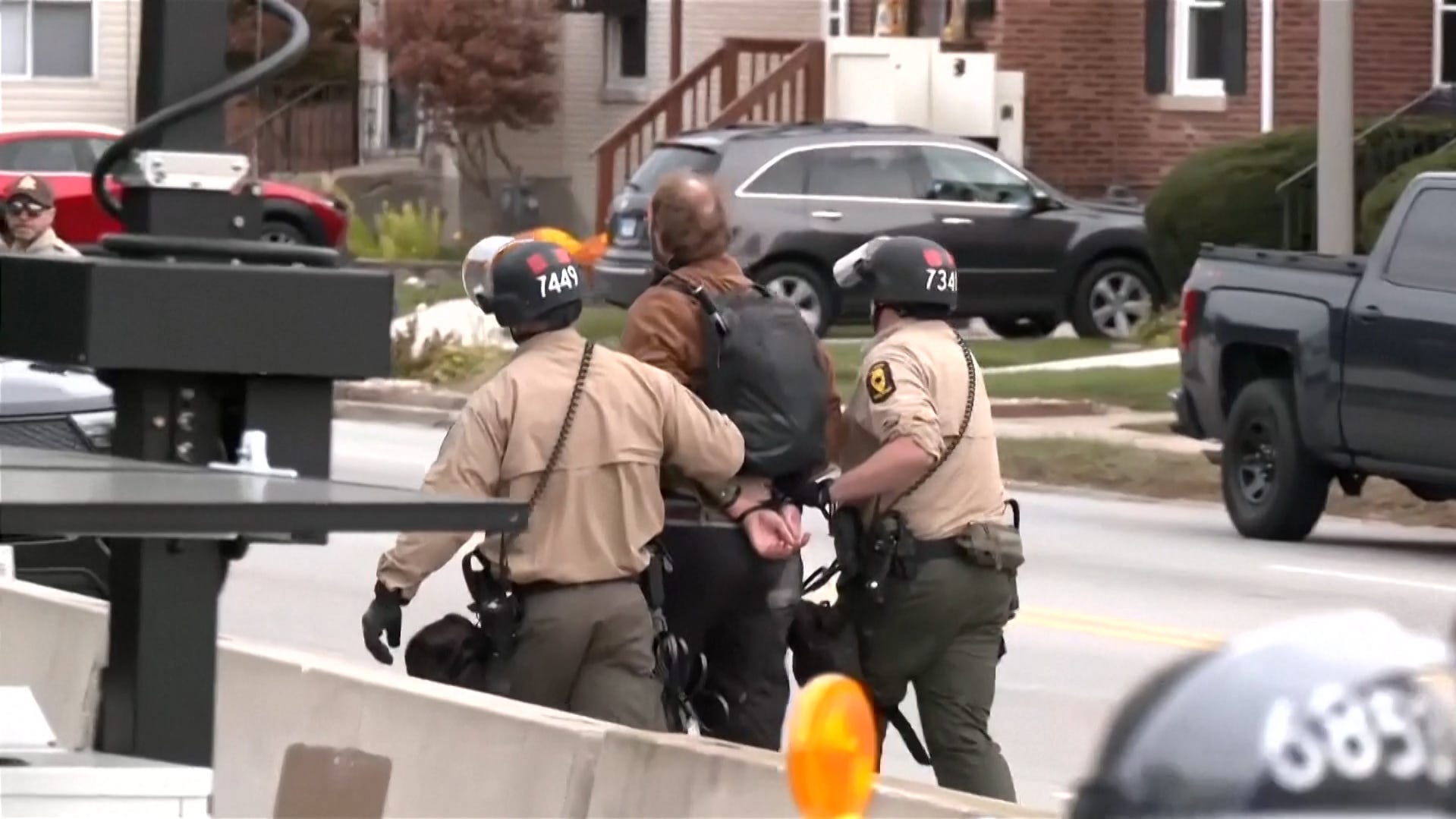

Anti-ICE protesters confront police in Chicago
One month has passed since the “Operation Midway Blitz,” and protesters are taking to the streets in Chicago to protest the Trump administration’s immigration policies.
- President Donald Trump’s “Operation Midway Blitz” immigration crackdown continues in Chicago despite legal challenges.
- A federal judge temporarily blocked the deployment of the National Guard to assist immigration officials.
- Another judge restricted the use of chemical weapons by federal agents and ordered them to wear body cameras.
President Donald Trump’s immigration crackdown is moving forward in Chicago, despite continued pushback on the ground and in the courts.
Operation Midway Blitz began on September 8, with the Department of Homeland Security saying it would target “the worst of the worst” among illegal aliens. They say they have arrested more than 1,500 people, but USA TODAY has not been able to independently confirm that number. Federal immigration authorities have followed people in cars during apartment raids, rappelled from helicopters and clashed with protesters at suburban properties.
President Trump had deployed the National Guard to assist immigration officials, but that, along with other DHS efforts, was challenged in court. What’s the latest on those cases? Here’s what you need to know.
Is the National Guard deployed to Chicago?
The U.S. Supreme Court is currently considering whether to allow President Trump to send troops to Chicago..
In early October, President Trump planned to send hundreds of Illinois and Texas National Guard troops to the Chicago area as part of Operation Blitz. His lawyers argued that agents cannot enforce federal law without the help of the military and that their backlash in Chicago amounted to a potential “insurrection.”
But in response to a lawsuit from the Illinois Attorney General’s Office, U.S. District Judge April M. Perry blocked the White House from sending troops. Perry questioned whether the Department of Homeland Security claims cited by White House lawyers in their arguments were “tied to reality.”
Trump’s lawyers appealed Perry’s ruling, but the U.S. 7th Circuit Court of Appeals upheld Perry’s ruling in a unanimous decision. But Trump’s lawyers appealed again, and the case is now before the Supreme Court. It is unclear when they will be able to govern.
Trump administration lawyers agreed to keep Perry’s order barring the deployment of the National Guard in place pending a Supreme Court ruling. The Chicago Sun-Times reports that legal experts say the White House’s proposal shows it believes the high court will rule in its favor.
DHS employees sued over chemical weapons use
A group of journalists, clergy, and protesters also filed a lawsuit against Department of Homeland Security officials over the use of chemical weapons against people in the Chicago area. At an Oct. 9 court hearing, Assistant Attorney General Eric Hamilton said federal agents deployed $100,000 in non-lethal weapons to stop “rioters” from interfering with immigration.
U.S. District Judge Sarah L. Ellis issued an order restricting agents’ use of chemical weapons in the Chicago area and forcing them to wear identification cards.
Concerned that immigration officials were not following his orders, Ellis amended his orders a week later, on October 16, to ensure officers were equipped with body-worn cameras. She also ordered top officials from the Department of Homeland Security to appear in court and testify.
Customs and Border Protection Incident Deputy Commander. Kyle Harvick and Immigration and Customs Enforcement Deputy Director Sean Byers told a judge on Oct. 20 that agents were acting on her order to issue a warning before using chemical weapons.
Local residents who have been tear gassed say they did not hear the warnings being issued. Harvick and Byers’ testimony came after Perry found the Department of Homeland Security’s account of events in the city unreliable in a separate case.
Mr. Harvick also justified federal agents shooting a local pastor with a pepper ball. A clip of the incident shows the Rev. David Black standing among a group of protesters when he is shot directly in the head by officers stationed on the roof of the building.
“What is not shown is that he was given multiple orders to move,” Harvick said.
Byers said 75 people were arrested in connection with attempts to thwart immigration enforcement in the Chicago area.
Next, Ellis authorized the removal of Gregory Bovino, the commander in chief of Customs and Border Protection, in connection with his instructions to agents. Bovino is the face of the Blitz. Among the actions he participated in were the raid on Little Village and the September 30 raid on the South Side Apartment Building, where he witnessed agents rappelling from a Black Hawk helicopter.
Lawsuits against protesters who don’t get the Trump administration’s way
People across the Chicago area filled the streets to protest President Trump’s immigration crackdown. In particular, the Department of Homeland Security’s detainee processing facility outside Broadview has been a hotbed of protests, with the attorney general pledging on September 29 that “violence against federal employees will not be tolerated.”
“The Department of Justice is deploying officers to secure ICE facilities, arrest violent instigators on the spot, and bring the strongest federal charges possible. The rule of law will prevail,” Bondi told X.
So far, the case has not gone the way the Trump administration had hoped.
On September 29, the U.S. Attorney’s Office announced charges against five people in connection with protests outside an immigration enforcement processing facility. Charges against four of them were dropped, and charges against 70-year-old Vietnam War-era veteran Dana Briggs were reduced to a misdemeanor.
The charges against Ray Collins, 31, and Jocelyn Robredo, 30, were dropped after a grand jury declined to return the indictment, which is unusual in the federal system. Federal officials initially touted the couple’s arrest as an example of the type of violence law enforcement faced. Both men were found to be in possession of guns at the time of their arrest. However, it turns out they were legally in possession of guns.
Chicago man accused of punching Border Patrol officer
Juan Espinoza Martinez, a native of Mexico, is accused of offering $10,000 to kill Bovino, the face of the Trump administration’s Chicago-area crackdown.
In a news release, the Department of Homeland Security shared a screenshot of an alleged Snapchat message sent by a 37-year-old man that offered $2,000 for information about Bovino and “$10,000 if we could take him down.”
Espinoza Martinez’s attorney said his client is innocent.
A jury trial in the case is scheduled to begin the week of January 20th.
Woman shot and killed by Border Patrol faces charges
Miramar Martinez and Anthony Ian Santos Ruiz are charged with assaulting a federal officer in connection with an incident dating back to Oct. 4. According to federal court filings, the two men were chasing Border Patrol agents in their car when they crashed into the agent’s vehicle in the Southwest Side neighborhood of Brighton Park.
Prosecutors said investigators fired five shots at Martinez in self-defense at the scene of the accident. At the Oct. 15 arraignment, the bandage from the wound could be seen peeking out of the orange jumpsuit Martinez wore to court.
Martinez’s lawyers have argued that federal agents attacked his client, and attorney Christopher Parente said during an Oct. 15 hearing that “we don’t think this is a complicated case.” “This was a traffic accident where one of the drivers got out and shot the other driver.”
A jury trial in the case is scheduled to begin on February 2nd.
Aldermen detained by federal agents files lawsuit
Aldo. Chicago City Councilman Jesse Fuentes filed a lawsuit against federal officials after he was briefly detained at a hospital in his jurisdiction. Mr. Fuentes asked the agents if they had a judicial warrant to arrest the suspects they were pursuing inside the facility.
The agents handcuffed her, took her outside and threatened to arrest her if she returned to the hospital, according to a copy of the complaint shared with USA TODAY.
Mr. Fuentes filed a lawsuit seeking $100,000 in damages under the Federal Tort Claims Act in response to the incident.
Legal experts say filing charges against federal officials can be extremely difficult. However, Federal Tort Claims Law suits hold the U.S. government responsible, rather than the officers individually, and are thought to have the potential to hold the officers liable.
Immigration officers come under intense scrutiny for warrantless arrests
Another case underway in federal court in Chicago concerns whether immigration officials have warrants for people they arrest in the area.
A 2022 lawsuit settlement agreement in the Northern District of Illinois limits how ICE officers can make arrests during traffic stops without a warrant.
In response to immigration crackdowns under the Trump administration, the plaintiffs in the case filed notices that immigration officials violated the settlement agreement.
A federal judge has already found that at least 22 people have been arrested by immigration officials in violation of the agreement, according to court filings. Mark Fleming, a lawyer involved in the case for the National Immigration Justice Center, said the judge allowed the people to be released and ordered the arresting officers to retrain.
Fleming said the plaintiffs in the case will continue to notify the court of potential further breaches of the agreement.
Kinsey Crowley is a Trump Connect reporter for the USA TODAY Network. Please contact kcrowley@gannett.com. Follow her on X and TikTok @kinseycrowley or Bluesky (@kinseycrowley.bsky.social).


