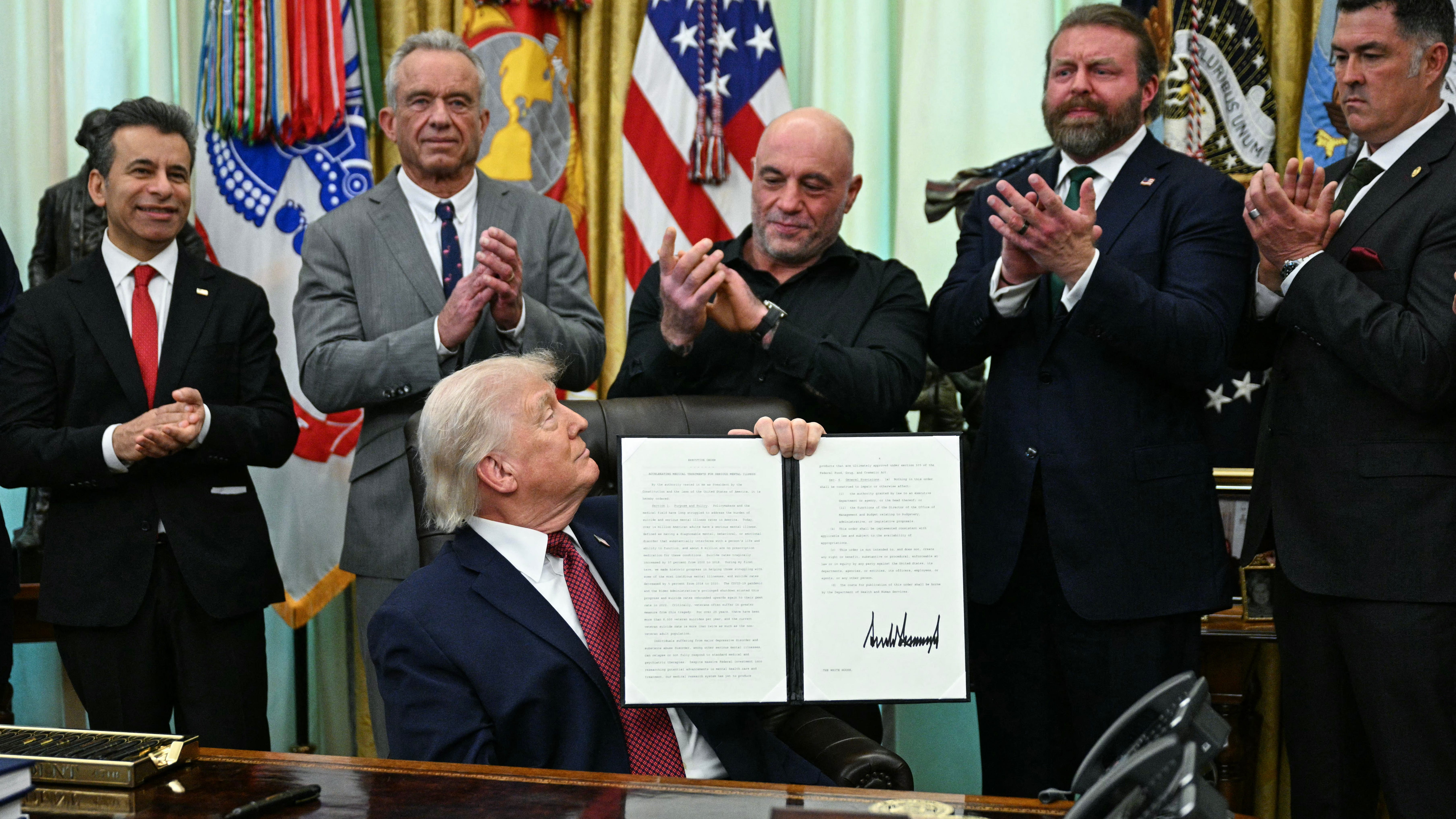

President Trump signs executive order on psychedelic drugs with Joe Rogan
Podcaster Joe Rogan accompanied President Trump in the Oval Office as he signed an executive order aimed at accelerating research into psychedelics.
Americans are turning to alcohol and drugs to soothe themselves after work, and many are self-medicating to get through the day.
Nearly two-thirds of workers report using alcohol, cannabis, or non-prescription drugs such as Xanax or Klonopin at the end of a shift in the past 12 months, according to a new report from workplace mental health platform Modern Health.
More than half (52%) said they had used these substances at work.
Using drugs to help with daily life is not a new phenomenon. If the caffeine boost of your morning coffee isn’t enough, energy drinks and nicotine pouches can help you stay alert and focus. Wall Street bankers rely on Adderall and other stimulants to boost productivity, while Silicon Valley executives have been known to microdose ketamine and use psychedelics to boost creativity.
But the study points to another type of drug use, caused by high rates of workplace stress and burnout. Younger workers in particular are always turning to self-medication to ease their anxiety, rather than relying on coping mechanisms such as exercise or connecting with friends and family.
More than half (51%) of Gen Z workers use THC while at work, but this percentage is only slightly lower than the 59% who use THC after work.
“What surprised me was the scale.”
Jessica Watrous, chief clinical officer at Modern Health, said the study delves into how people cope when daily stress becomes too much. She was not surprised that workers were seeking solace in alcohol and drugs.
“What struck me was the scale of it, especially the fact that so many people reported using drugs on the job,” Watrous told USA TODAY. “Our data records whether someone has used these substances at any point in the past 12 months, so it doesn’t necessarily mean daily or continuous use. But it is a worrying sign that many workers are turning to substance use to manage work stress, even if only as an incident.”
This is not the first time a study has revealed drug use in the workplace.
A Drug Rehabilitation USA survey released in March found that about half of respondents reported using drugs such as alcohol, marijuana or nicotine after work, and about 30% reported using drugs before starting work.
But dependence on cannabis or alcohol while on the job “is an indication that stress is impacting daily life and should be taken seriously,” Watrous said.
Short-term relief, but high risk
Using substances to manage difficult emotions and moments may provide short-term relief, but it doesn’t address the root causes of stress, she said.
“Over time, it can become difficult for people to develop more sustainable coping strategies or seek other effective support options before the problem becomes more complex,” Waltras said.
For younger workers who haven’t yet developed coping mechanisms, drug use can put them at risk for negative outcomes, Waltras said.
“It is also concerning that the boundaries of the work day are collapsing when it comes to THC use during and after work,” she said. “If this situation continues, it could quickly become normalized and a daily stress management method for this generation.”
What drives drug use? burnout syndrome, stress
Research shows that workers are struggling.
Recent data from Gallup shows that workers’ personal and professional conditions will be worse at the end of 2025 than at any point in the past three years.
For the first time since Gallup began tracking the life evaluations of U.S. workers, more workers report struggling in life (49%) than succeeding (46%).
Modern health research also found high rates of burnout.
Nearly half of workers said their job had had a negative impact on their mental health in the past year. Nearly 9 out of 10 employees say burnout reduces their productivity.
In the past 30 days, 51% of employees have cried due to work stress, an increase of 12 percentage points from 2025, and 52% have experienced anxiety or panic-like symptoms at work.
In addition to work pressure and financial insecurity, people are also dealing with fear that artificial intelligence will take their jobs, the report found.
Nearly 7 in 10 employees believe AI will cause layoffs at their company within three years. Almost half personally fear losing their job to AI, and AI ranks as one of the most serious stressors for individuals measured in surveys. Almost a quarter say fear is having a negative impact on their mental health today.
“What this survey shows is that many workers have more on their plate than they can manage,” Waltras said. “There are strong signs that the U.S. workforce is feeling stretched, burnt out, and unsupported. As a result, faster, more immediate relief is preferred, but the result is that it fails to address the underlying stress, potentially creating deeper and more costly problems downstream.”


