Twenty-seven states prohibit transgender girls and women from participating in girls’ school sports teams. Opinion polls show widespread support for suspending trans athletes.


President Trump and Republicans react to SCOTUS ruling on transgender women in sports
President Donald Trump reacted to the Supreme Court’s decision upholding a ban on transgender women playing on women’s sports teams.
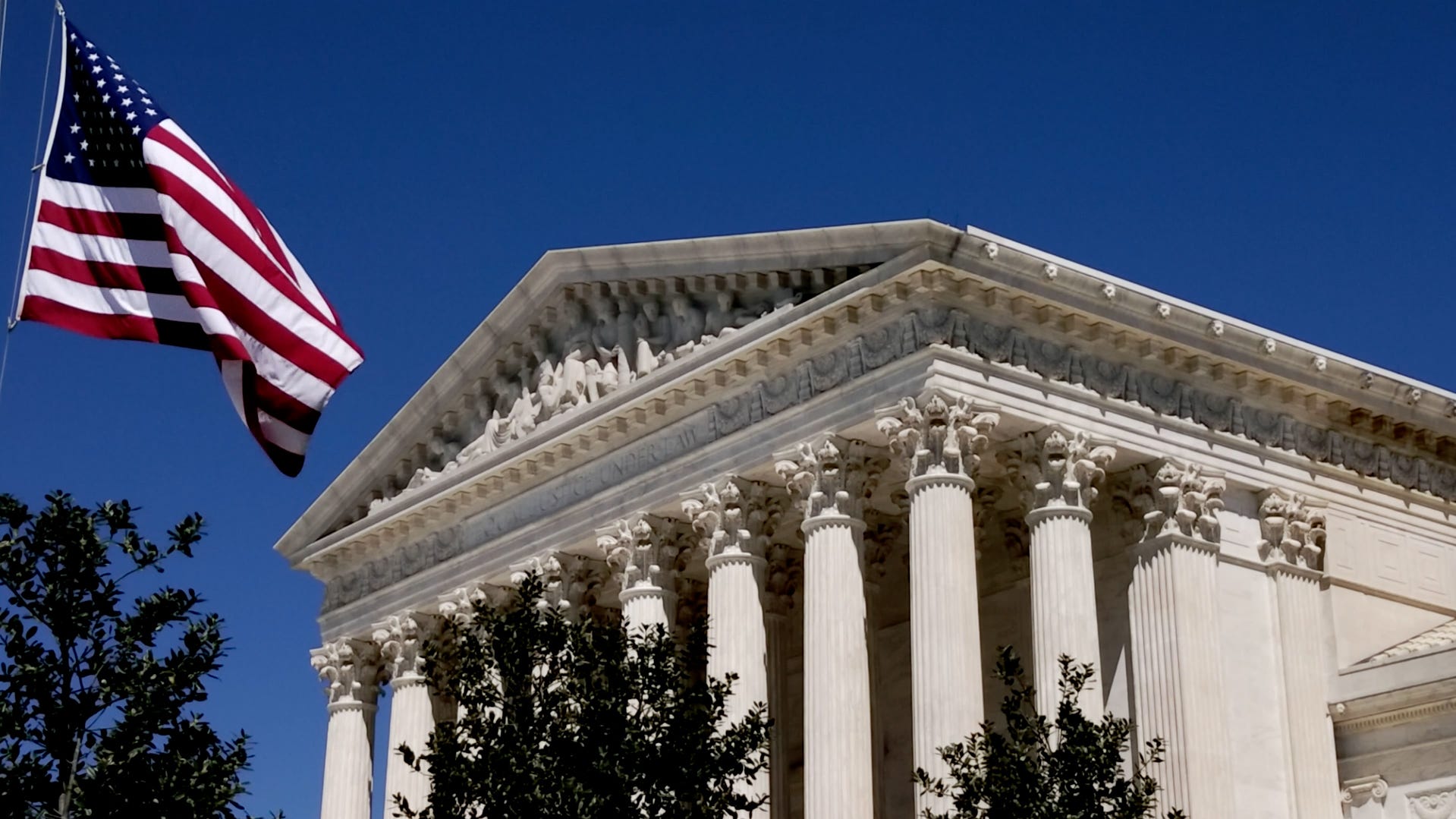
WASHINGTON – States can ban transgender women and girls from competing on women’s sports teams, the Supreme Court ruled June 30, addressing a major cultural and political flashpoint ahead of the summer recess.
The ruling marks the latest setback in a series of recent decisions the high court has handed down for the LGBTQ+ community that impact transgender Americans.
The court said West Virginia and Idaho’s bans on transgender female athletes do not violate the Constitution or federal law prohibiting sex discrimination in education.
Justice Brett Kavanaugh, writing for the majority, said schools “may determine women’s and girls’ eligibility to participate in sports based on their biological sex.”
“It makes sense to separate sports teams between biological males and biological females,” he wrote.
Justice Sonia Sotomayor, in a partial dissent joined by two liberal colleagues, said she would have given students challenging West Virginia’s law an opportunity to show that the ban should not apply to them.
“The vast majority who choose not to do so express great sympathy for the people they support: young cisgender girls and women in sports,” she wrote. “However, I respectfully disagree because the majority is inflicting hardship on those who are against it by denying them the fair and full opportunity to litigate that the Constitution requires.”
West Virginia Attorney General J.B. McCaskey called the decision “a monumental victory for every female athlete who has ever competed or dreamed of competing on a fair and safe playing field.”
“This landmark victory will give not only West Virginia, but all states, the clarity and confidence to ensure equity and safety for female athletes today and for generations to come,” McCaskey said in a statement.
Twenty-seven states have passed similar bans, saying they seek to ensure equity and address safety concerns for non-transgender women.
Transgender students who challenged the law said hormone therapy and other treatments eroded the physiological benefits of being born male. Therefore, they said, the law should not apply to them.
Students also looked forward to a landmark 2020 Supreme Court ruling protecting transgender employees from workplace discrimination.
But since the conservative court’s unexpected 6-3 ruling, justices have increasingly ruled against transgender Americans. This includes a 2025 decision that states can ban gender-affirming care for transgender minors.
President Trump supports state ban
The court’s latest ruling, one of the most anticipated of this term, comes amid President Donald Trump’s broader efforts to target transgender people.
Trump has made opposition to transgender women’s participation on women’s teams a centerpiece of his 2024 campaign, and as president he has moved to cut federal funding to schools that allow transgender women to participate in women’s sports and women’s sports.
The Department of Justice helped West Virginia and Idaho defend their bans in the Supreme Court.
Separately, the administration is seeking to block states from allowing transgender girls to play on women’s teams, but the Justice Department asked the court to rule only that the ban is allowed at this time, not to get into whether it is necessary.
Lower courts sided with trans athletes.
Boise State University student Lindsey Hecox tried to abandon her challenge to the Idaho law before the high court considered it, given the intense public attention and growing criticism of transgender athletes.
Two appeals courts sided with transgender students early in the case, blocking the law from going into effect as challenges continued.
Hecox said that because her testosterone was suppressed and she was taking estrogen, her testosterone levels were typical of a non-transgender woman, and her muscle mass and size (which may have been in her favor) were both reduced.
Are the laws “overreacting”?
Hecox’s attorney said he played soccer and ran on his school’s club team before retiring from sports this year. Her transition was to the “uncut” sport. She said she wasn’t fast enough to join the NCAA cross country and track teams.
“I think it’s an important time to step back and ask, ‘Is this law actually addressing the problem in a reasonable way, or are we overreacting to the assumption that transgender women are absolutely going to be strong athletes?'” Hecox’s attorney, Kathleen Hartnett, told the court.
He argued that a workaround to an outright ban could require students like Hecox to have their testosterone levels tested, but an attorney for Idaho said states don’t need to make such considerations.
“Idaho’s law is substantially compatible with 99 percent of men, and it does not have to be completely compatible,” Idaho Attorney General Alan Hurst said in court.
West Virginia students block male puberty
Becky Pepper Jackson began challenging West Virginia’s law when she entered middle school and is taking puberty-delaying drugs and estrogen.
Still, West Virginia maintained its physical advantage, with Pepper Jackson placing third in last year’s state discus throwing tournament and eighth in shooting when she was a freshman in high school.
Pepper Jackson attributed her athletic achievements to hard work and practice and said her grades were “within the range” of non-transgender girls her age.
Her lawyers argued that the judges should send the case back to federal district court for a trial to determine whether she has an advantage over her teammates and rivals who were identified as female at birth.
“Then the facts will be in front of you, and maybe the problem will be resolved,” Joshua Bullock, an American Civil Liberties Union attorney who is representing Pepper Jackson, said during oral arguments. “You know, I don’t think it’s necessary to intervene in this case with sweeping legal conclusions about what may actually be a narrow factual dispute.”
Michael Williams, a West Virginia attorney, countered that the primary responsibility for weighing evidence in “evolving areas of science and medicine, particularly those involving children,” and making policy decisions rests with state legislatures, not courts.
Opinion poll shows support for banning trans athletes
Opinion polls show widespread public support for requiring transgender athletes to compete on teams that match the gender assigned to them at birth.
Idaho and West Virginia have said transgender athletes’ participation in women’s sports is a serious issue, but advocates say the scope of the controversy is blown out of proportion.
SCOTUS hears arguments in transgender sports lawsuit
Transgender students in Idaho and West Virginia are challenging state regulations that ban transgender women from participating in women’s sports.
For example, Pepper Jackson was the only transgender student in West Virginia who asked to join the women’s team.
Her lawyer, Mr Bullock, called the court’s decision “heartbreaking”.
“The reality is that equality for transgender women and girls does nothing to take away from equality for all women and girls; in fact, it advances it,” Block said in a statement.
Kavanaugh, who coached his daughters in basketball, said during oral argument that he disliked the idea that even if they wanted to play sports, they might not be able to. But if a transgender girl were to join a team or a starting lineup, he said, she would run into conflict with someone else.
“And I don’t think it can be wiped away,” Kavanaugh added.
Kavanaugh emphasized that point in his opinion, but also called for respect for transgender athletes, who are at the center of national debate.
“Student-athletes want to play sports, and their desire to compete deserves to be respected,” he wrote. “No student-athlete on either side of this issue, whether biologically female or transgender, should be ostracized or vilified.”
There are no clear statistics on the number of students affected by the ban.
In 2024, NCAA President Charlie Baker told a Senate committee that he was aware of fewer than 10 transgender athletes participating in college sports across U.S. campuses.
The Williams Institute at UCLA School of Law, a think tank that studies sexual orientation and gender identity, estimates that as many as 122,000 transgender youth may be participating in team competitions at the high school level. At the college level, fewer than 1.5% of student-athletes are likely transgender, according to the institute.


