
As childcare costs soar and offices reopen, women are paying the price.
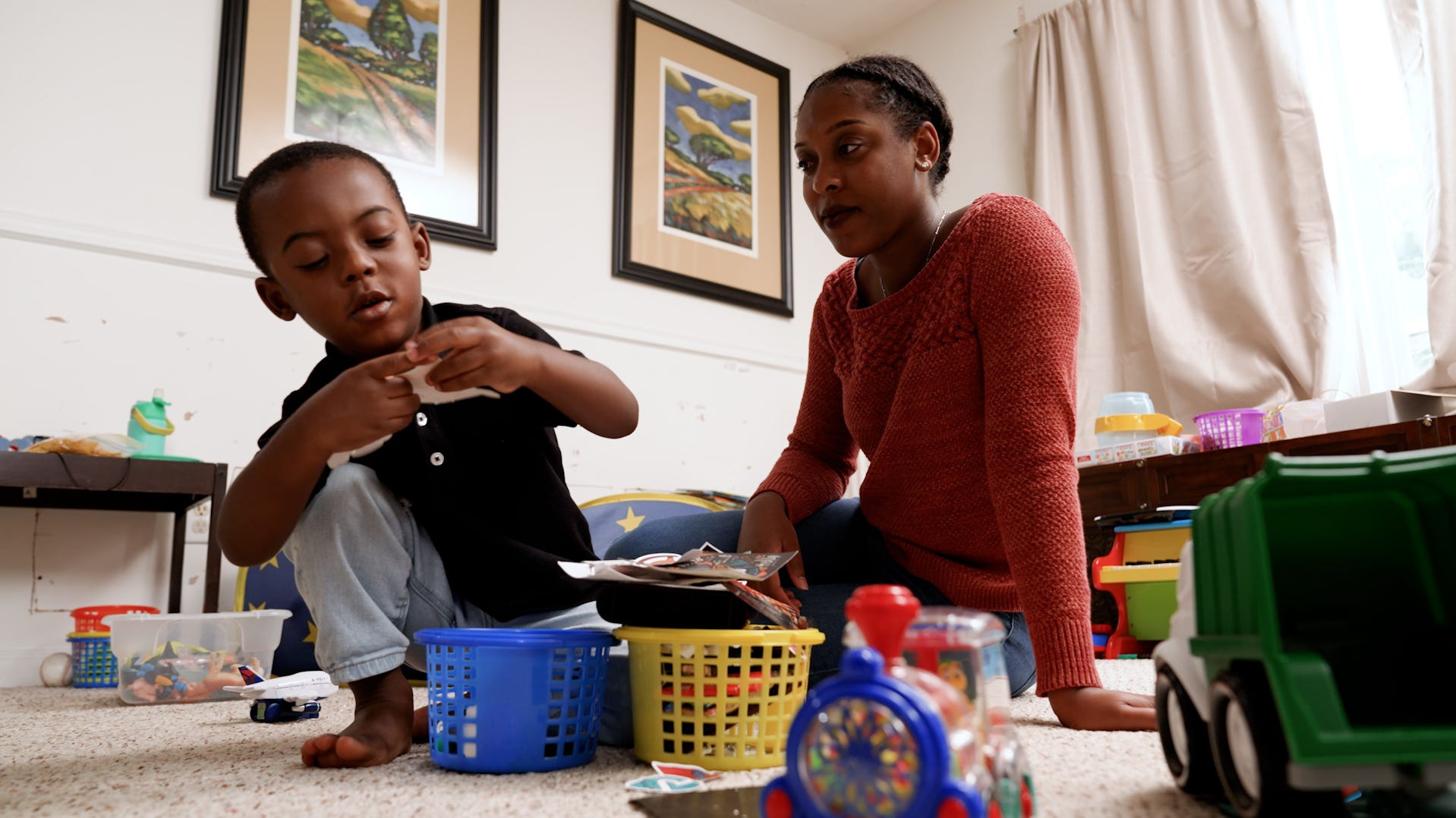
Miya Walker, a mother of a 3-year-old in Georgia, said childcare costs and the obligation to return to work forced her to become a stay-at-home mom.
As Becky Kennedy began her keynote address at the Mom 2.0 Summit on April 17, women in pink pantsuits and floral ankle-length skirts dropped spoons into Chobani yogurt boxes and opened their cell phone cameras.
Kennedy, a clinical psychologist and mother of three, needed no introduction to this crowd of mothers, nursing brand executives, and parenting influencers gathered in Austin, Texas, to discuss all things content creation, business building, and motherhood. Kennedy’s parenting platform, The Good Inside, has more than 100,000 paying users, and her Instagram page has 3.4 million followers. If you’re a parent of children between the ages of 2 and 8, you probably know “Dr. Becky.” She has recently branched out into the realm of preteen, teen, and baby parenting, gaining even more fans.
Kennedy, wearing a baby pink cardigan and silky skirt, turned to the audience and said something many parents think but few say out loud. “Being a parent is very inconvenient.”
She talked about the illusory and unhelpful idea of ”perfect parents” (there is no such thing, she pointed out) and said she doesn’t really care about being liked, even though she has millions of followers and posts every day.
The room was paying attention to her every word.
While some may not take the influencer world seriously, there’s no denying that many moms in this industry are making a lot of money speaking online. These are career women who are also authors, business owners, podcasters, and brand marketing experts. they are knowledgeable. They use their skills to build careers, in some cases earning much more than their partners, and are the main breadwinners in their households.
Monica Favara, 43, is a former financial executive who came to the summit looking for inspiration. Before leaving the corporate world three years ago, she said she judged content creators to be dishonest and “full of themselves.” Now, she’s learning from them and growing her own business and personal brand.
“Everything that I used to criticize, I’m now like, ‘Wow, that’s amazing,'” Favara said. “My way of thinking has definitely changed.”
These mothers are reclaiming the image of modern motherhood
The corporate world isn’t always kind to modern mothers. Favara said that while working in the financial industry, her son’s appendix burst and he missed several meetings. One day her boss called her and said, “Monica, kids are no excuse.” Another Mom 2.0 mother, Thilmin Gee, said her request to reschedule the meeting once so she could breastfeed her twins was denied. She didn’t boycott the meeting, but told her boss, “I’m not on camera and I’m feeding the kids.” She quickly quit that job and recently launched a travel startup, which she posts about online.
Podcaster Tara Clark, who has 778,000 followers on Instagram, said she saw the influencer industry coming from a mile away. She had been a stay-at-home mom for about three years when Instagram started gaining traction.
“I told my friends and family, ‘I’m going to start an Instagram page about parenting and monetize it,'” she said. That was in 2016. At first they didn’t understand her, but within a year and a half her account “exploded.” She has been featured in local magazines, written a book, and started a podcast in 2022. I earn over $100,000 a year. “I kind of felt it,” she said.
Mom influencers are also responsible for using their viral platforms to reshape the image of motherhood and shine a spotlight on once-taboo topics like miscarriage, postpartum depression, and mom guilt.
“We’re talking about serious issues like maternal mental health and pregnancy loss,” Clark said. “Thanks to social media, we can control our time, control our money, and build lives where we can share our stories. In doing so, we help other women validate their feelings.”
Most mothers at the conference eschewed the label “influencer” in favor of “content creator.” The difference, Clark said, mainly has to do with transparency.
“Trad wives make everything look so easy,” Clark said, adding that some of these women have a lot of help behind the scenes. She said the creators of Mom 2.0 are honest about their experiences with motherhood and the money they make from their content.
A maternal sisterhood or a battle over brand deals?
The night before the keynote, Kennedy hosted a special gathering on Airbnb as part of his partnership with the company. It was located in Old Enfield, one of Austin’s historic neighborhoods on the west side of town. Guests including Paige Connell, Suzanne White and Dr. Caris Chambers were welcomed with an open bar, a live pianist and singer, and an elegant pale pink bouquet centerpiece set on a long table.
Throughout the evening, Kennedy encouraged guests to share stories from their early years as mothers and the guidance they wish they had received as new moms. Some women spoke emotionally about the incredible anger they felt as new mothers, the loneliness they felt in the early days, and what Kennedy described as the “four o’clock fear.” As a new mom, I realized there was so much time left in the day and I was worried about how my baby would sleep at night.
It was the kind of event that most of the Mom 2.0 attendees wanted to be a part of. Instead, most conference attendees returned to the conference hotel to drink cocktails at the summit’s official happy hour, exchange Instagram handles, practice elevator pitches, and build the connections and confidence needed to pursue content creation full-time.
Several content creators on Mom 2.0 claimed that there is no strong sense of competition among women in the industry. But brands have a limited amount of money to spend, says marketing strategist Mariam Shahab. The Mom 2.0 floor featured dozens of brand stands looking to sign up content creators to promote strollers, children’s snacks, and juice boxes.
Shahab said the industry is unregulated, so there are disparities in who gets paid and how much. Some creators of color say they don’t feel like they have the same opportunities as white creators. Some say they’ve seen brands shy away from creators who talk about controversial topics.
“There’s a difference in motherhood when it comes to white mothers and black mothers,” content creator Kendall Williams said during a panel discussion on authenticity. “The truth is that some white women don’t have to worry about their children leaving the house at night, or being stopped by the police during the day and maybe being killed, or being racially characterized. I’m not saying that’s always the case, but we have to be realistic about travel.”
Mothers find real community online
There are many moms in the industry who don’t have a corporate background. Emily Ferre, who has 1.3 million followers on TikTok, stumbled into the world of Momfulness while searching for a community as a new mom.
“I was looking at these beautiful marble countertops and kids and people dancing in slow motion, and I thought, ‘Oh, no. That’s not what my life looks like,'” she told the authenticity panel.
Ferret said he had been posting “silly little videos” for about six years, and for three of those years was earning a full-time income. Last year, her income exceeded her husband’s salary for the first time, Ferre told USA TODAY. She plans to publish her book in the fall.
Cindy Hoffer echoed Ferret and Williams’ sentiments during the panel discussion.
“I was a stay-at-home mom, lonely at home, and I was on the internet, but I felt like there was no one who looked like me,” she said. “I was a plus-size mom and a bit of a dirty person. My early motherhood was very sad.”
Hoffer said she started posting after looking for other mothers who could relate but couldn’t find any. People responded. “The internet saved me,” she said. At this point, she said, she was also earning enough to “retire my husband.”
Despite being a multi-billion dollar industry, content creators at the conference told USA TODAY they often face disdain from friends, family and commenters who don’t see value in their videos. But those closest to them see the effort they put into their business.
Kelsey Pomeroy once heard her husband bragging about her to an engineering colleague.
At the time, “I wasn’t making much money,” she said. But when a colleague asked her husband about Pomeroy’s work, he told her about her videos. “And he said, ‘Honestly, if we’re ever going to be rich, it’s because of her.'”
Madeline Mitchell’s role covering women and the care economy for USA TODAY is supported by a partnership with Pivotal and Journalism Funding Partners. Funders do not provide editorial input.
Contact Madeline at: memitchell@usatoday.com and @maddiemitch_ With X.


