Home Blog Page 556

Military families expected to receive paychecks amid government shutdown

0


Payday was a nerve-wracking event for military families in this heavily militarized region.

play

NORFOLK, Va. – As the sun set on Oct. 15, military families in Hampton Roads, Virginia, looked at their bank accounts with increasing anxiety.

On that day, active-duty military personnel were scheduled to receive their mid-month paycheck. But as the government shutdown continued, military families grappled with difficult financial decisions and wondered how they would make ends meet if their pay was stripped 200 miles away in Washington, D.C. due to unresolved congressional disagreements.

“It’s literally like counting down the clock,” said Sharyn Pugh, 33, whose spouse is in the Navy. “You’re checking the news, you’re checking posts, you’re checking to see if anyone has any updates on whether or not they’re actually waiting for a paycheck.”

Most bimonthly service members received their paychecks on Oct. 1, the day Congressional Democrats rejected a Republican plan to keep the government funded and the government shutdown began.

But at the start of the week, mid-month salaries due on the 15th remained uncertain.

“It’s nerve-wracking,” Air Force Reserve officer Angela Sales said.

On the morning of Oct. 15, some active-duty military members told USA TODAY their checks had gone through. Some said they were still confused about their salary situation. Some reservists and non-military Pentagon civilians said they knew they would not be paid, even though they are required to report to work for jobs deemed essential to national security.

That afternoon, President Donald Trump said all active-duty military members would receive pay. “We want the people who want to get paid to get paid, and we want the FBI and the military to get paid,” he said.

The military’s next paycheck, due in two weeks, is still pending. Republican House Speaker Mike Johnson said President Trump’s directive to pay military personnel on October 15 is “not permanent.” If the shutdown continues, “we know that our military members are at risk of not receiving their full paycheck at the end of this month,” he added.

Stress builds up at Naval Base Norfolk before payday

Hampton Roads includes a group of cities that span the Chesapeake Bay, including Newport News, Hampton, Norfolk, Portsmouth, and Virginia Beach. It is home to more than 51,000 federal employees and 88,000 active-duty military personnel, many of whom are stationed at Naval Base Norfolk, the nation’s largest naval base.

On Oct. 13, a federal holiday, families flocked to the Navy Exchange shopping center on base, where military IDs were required. Families and couples loaded up carts with canned goods and snacks and compared fabrics for clothing. Many had small children in tow or strollers filled with blankets and toys.

One of them, Ms. Pugh, was pushing her daughter in a stroller as she browsed the store aisles. Her spouse plans to return to the family in the next few weeks after attending an educational program on the other side of the country. Alone in Norfolk and with three children at home, Pugh anxiously watched her approaching payday.

“You can’t predict when your car will break down or you’ll need a new washer or dryer,” she says. “That money can make or break us.”

She was considering taking on additional jobs such as cleaning or babysitting. She says the $10 or $15 surcharge that was once just “change” now adds up. “Every penny must be accounted for,” she said.

In the shopping center cafeteria, Angela Sales and Jeremias Sales, 48, and their two children, ages 17 and 12, were crammed into two shared Styrofoam containers containing lo mein noodles and chicken.

“We hardly ever eat out,” said Angela Sales, an Air Force reservist. Sales said she has already lost her paycheck. She still hasn’t received a check for five days of work last month, which included traveling across state lines to another military base.

“It’s hard when it’s an unknown,” she said. “That’s half our income.”

Stress is already affecting children. Sales’ teenage daughter said she worries the family won’t be able to afford a trip to New York for the track team’s national championships, as well as a long-awaited vacation to Oregon to celebrate graduation with her high school seniors.

Sales said families will likely make the difficult financial decision to tap into their military retirement savings. “It’s our last resort,” she said.

Economic sacrifice, looming dilemma

Military families in Norfolk say the government shutdown has made their financial choices riskier, from comparison shopping for the cheapest toilet paper to frequenting Costco to buy in bulk.

For some, these choices were particularly acute. Kevin Henderson, a civilian with the Pentagon, was scheduled to undergo neck surgery in early November. As an employee deemed essential to national security, he was working without pay. Financial constraints may force you to postpone the procedure and instead take up a side job as an electrician.

“That’s out of my control,” Henderson said.

“I’m trying to be optimistic,” said his wife, Heather, as she placed a baby bottle between the couple’s unwrapped sandwiches and bounced their young granddaughter on her lap. The couple has one son, who is still 12 years old, at home. One of his adult sons, a Coast Guardsman stationed in Portsmouth, was watching his mid-month payday approach.

“I could never have imagined having to go through this when all three of my sons were at home,” she said.

Heather Henderson, a hair salon owner, said she worries the economic fallout from the closures in military-heavy Hampton Roads will ultimately hurt her industry.

“I just hope it doesn’t affect my job, but it probably will eventually,” she said. “Hair is not a necessity.”

Troubled soldiers turn to their communities

Food banks are reportedly proliferating across the United States as both military personnel and government workers face insecurity. In Norfolk, food banks have announced new distribution efforts and community support events.

Lena Hobbs, 34, said her church is working with other local organizations to extend support to military personnel in dire situations.

“All you can do is rely on the community,” she says.

Hobbs said a loan from the Navy federal government has helped her maintain her family, including her husband, who served in the Navy for 15 years, and two children, ages 9 and 6. Other military members said that loans from credit unions, which offer interest-free loans during the government shutdown, are standing between them and their financial struggles.

Hobbs said that while the government shutdown may have upset her at the beginning of her marriage, she now knows it’s time to prepare and increase her savings.

“You get used to it,” she said. “It’s not a question of ‘if’ it happens, but ‘when’.”

Many Norfolk military personnel and their families expressed their frustration to lawmakers. Many speculate that if politicians are denied paychecks, the government shutdown will end quickly. According to the U.S. Constitution, members of Congress continue to receive paychecks even during the shutdown.

“The people making these decisions aren’t losing out financially. They’re still getting paid,” Heather Henderson said. “If they were affected financially by this…maybe decisions would be made sooner.”

Hobbs added: “It’s a little disgusting that our politicians are playing games with other people’s paychecks instead of their own.”

The AI ​​bubble may become a reality. Is it time to exchange stocks for cash?

0

play

The stock market is soaring. Some analysts say it’s too expensive.

Many Wall Street observers are warning that the stock market may be entering “bubble” territory. This is similar to the overvalued markets of 2008 and 1999, when the bubble burst and the market crashed.

When investors fear a decline in stock prices, their thoughts may turn to taking money out of the market and putting it in cash, such as money market funds, Treasury bills, or even regular savings accounts. The see-saw phenomenon of stock prices fuels their ennui.

“Many of my clients have been calling me in a panic this week,” said Monica Dwyer, a certified financial planner in West Chester, Ohio.

For long-term retirement savers, withdrawing money from the stock market is not a decision to be taken lightly.

Is now the time to collect a lot of cash? We’ll get to that question in a moment. But first, let me explain why I ask this question.

Stock prices are breaking records. Is it too expensive?

In 2025, stock indexes are breaking records. This is not unusual. The stock market tends to rise.

What’s unusual, economists say, is the historically high ratio of stock prices to corporate profits.

The price-to-earnings ratio indicates whether a stock is overvalued or undervalued. The cyclically adjusted price-to-earnings ratio (CAPE), a common measure, is 39.65 for the S&P 500.

In fact, the last time it was this high was during the peak of the dot-com bubble in 1999-2000. The CAPE ratio also spiked in 1929, just before the Great Depression.

Are we in a stock market bubble?

Are we in a new bubble? Will the market crash? The answers to these questions depend on who you ask.

Federal Reserve Chairman Jerome Powell warned in a recent speech that stocks are “pretty overvalued.” Chairman Powell told a large audience that stock prices were too high.

“There are a lot of assets that look like they’re entering bubble territory,” JPMorgan Chase CEO Jamie Dimon told reporters in a market commentary on Oct. 14.

Every day or two, another op-ed or financial headline reminds us that we may be living in a new bubble, fueled by unrealistic expectations about the profitability of AI. Other experts disagree, arguing that companies are profitable and the market is fundamentally healthy.

AI and big tech have been driving the big stock gains over the past decade. According to The Motley Fool, The Magnificent Seven’s total return from 2015 to 2024 was 698%. At the time, the overall S&P 500 returned a relatively low 178%.

Analysts say if we were in a bubble, these stocks helped inflate it.

Many investors are already turning to cash. Money market funds held a record $7.7 trillion in assets in September, the Wall Street Journal reported.

Money market funds are generating higher returns than in the past. Some investors are content to stay on the sidelines, as the stock may be overvalued.

But that doesn’t mean everyday investors should cash out their stocks and cash every dollar.

The dangers of timing the market

This is the theory. If you exit a “bubble” market at a high price, you can wait until the market falls and then put your money back into stocks to buy on the edge.

It definitely sounds like it. But investment experts warn that timing is difficult.

“When you’re trying to avoid a recession, the risk of making a mistake is very high,” says Peter Lazarov, a certified financial planner in St. Louis. “And you have to get it right twice.”

As Lazarov explains, you have to make two decisions: when to sell high and when to buy low. That requirement is more difficult than you might think.

Sell ​​high? A market can close at a record high one day and set a new record the next day. You won’t know until the peak has passed.

Buy cheap? Due to the Great Recession, the Dow lost more than half of its value from 2007 to 2009. If we had bought back sometime in 2008, we would have missed the bottom.

“The problem is, we’ve seen over and over again that it’s very difficult to implement that kind of approach in practice,” said Amy Arnott, portfolio strategist at Morningstar. “You end up missing out on some profits.”

Cash reserves help you “buy cheap”

But there’s nothing stopping you from having cash on hand to protect against stock market booms.

Financial advisors regularly tell older clients to reduce their stock holdings as they approach retirement. The idea is to protect yourself from the market’s inherent volatility and ensure you have enough cash to cover your expenses during economic downturns.

“Right now, I tell my clients to shore up their cash. You don’t want to take out your portfolio when it’s down, just in case you need something,” said Zaneilia Harris, a certified financial planner in Washington, D.C.

Harris said younger investors and those saving for retirement may consider setting aside cash, even if it’s only a fraction of their investable amount.

If the stock price falls, anyone with cash has the opportunity to buy the stock at a discount.

“If you don’t have cash to put into the market when the market is down, you’re missing out,” Dwyer said.

If the market declines, even cash-strapped investors may take advantage of sale-priced stocks.

“If you don’t have cash on hand and you see a significant market decline, increase your 401(k) contributions by 1 to 2 percentage points,” Dwyer said. “You probably won’t even notice it.”

Higher 401(k) contributions mean you can earn more discounted stocks during a recession. This is another way to buy cheaply.

Is the government still closed? Here’s what we know Thursday.

0

play

The partial federal government shutdown is in its 16th day as of Thursday, October 16, as Democrats and Republicans continue to spar in Congress over a budget impasse. Republicans hold majorities in both chambers, but they need at least seven Democratic votes to pass the funding bill in the Senate, where Democrats favor extending health insurance subsidies.

Democratic leaders say they will not bow to President Donald Trump’s pressure tactics, including mass layoffs, and on Wednesday, the Senate voted for the ninth time against a Republican funding bill aimed at reopening the government. The Senate is scheduled to vote again Thursday at 11 a.m. ET.

Is the federal government still closed?

Yes, the federal government has remained largely shut down since shortly after midnight on October 1st.

More than 750,000 federal employees have been furloughed and ordered not to report to work. Personnel deemed essential to public safety, including military personnel, law enforcement officers, border patrol agents and air traffic controllers, are required to work regardless. President Trump signed an executive order on October 15 directing the Department of Defense to preserve pay for active duty military personnel despite the government shutdown, but this does not apply to other federal employees.

What do Democrats and Republicans want from reopening the government?

Democrats want to secure tax cuts for the 24 million Americans who get insurance through the Affordable Care Act (known as Obamacare) and refuse to support government spending bills that do not address the issue.

Senate Democrats want to make the tax cuts, which are set to expire at the end of the year, permanent and provide reassurance to prevent the Trump administration from temporarily withholding funds.

Republicans and the president have said they are open to considering fixes to the expiring ACA tax cuts, but want the issue to be addressed separately from the ongoing budget impasse. Republicans also argue that the Democratic proposal could pay some of the health insurance premiums of undocumented immigrants. That’s not true, according to the nonpartisan Congressional Budget Office.

What about Social Security, Medicare, and Medicaid?

According to the Social Security Administration’s closure plan, the agency will continue to provide retirement and disability benefits, but will furlough 12% of its employees and suspend marketing campaigns.

Payments will continue under the Medicare and Medicaid health care programs as well.

Will American mail be delivered?

The USPS said in a statement that it is open because the U.S. Postal Service is not dependent on Congress for funding.

What about the airport?

More than 13,000 air traffic controllers and about 50,000 Transportation Security Administration employees will still be required to report to work during the shutdown.

Will food assistance continue under SNAP and WIC?

The U.S. Department of Agriculture says the Supplemental Nutrition Assistance Program (SNAP), the nation’s largest food assistance program, and the Special Supplemental Nutrition Program for Women, Infants, and Children, known as WIC, will continue to operate as funds allow.

But the federal agency warned that if the shutdown doesn’t end, there won’t be enough money to pay all of November’s SNAP benefits.

State health officials across the country, including North Carolina, Wisconsin and Minnesota, have begun warning recipients that they may run out of money for November.

What does the military shutdown mean for the military?

President Trump signed an order on October 15 directing the Department of Defense to ensure active duty military personnel are paid despite the federal government shutdown.

As of Oct. 15, 1.3 million active-duty military personnel received paychecks, but about 55% of the Pentagon’s 740,000 civilian workforce has been furloughed, including employees in training, acquisition, and administrative support. Civilians in cybersecurity, medical care, weapons systems maintenance, intelligence, and logistics are still working and are not included in President Trump’s pay order for active-duty employees.

The National Guard, which President Trump deployed to American cities, must also remain active.

What about Homeland Security, Immigration and Border Patrol agents?

Only 5% of the Department of Homeland Security’s 271,000 employees are furloughed, including those involved in research, planning, training and auditing.

Secret Service agents, immigration and border officials, airport security screeners, Coast Guard personnel and Federal Emergency Management Agency emergency personnel remain on the job. Still, not all will be paid in a timely manner, and only those roles covered by the president’s executive order will be paid.

The shutdown is the 15th since 1981 and is expected to be the fourth longest in U.S. history, surpassing the 12-day shutdown in 1977 under President Jimmy Carter. The longest shutdown lasted 35 days during President Trump’s first term in 2018-2019.

Contributors: USA TODAY’s Natalie Alland, Zach Anderson, Joey Garrison, Bert Jansen, Melina Khan, Sudiksha Kochi, Zachery Shermere, Saman Shafiq, Mary Walrath-Holdridge and Sarah D. Wyer. Reuters

Blue Jays’ Vlad Jr. and Andres Jimenez win ALCS vs. Mariners

0

play

How much of an impact can a 6-foot, 245-pound slugger have on a playoff series?

We’re about to find out that Vladimir Guerrero Jr. is participating in the American League Championship Series.

Vladi was an even chance destroyer in Game 3. He nearly punched a hole in the left-field fence with a crucial double, then a tuck-on home run that eluded the pounce of center fielder Julio Rodriguez, cracking a hole in right-center for what would have been a triple and a playoff cycle.

Vladi was a prophet, pulling away from No. 9 hitter Andres Jimenez before the game and telling the light-hitting shortstop, “You’re going to the yards today.”

“I told him to try and pull the ball,” Guerrero said in a postgame interview on Fox Sports about his conversation with Jimenez before he hit the game-tying two-run homer. “Thank God he listened to me. I’m going to the garden today.”

And perhaps most importantly, Vladi has proven himself to be a postseason monster.

He entered the game 0-for-7 in the ALCS and 0-for-2 with the Blue Jays, leading to a must-win game against Mariners right-hander George Kirby.

Guerrero had four hits, reaching just three short of the cycle, then outscored Seattle, 13-4, to end in much better shape.

Guerrero is currently 13-for-28 (.464 batting average), with four home runs, 10 RBIs, and just one strikeout this postseason. And the Blue Jays now lead this ALCS by just 2-1 thanks to one swing and one superstar.

“Oh, that was a big swing by Andres,” Blue Jays manager John Schneider said of Jimenez’s game-tying two-run hit in the third inning.

Oh, that was so reversed:

With this score, the Mariners defeated the Blue Jays again with a two-run home run by Julio Rodriguez, taking a 2-0 lead and a 3-0 lead against the ALCS in sight.

The Blue Jays’ offense was sluggish, with only eight hits in 61 at bats and no extra-base hits in Games 1 and 2.

The atmosphere, to say the least.

After Jimenez’s outburst started a five-run outburst, Toronto suddenly became unstoppable and the rally resumed as Guerrero hit a 165 mph liner into the left-field wall, a wild pitch and Dalton Varsho’s two-run double to eventually extend the lead to 5-2.

Amazingly, it all started with Jimenez simply attempting to send Ernie Clement to third base on a grounder to right. He took Kirby’s fastball a little more than that.

“You know, what happened is OK,” Jimenez told reporters in Seattle with a laugh.

We won’t know until one, two, four more games have passed whether that swing turned this ALCS around. But that was certainly the case in the Toronto dugout.

“You have to trust everyone in that lineup, and when you tie the game like that, everything changed in that dugout,” Guerrero said in his postgame press conference.

There was flogging. Guerrero, George Springer, Alejandro Kirk and Addison Berger also joined Jimenez in celebrating the home run in deep blue La Gente del Barrio sport coats.

Shane Bieber, inspired by the fact that Rodriguez’s wish to “pick me up” after allowing a home run, was granted, pegged him at five. And now we have the curiosity of Max Scherzer, 41, pitching to win the series.

No one knows what will happen to the old man, but Schneider will sleep much better tonight knowing he woke up at T-Mobile Park.

For the team and its catalyst.

Get to the heart of the news quickly with the USA TODAY app. Download award-winning coverage, crosswords, audio storytelling, e-newspapers, and more.

What are the winning numbers for Powerball’s $273 million jackpot?

0

play

The Powerball jackpot rose to $273 million for the Wednesday, October 15th drawing after no one won the top prize on Monday, October 13th.

If the ticket matches all five numbers and the Powerball in the 11 p.m. ET drawing, the winner can elect a one-time cash payment of $127.8 million before taxes.

Top 10 Powerball Jackpots

  1. $2.04 billion – November 7, 2022 – California
  2. $1.787 billion – September 6, 2025 – Missouri, Texas
  3. $1.765 billion – October 11, 2023 – California
  4. $1.586 billion – January 13, 2016 – California, Florida, Tennessee
  5. $1.326 billion – April 6, 2024 – or
  6. $1.08 billion – July 19, 2023 – California
  7. $842.4 million – January 1, 2024 – Michigan
  8. $768.4 million – March 27, 2019 – Wisconsin
  9. $758.7 million – August 23, 2017 – Massachusetts
  10. $754.6 million – February 6, 2023 – Washington State

To find out the winning numbers for the October 15th Powerball drawing, check below.

Powerball winning numbers for October 15, 2025

The winning numbers for Wednesday, October 15th drawing are 10, 13, 28, 34, 47 and Powerball is 15. The “power play” multiplier is 3x.

The lottery winning numbers sponsors are: Jackpocket is the official digital lottery carrier of the USA TODAY Network.

Has anyone won Powerball?

Powerball winners will be posted here as soon as they are announced by lottery officials.

To find a complete list of past Powerball winners, go to Click on the link to the lottery website.

When is the next Powerball drawing?

The next drawing will take place on Saturday, October 18th at just after 11pm ET.

How to play Powerball

To play Powerball, you must purchase a $2 ticket. This can be done at a variety of locations, including local convenience stores, gas stations, and grocery stores. In some states, you can purchase Powerball tickets online.

Once you have your ticket, you have to choose six numbers. Five of them are white balls with numbers from 1 to 69. The red Powerball range is 1-26. You can also add a “Power Play” for $1, which increases your winnings on all non-jackpot prizes.

“Power Play” multipliers allow you to increase your winnings by 2x, 3x, 4x, 5x, or 10x.

If you’re feeling unlucky or just want to let the computer do the work for you, you can take advantage of the “Quick Pick” option, where a computer-generated number is printed on your Powerball ticket. To win the jackpot, players must match all five white balls with the red Powerball in any order.

Powerball drawings are held on Monday, Wednesday, and Saturday nights. The winnings continue to increase even if no one wins the jackpot.

Where to buy lottery tickets

Tickets can be purchased directly at gas stations, convenience stores, and grocery stores. Some airport terminals may also sell lottery tickets.

You can also order tickets online Jackpocket, USA TODAY Network’s official digital lottery delivery companythese states and territories of the United States: Arizona, Arkansas, Colorado, Idaho, Maine, Massachusetts, Minnesota, Montana, Nebraska, New Hampshire, New Jersey, New York, Oregon, Puerto Rico, Washington DC, and West Virginia. The Jackpocket app allows you to select your lottery games and numbers, place your order, view your tickets, and claim your winnings, all from your mobile phone or home computer.

Jackpocket is the official digital lottery carrier of USA TODAY Network. Gannett may earn revenue from viewer referrals to the Jackpocket Service. Must be 18 years or older, 21 years or older in Arizona, 19 years or older in Nebraska. Not affiliated with any state lottery. Gambling problem? Call 1-877-8-HOPE-NY or text HOPENY (467369) (NY). 1-800-327-5050(MA); 1-877-MYLIMIT (OR); 1-800-981-0023 (PR); 1-800-GAMBLER (ALL OTHERS). visit jackpocket.com/tos Over the entire period.

Fernando Cervantes Jr. is a trending news reporter for USA TODAY. Contact us at fernando.cervantes@gannett.com and follow us at X @fern_cerv_.

Oklahoma’s new superintendent drops Bible education requirement

0

play

OKLAHOMA CITY — Oklahoma’s new public schools superintendent announced Oct. 15 that he is rescinding an order by his predecessor that required schools to teach the Bible and display Bibles in classrooms.

Superintendent Lindell Fields announced his decision a day after the Oklahoma Supreme Court gave him two weeks to decide whether to revoke former Superintendent Ryan Walters’ mandate and halt the Oklahoma Department of Education’s attempt to purchase Bibles for these classrooms.

In June 2024, Walters ordered the state’s public schools to incorporate the Bible into their curriculum “as an instructional support” for grades 5 through 12. The order received national attention as Walters’ effort to introduce Christian teachings into public schools.

“While we plan to file a motion to dismiss, we have no plans to distribute the Bible or the Biblical Character Education Curriculum in classrooms,” Fields said in a statement. “The timing is fortunate as my team and I are currently looking at the budget, if any resource allocation remains.”

Walters resigned on Sept. 30 to take a job in the private sector, and Gov. Kevin Stitt appointed Fields as superintendent on Oct. 2. The Oklahoma Supreme Court had given Fields an Oct. 28 deadline to decide on the mandate, which is at the center of the ongoing lawsuit.

“I couldn’t be more disappointed in the decision to walk away from empowering Oklahoma’s teachers to use foundational texts like the Bible in their classrooms,” Walters posted on social media on Oct. 15.

Former Superintendent Ryan Walters’ lawsuit against Bible commands

Tara Thompson, interim spokeswoman for the Oklahoma State Department of Education, said in an Oct. 15 briefing that resolution of the lawsuit known as Walk v. Walters has been brought forward as a priority due to a court-ordered deadline.

A group of more than 30 Oklahoma residents sued Walters, the state Education Department, the Oklahoma State Board of Education, and the Office of Management and Enterprise Services (OMES) in October 2024 over the mission and Walters’ attempt to purchase Bibles with public funds.

In its order, the state Supreme Court noted that in addition to Walters, there was a “substantial change in public officials” named as defendants in the lawsuit. None of the State Board of Education members named in the lawsuit are currently serving on the school board, including Rick Rose, who resigned from the OMES board last month.

“The court notes that the resignation of Superintendent Ryan Walters may ultimately lead to resolution of the pending litigation,” the order, signed by Chief Justice Dustin Rowe, reads.

“To the extent that the new Director intends to revoke or revoke any or all of the above directives and (Request for Proposals), now is the time to so recommend to the court,” the order states.

After the authorities update the court on Mr. Fields’ intention not to enforce his obligations, the plaintiffs will have 10 days to respond and tell the court whether they believe there are any remaining claims for the court to respond to.

Alex Luchenitzer, a lawyer for one of several civil rights groups representing plaintiffs in the case, said he was encouraged to hear that Fields would not pursue Biblical commands and would discuss next steps with his clients.

“The promise of separation of church and state guaranteed in the U.S. and Oklahoma constitutions means that families and students, not politicians, can decide when and how to interact with religion,” said Rushenitzer, vice president and associate legal director of Americans United for Separation of Church and State. “The attempts to promote religion in the classroom and the abuses of power committed by the Oklahoma State Department of Education during Mr. Walters’ tenure must never occur again in Oklahoma or anywhere in the United States.”

Oklahoma State Department of Education is working to resolve legal issues

The case has been pending in the state Supreme Court for several months. On March 10, the court blocked the state Department of Education’s second “request for proposals” to spend $3 million on Bibles and another RFP already issued for a Bible-based curriculum for Oklahoma classrooms.

In a lawsuit filed in court in July, Walters said he was “asking” the court to lift the suspension, saying it was “essential that the Department of Education be authorized to proceed with securing and purchasing curriculum materials in accordance with the (new social studies scholar) standards approved by both the State Board of Education and the Oklahoma State Senate.”

Implementation of those standards, which include dozens of references to Christianity and its influence on U.S. and world history, has also been blocked by the Supreme Court as part of a separate lawsuit.

More than a dozen lawsuits filed against Walters are pending in state or federal court. Thompson said on Oct. 15 that the department is working to resolve the issue.

“Quite frankly, we want these lawsuits dismissed as soon as possible, because not only is this helpful to the employees and is a distraction in some ways, but again, it costs taxpayers money,” Thompson said.

“So I can say that we are prepared to have these discussions through the appropriate legal channels in order to resolve as many cases as possible peacefully. If we have to go through the court system, that is the purpose, but we are hopeful that we can resolve some of these relatively quickly,” she continued.

Burger King’s Halloween Bucket is back. Here’s how to get it:

0

play

Another day, another Halloween-themed product from the fast food giant.

Trick-or-treat buckets are back this week and are available at participating Burger King restaurants nationwide while supplies last.

Burger King said in a Sept. 29 news release that the decorative, limited-edition buckets, introduced in 2023, are “perfect for collecting candies (or nuggets) and keeping the spooky atmosphere alive long after the last jack-o-lantern disappears.”

In addition to winning a “trick-or-treat bucket,” customers can also get in the mood by ordering BK’s first-ever “Monster Menu,” which features a series of “unforgettably delicious twists on fan-favorite items inspired by some of the most iconic monsters.”

Burger King says, “We have a long-standing tradition of making Halloween spooky and delicious, and this year’s Monster Menu is no exception, offering a collection of spooky and delicious dishes that are sure to have your guests screaming with joy.”

Here’s what you need to know about Halloween at Burger King, including how to get your own Halloween bucket “inspired by the monster menu.”

How to get Burger King Halloween buckets

Burger King’s Trick-or-Treat Bucket is available for $2 in-store or through the drive-thru at participating restaurants, while supplies last. Bucket is not part of BK’s “Monster Menu” and must be purchased a la carte.

What’s on Burger King’s “Monster Menu”?

From Mummy Mozzarella Fries to Vampire Nuggets, Burger King’s first ever Monster Menu has something for everyone.

The contents of the “Monster Menu” are as follows.

  • jack o lantern whopper: The iconic flame-grilled Whopper is layered with American cheese, bacon, tomato, lettuce, onion, pickles, ketchup, and mayonnaise, layered on a striking jack-o-lantern orange bun, and topped with black sesame seeds for a festive hue from natural spices.
  • vampire nugget: Shaped like vampire fangs or bats, these crispy chicken nuggets come in coffin-shaped cartons, perfect for dipping and sharing at gatherings. These exciting treats are available as part of a King Junior meal or a la carte.
  • Mummy mozzarella fries: Crispy mozzarella sticks are ‘wrapped’ in golden breadcrumbs, combined with marinara dipping sauce and delivered in a special limited edition mummy-themed box.
  • frankencandy sundae: Creamy vanilla soft serve is topped with Oreo cookie crumble franken mix, purple franken candy syrup, and purple and green popping candies to tie together a numbingly sweet dessert.

Burger King launches Halloween-themed kids meals

Burger King hasn’t forgotten about the little monsters, offering a special edition King Jr. meal for the “littlest monster in the family.”

The Halloween-themed kids meal comes with “Vampire Nuggets,” a side, a drink, and one of six collectible toys inspired by Scooby-Doo and the Mystery Gang.

According to Burger King, “Kids can help solve riddles and catch monsters while enjoying the monster menu. Now’s the time for spooky fun!”

Blue Jays defeat Mariners and return to ALCS with Game 3 victory

0

play

From total futility to astonishing volleys. That’s the story of the Toronto Blue Jays in this American League Championship Series.

And after two games of a punchless offense, the batting lineup revolted in Game 3, and they’re still in it.

On October 15, at T-Mobile Park in Seattle, the Blue Jays struck out starting pitcher George Kirby and three relief pitchers from the Seattle Mariners, allowing 18 hits and five home runs in a 13-4 victory.

The biggest wake-up call? Vladimir Guerrero Jr., who was held hitless in seven at-bats at Rogers Center, went 4-for-4 with two doubles and a home run, showing that the most dangerous hitter in the series is not quiet.

Seattle still leads this series 2-1, and in Game 4, the Blue Jays will use 41-year-old Max Scherzer to make his first postseason start. Perhaps Game 3 was just a speed bump for the Mariners on their way to their first World Series appearance in franchise history.

Or maybe this series has really changed direction.

Road teams have won every game in this No. 7 contest, and the Blue Jays’ hopes are to continue that trend in Games 4 and 5. After Julio Rodriguez hit a two-run homer in the first inning and Mariners starter Kirby continued his solid postseason run with two scoreless innings, it looked like early winter in Ontario.

And they jumped over him. No. 9 hitter Andres Jimenez tied the game with a two-run home run, and Dalton Varsho hit a two-run double to give Toronto a 5-2 lead in the top of the third.

George Springer and Guerrero added home runs in the fourth and fifth innings, and Kirby was chased with no outs in that inning, giving up eight runs.

After extending the lead to 12-2, Randy Arozarena and Cal Lowry hit solo home runs in the eighth inning that graced the scoreboard.

But what a turnaround! Toronto had zero extra-base hits and was just 8-for-61 (.131 batting average) in the two losses at Rogers Center. In Game 3, he had 7 extra-base hits, 18 total.

Everything will go back to zero in Game 4. However, the Blue Jays finally made it to the ALCS.

Here’s how Game 3 played out.

This is a real blowout in the Pacific Northwest, and it puts the Toronto Blue Jays in an even better position to bounce back in this ALCS.

In Game 3, Alejandro Kirk’s three-run homer in the sixth inning gave Toronto a 12-2 lead over the Seattle Mariners.

This means the Blue Jays can keep all of their high-leverage and even mid-leverage relievers out of the game and save them for Game 4. They’ll probably need a backup in Game 4, with 41-year-old Max Scherzer making his first start this postseason.

Vladimir Guerrero forces George Kirby out of the game, and the Toronto Blue Jays continue their hot pursuit in Seattle.

Guerrero hit his first ALCS home run, and a triple for the cycle was all that was needed — and the Blue Jays led the Mariners 8-2 by midway through the fifth inning.

Guerrero’s shot to center field narrowly escaped the grasp of a leaping Julio Rodriguez. This was Toronto’s third home run of the night, following Andres Jimenez’s two-run homer and George Springer’s solo homer. Ernie Clement added an RBI late in the inning.

The Toronto Blue Jays are fully revitalized.

George Springer hit a pitch from George Kirby into center field in the fourth inning, giving Toronto a 6-2 lead over the Seattle Mariners in Game 3 of the ALCS, moving him into fourth place on the all-time playoff home run list.

Springer’s home run was his 22nd in the postseason, tying him with Bernie Williams.

It was also the fifth extra-base hit in the past two innings for the Blue Jays, who are looking for their first win in the ALCS.

The Toronto Blue Jays have woken up. After all, this ALCS may not be complete yet.

After going hitless through the first two games and two innings of the series, he had four hits in the third inning, including a game-tying two-run homer by Andres Jimenez and a two-run double by Dalton Bacho, giving them a 5-2 lead entering the bottom of the third inning.

What an attack! Vladimir Guerrero Jr., who was hitless in seven at-bats entering the game, reignited the rally with a 165 mph fastball into the left-field wall after Ernie Clement’s leadoff double and Jimenez’s game-tying hit.

After scoring the first run on a wild pitch with the bases loaded that Cal Lowry couldn’t stop, Varsho, who was also 0-for-8 in the ALCS at this point, hit a line drive through the right-field wall for a 5-2 lead.

All of the damage was done by starting pitcher George Kirby. Kirby looked untouchable until the second inning, but he wasn’t.

Ready to set T-Mobile Park on fire, Julio Rodriguez wasted no time in bringing excitement to Game 3 of the ALCS.

Rodriguez hit a two-run home run in the bottom of the first inning, giving the Seattle Mariners a 2-0 lead over Toronto. It was a night when they were one game away from advancing to the World Series for the first time in franchise history.

It may be a short night for Blue Jays starting pitcher Shane Bieber, who was unable to escape in the third inning in his start against New York in the American League Division Series. On this night, he gave up a walk to Randy Arozarena and hit Rodriguez with a 93 mph fastball over the middle of the plate and into the left field seats.

Mariners starting pitcher George Kirby successfully avoided Vladimir Guerrero Jr.’s infield hit with two outs and got through the first inning unscathed.

This was Kirby’s fifth career postseason appearance, and he pitched 18 innings with 20 strikeouts and a 1.50 ERA.

“I thought he did a really good job of mixing it up really well,” Mariners catcher Cal Lowry said of Kirby before Game 3. “Obviously, I think he’s kind of reaching his limit with all the injuries he’s had this year, but he’s finally found his groove.”

  1. Randy Arozarena (R) LF
  2. Cal Lowry (S) C
  3. Julio Rodriguez (R) CF
  4. Jorge Polanco (S) 2B
  5. Josh Naylor (left) 1B
  6. Eugenio Suarez (R) 3B
  7. Dominic Song (L) DH
  8. Victor Robles(R) RF
  9. JP Crawford (L) SS
  1. George Springer (R) DH
  2. Nathan Rooks (left) LF
  3. Vladimir Guerrero Jr. (R) 1B
  4. Anthony Santander (S) RF
  5. Alejandro Kirk (R) C
  6. Dalton Varsho (left) CF
  7. Addison Berger (L) 3B
  8. Ernie Clement(R) 2B
  9. Andres Jimenez (left) SS

Mariners vs. Blue Jays predictions, odds for Game 3

Game 3 of the ALCS will be 8:08pm ET Wednesday, October 15th.

Smucker’s sues Trader Joe’s over crustless PB&J sandwiches

0

play

The maker of Jif peanut butter and Smucker’s jams and jellies is suing Trader Joe’s, alleging that the supermarket chain’s crustless PB&J sandwiches infringe on its Uncrustables frozen sandwich trademark.

JM Smucker Co. filed a federal lawsuit in the Northern District of Ohio on October 13, seeking damages against Trader Joe’s for alleged trademark infringement and deceptive trade practices.

“Consumers instantly recognize Smucker’s Uncrustable Sandwiches by their unique design features, which are protected by several U.S. trademark registrations,” the company claims in its complaint. “In exchange for Smucker’s valuable goodwill and Smucker’s significant investment in valuable intellectual property related to the Uncrusted Sandwich, Defendant Trader Joe’s Company launched a clear counterfeit product.”

Smucker’s introduced a thaw-and-eat sandwich in 2000 after acquiring the brand from founders Len Kretschman and David Geske in 1998. They started making it in Fergus Falls, Minnesota in 1995 because kids wanted a PB&J sandwich without the ears.

The entrepreneurs eventually began making candy for local schools, The Athletic of The New York Times reported in October 2024. The snack became popular among National Football League players because of its portability, the paper said.

What is the difference between Uncrusted Bulls and Trader Joe’s Crustless Sandwiches?

JM Smuckers insists in its lawsuit that it doesn’t matter much. Smucker’s alleges that Trader Joe’s introduced a “round, crustless sandwich with folded edges” last year to “trade name and recognition” for Uncrustable, the complaint says.

Trader Joe’s describes the Crustless Peanut Butter and Strawberry Jam Sandwich on the chain’s website as “salted peanut butter and bright strawberry jam wrapped in chewy white bread with a shrunken crust to enclose a sweet and salty filling.”

Trader Joe’s did not respond to a request for comment when contacted by USA TODAY on Wednesday, October 15th.

Smucker’s claimed in its lawsuit that Trader Joe’s infringed on its trademarks by images of a “round pie-like shape with a distinct wavy crimp around the perimeter” and a “clusterable with a bite taken out to reveal the filling inside to identify the sandwich product.”

Consumers are “led to believe that Defendants’ products are somehow sponsored by, emanated from, or affiliated with Smucker, when in fact they are not,” the company claims. Smucker’s claims this will harm the approximately $1 billion Uncrustables brand, and the company says in the lawsuit that it produces approximately 1.5 billion Uncrustables annually.

Smucker’s is seeking damages and profits from Trader Joe’s’ “tort of trademark infringement.” It also asks the court to prohibit Trader Joe’s from using images similar to Uncrusted Bulls or any other conduct that is “likely to cause confusion, error or deception” regarding Smucker’s products.

The company is also asking the court to order Trader Joe’s to turn over all materials associated with the doughless sandwiches, including the product itself, containers, labels, packaging materials, and wrappers, so it can be destroyed.

Contributed by: Reuters

Mike Snyder is a national trends news reporter for USA TODAY. You can follow him on Threads, Bluesky, and X, and email him at: mike snyder & @mikegsnider.bsky.social & @mikesnider & msnider@usatoday.com

What is everyone talking about? Sign up for our trending newsletter and get the latest news of the day

Ark de Trump? President Trump touts new ideas for capital

0

play

Call it “Arc de Trump.”

President Donald Trump announced the new plans at a dinner to thank donors to his longtime passion project: a $250 million, 90,000-square-foot White House ballroom.

On October 15, as guests sat at round tables, he stood behind a podium in the East Room and held up a 3D model of a giant arch reminiscent of Paris’s majestic Arc de Triomphe. He pointed to a table with a map showing the proposed site across from the Lincoln Memorial. This arch serves as the gateway to Washington, DC from Arlington National Cemetery in Virginia through the Arlington Memorial Bridge.

“That’s the Arlington Memorial Bridge,” he said. “And at the end of it, there’s a circle that was built 150 years ago. There’s two columns on one side and two columns on the other side, but in the middle it’s just a circle. And everyone in the past said something was supposed to be built there. But something called the Civil War got in the way, and that’s good reason.”

Trump said he showed off 3D models of the project in three sizes: “small, medium, and large.”

He did not provide further details about how much it would cost, who would fund it, what permits would be needed or when it would be built. The White House did not immediately respond to questions about the proposed arch.

Trump went on to list the names of presidents who have worked on various projects in the White House: “James Monroe who added the south portico, Andrew Jackson who added the north portico, Theodore Roosevelt who added the west wing.” “And Harry Truman, who added the Truman Balcony.”

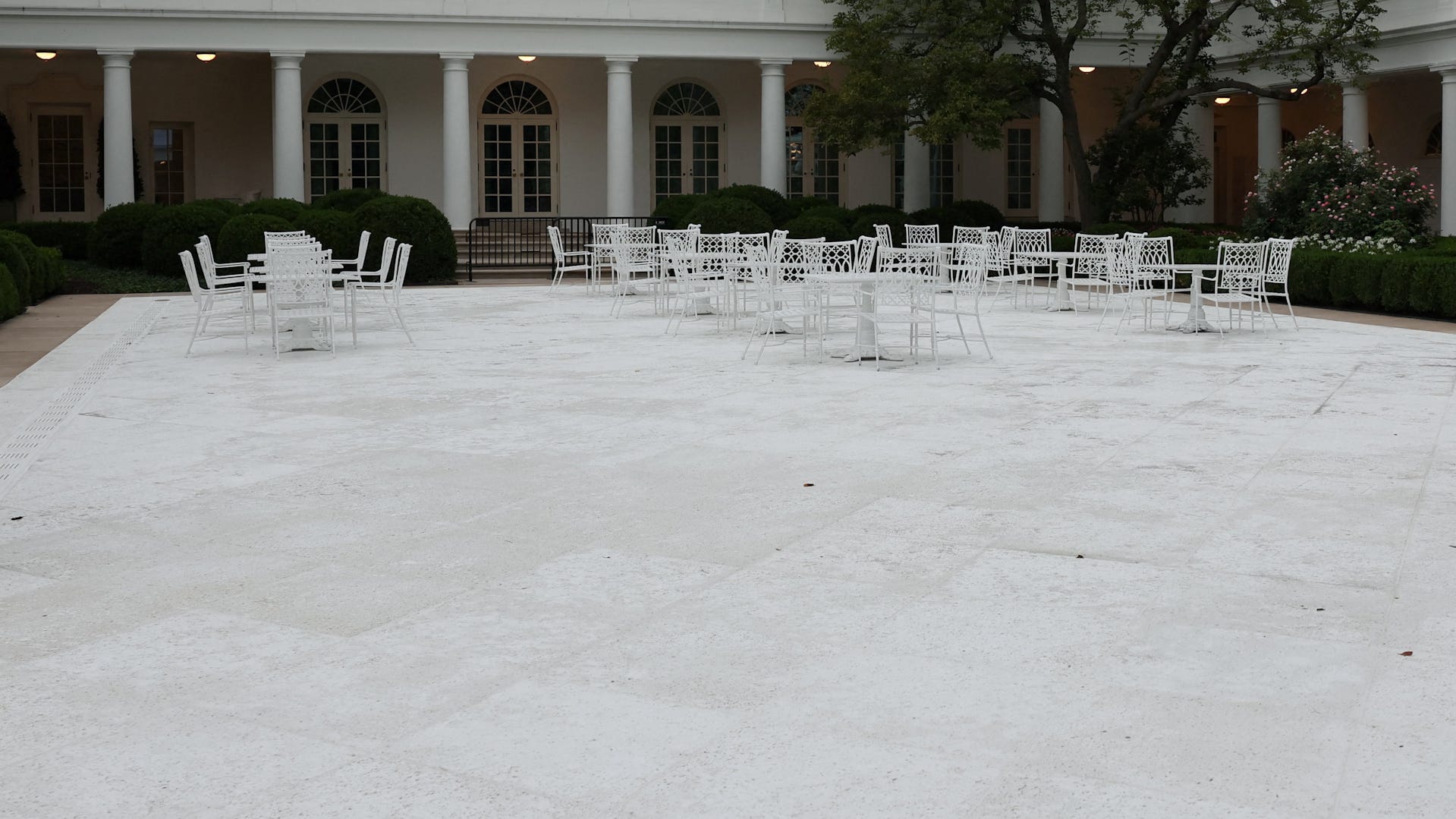
Trump, who has a background in real estate, has made several changes to the White House, including replacing the Rose Garden lawn with a paved patio and painting the Oval Office with gold.

“Real estate is very relaxing to me,” he told guests in the East Room. “Real estate is a very difficult business for a lot of people. I’ve always loved real estate and I’ve always done well in it.”

At one point, Trump assured donors that the banquet would be presented in “exquisite” taste.

“I consider myself an important designer, because they bring things that might be good designers, but, well, what they can recommend is terrible,” he said.

White House officials told USA TODAY that donors at the dinner included representatives from some of America’s biggest companies, including Lockheed Martin, Palantir, Alphabet Inc.’s Google, Meta and Amazon.

President Trump has for years pushed for a ballroom in the White House that could accommodate large gatherings such as state dinners. He lamented the fact that many of the extravaganzas of the past took place inside tents.

He pitched the idea of ​​building a ballroom to two former presidents, Barack Obama and Joe Biden, and even said he would build it and pay for it himself.

There was no taker.

When he finally got his second chance to occupy the White House, he announced his intention to build a “beautiful” banquet hall on February 6, two weeks after his inauguration.

He said he would pay the money himself.

But plans evolved over several months, and the White House announced that the $250 million project would be funded by private donors and the president.

President Trump said the banquet hall project was “fully funded” and that “there is still money left” for future projects.

“We’re probably going to use it for Ark or something else down the road,” he said.

Swapna Venugopal Ramaswamy is USA TODAY’s White House correspondent. You can follow her at X @SwapnaVenugopal.

Diane Keaton’s cause of death revealed by family: Report

0

play

Diane Keaton’s cause of death was reportedly announced days after news of her death became public.

The 79-year-old Hollywood star died of pneumonia on October 11, his family said in a statement to People magazine on October 15.

“The Keaton family is extremely grateful for the extraordinary messages of love and support we have received over the past few days on behalf of our beloved Diane, who passed away from pneumonia on October 11th,” a statement to People magazine reads.

“She loved animals and was a staunch supporter of the non-fed community, so making a donation to your local food bank or animal shelter in her memory would be a wonderful and much-appreciated tribute to her.”

Adults 65 and older are at higher risk of developing pneumonia, which infects the lungs, because they have other chronic health conditions and because their immune systems generally weaken with age.

USA TODAY has reached out to Keaton’s representatives for confirmation.

People, the New York Times, and CBS News reported on October 11 that Keaton had died, citing people close to him, including producer Dolly Russ. Details of the situation were not disclosed at the time, but the Los Angeles Fire Department confirmed to People and CNN that paramedics were dispatched to Keaton’s home and transported a woman to the hospital.

Born Diane Hall in Los Angeles on January 5, 1946, Keaton landed her breakthrough role as Kay Adams-Corleone in The Godfather at the age of 26.

She continued to win fans around the world for her comedic performances in “The First Wives Club,” “Father of the Bride,” and “The Family Stone.” She won her first and only Oscar statuette for 1977’s “Annie Hall,” one of her many collaborations with former partner Woody Allen.

Keaton also flexed his dramatic skills on the big screen, including in 1977’s “Looking for Mr. Goodbar” and 1982’s “Reds,” for which he was nominated for an Academy Award. She was nominated two more times, for “Marvin’s Room” (1996) and “Something’s Gotta Give” (2004).

Trade war with China is already underway, President Donald Trump says

0


China’s decision on October 10 to restrict exports of rare earth minerals began a second round of retaliatory measures.

play

Two weeks before he was scheduled to meet with Chinese President Xi Jinping, President Donald Trump told reporters that his spat with China over trade had escalated into a full-blown trade war.

Asked by reporters whether the United States would enter into a “sustained trade war” with China if they fail to reach an agreement at a meeting with President Xi Jinping in South Korea at the end of this month, the president said, “We are currently in a trade war.”

“We have 100% tariffs,” President Trump said, referring to the tariffs that have recently threatened China. “If there were no tariffs, we would be exposed as nothing.”

On October 14, President Trump announced that the United States would stop purchasing edible oil from China in response to China’s decision to remove the United States from its list of soybean suppliers. In a post on Truth Social, President Trump called this an “economically hostile act.”

China is the largest buyer of U.S. soybeans, according to the U.S. Soybean Association.

In retaliation for U.S. tariffs imposed by President Trump in April, China has stopped purchasing U.S. soybeans and has instead switched to supplies from Argentina and Brazil.

China’s decision to restrict exports of rare earth minerals on October 10 triggered a second wave of retaliatory measures after President Trump announced “reciprocal” tariffs on dozens of countries in April. A tariff truce was established with China in August, suspending triple-digit tariffs for 90 days.

President Trump has said he will impose 100% tariffs on China starting November 1 in response to China’s restrictions on rare earth minerals that are essential to U.S. industry. This would be in addition to the 30% tariff that the United States currently imposes on products from China.

From 2020 to 2023, China accounted for 70% of U.S. imports of rare earths used to make magnets, electronics, and defense systems.

Mr. Trump and Mr. Xi are scheduled to meet on October 31st at the Asia-Pacific Economic Cooperation Conference in Seoul, South Korea.

Los Angeles County declares state of emergency following federal immigration raid

0

play

Los Angeles County officials have voted to declare a state of emergency in response to the Trump administration’s sweeping immigration crackdown, a measure typically reserved for natural disasters.

The Los Angeles County Board of Supervisors voted 4-1 on October 14 to approve the state of emergency. This will allow counties to mobilize resources, expedite contracting and procurement, coordinate interagency responses, and request state and federal assistance to protect communities affected by recent federal immigration raids. The Supervisory Board stated that this declaration remains in effect until terminated by the Board of Directors.

The declaration, issued by County Supervisors Lindsey P. Horvath and Janice Hahn, said the actions of U.S. Immigration and Customs Enforcement and tactics used by other federal agents are “creating a climate of fear, causing widespread disruption to daily life, and negatively impacting the local economy.”

The Board of Supervisors said ongoing immigration raids and operations across Los Angeles County, home to more than 3 million immigrants, are reducing the number of people reporting to work and straining essential services such as schools, hospitals and places of worship.

“What is happening in our community is an emergency and Los Angeles County is treating it as such,” Horvath said in a statement on Oct. 14. “The declaration of a local state of emergency brings together the full strength of county government to assist immigrant communities targeted by federal action.”

“For months, families have been under threat and workers have been taken from the field. This declaration is about action and speed, allowing us to act faster, work better together, and use every tool available to protect and stabilize our communities,” the statement continued. “Today, and for as long as it lasts, we stand with our immigrant neighbors.”

Los Angeles County Supervisors Warn of Possible Legal Issues

County Supervisor Kathryn Berger, who opposed the state of emergency declaration, argued the motion was not “the correct or responsible way” to respond to federal immigration measures and warned that potential legal challenges could further strain the county’s “already stretched” budget.

“Emergency powers exist for life-or-death crises like wildfires, not as shortcuts to complex policy issues,” Berger said in a statement on Oct. 15. “Expanding emergency powers to address federal immigration would defeat that purpose, invite legal challenges, and circumvent the public process.”

But other county officials say the measure will provide support and resources to people affected by immigration raids. Citing a study conducted by the Bay Area Council Economic Institute in collaboration with the University of California, Merced, officials argued that the raids would cost the state $275 million in gross domestic product.

The raids earlier this year had a dramatic and immediate impact on workers. Approximately 465,000 California workers fled the working class during the week of June 8, as immigration authorities raided workplaces across Los Angeles, according to a study released in July.

As a result, the number of people working in the private sector in California fell by 3.1%, a decline not seen since the COVID-19 pandemic, although it is unclear whether they left permanently or just for a short period of time, the study notes.

Declaring a state of emergency could bring us one step closer to suspending evictions

The state of emergency could also be the first step toward a moratorium on evictions to provide relief to tenants who have been financially hurt by President Donald Trump’s immigration crackdown. Such a suspension would still require a vote by the Supervisory Board.

The vote allows Los Angeles County to impose an eviction moratorium that protects renters from being evicted for nonpayment of rent if they can prove they have been financially affected by an immigration raid. The renter still owes the money to the landlord and must pay it once the grace period ends.

At last week’s county supervisors meeting, a slide presentation pointed out that the eviction moratorium would create hardships for landlords. The presentation also said an alternative could be for the county to increase rent relief subsidies for tenants.

Los Angeles immigration operations spark widespread protests

Los Angeles County has become the epicenter of the Trump administration’s immigration crackdown. President Trump sent National Guard troops and Marines into the city in June to protect federal buildings and protect ICE agents who carried out the attack, sparking widespread protests and outrage.

Protests in Los Angeles County began in response to several attacks on immigrants, including one outside a hardware store and another at a clothing manufacturer in the city’s Garment District. The raids and ensuing violence came as the Trump administration has stepped up its efforts to detain and deport immigrants at workplaces, traffic stops and routine statutory inspections.

The Trump administration has maintained that the raids were legal and aimed at illegally removing immigrants from the United States. The president has since moved to deploy the National Guard to other Democratic cities, including Washington, D.C., Memphis, Tennessee, Chicago and Portland, Oregon.

Contributors: Terry Collins and Christopher Cann, USA TODAY. Reuters

Glock banned? A crackdown on handguns begins in California.

0


California’s new law targets Glocks, which critics say can be easily converted into machine guns. Other states are also struggling with this problem.

play

A new law passed in California would limit the sale of a popular type of handgun that critics have long said is too easy to convert into a machine gun.

The law, signed by Gov. Gavin Newsom on Oct. 10, bans the retail sale of semi-automatic handguns that can be easily modified using a category of tools commonly known as “Glock switches,” machine gun conversion devices that jam the gun’s trigger device and allow it to fire continuously while the trigger is pressed.

The law was enacted after years of criticism and lawsuits targeting Glock, which continues to make guns compatible with the Switch. The device allows the pistol to fire up to 1,200 rounds per minute, according to gun control advocacy group Everytown for Gun Safety.

For example, last year’s shooting in Birmingham, Alabama, which left four people dead and more than a dozen injured, authorities believe used a gun with a modified Glock switch.

The move in California comes as a number of Democratic-led states are seeking their own solutions to the problem of illegal machine gun converters, turning to lawsuits and considering their own countermeasures against Glock while the company has not taken steps to stop the converters, said Jennifer Dineen, a University of Connecticut professor and member of the Regional Gun Violence Research Consortium at the Rockefeller Institute of Government.

“California is the first time we’ve had success here,” Dineen said. “The state is taking action even though the manufacturers are not taking action.”

Although the law significantly tightens enforcement of modified semi-automatic handguns, California does not completely ban Glocks from the state, but instead focuses on making them harder to obtain.

“No one is taking away anyone’s Glock. No one is removing guns that are already there,” Dineen added.

What does the new law say?

The law, Assembly Bill 1127, targets Glock handguns and similar handguns that use a “cruciform trigger bar.” The report notes that the sale of machine guns is already prohibited, and expands the definition of machine gun under state law to include handguns that can easily be modified to fire automatically.

Firearms dealers will be prohibited from selling guns starting in 2026. Dealers will still be allowed to sell guns they owned before the law took effect, but there are exceptions for law enforcement and private sales.

It does not affect the ownership of handguns, only the sale of them.

Why ban the sale of Glock handguns?

This small converter part is not affiliated with or sold by Glock, but it is a “do-it-yourself” hack that is causing problems in the United States. Illegal “autoshears” can be easily and cheaply made using 3D printers, and can instantly turn a handgun into an illegal machine gun.

Federal authorities say they are the most commonly seized weapon in gun-trafficking cases and are commonly used by young people. From 2017 to 2021, the Bureau of Alcohol, Tobacco, Firearms and Explosives seized 5,454 machine gun conversion devices, including Glock switches. This is a 570% increase over the previous five years, when the agency recalled 814 parts.

The bill states that a gun can be “easily converted into a machine gun by hand or by the use of common household tools by the installation or attachment of a pistol converter…any device or instrument that, when installed or attached to the rear of the slide of a semi-automatic pistol, substitutes for the backplate and interferes with the trigger mechanism, thereby enabling the pistol to fire multiple shots automatically by the single function of the trigger.”

“Now people can (3D) print things and get things from the internet,” Dineen said. “The ability to do DIY modifications is better than it was 10 years ago.”

Even guns that are completely legally purchased and compliant can be quickly turned into illegal weapons, she said.

NRA immediately challenges new law in court

The National Rifle Association announced on October 13 that the Firearms Policy Coalition, Second Amendment Foundation, Poway Weapons and Gear, and two members of the NRA would join in filing a lawsuit challenging the new law. The lawsuit claims the law violates the Second Amendment, citing previous Supreme Court decisions striking down handgun bans.

“California’s ban on many of America’s most popular handguns clearly contradicts court precedent,” the NRA’s Legislative Action Institute said in a statement.

But Dineen said that argument could be difficult to prove because the new law does not ban all firearms, or even all handguns. It only prohibits the sale of handguns of certain types and designs, not their ownership.

A coalition of states also sued Glock.

Dineen said manufacturers are ignoring growing calls to change the design of Glock handguns to make it harder to “switch” to a machine gun. As a result, countries are beginning to take matters into their own hands.

“Gun violence is an epidemic and we cannot afford to turn a blind eye as manufacturers turn firearms into illegal machine guns,” said California Congresswoman Katherine Stefani (D).

Dineen said that by banning the sale of handguns similar to the Glock, California, which ranks third among states for gun sales in 2023 behind Texas and Florida, could put significant financial pressure on Glock to pursue these reforms.

The pressure is also coming in the form of lawsuits against Glock. States including New Jersey, Minnesota and Maryland, and cities including Baltimore, Chicago and Portland have filed lawsuits against the company in recent years, accusing the company of allowing the proliferation of machine guns by promoting the sale of easily modified guns, according to reports.

Some of the lawsuits allege that Glock has known for years that its weapons could easily be converted into machine guns and did nothing about it.

Glock did not immediately respond to a request for comment about the California law or the lawsuit’s claims against it.

Other states, including New York and Illinois, are also considering legislation that would ban the sale of Glocks and similar handguns.

Glock switches are already prohibited under specific laws in at least 28 states, including California, according to a tally by Everytown for Gun Safety.

CVS completes takeover of Rite Aid assets in bankruptcy transaction

0

play

CVS Pharmacy announced in an Oct. 15 news release that it will take over certain Rite Aid assets across the United States, including prescription files for 626 stores.

The drugstore chain acquired stores in Idaho, Oregon, and Washington and prescriptions in 15 states, giving the company more than 9 million former Rite Aid and Bartell Drugs patients.

“We are helping maintain and expand access to convenient and reliable pharmacy care across the United States and are expanding our retail footprint and presence in local communities,” Len Shankman, president of pharmacy and consumer wellness for CVS Health, said in a release.

The company said it employs more than 3,500 former Rite Aid and Bartell Drug employees and that most stores that received prescription files from Rite Aid are located within three miles of former Rite Aid stores.

CVS announced on May 21 that it had approved the acquisition of bankruptcy assets. According to Reuters, Rite Aid found buyers for customer files in 810 stores, but could not find buyers for files in 200 other stores.

Rite Aid announced in May that it had filed for Chapter 11 bankruptcy protection. This is the second time since October 2023. The store closed on October 3rd.

Where did all the other Rite Aid assets go?

Walgreens received prescription files from certain Rite Aid pharmacy locations in nine states, a company spokesperson said in a statement to USA TODAY in May. Rite Aid prescription files were also transferred to operating companies including Albertsons, Kroger and Giant Eagle, USA TODAY previously reported.

“Rite Aid’s top priority is to ensure that as many of our loyal customers as possible continue to receive the pharmacy services and care they need without interruption,” Rite Aid CEO Matt Schroeder said in a statement after the transfer was approved.

Thrifty Ice Cream, a longtime symbol of the pharmacy chain, has been sold to a holding company tied to Monster Beverage Corp. executives Hilton Schlossberg and Rodney Sachs. “We plan to revitalize Thrifty without changing the core of what has made it unforgettable for over 85 years,” Hillrod Holdings said in an Aug. 7 press release.

Contributor: USA TODAY’s Jonathan Limehouse

U.S. flag with swastika on Capitol Hill by Rep. Dave Taylor

0

play

CINCINNATI — A Republican congressman from Ohio has condemned the display of an American flag altered to show a swastika inside the Oval Office in Washington, D.C., calling it a “despicable and highly inappropriate symbol” that is currently being investigated by U.S. Capitol Police.

“The content of that image does not reflect the values ​​and standards of this office, my staff, or myself, and I condemn it in the strongest terms,” ​​U.S. Rep. Dave Taylor said in an Oct. 15 statement.

The flag, first spotted in Taylor’s office during a virtual meeting on Oct. 14, features stripes forming the Nazi symbol and appeared to be pinned to the wall of a cubicle behind one of Taylor’s staffers, Politico first reported.

The employee was identified as Angelo Elia, who is listed as the lawmaker’s legislative correspondent on LegiStorm, a website that publishes congressional data and contact information, according to the USA TODAY Network’s Cincinnati Enquirer.

“Upon learning of this matter, I immediately directed a thorough investigation with the Capitol Police, which is ongoing,” Taylor added. “I will not be commenting further until the investigation is complete.”

Taylor’s office called the flag “an act of vandalism” and said lawmakers were investigating.

Is there an official police report?

When USA TODAY contacted the U.S. Capitol Police, it received an automated message saying the department’s intelligence unit was closed due to the ongoing federal government shutdown. Taylor’s office was also contacted but has not yet received a response.

Who is Congressman Dave Taylor?

Taylor won a crowded 2024 Republican primary to represent Ohio’s 2nd Congressional District, replacing former Congressman Brad Wenstrup. His first term began in January.

Taylor, who grew up in Amelia, Ohio, is also the head of his family’s concrete company, Sardinia Ready Mix, the Cincinnati Enquirer reported.

Fernando Cervantes Jr. is a trending news reporter for USA TODAY. Contact us at fernando.cervantes@gannett.com and follow us at X @fern_cerv_.

EV sales set a new record with 2.1 million units sold worldwide in September

0

play

Global sales of all-electric and plug-in hybrid vehicles rose 26% from a year earlier to a record 2.1 million vehicles in September, market research firm Law Motion said on Wednesday, due to strong demand in China and a delayed U.S. tax credit rush.

China accounted for about two-thirds of global sales with about 1.3 million units, and North America also set records as U.S. buyers moved to secure incentives before they expire, said Charles Lester, data manager at Lowmotion.

Why is it important?

China is the world’s largest car market, accounting for more than half of global EV sales, and Rho Motion’s data includes battery electric vehicles and plug-in hybrids.

September, typically the busiest month for car purchases in China, saw sales rise as shoppers sought to make the most of trade-in subsidies before they began to be phased out in some regions.

U.S. demand reflects a surge as buyers rush to claim the expiring $7,500 EV tax credit, but demand is expected to decline sharply in the fourth quarter “as both consumers and businesses lose access to the federal incentives that have supported EV purchases,” Law Motion said.

Prices also hit new highs in Europe, supported by incentives from Germany and strong demand from the UK, but competition is expected to intensify in the coming months as Tesla rolls out its low-cost Model Y in Europe.

In terms of numbers

Global sales of battery electric vehicles and plug-in hybrids rose 26% in September to a record 2.1 million units, according to Rho Motion data.

Sales in China increased to approximately 1.3 million units. Sales in Europe increased by 36% to 427,541 units, and sales in North America increased by 66% to approximately 215,000 units. Sales in other regions increased by 48% to 153,594 units.

main quote

“With federal incentives gone, U.S. demand is expected to fall sharply in the final quarter of this year,” Lester said.

Some automakers, including General Motors Co GM.N and Hyundai Motor Co 005380.KS, are trying to cushion the blow by offering discounts and leveraging dealer inventories, but overall production is shrinking, he added.

Report by Jesús Calero. Editing: Alexander Smith

Kim Kardashian’s Skims releases thong that looks like pubic hair

0

play

Skims is back with an eye-catching new thong line.

Kim Kardashian’s shapewear brand, known for its nipple bras, sculpting face wraps, and butt-enhancing padded shorts, is back with a faux-hair microstring thong. The company dropped its “bold” new panties in a 1970s-inspired campaign with a mock dating show titled “Does the carpet match the curtains?” Refers to the pubic hair-like appearance of a thong.

“With these iconic new panties, you can turn your carpet any color you want!” Skims wrote in a press release.

There are 12 faux hair and braid color variations with straight and curly textures, and the braids are currently sold out on the Skims website. It’s unclear how long they were in stock, but the concept generated a lot of buzz.

Online reactions to the product drop showed that people were confused, with one X user writing: “Who spends $32 on a fake pubic thong?!!! (I wish I could just grow my hair out). I bet the people at Skims are running out of ideas ’cause this is ridiculous.”

You opened Skims because Kim Kardashian is selling thongs with bushes and you think this is a joke, right? right? ? ? “And it’s sold out?” another wrote, “Who’s going to buy this?”

The fake hair thong follows the release of the controversial face wrap series. Featuring “collagen threads for ultra-soft support,” the wrap is targeted at people with elaborate morning undressing habits. Basically, the idea is to keep tension in your face and “grasp” your chin. The campaign was quickly met with backlash and confusion from doctors who said it was ineffective.

In September, Skims launched its long-awaited collaboration with Nike, NikeSkims, unveiling the first three major activewear collections and four seasonal collections, featuring pieces designed for everything from strength training and everyday training to lounging and running errands. The campaign featured Kardashian and athletes Serena Williams, Shakari Richardson, Jordan Childs and Chloe Kim.

The Fed cut interest rates. Here’s what it means for car buyers

0

play

  • The Fed’s recent 0.25% interest rate cut could make it cheaper for consumers to take out large loans.
  • A lower interest rate will reduce your total payments over the life of your car loan, potentially saving you hundreds of dollars.
  • Experts have suggested that used-car loans could be more directly affected by the Fed’s interest rate cuts than new-car loans, which are often already subsidized by automakers.

The Federal Reserve made a long-awaited rate cut in September, lowering interest rates for the first time in almost a year.

A 0.25% interest rate cut could put consumers in the position of taking out larger loans to purchase things like homes and cars.

“Lower interest rates are a great thing,” Jessica Caldwell, director of insights at online car information site Edmunds, told the Courier Journal, a member of the USA TODAY Network. “Most people have some funding set aside for their car, so this really makes a big difference.”

As of Oct. 7, 73- to 84-month auto loan interest rates for new vehicles are as low as 6.49% annualized for borrowers with “excellent” credit histories, according to Navy Federal Credit Union. Meanwhile, Navy Federal Credit Union reported that its auto loan interest rate was as low as 6.69% before the rate cut. The annual percentage rate (APR) is the total cost of your car loan expressed as a percentage and includes interest rates and fees to give you a clear picture of your total borrowing costs.

Caldwell said that for most car buyers, the average term of a car loan is 70 months, and the average loan amount is nearly $43,000.

Caldwell said the average monthly payment for a new car is currently $761 and the average monthly payment for a used car is $570. But back in 2019, before global tensions between trade, parts shortages and the coronavirus pandemic, the average monthly payment for a new car was $559.

“People are almost in sticker shock,” Caldwell said of the drastic change in car prices in just six years.

Shoppers can use online tools like the Edmunds Car Loan Interest Calculator to see how much interest they’re “actually paying on their auto loan.”

For example, if you finance $40,000 for 72 months at an annual interest rate of 6.49%, you’ll pay $8,402 in total interest. If you finance $40,000 for 72 months at an annual interest rate of 6.69%, you’ll pay $8,674 in total interest.

And for those considering refinancing their current loans, Caldwell said it’s still important to consider how much money is left on your current loan, even though lower interest rates may provide some financial relief.

“If you sign up for a new loan, are you signing up for another five years? That’s not ideal,” Caldwell said. “Ultimately it depends on the person’s situation, and if you’re paying a high interest rate and it’s going to take about two years, it might be better to just keep using it.”

As car buyers explore the best time to buy and what the latest Fed rate cuts mean for car prices, USA TODAY Network spoke with Caldwell to discuss what people should consider when buying a car.

Note: This interview has been lightly edited for clarity and brevity.

Have interest rates fallen enough to affect your car loan?

caldwell: “Two things happen with auto loans. For new cars, many automakers offer some sort of subsidized interest rate as a form of incentive to get people to buy the car. When the Fed lowers interest rates, a lot of the time…those rates don’t necessarily show up in the data because[the automakers]are already subsidizing those rates.”

“On the used car side…with the exception of certified used cars, there’s probably going to be a little more influence on what the Fed does with used cars. Used cars are going to see a lot more reaction to what the Fed does than on the new car side.”

Which types of new, used, or certified pre-owned buyers will benefit most from interest rate reductions and why?

caldwell: “Eventually it’s going to happen to everyone. Even on the new car side, if automakers decide it’s cheaper to borrow money, they can offer more generous incentives to their customers. On the used car side… they’re often heavily influenced by what’s happening on the Fed side. This really benefits everyone who is borrowing money, the vast majority of Americans.”

How does loan interest rate affect EV?

Caldwell said leasing these vehicles could impact APRs for shoppers who may be interested in electric vehicles, especially given the EV tax credit disappears. Caldwell said most people who buy an EV tend to lease it, and more than 70% of new cars purchased at dealerships are leased.

“EVs are a different beast in some ways, and I think that’s why more and more people are choosing to lease rather than buy an EV,” Caldwell said. “Things may change because buyer behavior may be different now that the federal tax credit has been eliminated. But it’s only been a few days since that happened, so it’s hard to say.”

How will lower interest rates affect lease agreements?

Caldwell: “If you can lower the money factor, your monthly payments will be lower. But if you look at the industry as a whole, across all new cars sold, lease rates are around 20%, so about one in five people are affected. If you lower the interest rate, you lower the money factor, which essentially means lower monthly payments. That’s what everyone really wants.”

What should car buyers consider in light of lower interest rates?

Caldwell: “Credit scores are probably very important. … It’s really important, because if you’re in a certain credit range … especially if you’re financing for 72 months, it can make a big difference. … And I think people really need to reevaluate what their driving habits are, because sometimes people … want something new.

“I think the other thing is that the market is in such turmoil between COVID-19 and the semiconductor shortage and even tariffs. I think it’s a better idea to really consider (and ask) what kind of car you can buy. Is newer a better idea? Or is it certified pre-owned? Considering the total package of price, interest rate, and how long you’ll own this car, I think that’s probably what’s important to you.” ”

Contact business reporter Olivia Evans at oevans@courier-journal.com or @oliviamevans_ on X (formerly Twitter)..

President Trump ‘considers’ ground attack on Venezuelan cartels

0


President Trump is considering attacks on land targets as part of his campaign to stem the flow of drugs from Venezuela after five recent boat attacks.

play

WASHINGTON – President Donald Trump said he is considering U.S. military strikes against land targets to counter the flow of drugs from Venezuelan cartels to the United States, following five recent maritime attacks on alleged drug-smuggling vessels.

President Trump told reporters on October 15: “We are certainly looking to the land now because the oceans are well managed.”

President Trump made the remarks after the New York Times reported that his administration had secretly authorized the Central Intelligence Agency to carry out covert operations in Venezuela in an escalating campaign against the government of Venezuelan President Nicolás Maduro.

President Trump confirmed the report and said the move was in response to Venezuelan immigrants and drugs entering the United States.

“We understand that a lot of Venezuelan drugs come in by sea, but we’re going to stop them from the land as well,” Trump said.

President Trump did not specify the location of possible attacks on land targets.

Asked by reporters whether the CIA had the authority to “remove” Maduro, Trump said: “I guess that’s a stupid question for me to answer, but I think Venezuela is feeling the heat.”

On October 14, the US military carried out its fifth attack on a boat in the Caribbean since September, killing six people. President Trump said each was a “narcoterrorist” trying to bring illegal drugs into the United States. A total of 26 people were killed in the five boat attacks.

In February, President Trump designated some drug cartels as “foreign terrorist organizations,” a move that officials say gives them legal justification for attacks.

But the Trump administration has yet to provide Congress with evidence to support its claims that the alleged drug smuggling vessel was carrying drugs. Democrats and other critics have questioned President Trump’s legal basis for using the military to attack ships that pose no imminent threat of attack, even if they are carrying drugs.

Contact Joey Garrison at X @joeygarrison