Home Blog Page 504

Amazon, Target, Home Depot targeted in anti-Trump boycott over DEI

0

play

A group of grassroots organizations is calling on shoppers to boycott big retailers like Amazon, Target and Home Depot, accusing them of bowing to President Donald Trump and breaking their pledges to support diversity, equity and inclusion programs.

Black Voters Matter, Indivisible, and Freedom said in a statement that they are launching the “We Won’t Buy It” national economic pressure campaign ahead of the holiday season “to show businesses the consequences of not standing up loudly for core democratic principles of freedom, equity, justice, and freedom.”

The aim is to get shoppers to boycott stores during the important holiday season. Shoppers surveyed by PricewaterhouseCoopers said they expected their holiday spending to be 5% lower on average this year compared to last year, the first significant decline since 2020. Retailers are trying to lure shoppers by starting Black Friday early with doorbusters and other sales.

Boycott organizers are asking shoppers to support retailers who stand up to Trump, as well as black, minority and immigrant-owned businesses and local small businesses, rather than patronizing retailers that have supported Trump.

“Instead of fighting back and supporting the very people who are putting money in their pockets, businesses and retailers are falling at President Trump’s feet. But we will not stand for that,” LaTosha Brown, co-founder of Black Voters Matter, said in a statement. “We don’t agree that the world’s richest country punishes poor people by withholding SNAP benefits during the holiday season. We don’t agree that families can be torn apart and people can be kidnapped from the streets by masked ICE agents. We don’t agree that DEI and racial justice efforts can be tossed aside at the whim of political expediency. And we don’t agree that corporations are powerless in all of this.”

Recent consumer boycotts illustrate the dangers companies face when they become embroiled in controversial culture war issues in a volatile and polarized political environment.

In the 1990 election for U.S. Senate in his home state of North Carolina, Michael Jordan refused to publicly support Harvey Gantt, a black American Democrat who was running against Republican Jesse Helms on repeated charges of racism, saying, “Republicans buy sneakers, too.”

Jordan later said the off-the-cuff comment was a joke, but more than 30 years later, it’s still being repeated, especially at a time when shoppers of all political stripes are brandishing their wallets at the register to make their feelings and beliefs clear.

Most recently, a pressure campaign from activists like Robbie Starbuck and Matt Walsh, who accused Cracker Barrel of bowing to “wokeness” and distancing itself from its rural roots and conservative values, forced Cracker Barrel to scrap its plans to sport a vintage logo featuring a veteran wearing overalls and leaning on a barrel. Starbucks supporters also pressured Walmart, Ford, Harley-Davidson, Tractor Supply and others to curb their DEI efforts.

Bud Light, owned by beer giant Anheuser-Busch, has struggled following conservative backlash over a social media campaign featuring transgender influencer Dylan Mulvaney.

Target moved the pride display from the entrance to the back of the store after shoppers confronted employees and destroyed the display. Last year, Target scaled back its Pride collection and no longer carried the collection in all of its stores. Then, a nationwide boycott over the company’s DEI retraction hit the company from across the aisle, and sales at Target, which recently announced it would cut about 1,800 positions, fell.

A new study on the Tesla boycott suggests that Elon Musk’s “polarizing and partisan” political activities alienated the electric car maker’s base and cost U.S. car sales by more than $1 million from October 2022 to April 2025.

“We find that by the first quarter of 2025, without Mr. Musk’s partisan effect, Tesla’s monthly sales would have increased by approximately 150%,” Yale researchers said in a research report.

Boycotts that ask shoppers to stay away from stores during power outages may not be as economically effective as sustained boycotts, Brayden King, a professor of management and organizations at Northwestern University’s Kellogg School of Management, previously told USA TODAY.

He said shoppers will buy before and after the power outage. King said that during a prolonged boycott, it may also be difficult to “convince enough consumers to make changes to their purchases to improve profitability even slightly.”

Michael Blake challenges Ritchie Torres over support for Israel in 2026

0


Michael Blake has made Torres’ fervent support for Israel during the brutal Israel-Hamas war a central part of his platform, an issue that deeply divides many Democrats.

play

Former Democratic National Committee Vice Chairman Michael Blake announced this month that he will challenge fellow Democratic Congressman Ritchie Torres for the New York Congress seat representing the Bronx next year.

Mr. Blake, a former state lawmaker who once worked in the Obama administration, has built a platform on Mr. Torres’ fervent support for Israel during the brutal Israel-Hamas war, an issue that is deeply divided within the Democratic Party.

A two-minute campaign video posted to Blake’s social media accounts on November 5 shows social media users criticizing Torres for accepting funds from the pro-Israel lobby group AIPAC and for being a vocal supporter of the Israeli government.

“I’m running for Congress because the people of the Bronx deserve better than Ritchie Torres,” Blake said in a social media video post. “While Richie is fighting for genocide, I am ready to fight for you and lower your cost of living. As Richie focuses only on AIPAC and Bibi, I will focus on affordable housing and books. I will invest in the community. Richie is investing in Bombs. I want to abolish credit scores for housing. Richie just wants to take the credit.”

Blake ran unsuccessfully for mayor of New York this year. He previously challenged Torres for New York’s 15th Congressional District seat, but lost in the June 2020 primary.

In a statement to Politico, Torres spokesman Benny Stanisławski responded to critical claims, saying Torres “has been fiercely focused on issues like public housing and housing affordability while standing up to Donald Trump.”

“Michael Blake has no interest in the Bronx,” Stanislawski said. “He is only interested in using it to run for a fifth time, and the result will be the same as before, he will lose again.”

Support for Israel and anger over military operations in Gaza since late 2023 have created one of the most pronounced rifts within the Democratic Party in recent years, with candidates mired up and down the vote in last year’s elections. Former Vice President Kamala Harris faced fierce criticism from the left of her party over the issue during her bid for the White House last year, and midterm campaign efforts in early 2026 suggest the issue will play a prominent role again in the election cycle.

In addition to New York’s Blake, Democratic congressional challengers in several districts across the country, including California, Michigan and Maine, have also made promises to reject pro-Israel lobbying central to their early campaign messages. Pro-Israel groups such as AIPAC and the United Democracy Project have spent millions of dollars on the 2024 Democratic campaign, often supporting more centrist-leaning pro-Israel candidates against left-wing challengers who take pro-Palestinian positions.

Kathryn Palmer is USA TODAY’s political reporter. She can be reached at the following address: kapalmer@usatoday.com And to X@Kathryn Purml.

As southerners shivered in record-breaking cold temperatures, heavy snow lashed the north.

0


Winter weather warnings are in effect for several states, with the possibility of several inches of snow. Florida and other parts of the South are suffering from unseasonably cold weather.

play

A frigid air mass is expected to bring “severe cold” to the eastern two-thirds of the country, dumping heavy snow in the Great Lakes region Monday morning, and temperatures across the Southeast are expected to drop 20 to 30 degrees below average into the evening of Nov. 10, breaking many records, according to the National Weather Service.

Snow was reported in Chicago throughout the morning. There were multiple reports of about a foot of snow around the Great Lakes in the morning, including 14 inches near Big Bay, Michigan, the National Weather Service said. 13 inches in Kenosha County, Wisconsin; 11.5 inches in Lakeville, Indiana;

According to the National Weather Service, freeze watches and warnings are in effect for the Lower Mississippi River Basin to the Virginia Tide through the morning of Tuesday, Nov. 11, and winter weather advisories are in effect for several states, including parts of Ohio, Wisconsin, Virginia, Tennessee, Illinois, Indiana, and New York.

Florida could experience record cold weather, forecasters said.

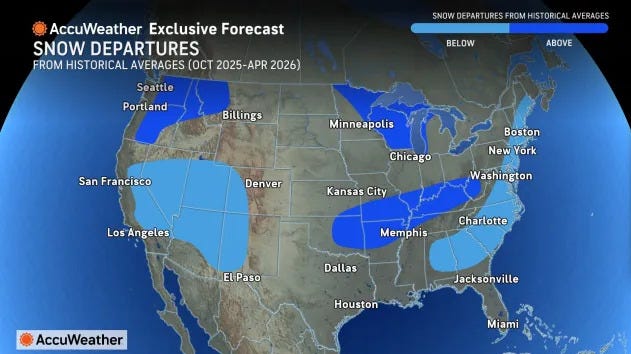
According to AccuWeather’s latest forecast, “significant snow” is likely to fall from the shores of Lake Superior to Lake Ontario, particularly affecting areas such as Chicago, Cleveland, Buffalo and Pittsburgh.

“This storm pattern will bring some of the coldest air for early November, and that’s why we expect so much snowfall in the Great Lakes and the extent of the snowstorm as far south as the Appalachians,” AccuWeather Senior Meteorologist Chad Merrill said of the site’s Monday morning forecast.

Where does it snow?

According to the Chicago NWS office, “flurry snow with lake effect” continues and is expected to affect the morning commute on Nov. 10. Forecasters said travel was not recommended in areas where the snow was falling as conditions could change “considerably” over short distances.

“Snow will gradually decrease from the north to the southeast into the morning,” the NWS said.

The NWS office in Buffalo said there was light snow overall on Nov. 10, but the snow is expected to shift to “an area of ​​lake-effect snow southeast of the lake,” then move into areas east of the lake, with the snow expected to ease by Tuesday, Nov. 11.

play

What’s the winter forecast? Check out AccuWeather’s winter outlook.

It won’t be long until the cold and snow returns. AccuWeather’s long-term experts share what this winter will look like in the U.S.

Areas near Albion and Rochester are expected to receive 4 to 6 inches of snow, while areas a little further east, including Sodus and Fulton, are expected to receive 6 to 8 inches.

The National Weather Service said “intermittent snowfall” is expected to continue in Cleveland through Monday, with most of the snow expected in traditional snowpack areas, especially inland northwestern Pennsylvania. The weather service said 6 to 11 inches of snow could fall in Erie County, Pennsylvania, with locally higher amounts possible in higher elevations.

According to AccuWeather, the snow will extend into southeastern Indiana, southern Ohio, central and northern Pennsylvania and the Appalachian Mountains, and snowfall could move south into eastern Kentucky, southern West Virginia, eastern Tennessee and parts of the Carolinas early this week.

florida freezing

On Monday night, Nov. 10, overnight temperatures are expected to remain very cold and move south through the Mississippi Valley and areas of the southeastern states, AccuWeather said.

Parts of the Florida Panhandle and coastline are also expected to see low temperatures in the 30s to 40s.

According to the National Weather Service, much of the Florida peninsula could experience record cold temperatures on Tuesday, Nov. 11, as a polar air mass continues to move south.

“The Florida peninsula will be shivering, with highs in the 50s south of Central Florida, and 60s as warm as South Florida, all likely to break cold records for daily highs,” Weather.com meteorologist Jonathan Erdman said in an online forecast.

How long will the cold wave last?

“If this cold catches you too fast, we have good news: It won’t last very long,” Erdmann said.

He said calm air will already return to central regions of the country by Tuesday, Nov. 11, “and that calm air will spread across much of the South and into the Midwest for the remainder of this week.”

However, according to Weather.com, it could be somewhat stubborn for the cold air to leave the Northeast as another strengthening cold front pushes in from Canada.

This story has been updated with new information.

Gabe Hauari is USA TODAY’s national trends news reporter. You can follow him at X @gabehauari Or email Gdhauari@gannett.com.

Flight cancellations exceeded 1,400. Live updates as closure agreements emerge

0


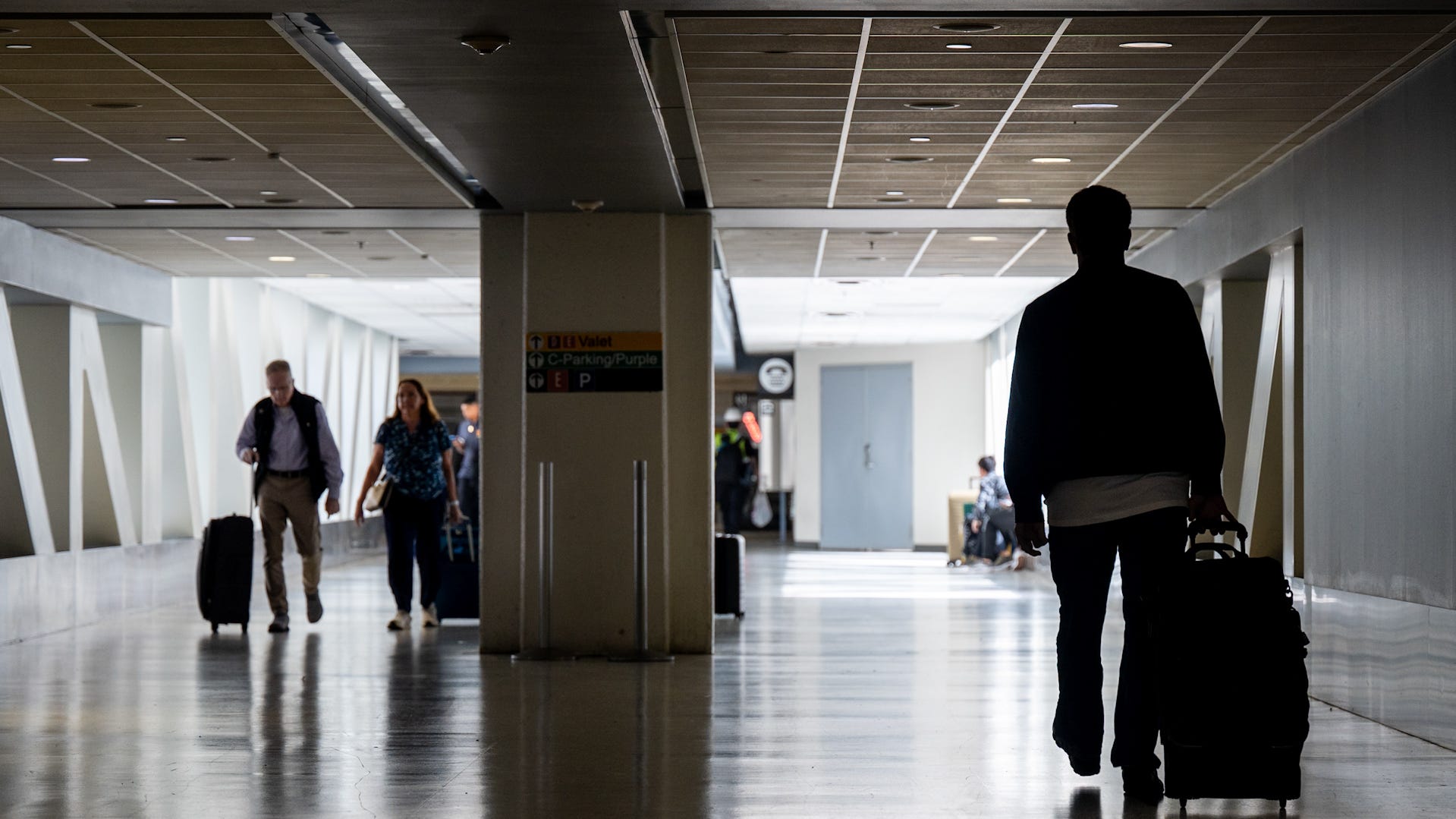
Travelers continue to face cancellations and delays as flight reductions due to the government shutdown enter their fourth day.

play

More than 1,400 flights were canceled Monday, the fourth day of confusion by federal transportation officials during the longest government shutdown in U.S. history.

About 5.5% of flights are affected, which is higher than the 4% reduction currently ordered by the Federal Aviation Administration to make up for the controller shortage. The cuts are set to rise to 10% by November 14, but it is unclear whether a resolution expected this week to end the shutdown will bring about any change.

Not all current cancellations are due to government-mandated flight reductions. A winter storm has hit the Chicago area, impacting both Chicago Midway and Chicago O’Hare flights. Aviation experts told USA TODAY that weather could exacerbate delays and cancellations.

Transport Secretary Sean Duffy warned on Sunday that disruption to air travel would increase.

“It’s only going to get worse,” Duffy said in an interview with CNN. “We’re going to see a very small drop in air travel two weeks before Thanksgiving.”

More than 2,600 flights were canceled on Sunday, making it the fourth worst day for cancellations since January 2024, according to aviation analytics firm Cirium. Cirium reported that just over 60% of flights departed on time and 30% were delayed for more than 30 minutes.

Lawmakers reached an agreement to end the shutdown on Sunday, two sources told USA Today late Sunday.

But there is still a winding road before lawmakers can actually turn on the lights, and the government has yet to reopen.

Here are the latest updates:

President Trump orders all air traffic controllers to return to work

President Donald Trump threatened to cut pay for air traffic controllers who don’t report to work after the Senate agreed to a compromise to end the government shutdown.

“All air traffic controllers must get back to work now!!!” President Trump said on social media on November 10. “Those who don’t will be effectively ‘grounded’.”

Air traffic controllers continued to work without pay during the shutdown. However, some were unable to arrive, leading to flight disruptions across the country.

FAA Administrator Brian Bedford said in early November that between 20% and 40% of air traffic controllers were not at work on any given day, Reuters reported.

More air traffic controllers are retiring since the federal government shutdown began on Oct. 1, Duffy said. He told CNN that the FAA is short 1,000 to 2,000 air traffic controllers.

President Trump called on air traffic controllers who do not report to work to resign. He promised to recommend $10,000 bonuses to air traffic controllers who kept their jobs.

“I recommend that the air traffic controllers, who are great patriots and did not take any time off because of the ‘Democrat Shutdown Hoax,’ be given a $10,000 bonus each for their service to our country,” Trump said. “For those of you who complained and took time off even though we all knew you would be paid your full salary in the near future, I’m not happy with you.”

–Bert Jansen

Overall, flying remains safe, but the FAA warns that safety-related incidents, particularly instances of aircraft coming too close to each other on the ground or in the air, have increased since the shutdown began.

Transportation Secretary Sean Duffy said that’s part of the reason he ordered the traffic reductions, which should make the public safer heading into the Thanksgiving travel season.

“When I saw the 10% cut at 40 major airports, my first impression was that it was disappointing because it would affect millions of travelers, but if it’s something that has to be done for the safety of travelers, there’s no question that it’s the right decision,” Haley Berg, chief economist at online booking platform Hopper, told USA TODAY.

–Zack Wictor

Even if lawmakers hammer out a deal to reopen the government this week, travelers shouldn’t expect the nation’s airports to return to normal immediately.

Flights have already been cut at 40 of the nation’s busiest airports to make up for a shortage of air traffic controllers, and experts warn the disruption will continue long after the closures officially end.

“There will be massive disruption to the air transportation system across the country,” Henry Harteveldt, an airline industry analyst and president of independent travel analysis firm Atmosphere Research Group, told USA TODAY. And the effects could last longer than the closure.

–Eve Chen

Duffy warns of Thanksgiving travel disruption before closure agreement

Speaking on CNN, Duffy warned that holiday travel could be affected if the shutdown continues.

“There are a lot of people who want to go home for the holidays, want to see their families and celebrate this great American holiday,” Duffy said. “Listen, a lot of them aren’t going to be able to fly because there’s not going to be that many planes flying unless this thing restarts.”

On November 7, he said the limit could jump to 15% or even 20% of all scheduled flights. Officials initially said travelers would see a 10% reduction in flights at 40 major airports last week.

Duffy and other aviation officials said the restrictive measures were necessary to ensure safety as air traffic controllers are short-staffed and the shutdown adds to the strain.

− Kathryn Palmer

What does the shutdown agreement include?

The shutdown deal agreed to by at least eight Senate Democrats includes reversing federal layoffs, a promised future vote on Obamacare subsidies and a full reopening of the government by Jan. 30.

It was the first time in more than a month that Congressional Republicans succeeded in persuading a significant number of their colleagues across the aisle to join them in supporting a government shutdown.

The FAA-mandated flight reductions were one of the most public and high-profile effects of the shutdown.

− Zachary Charmelet

Flight during shutdown

Two USA TODAY reporters flew during the restrictions on Sunday, Nov. 9.

Nathan Diller and Eve Chen faced different experiences in the air, with Diller reporting that the trip from Nashville to Fort Lauderdale was “as smooth as it was before the shutdown,” although Chen’s flight from Atlanta to Miami arrived three hours later than originally scheduled.

See what it looks like in restricted skies.

Which airports will be affected by the cuts?

The FAA has selected the following airports to experience a gradual increase in cancellations:

  • TPA – Tampa International Airport
  • ANC – Ted Stevens Anchorage International Airport
  • ATL – Hartsfield-Jackson Atlanta International Airport
  • boss – Boston Logan International Airport
  • BWI – Baltimore/Washington International Airport
  • CLT – Charlotte Douglas International Airport
  • CVG – Cincinnati/Northern Kentucky International Airport
  • Dal – Dallas Love Field
  • DCA – Ronald Reagan Washington National Airport
  • that – Denver International Airport
  • DFW – Dallas/Fort Worth International Airport
  • DTW – Detroit Metropolitan Wayne County Airport
  • EEA – Newark Liberty International Airport
  • FLL – Fort Lauderdale/Hollywood International Airport
  • HRT – Honolulu International Airport
  • new – William P. Hobby Airport
  • they are – Washington Dulles International Airport
  • IAH – George Bush Houston Intercontinental Airport
  • India – Indianapolis International Airport
  • John F. Kennedy – New York John F. Kennedy International Airport
  • Russ – Las Vegas McCarran International Airport
  • LAX – Los Angeles International Airport
  • local government – New York LaGuardia Airport
  • M.C.O. – Orlando International Airport
  • MDW – Chicago Midway International Airport
  • Mem – Memphis International Airport
  • mia – Miami International Airport
  • MSP – Minneapolis – St. Paul International Airport
  • oak – Auckland International Airport
  • ont – Ontario International Airport
  • ode – Chicago O’Hare International Airport
  • PDX – Portland International Airport
  • PHL – Philadelphia International Airport
  • PHX – Phoenix Sky Harbor International Airport
  • sun – San Diego International Airport
  • Self-Defense Forces – Louisville International Airport
  • sea – Seattle-Tacoma International Airport
  • SFO – San Francisco International Airport
  • SLC – Salt Lake City International Airport
  • TEB – Teterboro Airport

Is the government still closed? Latest information for November 10th

0

play

After more than 40 days, the end of the longest government shutdown in history appears to be in sight.

On November 9, the Senate voted 60-40 to advance a bipartisan agreement to fully reopen the government through January 30.

Seven Democrats and one independent who caucuses with Democrats crossed party lines to agree with Congressional Republicans on the negotiated deal. However, the closure that began on October 1st is not over yet.

The Senate, which must take a final vote to pass the funding deal, is scheduled to reconvene at 11 a.m. ET on Monday, Nov. 10. The bill will then pass the House of Representatives and need to be signed by President Donald Trump.

Here’s the latest information on the government shutdown as of Monday, Nov. 10:

Is the government still closed?

As of Monday morning, November 10th, the government is still closed.

The Senate voted to move forward with a deal to fully reopen the government on Nov. 9, but there are still several steps that need to be passed before the crisis officially ends.

The government shutdown ends when both the House and Senate pass funding, after which President Trump must sign the bill.

What needs to happen to end the government shutdown?

The Senate appears on track to approve a temporary funding measure to reopen the government through January 30, but votes are still needed to pass the deal.

If the Senate passes the continuing resolution, the House would have to vote on the agreement. If approved by Congress, President Trump would need to sign the bill.

House Minority Leader Hakeem Jeffries indicated that House Democrats would not support the bill. However, Republicans hold a narrow majority in the House of Representatives. A House vote has not yet been scheduled.

What you need to know about the agreement to end the government shutdown

The temporary funding measure advanced by the Senate on November 9th would allow the government to fully reopen until January 30th.

These include reversing federal layoffs, a promise to vote in the future on expiring Affordable Care Act grants, and allocating additional funding to the Supplemental Nutrition Assistance Program through next September.

As part of the deal, Congress will also refund other agencies and programs, including veterans benefits and military construction.

A key issue for Democrats during the shutdown is extending subsidies for the Affordable Care Act (also known as Obamacare), which are set to expire on December 31st. Without an extension, Obamacare premiums are scheduled to double.

In the latest agreement, Republicans in Congress agreed to vote on the aid, likely in the second week of December.

Melina Khan is USA TODAY’s national trends reporter. Contact her at melina.khan@usatoday.com.

Contributed by: Zachary Schermele, Joey Garrison, Bart Jansen, USA TODAY

President Trump pardons Rudy Giuliani and others accused of election interference

0


The pardons followed President Trump’s pardons on the first day of his second term for approximately 1,600 people charged in the Jan. 6, 2021, attack on the U.S. Capitol.

play

WASHINGTON – President Donald Trump has pardoned a number of allies, including his former personal lawyer and former New York City mayor Rudy Giuliani, who were being charged and investigated for interfering in the 2020 election.

In what he called a “process of national reconciliation,” the latest pardons for more than 70 people followed President Trump’s pardons on the first day of his second term for about 1,600 people charged in the Jan. 6, 2021, attack on the U.S. Capitol.

Others pardoned included Mark Meadows, Trump’s former White House chief of staff. Jeffrey Clark is a former assistant attorney general at the Department of Justice and currently works at the Office of Management and Budget. Kenneth Chesebro is a private attorney who previously advised Trump. The three men are facing state charges in Georgia related to election interference, and Chesebro has pleaded guilty.

“This proclamation ends the grave national injustices inflicted on the American people after the 2020 presidential election and continues the process of national reconciliation,” President Trump said in a Nov. 7 memo.

Ed Martin, Trump’s pardon attorney at the Department of Justice, announced the pardon in a social media post on November 9th. The pardon applies to “actions related to advising, preparing, organizing, executing, filing, supporting, voting, operating, participating in, or defending” the presidential slate of electors in the 2020 election, as well as “efforts to expose voter fraud,” the statement said.

“These great Americans were persecuted and put through hell by the Biden administration for challenging an election that is the bedrock of our democracy,” White House press secretary Caroline Leavitt said in a statement.

Federal pardons do not apply to state-level crimes. Many of the pardons were granted to people facing state-level indictments for election interference in Georgia and Arizona, including Mr. Giuliani, Mr. Meadows and Mr. Clark.

In Arizona, a state appeals court sent a case against Trump supporters back to a grand jury in 2024, citing complaints about the way evidence was presented to the first grand jury.

The Georgia case, which charges Trump and more than a dozen allies, is on hold pending a new prosecutor after the state Supreme Court fired Fulton County District Attorney Fani Willis over her relationship with another prosecutor in the case.

Clark said Trump called him on Nov. 7 to inform him of the pardon, which he said he had not requested.

“I did nothing wrong when I questioned Georgia’s 2020 election, including drafting an unsent privileged letter urging Georgia officials to launch their own investigation and decide for themselves how to proceed,” Clark said in a social media post on Nov. 10. “I shouldn’t have had to fight this witch hunt for over four years.”

Stock futures soar after vote to reopen government

0

play

U.S. stock futures soared on Monday as an end to the government shutdown appeared in sight.

Futures tied to the S&P 500 are expected to rise nearly 1%, or 63 points, and the Dow Jones Industrial Average is expected to open up 178 points, or 0.4%. Nasdaq futures were up 1.5%, or about 375 points, as of 8:40 a.m. New York time.

The market frenzy came after the Senate voted 60-40 late Nov. 9 to advance legislation to end the government shutdown. Eight Democratic senators have broken long-standing demands on health care policy and joined with 52 Republicans to end the filibuster that blocked the bill.

Government reopening is not yet over. The Senate is scheduled to reconvene at 11 a.m. ET. The House must then vote on the bill again before sending it to President Donald Trump.

Still, U.S. industry has weathered Washington’s ups and downs this year better than many expected, especially the uncertainty surrounding tariffs. According to FactSet analysis, the proportion of S&P 500 companies reporting positive windfall earnings is above the 10-year average, but the size of windfall is on par with the 10-year average.

And on Nov. 9, Goldman Sachs analysts weighed in on the continued strong rise in AI stocks.

“While valuations are high, our equity strategists maintain that we are not clearly in bubble territory yet,” the group said, adding: “There is nothing stopping the market from accumulating further upside. Indeed, the lesson of past bubbles is that investors can sacrifice significant profits by exiting too early, given that prices can rise well above fundamental values.”

Ghislaine Maxwell asks President Trump to commute 20 years in prison

0

play

Aides to late sex offender Jeffrey Epstein intend to ask President Donald Trump to commute his sentence, according to reports from Politico and CBS News.

Ghislaine Maxwell was convicted in 2021 of five counts of sex trafficking and several other related charges and sentenced to 20 years in prison.

In July, she was interviewed by the Justice Department and then transferred from a Florida prison to a low-security facility in Texas.

The Senate reaches a deal and the shutdown is about to end. live updates

0


A vote in the Senate is scheduled for Monday, and House members have been given 36 hours’ notice to return.

play

WASHINGTON – The longest government shutdown in history is nearing an end, as food aid payments stall and flight cancellations and delays confuse travelers.

The U.S. Senate on Sunday took a major step towards voting on a bipartisan deal reached between some Democrats, Republicans and President Donald Trump’s White House to fully reopen the government through January 30.

The agreement would also continue funding for a variety of other federal programs, including food stamps and veterans benefits, into next year.

The decision by a group of moderate Senate Democrats to break away from the rest of the party marks the biggest turning point since the government shutdown began on October 1, but it deals an immediate political blow to them.

The pain for millions of Americans has steadily increased in recent weeks, and pressure on lawmakers to come together has ratcheted up. Air travel is in chaos. Flight cancellations and delays over the weekend wreaked havoc on many Americans’ plans, and federal transportation officials warned that air travel will worsen if the government doesn’t reopen soon.

Meanwhile, the U.S. Department of Agriculture on Sunday directed states to reverse course on helping provide food assistance benefits, in the latest back and forth over the Supplemental Nutrition Assistance Program (SNAP) since the funds expired for the first time in history earlier this month. This follows a U.S. Supreme Court order that allowed the Trump administration to continue to set aside $4 billion to fully fund the program that provides food stamps to approximately 42 million low-income Americans.

The Senate is scheduled to vote again on Monday, November 10th.

U.S. stock futures soared on Monday after a Senate vote cleared the way for the government to reopen.

As of 9 a.m. ET, futures for the S&P 500 were expected to rise 1%, or about 65 points, and the Dow Jones Industrial Average was expected to rise 177 points, or 0.4%. Futures on the Nasdaq Composite Index, which has a high proportion of high-tech stocks, rose 1.5% (386 points).

Stocks have weathered the shutdown well so far, but there are signs of tension among publicly traded companies tied to government spending.

Defense contractor General Dynamics said on an earnings call in late October that it was managing uncertain cash flow with short-term debt. “The longer[the shutdown]lasts, the greater the impact will be, especially on short-cycle businesses. Predictions in this environment are difficult at best and less reliable than we would like,” CEO Febe Novakovic told analysts.

Still, with earnings season nearly over, the percentage of S&P 500 companies reporting positive surprises is higher than the 10-year average, according to FactSet analysis.

– Andrea Riquier

Sen. Susan Collins (R-Maine), chair of the Appropriations Committee, said the temporary funding bill to restart the government would provide back pay to all federal employees.

The bill includes three spending bills for military construction and veterans, agriculture, and the Legislature that received bipartisan support from the Senate on Aug. 1.

“Under our legislation, all federal employees, including military and Coast Guard members, Capitol Police officers, Border Patrol agents, TSA screeners, and air traffic controllers, will all receive back pay,” Collins said on the Senate floor Sunday.

The agriculture portion of the measure funds SNAP food benefits and the Women, Infants, and Children (WIC) program year-round. That means that even if lawmakers reach an impasse on Jan. 30, these programs are not at risk of being cut off in another shutdown.

“One of the most unfortunate and shameful consequences of this closure is that it has put these critical nutrition programs at risk for our most vulnerable families, including the 170,000 Maine residents who rely on the SNAP program,” Collins added.

– bert jansen

A deal to end the government shutdown will not only divide Democrats, it will divide families.

Stephanie Shaheen, a Democrat running for New Hampshire Congress and the daughter of former Granite State Sen. Jeanne Shaheen, blasted the shutdown agreement because it does not include an extension of federal health care funding that many Democrats are seeking.

“We need to end this shutdown and extend health benefits,” Stephanie Shaheen wrote on social media. “Otherwise, there will be no contract.”

Jeanne Shaheen was among eight Democrats who approved the closure agreement. Her daughter is running in the Democratic primary to replace Rep. Chris Pappas, who is running for the Senate seat vacated by Jeanne Shaheen.

Many Democrats are pushing hard for a closure agreement, and it could become an issue in the primary contest between Stephanie Shaheen and five other Democrats.

– zach anderson

The Trump administration needs to tell the Supreme Court today if it wants the justices to put on hold the appeals court’s decision that November’s SNAP food benefits must be paid in full.

Supreme Court Justice Ketanji Brown Jackson issued the order Monday morning after the Boston-based 1st Circuit Court of Appeals late Sunday upheld a federal judge’s order to fully fund the food stamp program this month despite the government shutdown.

Jackson suspended the judge’s order Friday. But she set that order to expire 48 hours after the appeals court’s ruling.

Jackson set a Tuesday morning deadline for cities, nonprofits and others to respond to the administration’s appeal. The government’s emergency request on Friday was handled by Mr. Jackson, as he is responsible for requests in that part of the country.

It is unclear whether a congressional deal to end the government shutdown would eliminate the need for a legal challenge.

– maureen groppe

Sen. John Fetterman (D-Pa.), who along with Republicans has repeatedly voted in favor of reopening the government, apologized to Capitol Police officers who worked without pay during the government shutdown and to SNAP recipients whose food benefits were delayed.

“This should not have happened,” Fetterman said in a statement. “This was a failure.”

– bert jansen

Under the agreement to reopen the government, federal food assistance will be funded at higher levels through 2026, but for now the Supplemental Nutrition Assistance Program remains in limbo.

SNAP benefits, also known as food stamps, expired this month for the first time in the program’s 60-year history. A federal judge ordered the Trump administration to pay the full amount of monthly food benefits, but the Supreme Court suspended the ruling on Nov. 7, allowing the government to make some payments.

The legal dispute means 42 million Americans receiving benefits will go into the weekend wondering how much aid they will receive and when.

– zach anderson

Travelers faced thousands of flight cancellations and delays Monday as restrictions imposed by federal transportation officials in connection with a historic government shutdown extended into a fourth day.

The disruption comes as more than 10,000 flights in and out of the United States were delayed on Sunday, the most disruptions in a single day since the government shutdown began, according to FlightAware.

Transport Secretary Sean Duffy warned on the same day that disruption to air travel would worsen as the country heads into the end-of-year busy season. Even if lawmakers hammer out a deal to reopen the government this week, travelers shouldn’t expect operations at the nation’s airports to return to normal anytime soon.

– N’Dare Yancey Bragg

Thousands of laid-off federal workers will keep their jobs as part of a deal to end the federal government shutdown.

The Trump administration began layoffs on October 10, citing the need to cut costs during the shutdown, but they were put on hold by a federal judge in California. The judge also halted pending layoffs.

In addition to canceling layoffs, the closure agreement also prohibits new layoffs until January 30th.

– zach anderson

Democrats are divided over a Senate compromise that would reopen the government by ensuring a vote on extending subsidies under the Affordable Care Act, even as SNAP food benefits are cut off and flight disruptions are at their peak.

Most Senate Democrats opposed ending the government shutdown unless the program’s tax credits, also known as Obamacare, are extended when they expire Dec. 31. But eight senators who caucused with Democrats joined Republicans to break the deadlock.

“Entering this agreement is illegal,” New Jersey Governor-elect Mikie Sherrill said in a statement.

“Pathetic,” California Governor Gavin Newsom wrote in a one-word post about X.

However, most Senate Democrats remained opposed to the compromise.

“We cannot support an agreement that still leaves millions of Americans with questions about how they will pay for their health care and whether they can afford to get sick,” said Sen. Mark Warner (D-Va.).

– Joey Garrison and Bert Jansen

Who were the eight Democrats who voted to advance the spending bill?

In a major change, senators late Sunday night cleared a procedural hurdle to begin the process of ending the shutdown.

Seven Democrats and one independent senator, Angus King of Maine, who caucuses with Democrats, voted to move forward with a funding deal that could reopen the government as soon as this week, along with most other Republicans.

Here is the complete list of Democrats who voted in favor of the spending bill:

  • you. Catherine Cortez Masto of Nevada
  • Senator Jacky Rosen of Nevada
  • Senator Maggie Hassan (New Hampshire)
  • Senator Jeanne Shaheen (New Hampshire)
  • Senator Dick Durbin of Illinois
  • Senator Tim Kaine (Virginia)
  • Senator John Fetterman (Pennsylvania)
  • Senator Angus King of Maine

Senate Minority Leader Chuck Schumer (D-N.Y.) voted against the bill.

What happens next?

Now that some Democrats have expressed renewed support for reopening the government, Congress must clear a number of procedural hurdles.

Once the new funding deal passes the Senate, which could pass as early as Monday, the package would then have to pass the House, which has not held a vote for weeks. House members have been given a 36-hour notice to return, so it will likely take several days (barring travel issues for members) to pass the Senate bill.

Senate Minority Leader John Thune (R-South Dakota) said last week that he did not expect the shutdown to last beyond Thanksgiving.

What is the contract?

The agreement includes reopening government offices through Jan. 30 and provides year-round funding for several agencies and programs, including food assistance and benefits for veterans. Supplemental Nutrition Assistance Program (SNAP) funding is expected to continue at the higher level through September.

Another element of the agreement includes a promise to hold a vote in the second week of December on legislation that could extend expired Obamacare subsidies. Tax credits, which millions of Americans rely on to help pay their insurance premiums, are a central issue in the shutdown fight.

Additionally, the agreement cancels layoffs for thousands of federal workers and prohibits potential layoffs until January 30th. Terminations have been temporarily prohibited by a federal court.


‘Star Wars’ protests against National Guard lead to arrests, lawsuits

0


Sam O’Hara’s protests have exploded on social media. Although he said he had “great respect” for the military, he criticized its presence in cities, including Washington, D.C.

play

  • Sam O’Hara started playing “Imperial March” from “Star Wars” behind a National Guard unit in Washington, D.C., in late August. His TikTok post showing the interaction received millions of views.
  • An Ohio National Guard sergeant called police in O’Hara on Sept. 11. He was accused of harassing the military, but O’Hara disputed the allegations.
  • The ACLU is suing various officials on O’Hara’s behalf, alleging, among other things, that O’Hara’s First and Fourth Amendment rights were violated.

Sam O’Hara was walking his 10-year-old rescue dog, Lincoln, a Dashund mix, near Dupont Circle in Washington, D.C., in late August when he saw two National Guard soldiers patrolling the area.

“The idea that they looked like stormtroopers kind of crossed my mind,” O’Hara, 35, said.

So he opened Spotify on his phone, pulled up the iconic Star Wars theme “Imperial March,” and started playing it out loud.

O’Hara doesn’t own a lightsaber, but said he has watched every Star Wars movie and “always identified with the Rebels.”

This song, composed by John Williams, symbolizes Darth Vader and the evil Galactic Empire. He thought playing it behind troops, recording the interaction and posting it to TikTok was a creative and peaceful way to protest what he described as an unnecessary and unrest-inducing National Guard presence in the city.

President Donald Trump sent the military in August to combat crime and homelessness in the nation’s capital, an effort that was met with resistance from many Washington residents.

“I’m not anti-National Guard or anti-military,” O’Hara said. “I have a lot of respect for people who join the military and decide to join to protect their country. My problem is that people are here under orders that I don’t agree with, and I’m protesting against that.”

He said the National Guard soldiers he approached on the first day responded obediently, adding that in subsequent encounters other soldiers responded with smiles and waves.

But September 11th was different.

As a result of that day’s events, the American Civil Liberties Union filed a complaint against authorities on O’Hara’s behalf, alleging violations of his First and Fourth Amendment rights.

According to an Oct. 23 complaint filed against the city and the Ohio National Guard, O’Hara began walking behind four Ohio National Guard members in the Logan Circle area and began playing the song — just as he had done several weeks earlier.

Less than two minutes later, the complaint says, an Ohio National Guard sergeant “turned around and threatened to call in D.C. police officers and ‘deal with’ Mr. O’Hara if he persisted.”

O’Hara continued to protest, at which point D.C. Metro Police were called to the scene and handcuffed him for harassing military personnel, according to the complaint. He has denied the accusations made at the time of the incident, repeating in his complaint that he did not harass or obstruct military personnel.

According to the complaint, O’Hara complained that he was handcuffed for 15 to 20 minutes and that no effort was made to loosen his handcuffs.

“A long time ago, in a galaxy far, far away, this type of government action may have been legal,” the complaint says. “Right now, however, the First Amendment prohibits government officials from shutting down peaceful protests, and the Fourth Amendment, along with the District’s prohibition on false arrests, prohibits baseless seizures.”

Both the Washington City Attorney’s Office and the Washington National Guard’s Joint Task Force said they could not comment on pending litigation.

First Amendment protects records of protests and officials

Music has long been used as a form of protest and solidarity, from spirituals by enslaved people to demonstrators during the civil rights movement, said David Cole, a constitutional law professor at Georgetown Law School.

He said O’Hara was continuing that long-standing tradition with his actions, exercising his constitutional right to publicly challenge government officials and record them doing their jobs.

However, these rights are subject to limitations.

The government is allowed to enforce time, place, and manner restrictions that are content-neutral, and protests cannot disrupt the work of law enforcement. However, Cole saw no evidence that O’Hara violated these restrictions based on the information presented in the ACLU’s complaint.

“He made fun of the role they were playing, and they were offended by it, that’s all,” he said. “There’s no allegation that for some reason they couldn’t do their job because someone was making fun of them.”

Michael Perloff, an attorney with the ACLU, echoed Cole’s sentiments, saying O’Hara’s conduct was “entirely consistent with the type of conduct that courts have determined is protected by the First Amendment.”

“I don’t think this is a borderline case,” he said.

Incidents and lawsuits “were not on the bingo card for 2025”

O’Hara previously lived in Massachusetts and Florida before moving to Washington, D.C., in 2015 and has since participated in numerous protests, including the Women’s March in 2017 and the People’s Climate March later that year.

He has lived in various neighborhoods, including Adams Morgan, Capitol Hill, and Dupont Circle, and describes the city as “very formative” for him as an adult.

He also described it as “gorgeous” and “amazing”.

In other words, O’Hara’s view is very different from how President Trump has characterized the city in justifying his move to call up the military. Although crime rates have fallen in recent years, he describes the city as “dirty, disgusting” and unsafe.

O’Hara said his protests have received an “overwhelmingly positive” response, and some TikTok users have expressed interest in doing the same in cities like Portland, where President Trump is also pushing for the deployment of troops.

“I think the negative people in the comments are people who don’t live in Washington, D.C., who don’t understand what it’s like to live in a once-beautiful city and one day have armed National Guardsmen with giant rifles standing in front of a subway station,” he said. “That’s insane.”

He said being a central figure in a First Amendment lawsuit against his beloved city was “not on the bingo card for 2025,” but the feeling of being part of a larger movement against the Trump administration outweighed his preference for a quiet, private life.

He hopes the case will be resolved quickly and that the law enforcement and military personnel involved will receive training on protesters’ rights. He said he would welcome an apology, but “I’m not holding my breath.”

Cole said the lawsuit could have an impact beyond O’Hara’s personal case.

“It’s about ensuring more broadly that law enforcement, whether it’s local police or the National Guard, respects our constitutional rights, even when we’re exercising them in ways that violate those rights,” Cole said. “It would be a good thing if the government could learn that lesson.”

Breanna Frank is USA TODAY’s First Amendment reporter. Please contact bjfrank@usatoday.com..

USA TODAY’s coverage of First Amendment issues is funded by the Freedom Forum in collaboration with our journalism funding partners. Funders do not provide editorial input.

Why the problem of flight reductions will not be resolved immediately even after the grounding ends

0

The Senate took the first major step toward ending the longest government shutdown in U.S. history Sunday night, voting 60-40 to advance a deal that could reopen the government within days. But even if lawmakers finalize a deal this week, travelers shouldn’t expect the nation’s airports to return to normal immediately.

Flights have already been cut at 40 of the nation’s busiest airports to make up for a shortage of air traffic controllers, and experts warn the disruption will continue long after the closures officially end.

“There will be massive disruption to the air transportation system across the country,” Henry Harteveldt, an airline industry analyst and president of Atmosphere Research Group, an independent travel analysis firm, told USA TODAY. And the effects could last longer than the closure.

Impact on flights: ‘Connecting passengers may be at further risk’

The Department of Transportation and the Federal Aviation Administration ordered 40 airports to reduce flights by 10%, starting Nov. 7 with a 4% reduction in flights.

“Flight reductions will be phased in in stages,” Harteveldt said. “It will start on Friday with a 4% reduction in flights, and increase from there in stages to 10%.”

Some airlines cancel flights in advance to avoid congestion at the airport on the day.

“Airlines need to consider the flow of aircraft and crew when canceling flights. It’s not just canceling one flight; that aircraft and crew are supposed to continue later in the day,” Ahmed Abdelghani, associate dean for research at Embry-Riddle Aeronautical University’s David B. O’Malley College of Business, told USA TODAY. “Thus, airlines with more round-trip loop flights in their schedules are in a better position to deal with cancellations. If you cancel both flights in a loop, the aircraft and crew will be placed in a suitable location later. This will avoid stranding the aircraft and crew, which will enable recovery.”

Affected airports include hubs such as Hartsfield-Jackson Atlanta International Airport, Chicago O’Hare International Airport and Los Angeles International Airport, but Shai Gilad, a professor of management practice at Georgetown University’s McDonough School of Business, said travelers at other airports will also be affected.

“Transit passengers are potentially at even higher risk and are likely to experience higher fares, fewer flights and fewer options,” and their layovers may be significantly longer than usual, he said, noting that airlines may raise prices to make up for lost revenue. Gilad has been an airline pilot for 10 years and his areas of expertise include the aviation industry.

Airlines are trying to minimize the impact on travelers, and Harteveld compared the challenge to dismantling Humpty Dumpty without breaking it into 1,000 pieces.

“Even though the government says they have 36 hours or so to start dismantling their carefully constructed flight schedules, that doesn’t give airlines a lot of time,” he said, noting that in addition to staffing, airlines are juggling gates, maintenance schedules and passenger demand. He said it is fortunate that demand is relatively low at the moment, which means flights have already been reduced compared to the summer. “So many airlines’ flights are often close to full or completely full, leaving airlines with little flexibility.”

Story continues below.

play

How to prepare for Department of Transportation flight reductions during government shutdown

USA TODAY’s Nathan Diller has travel tips to survive DOT’s reduced flights during the government shutdown.

The effects of cuts continue even after closures end.

Airlines could become even less flexible in the coming weeks.

“We have to remember that this is a reduction of up to 10% only based on staffing, but that doesn’t mean other types of delays won’t occur, such as weather or mechanical issues,” Gilad said. “These types of disruptions will continue to occur, and reducing capacity…makes it harder to recover. That could create problems because there are fewer aircraft and fewer employees in the system to recover.”

He and Haldefeldt warned that depending on how long the cuts last, some Thanksgiving travel plans could be upended or at least changed.

“That could mean more traffic on the highways and perhaps other forms of transportation, or it could just mean people not being able to travel at all… and having to opt out of spending time with their families over the holidays,” Gilad said.

If people choose not to travel, there will be a downward impact, not only on airline and airport concessions that will be economically affected, but also on potentially fewer visitors at the destinations they travel to, Hadefeld said.

This situation may be avoided if the shutdown ends early. But there are already lasting effects.

Transportation Secretary Sean Duffy told CNN that the number of air traffic controllers retiring has increased since the federal government shutdown began on October 1. He added that the FAA is short 1,000 to 2,000 air traffic controllers. The FAA reported early Sunday that there were staffing issues at 12 towers.

“I paid experienced controllers to keep their jobs and not retire,” Duffy said. “Whereas we used to retire about four controllers the day before a shutdown, we are now retiring up to 15 to 20 controllers a day.”

Hopper analyst Haley Berg said, “This capacity restriction will not be lifted the same day the shutdown ends. The proviso is that this capacity reduction will not be lifted until air traffic control and the FAA are operating at staffing levels…Even if these employees are paid and furloughed, it may not be lifted immediately.”

Abdelghani agrees: “Even if the government reopens, the recovery will still take time. Capacity cannot absorb everyone, so some passengers will have to be refunded and removed from the system. The severity and duration of this reduction will determine how long the recovery will take.”

Social Security benefits are scheduled to be sent on November 12th.

0

play

The first round of Social Security payments for November is scheduled to be distributed this week, with less than two months left until the next cost-of-living hike goes into effect.

The increase comes on the heels of the majority of payment recipients being forced to switch to receiving money via direct deposit into bank accounts or Direct Express cards.

The change from paper checks to direct deposit follows President Donald Trump’s executive order to stop the federal government from issuing paper checks, with a compliance deadline of Sept. 30.

Here’s what you need to know about this week’s Social Security payments.

Who will receive Social Security payments this week?

Beneficiaries born between the 1st and 10th of their birth month are supposed to receive their monthly Social Security benefits on Wednesday, Nov. 12, according to the SSA payment calendar.

When will my Social Security payments be sent?

Social Security benefits, which are paid primarily to elderly or retired beneficiaries, are typically paid on Wednesdays.

According to the SSA calendar, if the recipient’s birthday is between the 1st and 10th of the month, payments will generally be made on the second Wednesday of the payment month. Those born from the 11th to the 20th will receive the allowance on the 3rd Wednesday, and those born after the 20th will receive it on the 4th Wednesday.

People who received Social Security benefits before May 1997 can receive their payments on the third day of the month, excluding weekends and holidays.

For people who receive both Social Security and Supplemental Security Income (SSI), Social Security payments are made on the 3rd of the month and SSI payments are made on the 1st of the month.

visualization

SSI payment schedule for November, remainder of 2025, and through 2026

Recipients of Supplemental Securities Income (SSI) checks were set to receive payments on the first business day of the month, November 1, 2025, but because that day was a Saturday, the checks were shipped in the early morning hours of October 31, 2025.

According to the SSA calendar, SSI checks will be mailed on the following days in 2025 and early 2026:

  • Monday, December 1, 2025 (confirmed in December 2025)
  • Wednesday, December 31, 2025 (confirmed for January 2026)
  • Friday, January 30, 2026 (confirmed for February 2026)
  • Friday, February 27, 2026 (check for March 2026)

Fernando Cervantes Jr. is a trending news reporter for USA TODAY. Contact us at fernando.cervantes@gannett.com and follow us at X @fern_cerv_.

Thousands of people who dreamed of living in the United States are now turning back

0

Monday, November 10, 2025 episode of the podcast The Excerpt: For the first time in decades, migration flows are reversing. The Arizona Republic’s Daniel Gonzalez joins The Excerpt to explain why thousands of immigrants are giving up on their American dreams and what that means for the region’s future.

Press play in the player below to listen to the podcast and follow the transcript below. This transcript was automatically generated and edited in its current format for clarity. There may be some differences between audio and text.

Podcast: For true crime stories, in-depth interviews, and more USA TODAY podcasts, click here

Dana Taylor:

President Donald Trump has called for border security and the deportation of illegal immigrants he views as dangerous criminals. Since taking office, his administration has pursued aggressive enforcement policies, deploying ICE agents, conducting workplace and neighborhood cleanups, and stepping up deportations. As a result, immigrants planning new lives in the United States are increasingly reconsidering the dangerous journey north. Welcome to USA TODAY Excerpt, I’m Dana Taylor. Today is Monday, November 10, 2025. President Trump’s crackdown on illegal immigration is currently helping reverse the influx of people in Mexico and Central America. Daniel Gonzalez, a longtime immigration reporter for the Arizona Republic, traveled to Mexico’s southern border and Panama to speak with immigrants who are reevaluating the American dream.

Daniel, thank you so much for joining us on The Excerpt.

Daniel Cox-Gonzalez:

Thank you so much for having me.

Dana Taylor:

Let’s start with what the number of people crossing the border is currently. How drastic is the U.S.-Mexico border changing?

Daniel Cox-Gonzalez:

The impact on the southern border is very dramatic. I’ve been writing about immigration here in Arizona for 25 years, and I’ve never seen so few people cross the border as we are now. We visited the border extensively in April and saw very few migrants crossing. This is a very remarkable and dramatic drop in migration following the record number of encounters that have occurred over the past four years. As an example, in August 2023, across the border, there were 232,000 encounters with illegal aliens along the southern border. In August of this year, there were 9,000 people. So this tells us how significantly fewer people are trying to enter the United States at the border – asylum seekers and people trying to enter the country illegally.

Dana Taylor:

Daniel, immigration is not only slowing down, it’s even reversing, with many would-be border crossers turning around and heading back south. where will they go? Are they returning to their home country?

Daniel Cox-Gonzalez:

Now, when I visited the southern border of Mexico and Panama, I encountered a new and increasing phenomenon: people heading south. Those heading south include immigrants who were on their way to the U.S. and decided it wasn’t worth continuing their journey to the U.S. after hearing about the government shutdown, hearing that immigrants who entered the country illegally were being arrested and facing criminal charges, and seeing footage of aggressive ICE arrests in cities across the country. Many of the migrants heading to the United States come from very specific countries, primarily Venezuela, Cuba, and Haiti, and the migrants we met along the way were trying to return to Venezuela or another country in the region where they felt they might have a better life.

Dana Taylor:

I want to talk about the people you talked about, many of whom wanted to come to the United States, some even wanted to sell everything they had and come north. Please tell me about one of them.

Daniel Cox-Gonzalez:

When I arrived in Panama, we drove to this small fishing boat pier. There were people gathered there, all holding plastic bags. And what they were doing was getting ready to board a fishing boat to go back to Colombia and then back to Venezuela. Then I met a man. A young man, probably in his late 30s, he was with his father who was in his 60s, and then they were with their extended family. There were 9 people in total. And what happened to them was that they were trying to get to the United States, stopping in Chiapas, Mexico, doing construction work there, trying to save enough money to get to the U.S. border, and also waiting to see if these policies would continue.

And when they realized there was really no hope of entering the United States, they decided to change direction. So they have already come back from southern Mexico through Central America and are now in Panama waiting to board a ship back to Venezuela. And they sold everything they owned in Venezuela to start this journey, and now they were borrowing money to go back to Venezuela. I remember asking the man, “What’s going through your mind right now as you prepare to board this ship?” And the man kind of choked up and said, “I’m happy because I’m going back to Venezuela with my family, but I’m sad because I gave up everything for the hope of achieving the American dream.” And they had to give it up. And he also said, “We don’t know what situation Venezuela will return to.”

As many know, the economic and political situation in Venezuela is very dire, and tensions are currently rising between the United States and Venezuela due to the U.S. military’s attack on a suspected drug-trafficking ship that left Venezuela. So they had very mixed emotions because it was still a very dire situation.

Dana Taylor:

Daniel, this dramatic slowdown in migrants coming across the border is a sure win for the Trump administration. What do policy experts say about this?

Daniel Cox-Gonzalez:

There’s no question that this is a solid victory for the Trump administration, and that’s what they campaigned on, and they were able to achieve it in a very short period of time. And we’re seeing these dramatic changes even though the Trump administration has only been in office for a few months. But what policy experts say is that migrants themselves have not disappeared; they have not just disappeared; the conditions in which they fled in their countries have not changed, and in some countries, the situation has worsened. So this pressure is increasing in Latin America right now. We have to recognize, for example, that many of the migrants who left Venezuela, 8 million Venezuelans have been forced to leave their country since 2014, many of whom have never been to the United States, lived in neighboring countries of Venezuela, and now some are returning to those countries.

So what policy analysts have told me is that there is this inflationary effect happening in Latin America right now. The situation there is not changing, and migrants are waiting out the situation to find a better life, which could lead to another big surge at some point in the future.

Dana Taylor:

Daniel, you have clearly studied this issue in depth for a very long time. What long-term policies would allow either the United States or Latin American countries to address the root causes, rather than just the symptoms of immigration?

Daniel Cox-Gonzalez:

We’ve been interviewing experts working on these issues for years. What they tell us is that long-term solutions have to do with first of all addressing the root causes in the countries from which migrants are flowing. And those are very complex issues. Economic needs, jobs, opportunities, political stability, organized crime, gang violence, extortion, corruption… These are different kinds of reasons why immigrants leave their countries, and they are very, very complex problems with no short-term solutions, solutions that have to be addressed over years and decades. And if anything, what we’re seeing now is a reversal of that. Because many of these countries are receiving millions of dollars in aid from the United States that was supposed to provide them with some stability, some job opportunities, some security, but now has been eliminated and crushed by the Trump administration.

And another long-term problem, experts say, is that so many sectors of our economy rely heavily on immigrant labor sectors, such as construction, hospitality, agriculture, caregivers, and elder care…But right now, our immigration system doesn’t have clear opportunities for people who want to come and meet these labor needs. People always say, well, people can come the legal way, well, the legal way in the United States right now is you have to be a lawful permanent resident or a U.S. citizen who is in the United States and have someone to sponsor you, or you have to have an employer who can sponsor you. These are the main ways to come to the US legally. If you’re like many immigrants who come to the United States and want to come here for a chance to build a better life, in most cases those opportunities don’t exist.

Dana Taylor:

You’ve been covering the border for years, and like I said, you’ve seen multiple administrations try to address immigration issues, but how does this moment compare to changes you’ve witnessed in the past, like the caravan era or Title 42 deportations?

Daniel Cox-Gonzalez:

Different Democratic and Republican administrations have tried different solutions to address border issues, but often the primary way to address border issues is primarily through an enforcement-only lens. And it has been done by both Democrats and Republicans. For example, under the Clinton administration, we just started to see the border become more fortified under “Operation Gatekeeper” and “Operation Hold the Line.” But what we are seeing now, with border-wide effects such as a near complete cut off of access to asylum at the border, arrests and prosecutions of people crossing the border, including asylum seekers, and an aggressive posture by ICE across the country in cities like Chicago and Los Angeles, is arguably the most dramatic and hardline stance against immigration we have ever seen on this scale. And this is really just the beginning.

Under the so-called Big Beautiful Act, tens of billions of dollars will be dedicated to immigration and border enforcement over the next few years, and in reality, broader border and immigration enforcement is only just beginning, and it will also see a major expansion of ICE detention facilities that will hire thousands more Border Patrol and ICE agents and install machinery to conduct larger-scale immigration enforcement.

Dana Taylor:

Daniel Gonzalez is an immigration reporter for The Arizona Republic, a member of the USA TODAY Network. Thanks for joining us on The Excerpt, Daniel.

Daniel Cox-Gonzalez:

Thank you for having me.

Dana Taylor:

We would like to thank Senior Producer Kayley Monaghan and Executive Producer Laura Beatty for their production assistance. Let us know what you think about this episode by sending a note to podcasts@usatoday.com. Thanks for listening, I’m Dana Taylor. We’ll be back tomorrow morning with another episode of USA TODAY Excerpts.

Microsoft’s next big bet on AI: Building a humanist superintelligence

0

Microsoft is forming a new team to research superintelligence and other advanced artificial intelligence.

Mustafa Suleiman, head of Microsoft’s AI division that oversees Bing and Copilot, announced the creation of the MAI Superintelligence Team in a blog post. He said he would lead the group and that Microsoft would invest “significant amounts of money” into the effort.

“We do this to solve real, concrete problems, and we do it in a way that keeps us grounded and controllable,” Suleiman wrote. “We are not building some ill-defined, ethereal superintelligence. We are building practical technology clearly designed to serve humanity.”

Building a “humanist” approach to superintelligence

The move comes as major technology companies compete for top AI researchers. Facebook’s parent company, Meta, recently formed its own Meta Superintelligence Labs, spending billions of dollars on hiring experts and even offering up to $100 million in signing bonuses. Suleiman would not comment on whether Microsoft intended to take up such an offer, but said the new team would include both internal talent and new hires, with Karen Simonian serving as lead researcher.

Before joining Microsoft, Suleiman co-founded DeepMind, which was acquired by Google in 2014. He then led AI startup Inflection, which was acquired last year along with several Microsoft employees.

The employment push reflects broader trends. Since OpenAI released ChatGPT in 2022, companies have been racing to bring generative AI into their products. Microsoft uses OpenAI’s models in Bing and Copilot, but OpenAI relies on Microsoft’s Azure cloud to power its tools. Microsoft also owns $135 billion in OpenAI stock after its recent reorganization.

Reduce dependence on OpenAI

Despite the partnership, Microsoft has worked to diversify its AI sources to lay the foundation for future superintelligence research. After acquiring Inflection, the company began experimenting with models from Google and Anthropic, another AI startup founded by former OpenAI executives.

A new Microsoft AI research group aims to build useful AI companions to help people in education and other fields. Suleiman said the team will also focus on projects in healthcare and renewable energy.

A different path than your rivals

Suleiman said that unlike some of its peers, Microsoft is not trying to build an “infinitely capable generalist” AI. He doubts that such a system can be brought under control, and instead wants to develop what he calls a “humanist superintelligence,” an AI that responds to human needs and benefits the real world.

“Humanism requires us to always ask the question: Does this technology serve the interests of humanity?” he said.

While the risks of AI are widely discussed, from bias to existential threats, Suleiman said his team’s goal is to create expert systems that achieve “superhuman performance” without posing significant risks. He cited examples such as AI that can improve battery storage or design new molecules, as well as DeepMind’s AlphaFold project that predicts the structure of proteins.

The arrival of medical superintelligence

Suleiman said Microsoft is particularly focused on healthcare and predicts that AI capable of expert-level diagnostics could emerge within the next two to three years.

He described it as a technology that can reason through complex medical problems and detect preventable diseases earlier. “We can deliver expert-level performance across all diagnostics, as well as advanced planning and prediction in the clinical setting,” he wrote.

As investors question whether large investments in AI will be profitable, Suleiman stressed that Microsoft has set clear limits. “We are not going to build superintelligence indefinitely at all costs,” he said.

(Photo courtesy of Praswin Prakashan)

SEE ALSO: Microsoft offers free Copilot AI services to U.S. government employees

Want to learn more about AI and big data from industry leaders? Check out the AI ​​& Big Data Expo in Amsterdam, California, and London. This comprehensive event is part of TechEx and co-located with other major technology events. Click here for more information.

AI News is brought to you by TechForge Media. Learn about other upcoming enterprise technology events and webinars.

Democrats attack each other over deal to end government shutdown

0


Eight Democratic Party defectors who joined the Republican Party in hopes of returning to power have faced widespread criticism from within the party.

play

WASHINGTON – Eight Democratic defectors who joined the Republican Party in its bid to reopen the government are facing widespread criticism from within the party for supporting a deal that does not guarantee an extension of expired health care benefits.

New Jersey Gov.-elect Mikie Sherrill, one of the biggest Democratic winners in last week’s off-year elections, accused Senate Democrats of “cheating Americans out of a bill they can’t afford.”

“Make no mistake about it: If this bill passes, New Jerseyans will end up paying even more for health care on top of the already higher and higher costs for everything,” Sherrill, currently a four-term member of the New Jersey House of Representatives, said in a statement. “Conducting this transaction is illegal.”

For weeks, Senate Democrats have refused to reopen the government unless the bill also includes an extension of the Affordable Care Act, which expires at the end of the year and would result in higher premiums for millions of Americans.

But the agreement with Republicans only ensures a vote on the subsidy extension during the second week of December. In addition to reopening the government through Jan. 30, the continuing resolution would also reverse President Donald Trump’s recent cuts to government workers during the shutdown.

“Pathetic,” California Governor Gavin Newsom wrote in a one-word post about X.

Who are the eight Democrats who voted with the Republicans?

The eight Democrats who voted to advance the bill include four senators who had already voted multiple times with Republicans to reopen the government (Catherine Cortez Masto of Nevada, John Fetterman of Pennsylvania, independents Angus King of Maine and Jeanne Shaheen of New Hampshire), as well as four others who opposed it (Dick Durbin of Illinois and Maggie Hassan of New Hampshire). Jackie Rosen of Hampshire, Nevada and Tim Kaine of Virginia.

The decision to compromise on health care demands comes after Democrats had a hugely successful off-year election last week, giving the party hope for the 2026 midterm elections.

Several Democratic candidates for the 2026 Senate race have expressed disapproval of the compromise. “What we need now is fighters, not folders,” said Democratic Texas Rep. James Talarico, who is running for Senate.

Rep. Haley Stevens (D-Mich.), who is running for the Michigan Senate, also opposed the deal.

“We all want this shutdown to end, but if this is the deal the Senate is sending us, it’s not going to work in Michigan,” Stevens said in a post on X. “Republicans have already voted to raise health care costs for hundreds of thousands of Michiganders and threaten Medicaid for so many in our state. We’re going to need more than just empty promises to cut costs.”

“This doesn’t make any sense.”

Neera Tanden, president and CEO of the left-leaning Center for American Progress and a former White House aide to President Joe Biden, predicted that Republicans won’t ultimately negotiate with Democrats on expired health care subsidies.

“This makes no sense. They are not going to negotiate with you. There was no reason they couldn’t negotiate earlier. They just spent the weekend attacking the ACA,” Tanden wrote to X.

Rep. Ro Khanna (D-Calif.) attacked the leadership of Democratic Senate Minority Leader Chuck Schumer for expressing dissatisfaction with the agreement, even though Schumer voted against the continuing resolution.

“Senator Schumer is no longer effective and should be removed,” Khanna said in a post on X. “If he can’t lead the fight to stop the rising costs of health care for Americans, then what will he fight for?”

“We want nothing more than to reopen the government, get people back to work, and end the needless suffering this Republican shutdown is causing,” Sen. Mark Warner (D-Va.) said in a statement.

But Warner broke with fellow Virginia Sen. Kaine in voting against the deal, saying, “I cannot support an agreement that still leaves millions of Americans with questions about how they will pay for their health care and whether they can afford to get sick.”

X Contact Joey Garrison at @joeygarrison.

Who were the eight Democratic senators who voted with Republicans to end the shutdown?

0


The group includes moderate Democrats, independents, four former governors, and two senators who have announced their retirement. No one will be running the race in 2026.

play

WASHINGTON – Eight Senate Democrats broke away from their party and joined with Republicans in voting in favor of a deal late Nov. 9 to reopen the government.

The group includes moderate Democrats in the Senate, an independent who caucuses with Democrats, four former governors, and two senators who have announced they will retire at the end of their terms. None of the eight candidates will be up for re-election in 2026.

The deal, pushed forward by the Senate on a 60-40 vote, includes a promised December vote on reopening the government by Jan. 30, reversing federal employee layoffs and expiring Obamacare subsidies.

But the bill does not guarantee an extension of the aid, which Democrats have been demanding for weeks. Eight Democratic senators are facing widespread criticism from within their own party for capitulating one of the principles they have long touted. A similar phenomenon occurred in March during a potential funding impasse that ultimately did not result in a government shutdown.

Here are the eight Democratic senators who voted to advance the latest deal and how they explained their Nov. 9 vote.

Catherine Cortez Masto, Democrat – Nevada

“I have consistently voted against the government shutdown because I know it hurts working families, from TSA employees to government contractors,” said Cortez Masto, who voted for the original Republican bill to reopen the government several times.

“We also have an opportunity now to put Republicans on the record on the ACA. If Republicans want to help lower costs for working families, they have a chance to do so. If they don’t come to the table, they will be responsible for the premium increases they cause,” she said.

Dick Durbin, Illinois

“At the request of Democrats, today’s bill is not the same bill we rejected 14 times,” Democratic Senate Majority Leader Durbin said in a statement.

“Republicans have finally woken up and realized that Groundhog Day needs to end. This bill is not perfect, but it takes important steps to lessen the pain of the government shutdown. In addition to fully funding SNAP for the next year, the bill would reverse the mass layoffs ordered by the Trump administration during the government shutdown.”

Durbin has announced that he will not run for re-election in 2026.

John Fetterman, Democrat, Pennsylvania

“After 40 days of opposing the government shutdown, this is the 15th time I have voted in favor of reopening,” said Fetterman, who has consistently voted with Republicans in favor of reopening the government throughout the government shutdown.

“I’m sorry to the military, SNAP recipients, government workers, and Capitol Police who haven’t been paid for weeks. This should never have happened. This was a mistake,” he said.

Maggie Hassan, Democrat, New Hampshire

Senators such as New Hampshire’s Maggie Hassan last voted in favor of the Republican funding bill during the threat of a government shutdown in March.

She refrained from speaking this time – until now – arguing that the damage caused by the expiration of Obamacare subsidies is significant enough to risk the consequences of a government shutdown.

“After weeks of bipartisan dialogue, today I voted to reopen the government so I can get back to work supporting the people of the Granite State,” Hassan said in a statement on Nov. 9 explaining his change of heart.

“This agreement funds SNAP and food assistance programs, secures paychecks for law enforcement, air traffic controllers, and other federal employees, reverses the president’s recent reckless layoffs and prevents future layoffs, and, crucially, gives Congress a clear path to protect people’s health care.”

Tim Kaine, Democrat, Virginia

One Democratic vote came from Kaine, a popular former governor and the party’s 2016 vice presidential nominee.

“I’ve said for years that to win votes, we need to fix the Republican health care mess and move toward protecting federal workers,” Kaine said in a statement. “This vote guarantees a vote on extending the Affordable Care Act’s premium tax credit, but Republicans don’t want to vote for it. Lawmakers know they expect voters to vote for it. If they don’t, there’s a good chance they’ll be replaced at the polls by someone who does.”

Angus King, I Main

“Tonight’s agreement is a victory for the American people,” King said at a nightly press conference. “And this is a victory for the people who are advocating what I always hear, to protect our health care. In our judgment, the best way to do that is to pass the bill. Is there a guarantee that it will pass? No. Is there a guarantee that it will pass in the House? In fact, there is very strong interest in the House, and there is a possibility that a bipartisan bill will be introduced.”

Jacky Rosen, Nevada

“For the past 40 days, I have held President Trump and my Republican colleagues accountable and fought tooth and nail to get Congress to act to prevent dramatically higher health care costs for millions of hard-working families who will be economically hurt by higher health care costs,” Rosen said in a statement.

“Unfortunately, as we enter the second month of the Republican government shutdown, it has become clear that President Trump and the Republican Party in Washington are weaponizing their power in surprising ways to inflict unimaginable suffering on working people, including withholding SNAP benefits entirely, shutting down air travel and gutting the tourism industry.”

Jean Shaheen, New Hampshire

Another Democratic vote came from one of the party’s retiring senators.

“For more than a month, I’ve made it clear that both reopening the government and extending the ACA’s enhanced premium tax credit are my priorities,” Shaheen wrote in a post on X. “This is the best path to achieving both of those goals.”

X Contact Joey Garrison at @joeygarrison.

The closure is coming to an end. Take note of these important dates.

0


Please pay attention to the second week of December. And look out for January 30, 2026, when the shutdown crisis could begin again.

play

WASHINGTON – There may be a deal to end the government shutdown, but that doesn’t mean the lights will automatically turn on.

Lawmakers must vote again this week to approve the package in both chambers. Americans are under increased time pressure as they deal with food stamp suspensions and flight cancellations weeks before the holidays.

And even if they succeed, there is a deadline of January 30th to avoid doing it all over again. Mark your calendar for the next big moments as closures continue into a record sixth week.

  • this week: Starting Monday, November 10th, proposals to reopen the government will begin passing through both the House and Senate. House members have been given a 36-hour notice to leave, leaders announced late Sunday.
  • thanksgiving: Congressional leaders said they expect the shutdown to end by the holidays. Sunday’s agreement makes that claim even more likely.
  • 2nd week of December:The Senate will vote on extending expired Obamacare subsidies. It is unclear whether such a measure will be passed.

  • January 30, 2026: A short-term funding bill that lawmakers are expected to pass as soon as this week will keep the government’s lights on until January 30th. If more full-year spending bills are not passed by then, the government could be partially shut down again. Sunday’s agreement also prevents further federal job cuts until that date.
  • September 2026: Under a bipartisan framework announced Sunday, funding for food stamps would increase through the end of the next fiscal year, September 30, 2026.

Zachary Schermele is a Congressional reporter for USA TODAY. You can email us at zschermele@usatoday.com. Follow him on X at @ZachSchermele and on Bluesky at @zachschermele.bsky.social..

Donald Trump appears on FOX broadcast during Commanders vs. Lions game

0

play

President Donald Trump appeared at the Detroit Lions’ drubbing of the Washington Commanders on Sunday, November 9, in Landover, Maryland, becoming the first sitting president to watch an NFL regular season game since 1978.

The crowd made their feelings known to the 45th president by booing (with a few cheers) as shown on Northwest Stadium’s videoboard and during the halftime military swearing-in ceremony that Trump led.

President Trump also spent several minutes in the third quarter being interviewed by the FOX broadcast team of Kenny Albert and Jonathan Burma.

When Albert asked why he liked sports, Trump replied, “It’s a microcosm of life.” “It’s like life, the good, the bad and the ugly.

“You have victories. You have problems. You have to overcome them to win. You can never give up. You can never give up.”

President Trump stood between the two broadcasters and praised injured Commanders quarterback Jayden Daniels and praised reserve player Marcus Mariota, but he did not mention them by name, calling them “second team” and “first team.” He alluded to the Lions trading Matthew Stafford and Jared Goff, saying it worked out well for both parties.

The broadcast featured a team photo of President Trump wearing the number 85 from his days as a soccer player at the New York Military Academy. Trump admitted he has never scored a touchdown.

“I actually loved playing football…at least you know I’ll never lie,” Trump said.

Trump appears to have moved away from his allegiance to New York as a fan of both the Giants and Jets. Others praised quarterback Drew Brees, one of Vilma’s teammates with the New Orleans Saints. Regarding game analysis, President Trump emphasized the importance of the momentum of the coaches, who were trailing 32-10.

Wilma asked about the health status of the people. President Trump said the stock market had hit an all-time high, but also said that “prices are falling.”

“We’re doing well,” President Trump said. “I wonder what (the commanders) are doing now.”

After Deebo Samuel said that, Mariota scored a touchdown to cut the deficit to 32-16.

President Trump later said, “I love ratings.” “But you guys have ratings.”

Trump also waxed poetic about Washington’s former coaches, including George Allen and Joe Gibbs, whose names were rescinded.

When Albert allowed Trump to leave the stage, Trump replied, “I’d love to have a job.”

Trump is no stranger to sporting events. He attended Super Bowl 59 in New Orleans in February, shortly after his second term began. He also competed on the first day of the Ryder Cup in New York, the Major League Baseball playoffs, and the U.S. Open men’s final.

Trump tried to buy the Buffalo Bills in 2014, but his relationship with the league has been complicated during his tenure, including bashing the national anthem protests during his first term and standing in the Oval Office with Commissioner Roger Goodell earlier this year to announce that the 2027 NFL Draft would be held in Washington, D.C. ESPN reported on Nov. 8 that President Trump wants to name the Commanders’ new stadium on the site of RFK Stadium in Washington. after him.

How difficult is “Dancing with the Stars”? To find out, I trained with a professional.

0


For a closer look at one of the most popular shows on network television, USA TODAY sent a reporter to train and salsa with pro Brandon Armstrong.

play

LOS ANGELES – In the world of journalism, reporters rarely dress in the costumes of their subjects. you are not a storythe general doctrine dictates.

But every once in a while, you give yourself a few blisters and ditch it for the chance to dance in dazzling heels. At least, that’s what I thought as I sat on the sun-drenched floor of the Dancing with the Stars studio and was handed a plastic bag filled with movies of various sizes.

The show, which pairs celebrity contestants with ballroom dancing professionals, is a Moby Dick for network television, a linear program that has been on the air for 20 years and is riding a wave of ratings. What’s more? The wind driving Season 34 is made up of Gen Z and Millennial viewers.

I’m here for a crash course in the mirrored show’s rehearsal space.

A few days later, as I enter the ballroom for a performance, I find myself cursing the long car trip when this idea is born after a heated debate among friends about which reality show would work.

Clear eyes, blistered ankles, undefeated

But when Brandon Armstrong, the pro assigned to me, stepped into the rehearsal space in front of the entrance to the Ballroom of Fate, I marveled at the height of the heels I was tasked with dancing. If there’s an invisible Mr. Congeniality contest going on on set, Armstrong will definitely take home the crown.

He greeted me like an old friend and instantly helped erase some nightmare scenarios from my intermittent sleep the night before.

He assures us that our dance, salsa, includes some lifts, which aren’t very soothing, but adds, “If the going gets tough, I’ll just lift your little butt up and we’ll gyrate for Jesus.” When I told him I wasn’t a dancer, he insisted, “I’ll make you look like one.” After all, it’s his job.

That fact becomes very clear as we analyze the 8 counts. Armstrong paints a picture of encouragement by elongating the vowel in “yes” to express awe, providing atmospheric sound effects for each action, and light-heartedly cracking jokes between instructions.

Even though my time on set was strictly scheduled, I was shocked at how freely people talked to me. This was in stark contrast to the tightly controlled access to news outlets I was accustomed to.

During rehearsals, Armstrong appeared not to be wrapped in cellophane. He spoke candidly about the increasing pressures of creating social media alongside his traditional professional duties, his concerns over the conflict in Sudan and Palestine, and the 80-year-old contestant who ruined his chance on night one.

The same candor was evident in the hair and makeup trailer. Zena Green and Kimi Messina, veterans of the show, semi-glamorously told me that many of the male contestants use body makeup to contour their abs. They also revealed that “showmances” are sometimes seen breaking out behind the scenes between contestants and professionals.

Showmances that are particularly interesting to viewers are rich and varied.

Deena Katz, a longtime Dancing with the Stars casting director, is similarly honest when talking about her tendency to fall in love with her partner. “I think it’s great. It brings you really close,” she said, adding that she sometimes pairs people together precisely because she thinks there might be a spark.

“You don’t plan for it. Sometimes my gut says so, but… sometimes you just don’t know when it’s going to happen,” she says.

What makes a good ‘DWTS’ contestant? Lack of ego

Back in the studio, Armstrong and I landed a six-step turn in the middle of the choreography, destroying what little confidence we had built up. I’m starting to understand the risks as he lets me join so many times.

My rotation is sloppy and I’m adding an extra step. And all the grand investigative plots quickly melt away, from “Small Town Girl Stops a Massive Move” to “How to Lose Your Dignity in 10 Days.”

Mr. Armstrong keeps us on an even playing field by shaping his teaching to my questions and disarming me with jokes about my personal life. She has been a dancer since she was 10 years old and has been performing in the show for nearly a decade, but she has yet to win the coveted Mirror Ball trophy (she and partner Chandler Kinney placed third last season).

At one point, Mark Ballas, one half of the season’s leading couple, showed up to rehearsal. We met an hour earlier when we stopped by for a practice session with “Mormon Wives” star Whitney Leavitt. Leavitt echoed his advice: “Don’t hold back.”

“Throw yourself headlong into it,” he says. Armstrong said it in seconds.

“It’s a mentality issue. If[contestants]come in and think, ‘I’ve got this,’ they’re going to struggle,” he says. “They have to be excited about learning.”

I try to convey that feeling in the last hour of training. Remember, you are here to report on the process, not to save yourself from embarrassment. However, this thought causes real admiration for celebrities who have overcome this.

To be sure, this is a valuable PR exercise, and a relatively tenuous environment for stars who want to share their stories. But it’s also an act of courage to dedicate months of your life to training for hours a day most days of the week, all the while battling the risk of a serious camera failure.

It is that quality that makes the show a success. Fans need look no further than Andy Richter, this season’s breakout star, for proof of that. Richter has avoided elimination week after week, not because his samba is incandescent, but because it’s refreshing to see a star stripped of his usual affection. He’s miles outside of his comfort zone and provides an authentic perspective on what it’s like to venture that far later in life.

“Whenever there’s a viewer at home who thinks they can’t do it, it’s a great example for America to have someone on the show who says, ‘Look, I’m doing this, so you can do it, too,'” Katz says.

“DWTS” is also a meritocracy at first glance. Fans vote for their favorite dance duo and their metrics are combined with the jury’s scores.

“To me, it’s very reflective of real life,” Armstrong says. “You can choose to run away, but ultimately you will have to pay the rent.”

Everything falls apart under the ballroom lights on ‘Dancing with the Stars’

When the rent was due on Monday morning, I was sitting in my hair and makeup trailer, squeezing together a salsa and getting ready to perform under the disco ball before rehearsal time was over.

Green expertly applies false eyelashes, thick foundation, and a desert brown eye look, while Messina gets to work layering tight curls on top of my head. It looks flashy, but this is by design. If you don’t turn it up to 10 under lights and cameras, “you’ll look like you don’t have anything,” Green says.

Sprayed with water, I was ushered into a mini-rehearsal space outside the ballroom, where I would hear the stars practicing feverishly the next night during a commercial break. Shortly after being told we had 30 minutes to practice, someone popped up and told Armstrong and I that we would be ready in 10 minutes.

play

USA TODAY reporter Anna Kaufman stands on the DWTS ballroom floor.

After days of preparation, Anna Kaufman gets her shining moment as she dances on the ‘DWTS’ ballroom floor.

When I walk into the ballroom, my heart races to the baby’s toes, even though they look smaller than they look on camera. Unlike the celebrities (and the Los Angeles Times reporter who was equally enamored with the show in 2009), I won’t be facing a live studio audience. But not only the background, but also the appearance of professional people in the audience stirs my nerves.

I woke up in a state of skepticism, but the stage lights quickly erased my confidence, and after three passes through the taped performance, I felt deflated. During the lift, my hand wandered into Armstrong’s face and my movements felt jerky.

But that’s the show. The next night, when I returned to watch the real stars dance, I saw them practicing last-minute exercises backstage, watching them by the sink, next to the snack table, everywhere, feeling the urge to take steps to make sure they remembered all their wrist movements.

But when the lights come on, I wonder how many of you, like me, miss a step you played perfectly in rehearsal, or spend too much time in your head instead of in your body, and watch the instant replay and kick yourself.

But when I finally watch parts of the video again, my feelings are mixed. There were some of the same mistakes I made, but there was something else as well. There are rare moments when I achieve my goals, but it’s really emotional to see the elegant shape of my body that I take to work every day and point out every little detail in the mirror.

From my behind-the-scenes perspective, “Dancing with the Stars” seems to be popular right now for the same reason it didn’t feel awkward when the stars spoke to me. They weren’t afraid of controversy because the show wasn’t built around controversy.

Cameras are always rolling at the filming location. Even in rehearsal alone, Armstrong pointed out some things I hadn’t noticed. If you’re a diva, it’s on tape. But while many reality shows have become fertile ground for expressing larger tensions in America and spilling over into cultural and romantic debates, “Dancing with the Stars” is uninteresting.

“We’re not here to make fun of you or badmouth you, and there are certainly things that happen on camera behind the scenes that we don’t show,” Katz says. “Unlike other shows, the producers aren’t waiting for it.

“It’s not controversial. I don’t want to be political. I think there’s enough of that in the world,” she added. “I think it’s really important to know that you can just sit back, smile and enjoy yourself for two hours on a Tuesday night.”

Here are the winners and losers of the government shutdown deal

0


One thing is for sure: progressive Democrats are not satisfied.

play

WASHINGTON – A record U.S. government shutdown appears to be coming to an end after more than a month of Washington’s traffic jams caused major pain on Main Street.

For many in Washington and across the country, the news is welcome news after the impasse has led to furloughs and layoffs for hundreds of thousands of federal workers and left millions more Americans unable to travel, afford food or send their children to kindergarten.

Still, not everyone got what they wanted in the final deal.

Senate Democrats have backed away from long-standing health policy demands. Republicans, who want more spending cuts, are not thrilled with President Donald Trump’s White House.

It all adds up to Politics 101. That means there will always be winners and losers.

winner

Moderate Democratic Party: Moderate Democrats like New Hampshire Sens. Jeanne Shaheen and Maggie Hassan were happy to see a deal finally reached Sunday night. Shaheen called his decision to move forward with amendments to the funding bill “a major step forward in protecting health care for tens of millions of Americans.”

Moderates in the party have been itching to restart negotiations and negotiate with Republicans for weeks. Bipartisan behind-the-scenes maneuvering has waxed and waned, but was noticeably curtailed by the Democratic Party’s landslide victory in last week’s election.

Federal employees: The agreement is a boon for federal employees, including air traffic controllers, who have not been paid several times since the government shutdown on Oct. 1. Hundreds of thousands of people have been furloughed and others are working without pay. The contract guarantees everyone’s repayments.

The agreement also cancels the layoffs of more than 4,000 federal employees across the government who were laid off after the government shutdown began. These dismissals were subsequently suspended by the court. If passed, the bill would restore the Department of Education’s special education division, among many other departments that have disappeared.

republican (something like): Some Republican leaders, like Sen. Susan Collins of Maine, were excited to see a compromise reached. She was a key driver of bipartisan negotiations to end the crisis.

“I look forward to voting yes on this bill and ending this unnecessary harm to the security of our families and our nation,” she said on the Senate floor Sunday.

President Donald Trump has also been vocal about the need for an end to the government shutdown, asking senators to continue working without weekends until then.

losers

progressive democrats: Progressives balked at Sunday’s proposal.

Sen. Elizabeth Warren (D-Mass.) said, “I will not support a deal that does nothing to make health care more affordable.” “The fight to reduce costs is a just fight, and we must not abandon it.”

Senators are scheduled to vote in mid-December on extending the health care aid that is at the center of the government shutdown fight, but Republicans have not fully committed to approval. Sen. Bernie Sanders (Vermont) told reporters last week that voting with uncertainty is akin to “caving.”

Obamacare enrollees: Millions of Obamacare enrollees could see higher premiums next year unless Congress passes a subsidy extension in December to make health insurance more affordable.

Republican (something like): The most conservative members of the House, in particular, are likely to be dissatisfied with proposed increases in spending levels for some agencies and programs. The White House has also made concessions by promising to reverse federal layoffs and reduce encroachments on Congress’ spending authority.

Zachary Schermele is a Congressional reporter for USA TODAY. You can email us at zschermele@usatoday.com. Follow him on X at @ZachSchermele and on Bluesky at @zachschermele.bsky.social..