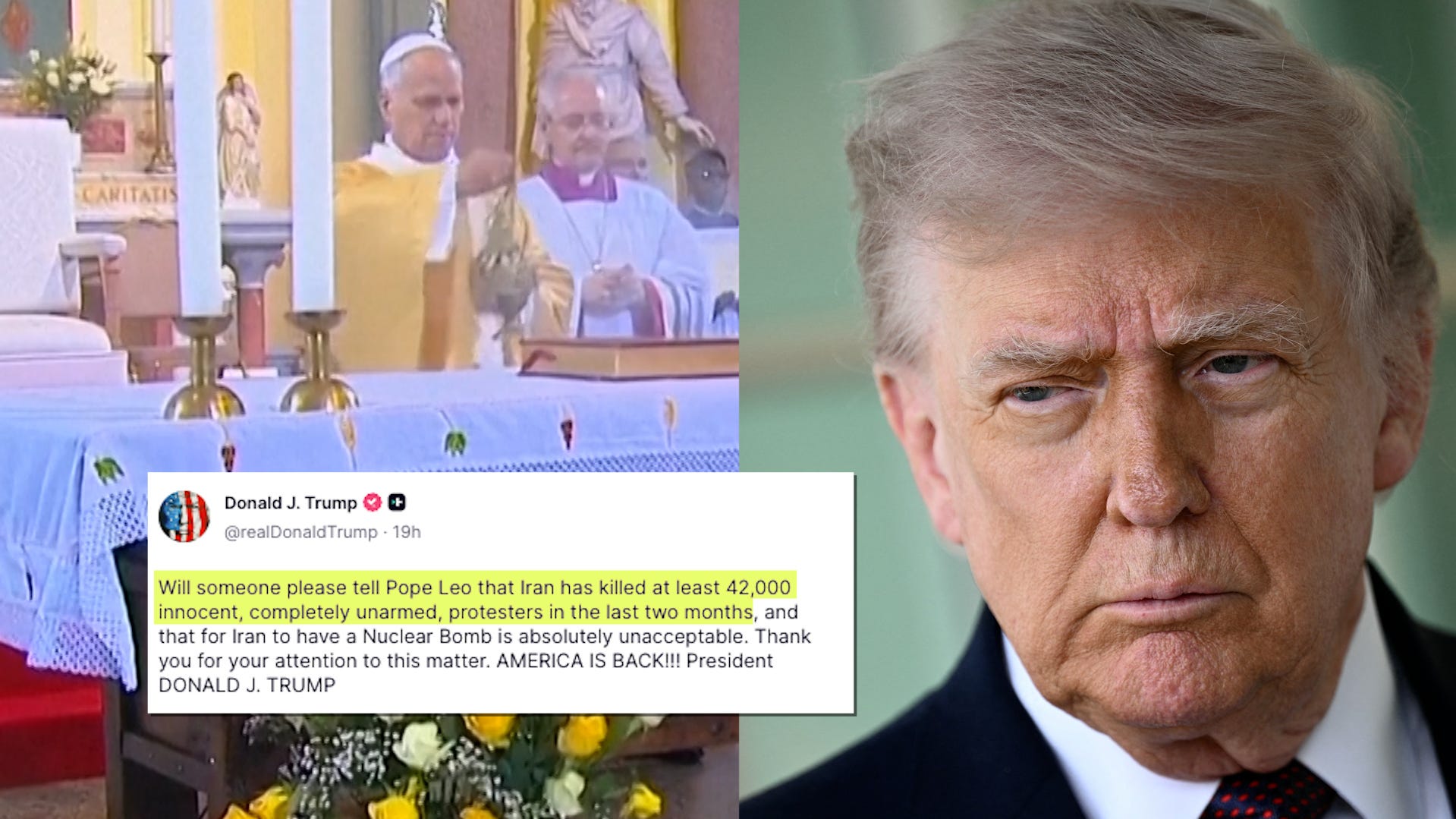

The controversy between Mr. Trump and the Pope continues with Mr. Vance and the bishops’ opinions
President Donald Trump continued his feud with Pope Leo in a post on Truth Social, calling Iran’s possession of a nuclear bomb “absolutely unacceptable.”
ROME – A priest celebrates a weekday Mass for dozens of faithful at the Cathedral of St. Augustine, the main church of Augustine in the Italian capital. The thin voices of the congregation echo through the scaffolding undergoing repairs and the footsteps of tourists passing by to take photos of Caravaggio’s 400-year-old masterpiece “The Madonna of Loreto” and Raphael’s 500-year-old fresco “Isaiah the Prophet.”
It is as old as Augustine himself, an early Catholic saint whose teachings led to the establishment of the order of priests to which Pope Leo XIV belonged, and contrasts with the tension between the secular and religious worlds pushing against each other.
Today, Leo, the quiet, scholarly, Chicago-born pope and the world’s best-known adherent of Augustine’s teachings promoting charity, truth, humility, and unity, fosters similar contrasts in his increasingly heated conflict with the fiercely bellicose, prideful, and outspoken political leader from New York.
But this war of words between the Pope and President Donald Trump goes far beyond a debate over deep-dish versus thin-crust pizza. It has also provoked a strong backlash from religious leaders as well as Mr. Trump’s conservative, Christian MAGA supporters and former allies, and he risks alienating key parts of his base, potentially exacerbating an already difficult 2026 election cycle for Congressional Republicans.
Mr. Leo, Mr. Trump and Mr. Trump’s vice president, J.D. Vance, have elevated their disagreements over war, peace and church doctrine to new rhetorical heights, Vatican officials and insiders say. Last summer, Francis Rocca, Vatican editor for the Catholic-perspective news service EWTN News, characterized Leo as a “quiet American.”
Rocca said that statement is now outdated.
“He’s come out of his shell now,” he said.
As an outspoken pope, Mr. Leo has been a vocal critic of President Trump’s war on Iran, while appearing to directly target the US president and his top aides, including Mr. Vance and Secretary of Defense Pete Hegseth. He hinted that the world was “ravaged by a handful of tyrants” and said anyone who is a disciple of Christ “will never stand by those who once wielded swords and today drop bombs.” Leo harshly criticized those who manipulate religion “for their own military, economic and political interests.”
President Trump told the leaders of the world’s 1.4 billion Catholics that they should “act together.” Social media posts have described him as “weak on crime and terrible on foreign policy.”
He told the Pope to focus on being Pope and accused him of moving into politics.
To illustrate this, President Trump posted a strange, unsettling, but literal image of himself, generated by AI, as a Jesus-like figure. Amid intense backlash from some Christian supporters, President Trump said he believed the image was intended to depict him as a doctor. In recent days, he has also tried to cool things down by insisting, “I’m not fighting with the Pope…The Pope can say what he wants to say, and I want him to say what he wants to say, but I can also disagree.”
Still, the Pope vs. President analogy also includes a warning from Mr. Vance, who converted to Catholicism in 2019, to Mr. Leo, the Catholic Church’s highest official. The latter had been deeply involved in the church for nearly 50 years as a priest, missionary and cardinal before being elected pope last May. But Vance told him to “be careful when talking about theological issues.”
And on April 6, the Free Press reported that in January, U.S. defense officials summoned Cardinal Christophe Pierre, the former papal ambassador to the United States, to the Pentagon and delivered a “scorching lecture” that essentially amounted to a threat to support the White House, while Leo was perceived to be criticizing the Trump administration.
In response to this report, the Vatican Press Office issued a statement confirming that the meeting had indeed taken place, saying, “The reports provided by some media about this meeting are completely false.” A Pentagon spokesperson said the story was exaggerated and that the meeting was a “respectful and reasoned discussion. We have nothing but the utmost respect and welcome continued dialogue with the Holy See.”
Rosario Forlenza, an expert on politics and religion at Rome’s Luis University, said there is a long history of suspicion between the Vatican and the United States.
But he said: “It’s never been this hostile, and it’s never involved a specific person. This is completely new.”
He also noted that Steve Bannon, Trump’s chief strategist during his first term, predicted there would be “friction” between Leo and Trump after Leo won the conference.
“It’s shocking that someone who had a Twitter feed and statements against senior American politicians could be elected pope,” Bannon said at the time.
Vatican and White House
Historically, the United States had little interest in the papacy or the Vatican until President Abraham Lincoln realized during the Civil War that cooperation with the church could secure greater Catholic support for the union and prevent the pope from recognizing the union, Forlenza said.
In other words, the tensions, intrigues, and divergent objectives involving the Vatican and the White House are not new.
In fact, the city-state that is the headquarters of the Roman Catholic Church and the United States only restored diplomatic relations in 1984 after more than 100 years of mutual distrust. Some Americans were concerned that Catholics were maintaining loyalty first to the church and second to American values and institutions. It was once unthinkable for an American president to be seen with the Pope. Woodrow Wilson became the first sitting U.S. president to visit the Vatican in 1919, during a post-World War I tour of Europe.
More recently, Pope Leo’s predecessor, Pope Francis, harshly criticized President Trump’s policies on immigration and climate. Pope John Paul II launched a major, but ultimately unsuccessful, diplomatic effort to lobby President George W. Bush, pleading with him to halt the 2003 U.S.-led invasion of Iraq. Just as Pope Leo said of President Trump’s Iran war, Pope John Paul II said the Iraq war lacked legal and moral legitimacy.
The ongoing spat between Mr. Leo and Mr. Trump has led to the Vatican’s College of Cardinals to elevate Cardinal Robert Francis Prevost to Pope Leo XIV in May 2025, less than six months after Mr. Trump’s second term. Theories have been rekindled that Trump’s decision to do so was, at least in part, a move aimed at finding a way to counter what was perceived as Trump’s shotgun and destructive approach to foreign countries. policy.
Why America’s Pope?
Six Vatican officials and insiders stressed that there is no easy way to definitively conclude why Leo was appointed to the role, nor do they have specific information about the May 2025 meeting. There was a general perception among some in the Holy See that a strong American who could stand up to another powerful American was a factor in Leo’s selection. (The pope’s vote is done in a series of secret ballots, effectively a trade between the cardinals and their consciences.) The U.S. pope could be more easily manipulated into becoming a thorn in Trump’s side, one Vatican official said. All spoke on condition of anonymity.
A senior Western diplomat based in Rome agreed with that assessment. The diplomat noted that President Trump’s inauguration was on many people’s minds during the meeting, and that Trump was never far from the headlines. The diplomat said it was inconceivable that Trump’s election did not play at least some role in Leo’s selection.
Trump himself seems to believe this theory, saying that Leo was given the papacy “only because he’s an American and they thought that was the best way to deal with President Donald J. Trump…If I wasn’t in the White House, Leo wouldn’t be in the Vatican.” A representative from the U.S. embassy in the Vatican did not respond to a request for comment on Trump’s claims and the theory that Leo was selected by some.
Still, others, including those who knew him best, said Leo’s personality and long service to the church and the Augustinian order were likely reasons for his rise to the papacy.
He is the first American pope and the 267th person to sit on the throne of St. Peter. Mr. Leo was ordained an Augustinian priest in 1982. He immigrated to Peru as a missionary in 1985 and obtained Peruvian nationality in 2015. Vatican experts said he developed extensive international contacts and relationships during his time in Peru, which may have helped boost his profile with the conference of cardinals that ultimately elected him.
Leo – Augustine’s “Unity”
Father Alan Fitzgerald is an Augustinian priest and longtime professor at Villanova University outside Philadelphia. Leo graduated from Villanova in 1977. Fitzgerald lived in Rome for 12 years, and for eight of those years Leo was not only the head of the Augustinian Order but also Fitzgerald’s neighbor.
Fitzgerald said Augustinians are “unifiers” who seek to “bring great differences together into a common project of respecting, appreciating, and learning to work together.” He said that unlike Jesuits (Franciscans), who tend to be “very outspoken and have the ability to tell people who they are,” Augustinians are typically more reserved and private, but also vary in how they approach their work.
“There’s a saying: ‘If you’ve met an Augustinian, you’ve met an Augustinian,'” he says.
Fitzgerald added that while the Jesuits are “innovators,” the Augustinians tend to be “more cautious in building,” and he sees Leo in that light in part because he believes Leo’s papacy would not exist without the Franciscan papacy, which regularly addresses how human dignity is violated by some world leaders. He said that when political leaders and others say, “‘Don’t talk about politics.'” Well, that’s nonsense. Politics is a part of life. You need to be careful. We need to be careful how we talk about issues. But faith is part of it all. ”
He also said that Leo does not tend to delay tactics.
Fitzgerald said that in late May last year, just weeks after Leo was sworn in as the new pope, he sent an email saying he thought it would be useful to consider writing an apostolic letter (a formal doctrinal letter issued by the pope) about how St. Augustine was a peacemaker.
It was Sunday.
Leo wrote back within 12 minutes.
“He tends to tackle things head on,” Fitzgerald said.
The Vatican is playing a long game
EWTN News’ Vatican Editor-in-Chief Rocca said that in the lead-up to the conclave that chose Leo, Vatican sources kept telling him “Plevo, Plevo, Plevo.” And I said, “Oh, but he’s American, right?” And they say, “Yes, but we don’t consider him an American.” Even the cardinal said he was not the American that the Vatican tends to think of him. He was a bishop in Peru. He was not a bishop in the United States. ”
Rocca said that if conclave participants believe Leo is a viable candidate for pope during Trump’s second term, they likely see him as an American who is good at fundraising and running a church.
But he doesn’t think that skill set necessarily worked in Leo’s favor. He said people “around here” (Vatican City) tend to think more long-term.
“They’re thinking for centuries,” he said. “And you probably believe that Trump will disappear soon.”


