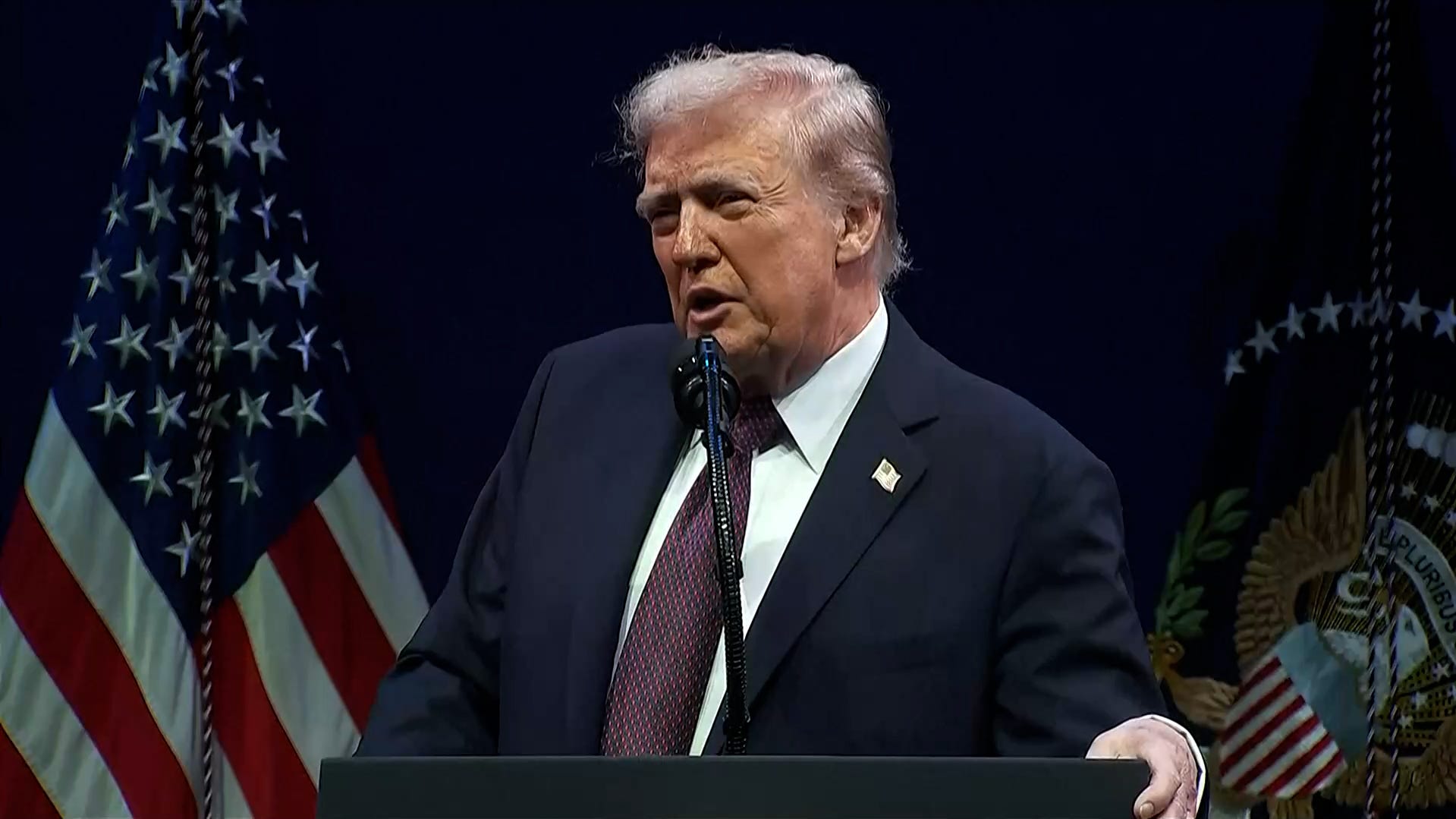

President Trump announces protection of prayer in public schools
President Trump announced new upcoming guidelines to protect prayer in public schools.
- The Commission on Religious Freedom, which President Trump established by executive order in May, held its final hearing on April 13 at the Museum of the Bible in Washington, D.C.
- Repeating themes from past hearings, members criticized the idea of separation of church and state and praised President Trump’s work on religion.
Members of President Donald Trump’s Religious Liberty Commission criticized the idea that church and state separation is necessary during the commission’s final hearing on April 13 in Washington, D.C.
The commission’s chairman, Texas Lieutenant Governor Dan Patrick, at one point called it “the biggest lie that has been told in America since the founding of the country.”
The First Amendment states, “Congress shall make no law respecting an establishment of religion,” but the term “separation of church and state” does not appear in the Constitution. President Thomas Jefferson popularized the term in the early 1919s.th century.
Americans United for the Separation of Church and State called Patrick’s comments “an attack on our democracy.”
Rachel Laser, the group’s president and CEO, said the separation of church and state is “uniquely American and something we should be proud of, fight for and cherish.”
Past committee hearings have addressed topics such as anti-Semitism in public education and religious freedom. A common theme throughout the hearings was the commissioners’ view that the legal system has been used as a weapon against people of faith, particularly Christians, under past administrations.
Trump established the commission through an executive order in May. The commission announced that it will end on July 4, 2026.th American Independence Day – unless extended by the President.
Civil rights activist: Religious freedom ‘essential’ to Greensboro sit-in
Helen Alvarre, professor of law and religion at George Mason University’s Antonin Scalia School of Law, was the first of many witnesses at the hearing held at the Museum of the Bible.
She said religious freedom is an “objective good” for this country and argued that there is “much more peace” in the United States than there is discord between religious groups. Historically, government overreach in Americans’ religious practices has been a bigger problem, she said.
Albarre praised the U.S. Supreme Court’s move in recent years toward a broader application of the First Amendment’s free exercise clause, exemplified by a 2025 decision in which the court sided with a group of Maryland parents who wanted to exclude LGBTQ+ themes from their children’s public school curriculum.
The idea that public school teachers could ignore the religious instruction their students receive at home in the name of the Constitution “has always bordered on absurdity,” she said.
Later hearings featured a different tone for a state law requiring public schools to display the Ten Commandments in classrooms, which is being legally challenged by parents who say it amounts to religious coercion. Patrick said more than 50% of the state’s approximately 9,000 public schools have implemented displays.
At one point, Patrick also touted Texas’ school voucher program, which allows taxpayer funds to be used to pay for tuition at private religious schools. He said more than 250,000 applications were received for about 100,000 spots. Parent and school groups sued the state over the program, alleging it discriminates against private Islamic schools in violation of the First Amendment.
Clarence Henderson, who participated in the Greensboro, North Carolina sit-ins that sparked widespread civil rights movements in the 1960s, also addressed the committee. Religious freedom was “vital” to the movement, he said.
“Church was the meeting place, faith was the language, and the Bible was the foundation,” Henderson said.
‘There’s a lot of work to do’ before submitting report to President Trump
Commissioners and witnesses also expressed concern about worrying trends regarding religion and other developments in the country.
Bishop Robert Barron lamented the negative effects of rising rates of religious withdrawal.
“It’s dangerous for our democracy. People start to forget, people stop hearing the story of the Good Samaritan, they stop hearing the Ten Commandments, they stop hearing the Beatitudes,” he said. “It affects our democracy. It’s not just a religious issue.”
Dr. Akshar Patel, president of the Hindu organization BAPS, said religious freedom is a means by which Hindu Americans can “thrive.”
At the same time, he was concerned about what he perceived as society’s increasing intolerance towards religion, particularly Hindu beliefs. “The environment of fear and insecurity has been devastating for our communities,” he said, referring to recent attacks on Hindu temples.
“Mandirs (Hindu temples) that once felt like sanctuaries of peace and unity are now places of concern for safety,” Patel said. “Families who came to this country seeking religious freedom now feel unsafe practicing their faith publicly.”
Commissioner Phil McGraw, widely known as the television character “Dr. Phil,” was similarly troubled by the situation at the Dominican Sisters of Hawthorne, a New York-based group of nuns that operates nursing homes in New York. They sued the state earlier this month, in part on First Amendment grounds, alleging that the state’s laws regarding the care of transgender patients violate Catholic beliefs.
The White House says the commission’s purpose is to “protect and advance America’s founding principles of religious freedom.” A comprehensive report on the foundations and current state of religious freedom in the United States must be submitted to President Trump by the end of his term.
Patrick said the committee “has a lot of work to do” before its presentation. During the hearing, there was also a suggestion that the commission could be expanded beyond its original charter, something that commissioners said was important to both President Trump and the nation as a whole.
Many advocacy groups have accused the commission of promoting Christian nationalism rather than true religious freedom for all. They include multifaith groups that sued the Trump administration, alleging that the commission illegally lacked religious and ideological diversity.
Americans United for the Separation of Church and State, which represents the plaintiffs in the case, echoed similar sentiments after the committee’s final hearing. “We condemned the separation of church and state, which is a fundamental pillar of religious freedom,” the group said.
Carrie Prejean Boller was removed from the committee after a February hearing on anti-Semitism. In an interview with USA TODAY, she claimed her firing was in retaliation for public statements inconsistent with the Trump administration’s position on Israel.
But commissioners at the April 13 hearing praised President Trump’s efforts on religious freedom.
“At the end of the day, I believe this will be one of his greatest legacies,” Patrick said.
Breanna Frank is USA TODAY’s First Amendment reporter. please contact her bjfrank@usatoday.com.
USA TODAY’s coverage of First Amendment issues is funded by the Freedom Forum in collaboration with our journalism funding partners. Funders do not provide editorial input.


