President Trump’s top messenger, J.D. Vance, is expected to rein in Prime Minister Benjamin Netanyahu’s actions that could have irreversible consequences.
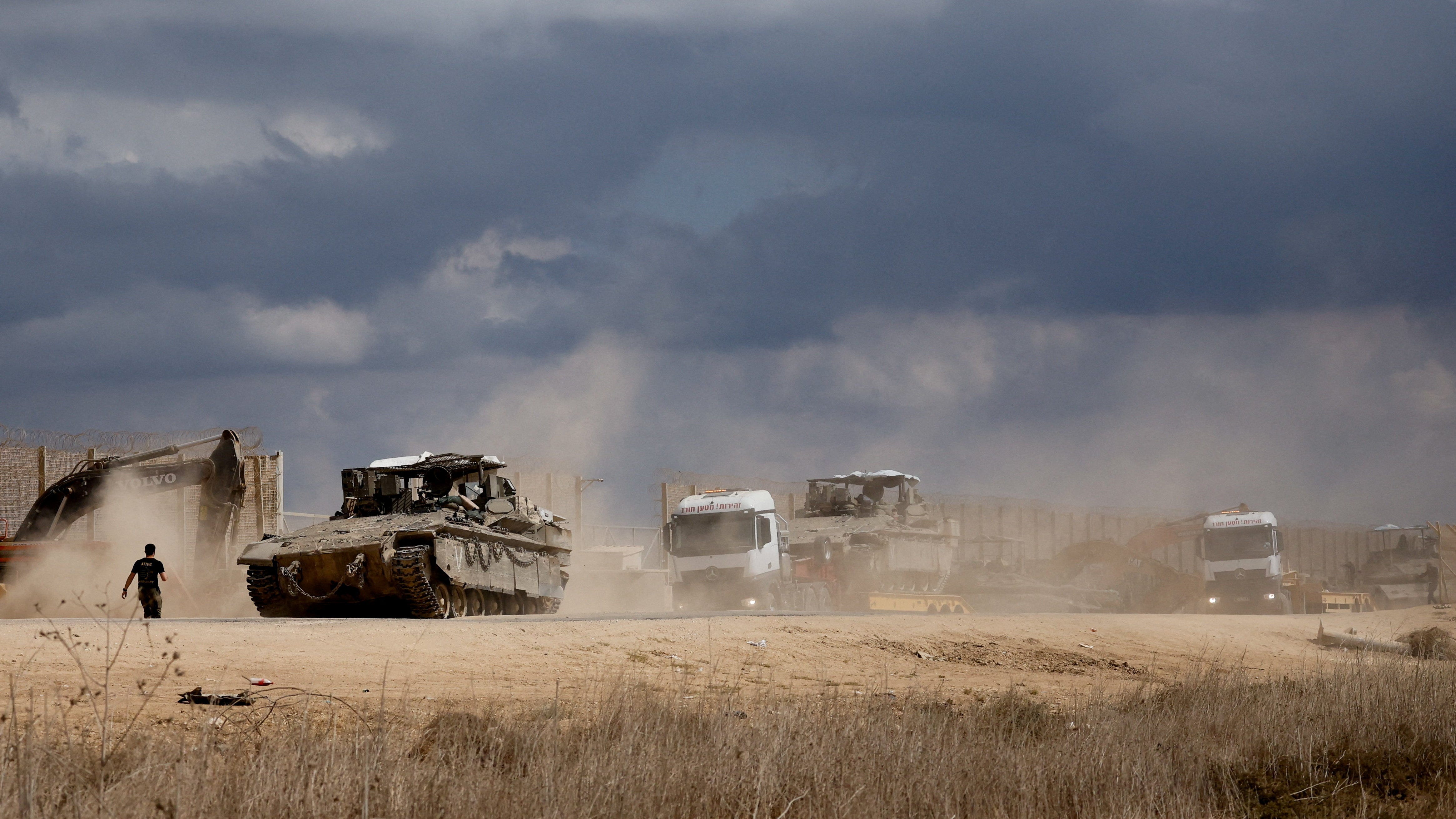

Israel attacks Gaza, accuses Hamas of attacking Israeli forces
Israeli officials said their military carried out airstrikes in southern Gaza after Hamas militants allegedly opened fire on Israeli soldiers.
WASHINGTON — President Donald Trump’s top emissary, J.D. Vance, is expected to visit Israel to try to stop the collapse of a week-old peace deal hailed as a U.S. coup to end a brutal two-year war and rein in Prime Minister Benjamin Netanyahu.
But with the White House-brokered deal in jeopardy, the vice president is entering difficult territory. The first part of the ceasefire was limited to the release of living hostages in exchange for Palestinian prisoners and an influx of aid. Vance faces the biggest hurdle in his remaining plans: disarming Hamas and withdrawing all Israeli forces from the enclave.
For a vice president with little foreign policy experience, this is a high-stakes gamble. Vance is looking to succeed in the latest chapter of the conflict that has engulfed previous U.S. administrations.
At a minimum, Vance, with the help of other Trump envoys, will need to persuade the Netanyahu government to show restraint in responding to Hamas’s provocations and ensure humanitarian aid reaches Gaza, former U.S. officials said.
Mr. Vance is also under pressure to clarify the ambitions of Mr. Trump’s peace plan, as questions remain about the future of governance and security in Gaza, including concerns about Israel’s own security.
These include which countries will join the U.S.-backed Arab Stabilization Force, which supports police forces vetted after Hamas disarms, and which countries will become part of the Palestinian commission that oversees Gaza.
“If there’s something missing, they’re going to have some explanation,” said Daniel Kurtzer, a former U.S. ambassador to Israel.
Fighting escalated and threatened to invalidate the agreement after Israel announced it had launched airstrikes on the Gaza Strip in retaliation for Hamas attacks, killing two soldiers.
The conflict led to a temporary suspension of humanitarian aid supplies on October 19. The Israeli military announced later that day that it had begun enforcing the ceasefire again.
In response, President Trump said Hamas had been “pretty violent” but that the ceasefire was in place.
Mr. Vance acknowledged the bipartisan act on the eve of his planned visit, telling reporters that preserving the agreement would be complicated and that any ceasefire would be a tumultuous development. The ceasefire needs to be monitored, he said.
“Hamas is going to fire on Israel, and Israel will naturally have to react. There will come a moment when there will be people inside Gaza who are sure of what they are actually doing,” Vance said. “But we think it is our greatest chance to achieve sustainable peace.”
The vice president has actively sought to increase his international exposure since taking office, visiting Germany, Greenland, India, the United Kingdom and the Vatican this year.
It will have to do more than maintain the fragile ceasefire between Israel and Hamas. In order to successfully advance into negotiations on the international stage, Mr. Vance must convey the points that President Trump has avoided going into detail.
“Showing evidence of progress toward the start of the second phase is critical to the survival of the plan,” said Khalil Shikaki, director of the Center for Palestine Policy and Research in Ramallah.
Shikaki, a senior fellow at Brandeis University’s Crown Center for Middle East Studies, said the administration needs to show that its plan did more than end the war and strengthen Hamas’ control of Gaza.
Rather, the administration must communicate that this is a short step that will be followed by other countries, including the creation of a non-political commission of Palestinian and international experts, based on the president’s proposal and to be overseen by a “peace commission” led by President Trump.
Hamas has agreed to withdraw from control of Gaza under President Trump’s plan, raising concerns about whether the administration will be able to carry out the second phase of the plan.
It will take a lot of pressure to get Hamas to disarm, said Jonathan Schanzer, executive director of the Foundation for Defense of Democracies and author of several books on Hamas and the Israeli-Palestinian conflict. And U.S. news organizations will be required to exert influence over Turkey and Qatar, two allies that have been guarantors in the insurgency’s negotiations, Hamas.
Mr. Vance is expected to rely heavily on Prime Minister Benjamin Netanyahu to ensure that the IDF does not react too aggressively to allegations of ceasefire violations.
“The message is very simple: Don’t respond with the full force of the IDF. We are still working to maintain the ceasefire. And basically, that means asking the Israelis to act firmly against the United States,” Schanzer said.
Mr. Vance’s visit to Israel marks a gradual increase in the Trump administration’s level of involvement in negotiations at a critical moment, as the president focuses on resolving the Russia-Ukraine conflict and trade tensions with China.
President Trump plans to visit Asia this month and has said he plans to meet with Russian President Vladimir Putin in Budapest in the coming weeks.
Negotiations in the Middle East have been led by Steve Witkoff, Trump’s special envoy, and Jared Kushner, the president’s son-in-law and author of the first Middle East peace plan.
Prime Minister Netanyahu agreed in concept to the 20-point plan during a visit to the White House in late September. The deal gained support from the Israeli government after Witkoff and Kushner pressed Netanyahu’s Security Council to accept it in a presentation earlier this month.
It will be up to Vance, who has a growing presence on the world stage, to convince Israeli officials to take the next step.
“It’s going to take a lot of U.S. involvement to make this successful,” said Kurtzer, a former ambassador to Israel and Egypt who represented the U.S. in Israeli-Palestinian negotiations during the previous administration. “It doesn’t happen in isolation.”
Francesca Chambers is USA TODAY’s White House correspondent. Follow her on X: @fran_chambers


