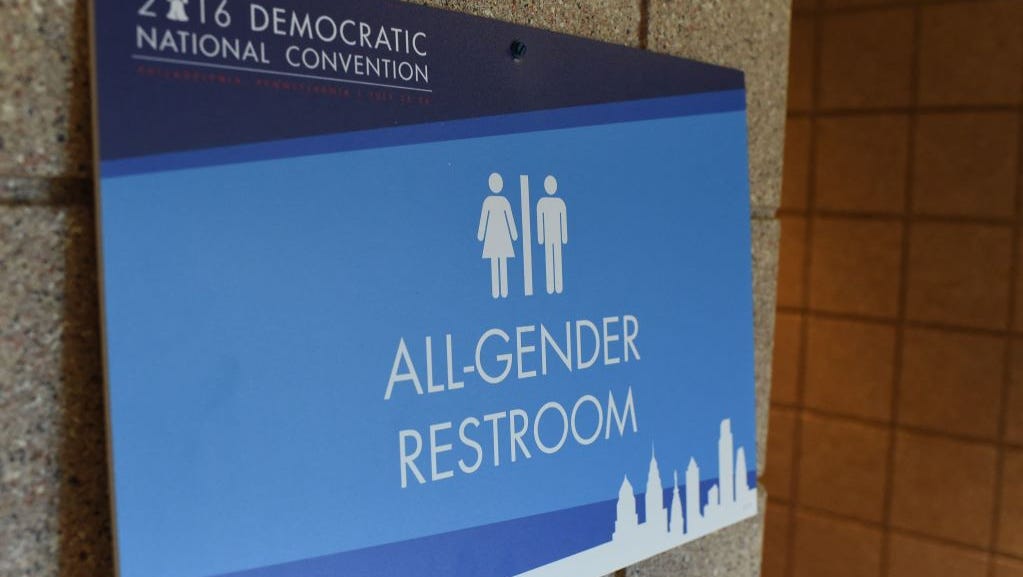

Texas Senate passes controversial transgender ‘bathroom bill’
The Texas Senate just passed a controversial transgender “bathroom bill.” The document now goes to Governor Greg Abbott’s desk for signature.
- In 2023, Michelle Evans posted a photo of a transgender politician in a women’s restroom, sparking an investigation under a state law that prohibits the distribution of images taken in restrooms without consent.
- Evans filed a lawsuit over the issue, arguing in part that the First Amendment protects her right to post images. Both the district court and appellate courts ruled against Evans.
- X, which has previously been involved in First Amendment litigation, said it was “proud to support” Evans and would seek review by the full court.
Elon Musk’s social media platform
Michelle Evans, chair of the Williamson County Republican Party, posted a photo of a transgender activist who had announced a potential run for the Texas Legislature in a women’s restroom on the day a gender transition bill was debated at the state Capitol in May 2023, according to a complaint filed in the U.S. District Court for the Western District of Texas.
The move sparked an investigation by the Texas Department of Public Safety, which led Evans to turn over his cellphone to authorities, which led to a partial First Amendment lawsuit. A three-judge panel from the District Court and the Fifth Circuit Court of Appeals both denied Evans’ request for a preliminary injunction, allowing the investigation to continue as the case progresses.
The state law regulating “invasive video recordings” was first enacted in 2001, but has been amended several times in the years since. The latest version, which went into effect in September, prohibits video recording without people’s consent in “places where there is a reasonable expectation of privacy” such as bathrooms, bedrooms and changing rooms.
Company X’s Global Government Affairs team said in a statement on Monday, Dec. 29, that it was “proud” of Mr. Evans’ case. He called the commission’s decision “misguided and dangerous” and said he would seek an appeal to the full Court of Appeal.
“We look forward to the entire Fifth Circuit correcting this wrong and upholding free speech, the foundation of American democracy,” the company said in a statement.
X’s announcement comes days after Texas Attorney General Ken Paxton launched a tip to report violations of a state law that requires government buildings to restrict access to restroom facilities based on biological sex.
In a statement to USA TODAY, Ms. Evans said she was “grateful” for Mr.
Tony McDonald, an attorney representing Evans, said this is an “important First Amendment case” and that he is “excited that Company X has joined the fight to protect Mrs. Evans’ right to free speech.”
Prosecutors in Travis County, including Austin, balked at X’s involvement.
“Of course, under the leadership of Elon Musk, X supports users posting photos of other users in the bathroom without their consent,” the office said in a statement.
USA TODAY has reached out to the activist and X for comment.
Investigation based on the law prohibiting the taking of images without consent in restrooms
According to the complaint, Evans did not take the photo in question. She said she saw the photo on Facebook, copied it and posted it to her X account.
The post quickly attracted attention and complaints from people who believed Evans had taken the photo. According to the complaint, Department of Public Safety officials detained Evans for questioning shortly before the vote on Senate Bill 14, which banned gender-affirming health care for transgender youth, was finally passed.
After Evans handed over his cellphone, he was told he could only leave if he left, according to the complaint.
Department of Public Safety officials later told Evans in the complaint that Travis County District Attorney Jose Garza ordered the investigation, citing a Texas law that prohibits distributing images of people in a restroom “without the other person’s consent and with the intent to violate the other person’s privacy.”
Evans sued Garza in this case in her official capacity as district attorney, arguing in part that the First Amendment “protects the right of Texans to speak on matters of public concern,” which she said applies to her case.
First Amendment right to take photos inside restrooms is unclear, court says
The court disagreed.
The district court denied Evans’ request for a preliminary injunction,th The U.S. Circuit Court of Appeals upheld this decision in a 2-1 decision.
“It is far from clear that there is a First Amendment right to take and distribute images of fully clothed adults while in a public restroom without their permission,” the court’s Dec. 9 opinion said.
“Is it everyone’s fair right to have their photo or video taken when they’re in the bathroom, celebrity or not?” the opinion read. “Does the fact that the person is an elected official change that equation? The law is certainly not clear that a politician can be pursued for the purpose of gaining and promoting his image, even in a public restroom.”
Similar questions arose in Arizona after a group of activists followed then-Democratic Sen. Kyrsten Sinema into a bathroom at Arizona State University in October 2021. Activists had been at odds with Sinema over her ambivalent stance on then-President Joe Biden’s Recovery and Better Act, The Arizona Republic reported.
The Court of Appeal panel said it was “not clear” whether Ms Evans would ultimately face criminal charges, but said “the threat of prosecution hangs over her”.
X previously sued the state on First Amendment grounds.
This is not the first time Company X has been embroiled in a First Amendment dispute.
In June, the company sued New York state over the No-Hide Hate Act, which requires companies to outline steps they take to combat extremism, disinformation and other potentially harmful content.
Company X argued that the law was unconstitutional because it “unacceptably interferes with the editorial decisions of First Amendment-protected companies…to remove, demonetize, or deprioritize such speech on their platforms.”
The company also reached a settlement with the state of California in February over a similar law.
It also sued the state of Minnesota in April, in part on First Amendment grounds, over a law that makes it illegal to use AI-generated deepfakes to influence elections.
Breanna Frank is USA TODAY’s First Amendment reporter. please contact her bjfrank@usatoday.com.
USA TODAY’s coverage of First Amendment issues is funded by the Freedom Forum in collaboration with our journalism funding partners. Funders do not provide editorial input.


