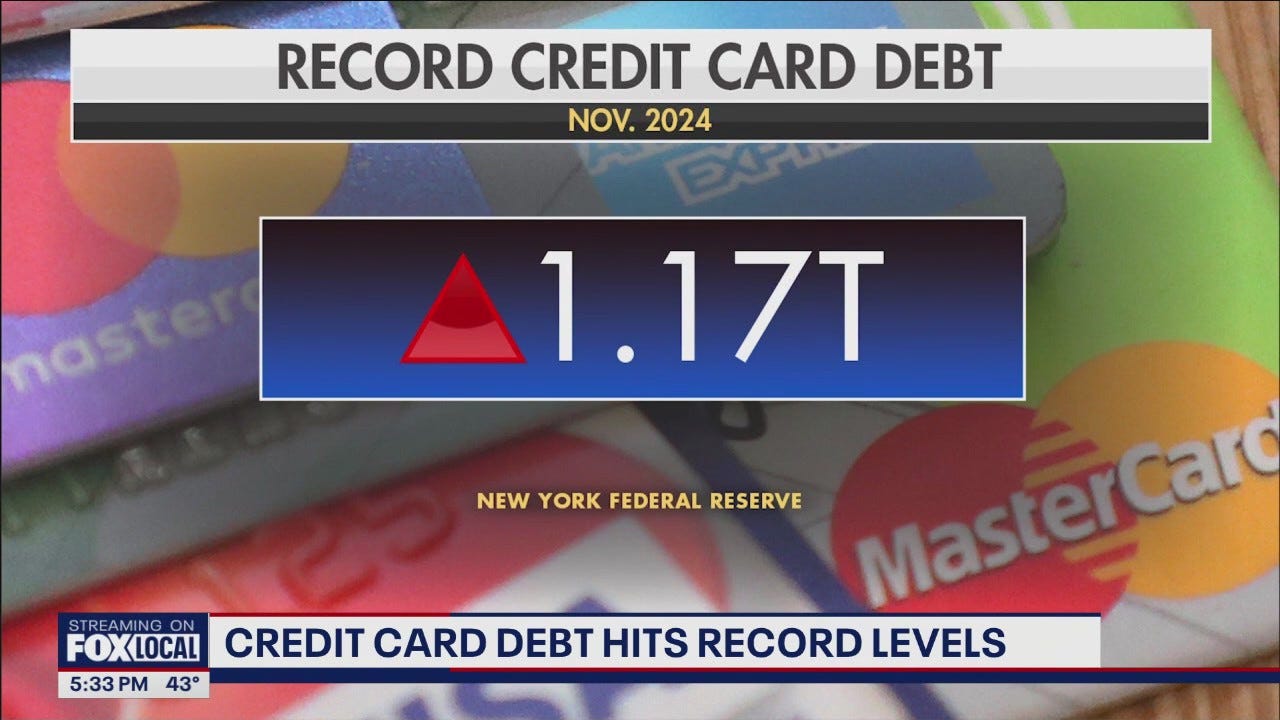

Credit card debt reaches record levels
Americans are carrying record amounts of credit card debt, and interest rates are near record highs.
Fox – Seattle
Visa and Mastercard are proposing to lower the fees merchants charge to accept credit cards in a bid to resolve a 20-year-old lawsuit, but some merchant groups say this is all “smoke and mirrors” and the plan won’t save anyone money.
Under the $200 billion proposal, Visa and Mastercard would lower credit card interchange fees charged to merchants for processing credit cards. Fees, which typically range from 2% to 2.5%, will average 0.1 percentage points lower over five years, compared to standard credit card fees that drop to 1.25% over eight years. Merchants have additional fee flexibility, and merchants who accept one of the network’s credit cards no longer have to accept all credit cards. The court still needs to approve the settlement.
Visa and Mastercard said the deal would reduce costs for merchants and consumers, but retail trade groups derided that consumers and merchants would end up paying more.
“No one should be fooled by the smoke and mirrors of the credit card industry,” said Lyle Beckwith, senior vice president of government relations for the National Association of Convenience Stores (NACS), an industry group. “This settlement supports business as usual, including allowing Visa and Mastercard to increase their own fees without restriction.”
What is the exchange fee?
Whenever you make a purchase using a credit card, the store must pay a behind-the-scenes interchange fee (also known as a credit card fee or swipe fee) to process that payment. Most of that fee goes to the bank that issues the card, but companies like Visa and Mastercard also receive a small fee for processing payments through their networks.
Fees are charged as a percentage of the total sales amount for each transaction, but each merchant is charged a different percentage, whether in-store or online. Factors that determine the percentage charged to the seller include: Seller type (department store, convenience store, gas station). The type of payment technology used by the merchant. Will the purchase be online or in person? and the type of card.
Total credit and debit card swipe fees reached a record $187.2 billion last year, according to industry group Merchant Payments Coalition (MPC).
What does this deal mean for consumers?
Industry groups, including the National Retail Federation, MPC, National Association of Convenience Stores and Retail Industry Leaders Association, said the deal offers no relief to consumers.
“The plan to limit interchange fees to a small percentage does not offset the price increases that have occurred over the past several years, let alone the past 20 years,” said Austin Jensen, RILA’s senior vice president of communications.
“Even the marginal reductions proposed in the bank fee settlement could allow Visa and Mastercard to raise their own fees without limit,” said Jennifer Hatcher, chief public policy officer at the Food Industry Association. “If Visa and Mastercard raise their fees, all the supposed savings for merchants and consumers could easily be wiped out.”
In theory, consumers could also face confusion and confusion at the checkout. The agreement allows merchants to decide whether to accept credit cards in three different categories: commercial, luxury consumer, and standard consumer. If a merchant chooses to only accept certain classes of Visa cards, such as low-fee standard cards or non-premium cards, customers with perks Visa cards will be turned away.
Why did the conflict last for 20 years?
The case began in 2005, when merchants sued Visa and Mastercard for alleged antitrust violations. They accused the two largest credit card processing companies that set exchange rates of duopoly.
Merchant associations want Congress to pass the Credit Card Competition Act. The law would require large banks to offer at least two credit card network processing options on cards, which it claims will lower fees for merchants and ultimately consumers. But Congress has not reintroduced the bill this year.
Meanwhile, Visa and Mastercard are trying to finalize agreements with merchants through litigation. The latest proposal is the third in the last 20 years. The last two are:
- In 2016, an appeals court struck down a $7.25 billion settlement, citing a conflict of interest among the lawyers representing the sellers.
- In 2024, a judge rejected a $30 billion settlement that would have lowered swipe fees by about 0.07 percent over five years and given merchants more room to charge additional fees. The judge said the fees remained too high and that the $6 billion a year the merchants would save would be “minor” compared to what Visa and MasterCard could continue to charge. The proposal also did not remove the “Honor All Cards” rule, which requires merchants to accept all Visa and Mastercard cards or none at all.
Is third time the charm?
The settlement still requires court approval.
Richard Hunt, president of the Electronic Payments Coalition, said it “could take up to four months” to find out whether the court would accept the settlement. The Electronic Payments Coalition includes Visa, MasterCard, and major issuers that support the settlement, including Bank of America, Capital One, Chase, and Citibank.
But he likes the chance. “It’s probably going to be a big deal because not everyone is happy,” he said. “This is very compelling,” he said, noting that merchants will save an estimated $200 billion over the life of the agreement.
“The last number a year ago was $30 billion,” he says.
Medora Lee is USA TODAY’s money, markets and personal finance reporter. Please contact us at mjlee@usatoday.com. Subscribe to our free Daily Money newsletter for personal finance tips and business news every Monday through Friday morning.


