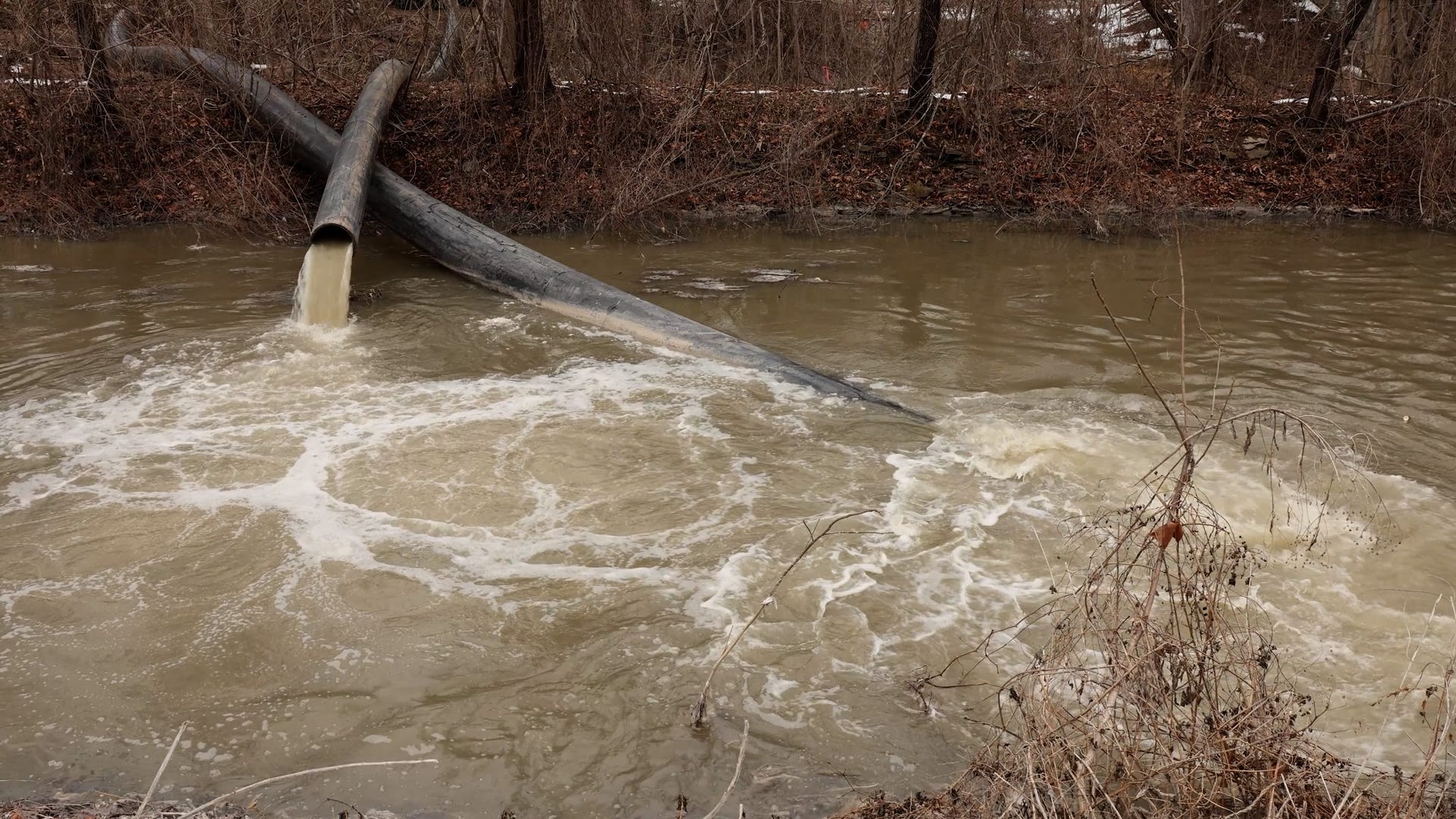

See broken sewer pipes on the Potomac River being repaired
Collapsed sewer pipes continue to spill raw sewage into the Potomac River, making it one of the largest sewage spills in U.S. history.
CABIN JOHN, Md. – One of the largest sewage spills in U.S. history has turned into a political battle between the federal government and local officials.
Recently, a sewer system collapsed in the Maryland suburb of Washington, D.C., spilling at least 200 million gallons of raw sewage into the Potomac River, a vital waterway surrounding the nation’s capital. The spill sparked widespread public health concern as E. coli bacteria reached dangerous levels in parts of the Potomac River and highlighted the risks posed by aging wastewater infrastructure.
Now, President Donald Trump is getting the federal government involved while blaming Maryland’s local Democrats, including the state’s Democratic governor, Wes Moore, for the leak. However, responsibility for sewerage does not rest solely with one municipality.
Here’s what you need to know about the spill.
When did the sewage spill start?
On January 19th, a sewer system collapsed in Montgomery County, Maryland, outside Washington, DC.
The collapse damaged part of the Potomac Interceptor sewer system, causing more than 200 million gallons of wastewater to overflow and flow into the Potomac River. The 383-mile river flows along the border of Washington, DC, Maryland, Virginia, and West Virginia.
DC Water, the utility that operates the Potomac Interceptor, said there have been no new sewage overflows since Jan. 29, after pumps were installed to divert sewage around the collapsed pipe on Jan. 23.
Drinking water was not affected by the spill, authorities said.
Residents warned to avoid contact with river water
The University of Maryland called the incident “one of the largest sewage spills in U.S. history,” and said researchers detected high concentrations of fecal-related bacteria and disease-causing pathogens in the river, including bacteria that cause E. coli and staph infections.
Dr. Rachel Rosenberg Goldstein, a microbiologist and assistant professor in the University of Maryland’s School of Global, Environmental and Occupational Health, said anyone who comes into contact with affected water or land is at risk of contracting the bacteria.
“Most people don’t swim in frozen rivers in February, but bacteria can survive below freezing temperatures and become active again when temperatures rise,” she said in a statement.
The Department of Energy and Environment in Washington, D.C., warned area residents to “avoid unnecessary contact with Potomac River water,” and to avoid fishing in the river and keeping pets away.
The line broke days before a winter storm brought historic sleet and subzero temperatures to the region. Weeks of subzero temperatures froze area streams, ponds and even parts of the Potomac River.
“Amazing thing” to see and smell
In Cabin John, Maryland, crews are working to shut off the flow of sewage from the Potomac Interceptor collapse site, remove large rocks and repair damaged pipes. Although the area is no longer flooded with sewage, the smell still hangs in the air and the constant noise of construction echoes along the roads where residents bike, walk and canoe.
When the collapse occurred, word quickly spread among neighbors, some of whom came to see the chaos for themselves. Philip Gray, past president of the Cabin John Civic Association, said witnessing the overflow was “alarming” and the smell was even worse.
“When I walk around and smell something, it hits my nose,” he says. “After 20 minutes, you’re wondering, ‘Am I still smelling it?'”
Beyond the temporary disruption, Gray and other residents are concerned about the long-term ecological impact on the river, citing the high levels of bacteria and pathogens such as E. coli.
“My question is how long will it last?” he said. “And will anything be excreted in some form when it gets warmer? And it’s not just human waste that people flush down the toilet.”
Who manages the sewers?
The Potomac Interceptor, which transports “approximately 60 million gallons of wastewater daily from the area near Dulles Airport to Potomac pumping stations in the District,” is operated by DC Water.
DC Water is an independent agency of the DC government and provides drinking water and wastewater treatment for DC and wastewater treatment for DC and parts of Virginia and Maryland.
Following the sewer line collapse, DC Water said it mobilized crews and contractors to mitigate the spill and keep the water as contained as possible so it could assess the damage and begin repairs.
By January 24, DC Water announced that an emergency bypass had been activated to reroute the flow and stop the discharge. As of February 16, the agency announced that emergency repairs to the Potomac interceptor were expected to take an additional four to six weeks.
Emergency repairs are expected to take an additional four to six weeks as of February 16, once the enhanced bypass system is activated. This will allow for “immediate repair of damaged sections of pipe, restoration of wastewater flow to the Potomac Interceptor, decommissioning of the C&O Canal’s temporary bypass pumping system, and environmental remediation,” the agency said.
President Trump targets Maryland’s Democratic governor
Nearly a month after the spill, Mr. Trump criticized the cleanup effort, blaming Democrats and Maryland Gov. Wes Moore, seen as a rising star in his party.
In a Feb. 16 post on Truth Social, President Trump said he was directing federal authorities to “immediately take the necessary controls, direction, and coordination to protect the Potomac River, the Metropolitan Water Supply, and the precious national resources in our nation’s capital.” He ordered the Federal Emergency Management Agency, which has undergone significant staffing cuts during Trump’s second term, to coordinate its response.
The president also singled out Moore for a Truth Social post criticizing his response to the sewage spill.
“As a result of gross mismanagement by local Democratic leaders, especially Maryland Governor Wes Moore, a massive ecological disaster is occurring on the Potomac River,” Trump wrote. “This governor can’t rebuild bridges either. It’s clear that local governments can’t adequately respond to this disaster.”
President Trump has singled out Moore for criticism in recent weeks, excluding the governor from a bipartisan event at the White House this week.
Moore’s press secretary, Ammar Moussa, said local leaders in Maryland were on the scene “within hours” of the breach and accused the Trump administration of “shirking responsibility” and endangering the public’s health.
“If the federal government is willing to act now, we will continue to respond collaboratively, as always, and keep the public informed about the federal government’s plans to repair the damage,” Musa said. “The Potomac River is not a talking point, and the people of this region deserve serious leadership in a timely manner.”
Contributors: Francesca Chambers and Michelle Del Rey, USA TODAY


