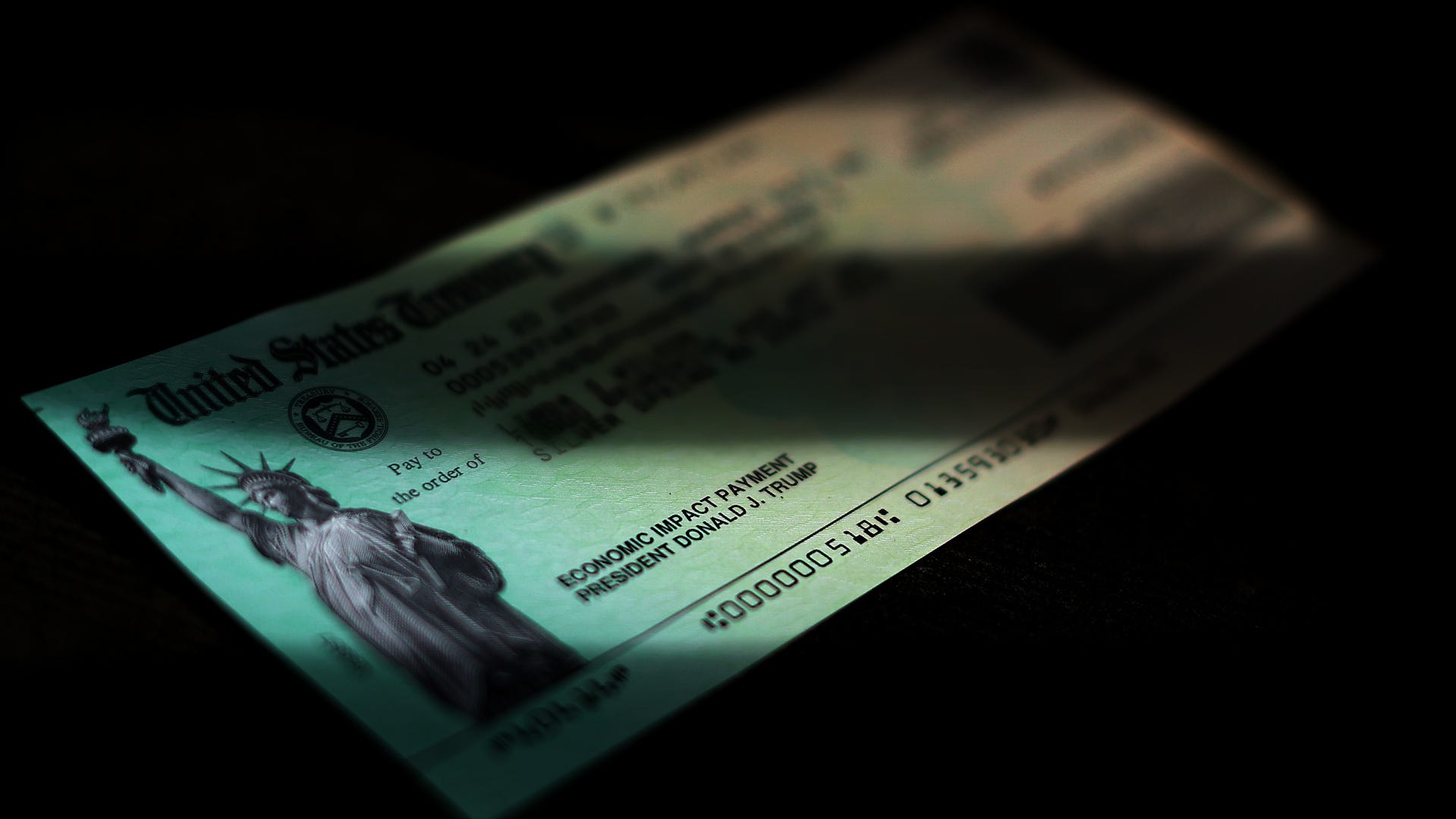

President Trump’s $2,000 tariff rebate plan could cost twice as much as it earns
President Donald Trump’s $2,000 tariff rebate plan could cost $600 billion a year, twice as much as tariff revenue.
Imagine the letter K.
On the right side, you can see that the top diagonal section is pointing upwards and the bottom section is falling to the ground. Now, if you replace high-income Americans on the top diagonal with a diagonal that moves away from the top and low-income people on the bottom diagonal, you can see why comparing our economy to the shape of a “K” resonates with so many people.
“The K-shaped phenomenon not only helps explain why so many Americans feel like they’re falling behind, but it’s also a reminder that economic policy has real-life consequences, and a warning that the disparity between the fortunes of wealthier people and the rest of the population is not healthy,” said Diane Swonk, chief economist at KPMG US.
The Gini coefficient is a technical analysis of the disparity between the rich and the poor.
“Inequality, as measured by the Gini coefficient, is at the second highest level in history,” Swonk said. “It’s at a level that’s more corruptive than growth-enhancing.”
But even more worryingly, there are real-life examples everywhere of the widening gap between wealthy and low-income Americans.
“Customers are feeling pretty stressed about the economy,” Ron Sargent, chief executive officer of the grocery company Kroger, said on an earnings call in September. “Low- and moderate-income households are really looking for deals. They’re using coupons more. They’re traveling less, but more often. And they’re buying more private label products. They’re also eating out less. If you look at higher-income households, they’re also worried about the economy and food prices, but they’re still spending.”
On Oct. 29, Chipotle CEO Scott Boatright told stock analysts that consumers of all income levels cut back on spending earlier this year as consumer confidence declined. “Since then, that gap has widened, with low-to-moderate income guests using them even less,” he said.
It may seem like a no-brainer that people with more disposable income would go out and spend more, but the U.S. economy hasn’t traditionally worked that way. In fact, while wealthy Americans have traditionally been more likely to save than spend, low-income consumers are more likely to spend a larger percentage of their paychecks or unexpected expenses like stimulus checks or tax refunds, Swonk noted.
A recent analysis by Jack Ablin, chief investment strategist at Cresset Capital, highlights this phenomenon. “Low-income households allocate a higher proportion of their income to spending on essentials such as housing (32.9% of spending), transportation (17%), and food (12.9%), making these households more vulnerable to increases in the prices of essentials,” he wrote.
About 87% of households with incomes above $100,000 own stocks, Ablin added, compared to just 28% of households with incomes below $50,000.
That’s a concern for many analysts.
“The U.S. economy remains resilient, supported by three thin pillars of growth: wealthy consumers, an AI-driven investment surge, and rising asset prices,” Gregory Daco, chief economist at EY Parthenon, said in a recent research note. “These interconnected supports are both a boon and a vulnerability, and can fuel both virtuous and vicious cycles. We expect momentum to weaken into 2026 as tougher tariffs and immigration policies continue to weigh on employment and demand, and inflation accelerates again.
Mr. Swonk also expects inflation to accelerate again as businesses begin to pass more tariff costs on to consumers and immigration crackdowns create a shortage of often low-wage and therefore cheap labor.
“Inflation is the reason why the economy may look good on paper when you add it up, but it doesn’t feel good to many people,” she says. “That’s what happens when people spend less. That’s another factor that exacerbates inequality.”
That means that depending on what happens to the U.S. economy, November’s vote, in which affordability concerns determined many elections, could look like a foreshadowing of what’s to come.
“Social history suggests that extreme inequality leads to populist political backlash and policy uncertainty, which disrupts markets,” Ablin wrote.


