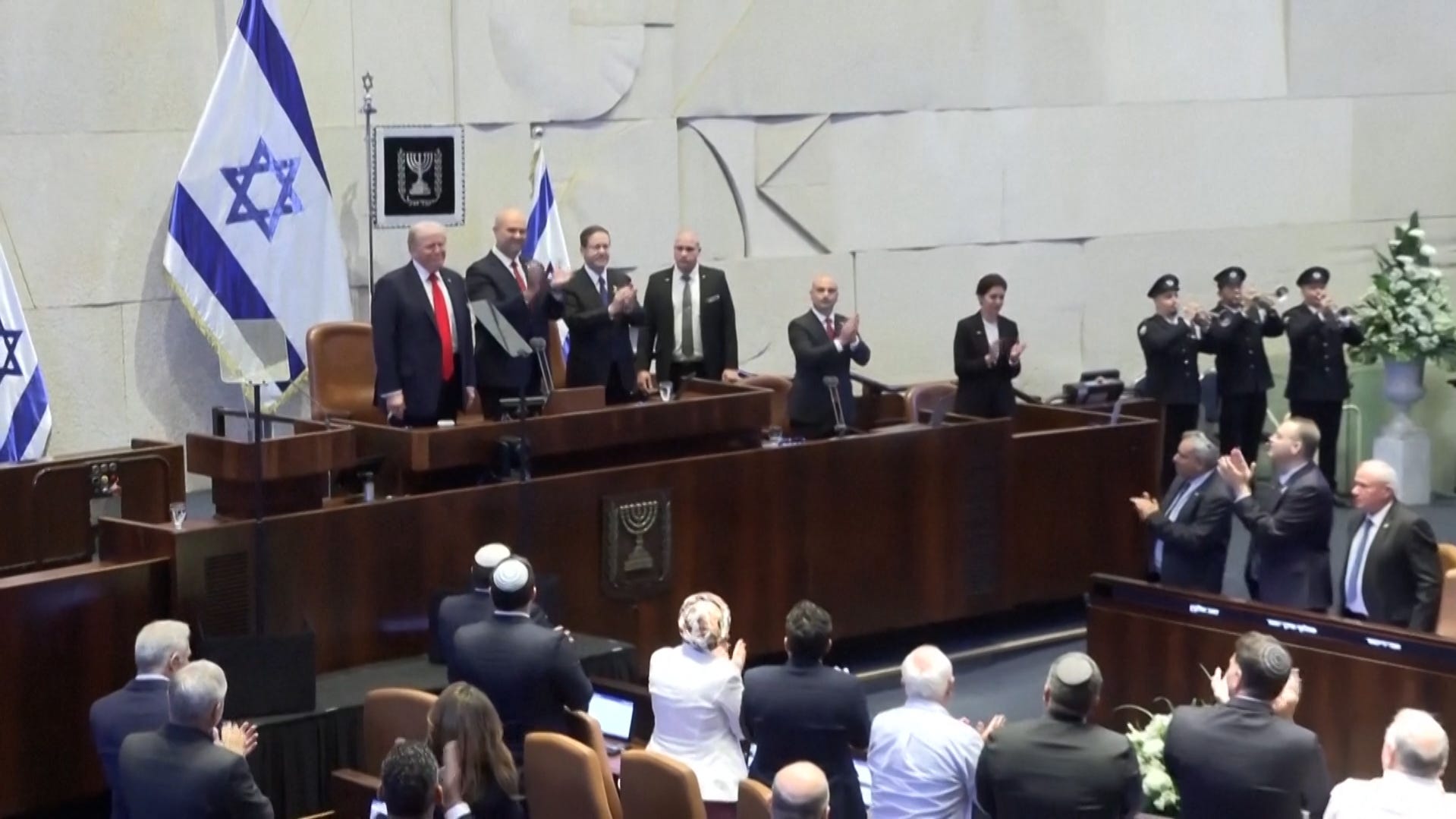

President Donald Trump receives standing ovation in Israel
President Donald Trump received a standing ovation in Israel’s parliament after supporting the release of 20 Israeli hostage survivors held by Hamas.
- President Trump outlined his growing desire for a peaceful Middle East in a speech to the Israeli parliament.
- Celebrations were held in Tel Aviv and Gaza to mark the release of Israeli hostages and Palestinian prisoners of war.
- A subsequent summit in Egypt discussed tackling difficult issues surrounding Israel’s security and the governance of Gaza.
The path to lasting peace between Israel and the Palestinians pursued by President Donald Trump will inevitably face obstacles and setbacks, and success in the long struggle is hardly guaranteed.
But on the morning of October 13th, there was joy.
“Today, after years of constant war and endless danger, the skies are calm, the gunfire is silent, the sirens are silent, and the sun rises over a holy land that is finally at peace,” Trump told Israel’s parliament in a 65-minute victory speech punctuated by asides and applause. “For generations to come, this will be remembered as the moment when everything started to change.”
There is jubilation on the streets of Tel Aviv and Gaza, with Trump both praised and ridiculed. IIn his homeland, he was hailed as a hero almost everywhere.
The brutal war that began with the Hamas hostage-taking and culminated in Israel’s bombing of Gaza subsided two years later. Hamas released the last 20 living hostages and began transferring the remains of the other dead. Israel has begun releasing Palestinian prisoners, withdrawing its troops, and allowing humanitarian aid to resume.
However, it was at least premature to declare, as President Trump did, that the ceasefire was a “historic dawn for a new Middle East.” The agreement is just the first step in a process that is expected to rebuild Gaza and ensure Israel’s security.
But without these first steps, it would be impossible to imagine everything that needs to be done after that.
In a speech to Israel’s parliament, President Trump outlined his burgeoning aspirations for “stability, security, dignity and economic development” in the devastated Palestinian territory of Gaza and a Middle East where today’s adversaries become “partners and ultimately friends.”
Peace between Ukraine and Russia? What about Iran?
His speech began several hours later than scheduled, starting around 7 a.m. on the East Coast, just in time for U.S. television morning shows. He spoke in a relaxed, easy-going manner, often deviating from the official text to poke fun at Netanyahu and introducing his companions, including negotiator Steve Witkoff, son-in-law Jared Kushner and Chairman of the Joint Chiefs of Staff Dan Cain, to applause.
He called on Israeli President Isaac Herzog to pardon Prime Minister Benjamin Netanyahu, who is on trial in an Israeli court on three corruption charges.
He blasted his predecessor, Joe Biden, as “the worst president we’ve ever had” and said Barack Obama “wasn’t that bad.”
And although some combatants from the previous seven wars dispute his account, he has now credited himself with having resolved the eighth war and expressed a desire to add a ninth to the war started with Russia’s invasion of Ukraine. He even suggested a “peace deal” with Israel’s sworn enemy, Iran.
“Is that OK?” he asked, and there was a small round of applause. “Isn’t it fine?
“President of Peace”
Some members of Israel’s parliament wore red MAGA-style hats that read “TRUMP THE PEACE PRESIDENT.”
President Trump’s leadership qualities and personal relationships may have made possible a ceasefire agreement that would have been avoided by other presidents.
He supported Israeli Prime Minister Benjamin Netanyahu, even though much of the world opposed him. hit with a hammer of Gaza. That ultimately gave the president the power to compel Bibi’s cooperation. Mr. Trump’s mercurial reputation and his comfort with unleashing military power – just ask the Venezuelans or the Iranians about that – meant Hamas took him seriously, and in a text to CNN’s Jake Tapper, Mr. Trump vowed “total annihilation” if they disagreed.
In doing so, he won the kind of historic moment that every president hopes to experience.
Recall that in 2010, Barack Obama signed the Affordable Care Act, the culmination of decades of efforts to expand health insurance coverage. Or, in 1987, Ronald Reagan and Soviet leader Mikhail Gorbachev agreed to the Intermediate-Range Nuclear Forces Treaty, beginning a partnership that marked the beginning of the end of the Cold War.
Or Jimmy Carter, who witnessed the signing of the Camp David Accords by Egyptian President Anwar Sadat and Israeli Prime Minister Menachem Begin in 1978.
Carter’s example may be particularly instructive both in terms of the possibilities it raised and the limitations it faced.
Sadat and Begin won the Nobel Peace Prize for being the first in the Arab world to reach a framework agreement between Egypt and Israel. However, this agreement did not resolve the Palestinian issue, and opposition from some Egyptians led to President Sadat’s assassination in 1981.
As for Carter, praise abroad did not improve his political prospects at home. He announced his candidacy for a second term in 1980 amid economic stagnation, inflation and turmoil over the Iran hostage crisis, but lost.
disarm Hamas and establish a Palestinian state
After speaking to the Knesset, President Trump was scheduled to head to Egypt’s Red Sea resort city of Sharm el-Sheikh to attend the Gaza Summit, co-chaired by Trump and Egyptian President Abdel Fattah el-Sisi, with more than 20 world leaders scheduled to attend. “The richest and most powerful group ever assembled at once, and they want nothing but good,” Trump said.
When U.S. and Israeli officials first told reporters that Prime Minister Netanyahu had unexpectedly accepted an invitation to attend, it was a sign of things to come. Israeli officials later announced that Netanyahu had declined, citing the proximity to the Jewish religious holiday of Shemini Atzeret Simchat Torah.
The next step will almost certainly be difficult. Disarm Hamas. This is something the leaders refuse to do. Prime Minister Netanyahu recognizes the Palestinians’ desire for statehood, which he has said he will never allow. Imposing international security to prevent the outbreak of new wars. Rebuilding devastated Gaza.
First of all, it’s Monday,, October 13th was a day of celebration.


