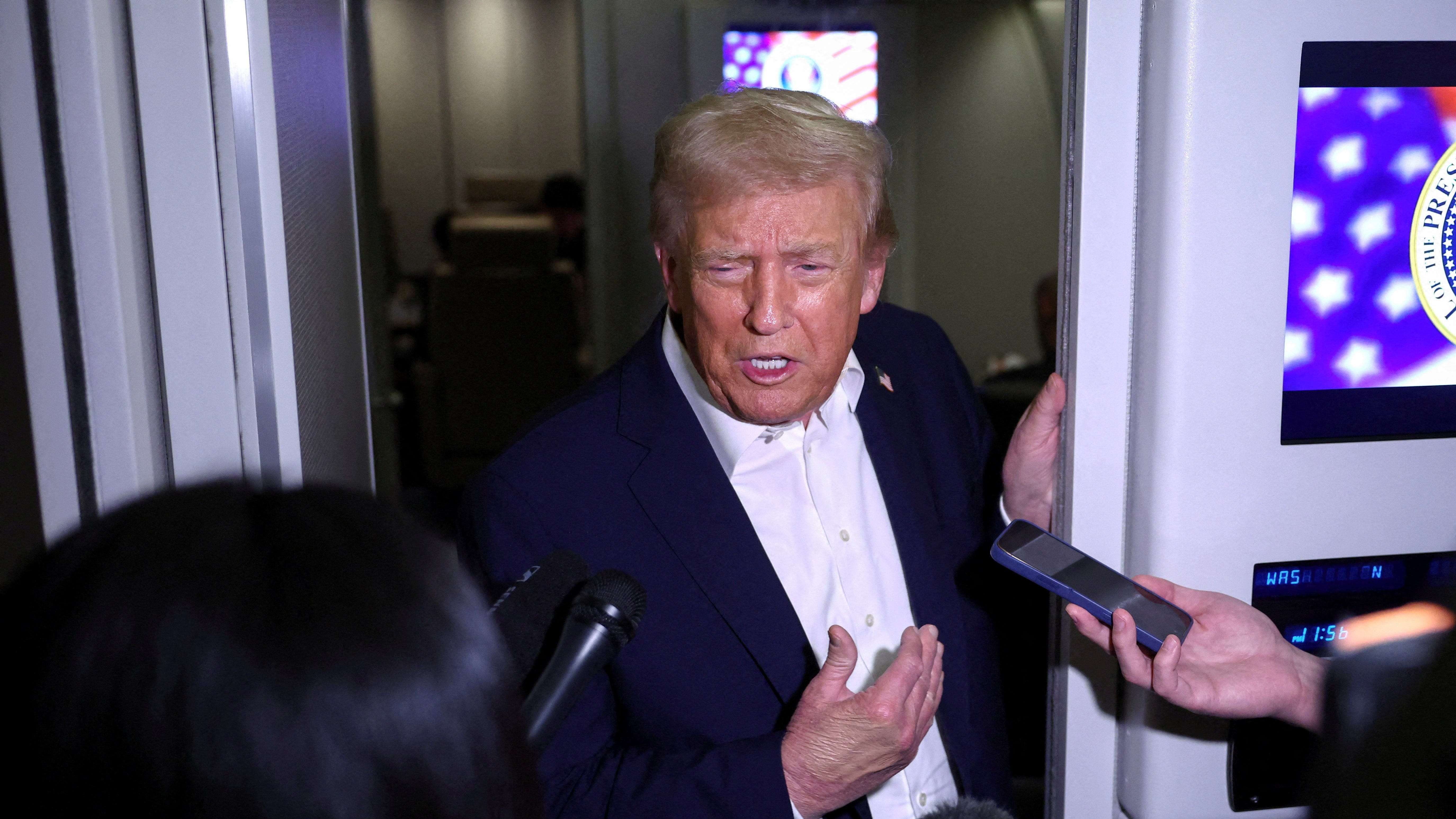

President Trump heads to Asia to seek trade deal with China
President Trump is scheduled to fly to Asia for six days and meet with China to negotiate a trade deal.
Chinese and U.S. economic officials agreed on a framework for a trade deal on October 26, and President Donald Trump said he was confident of expediting a deal during his meeting with Chinese President Xi Jinping in the coming days.
Treasury Secretary Scott Bessent and Trade Representative Jamieson Greer met with China’s Vice Premier He Lifeng and top trade negotiator Li Chengang on the sidelines of the ASEAN Summit in Kuala Lumpur, their fifth direct meeting since May.
“I think we have a very successful framework for the leaders to discuss on Thursday,” Bessent told reporters.
Bessent said on NBC’s “Meet the Press” that he expects the deal will delay China’s expansion of export restrictions on rare earth minerals and magnets and avoid new 100% U.S. tariffs on Chinese goods that President Trump has threatened.
He said Trump and Xi would discuss purchasing soybeans and agricultural products from American farmers, more balanced trade and resolving the U.S. fentanyl crisis, which was the basis for the U.S.’s 20% tariffs on Chinese goods.
China’s Li said the two sides had reached a “preliminary agreement” and would now go through their respective internal approval processes.
“The US is in a difficult position,” Lee said. “We have experienced very intense consultations and constructive exchanges to explore solutions and arrangements to address these concerns.”
President Trump will arrive in Malaysia on October 26th to attend the Association of Southeast Asian Nations Summit, the first stop on a five-day tour of Asia, which is expected to culminate with a meeting with President Xi Jinping in South Korea on October 30th.
After the meeting, he expressed a positive attitude, saying, “I think we will be able to reach an agreement with China.”
trade truce
The two countries are trying to avoid an escalation of a trade war after President Trump threatened to impose new 100% tariffs and other trade restrictions on Chinese goods starting Nov. 1 in retaliation for China’s expanded export restrictions on rare earth magnets and minerals.
China and the United States have lifted most of the triple-digit tariffs on each other’s products under a trade ceasefire that expires on November 10.
U.S. and Chinese officials said they discussed expanding trade, extending the ceasefire, fentanyl, U.S. port fees, rare earths, TikTok and more.
Mr Lee described the talks as “candid” and Mr Bessent said they were “very substantive negotiations”.
Bessent said the ceasefire could be extended depending on the president’s decision, making it the second extension since it was first signed in May.
issue
The White House has officially announced the long-awaited meeting between President Trump and President Xi, but the Chinese government has not yet confirmed that the two leaders will meet.
On the sidelines of the ASEAN summit, President Trump hinted at the possibility of meeting with President Xi in China and the United States.
“We agreed to meet. We will meet in China at a later date, and in the United States we will meet in Washington or Mar-a-Lago,” he said.
The topics of talks between Trump and Xi include China’s purchase of U.S. soybeans, concerns over democratically-ruled Taiwan, which Beijing considers its own territory, and the release of imprisoned Hong Kong media mogul Jimmy Lai.
The detention of the founder of the now-defunct pro-democracy newspaper Apple Daily is the most high-profile example of China’s crackdown on rights in Hong Kong.
President Trump also said he would seek China’s cooperation in the United States’ response to Russia as Russia’s war in Ukraine escalates.
fragile armistice
Tensions between the world’s two largest economies have intensified in the past few weeks as a delicate trade ceasefire struck after the first round of trade talks in Geneva in May and extended in August failed to prevent the two countries from clashing with further sanctions, export restrictions and threats of stronger retaliation.
The latest talks are likely to center around China’s expansion of rare earth export restrictions, which are causing a global rare earth shortage.
In response, the Trump administration is considering using software to block exports of everything from laptops to jet engines to China, Reuters reports.
(Reporting by Xinghui Kok; Writing by Mei Mei Chu, Yukun Zhang, John Mair; Editing by Tom Hogue, Ros Russell)


