Two factors are driving this decline: water use and less precipitation due to climate change. 260 billion gallons of water could be needed to save the lake.
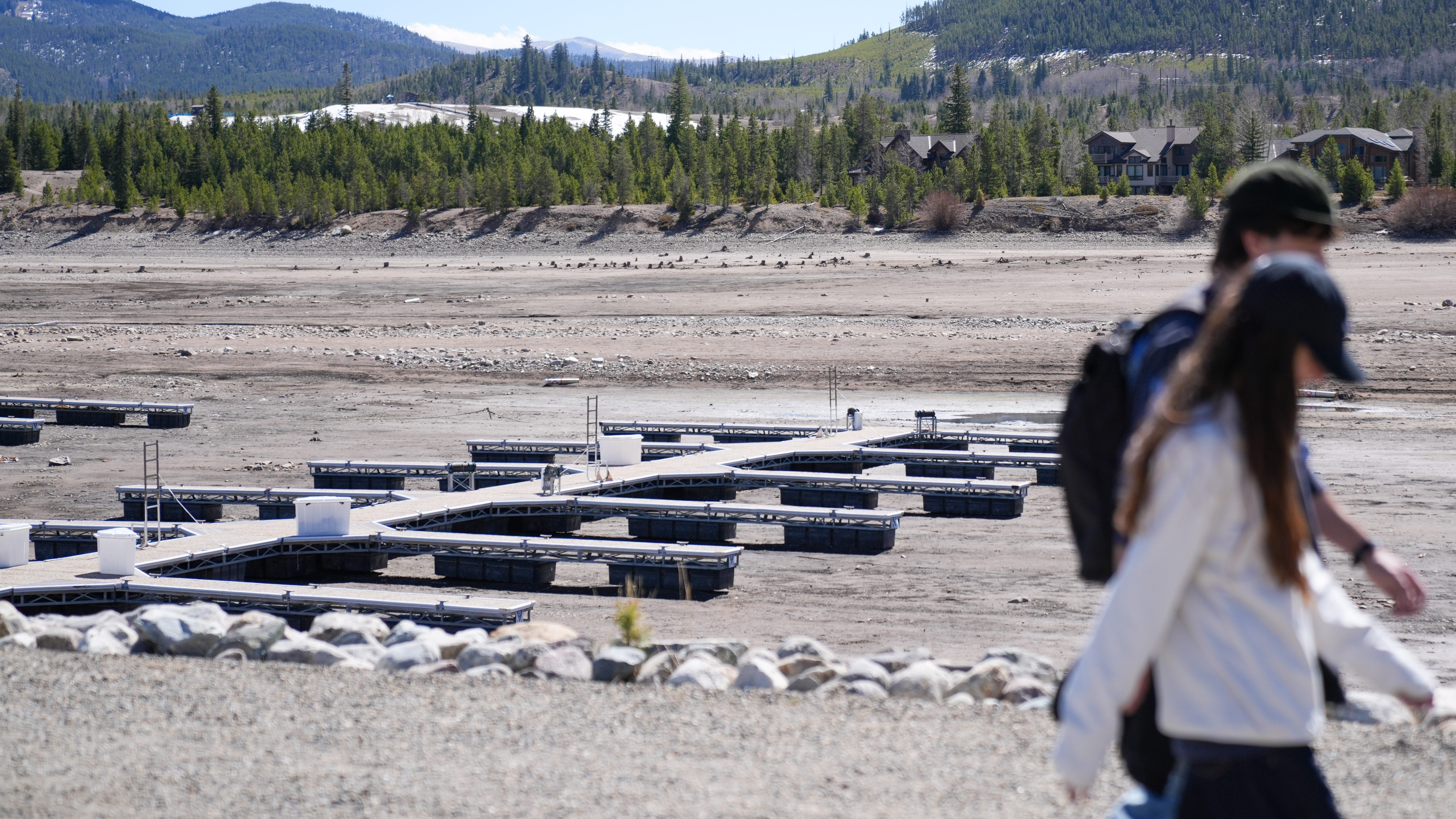

Water restrictions tighten across West as drought concerns grow
Communities across the West are facing a dangerously dry summer as record heat melts snow, threatens drinking water and increases the risk of wildfires.
The winter’s disastrously low snowfall could further complicate already ambitious plans to reclaim the moribund Great Salt Lake in time for the 2034 Utah Winter Olympics.
The plan, promoted by Utah officials and Olympic supporters, received a big boost after President Donald Trump proposed $1 billion in federal aid to acquire more water and address environmental issues. The lake has been shrinking for decades as farmers channel melted snow and rain into fields to grow crops like alfalfa for cattle.
Supporters remain optimistic that the coalition they have formed can reverse the long-term decline in time for the lake to reflect the Olympic torch to the world.
“I have complete confidence that we can solve this problem. This is a solvable problem,” said Utah businessman Josh Romney, son of former Sen. Mitt Romney, a 2012 Republican presidential candidate.
Josh Romney said preserving the lake could cost up to $5 billion and require about 260 billion gallons of water, about the same amount used by New York City residents and businesses over a nine-month period.
What challenges does the Great Salt Lake face?
The water level of the Great Salt Lake has always fluctuated, but in 2022, the water level dropped to its lowest point on record. Although there has been some recovery since then, ecologists, climate experts and lake advocates say long-term trends are grim due to water use and climate change.
In addition to its iconic role in Salt Lake City, the lake is a popular recreational destination and important wildlife habitat for migratory birds. It also has a thriving fishing industry, with workers scooping up large quantities of microscopic brine shrimp that are sold internationally as fish feed.
“Ecosystems are on life support. In addition to economic and hydrological collapse of the lake, we are on the brink of ecological collapse because of the overuse of water in areas of Utah, Idaho, and Wyoming,” said Ben Abbott, a professor of ecology at Brigham Young University and executive director of the water policy nonprofit Grow the Flow.
About 80 percent of the lake’s decline is due to overuse of water, Abbott said, with the rest due to climate change and drought.
Abbott and other lake experts said this year’s lack of snowfall won’t help their efforts.
Climate change is changing weather patterns across the West, increasing temperatures, increasing evaporation, and decreasing snowpack.
Why is the Great Salt Lake dry?
While climate change is contributing to the lake’s plight, Abbott and other experts said agricultural use is the biggest factor in causing it to dry up. Another factor is population growth.
The suburbs around Salt Lake City are among the fastest growing areas in the nation, and Utah is growing much faster than the rest of the country.
According to the Census Bureau, Utah’s population will grow by 1% from 2024 to 2025, faster than Arizona or Nevada, making it the fifth fastest growing state in that year. All these new residents, especially the lush lawns growing in the desert-like climate, are consuming water that would normally flow into the Great Salt Lake.
However, farmers who grow alfalfa for cattle and horses are the main source of water use. Romney also said it’s important that when it comes to convincing farmers to help recharge lakes, it’s all voluntary.
“It’s not the same as encouraging people with large lawns to turn down water,” he says. “When you have those conversations with farmers, not only does it affect the color of their lawn, but how much money they can bring back to their families affects their livelihood.”
The goal is to give farmers the opportunity to continue farming and growing crops in a way that reduces water use while realizing economic benefits, he said. “There are many solutions to reduce water use while maintaining crop yields.”
He sees a “huge” opportunity on the residential side, simply by getting people to stop over-watering their lawns. Even if people only watered their lawns as much as they needed, rather than the amount they thought they needed, the region could save 200,000 acre-feet of water, he said.
How will snowfall in 2025-2026 affect the lake?
Most parts of the West have historically had low winter snowfall, which has significant impacts on residents and businesses that rely on snowmelt for irrigation each summer. But the water that ends up in the Great Salt Lake itself is too saline for drinking or irrigation, so water managers won’t pump it like they do from other lakes and reservoirs, like Lake Powell in southern Utah.
Abbott said the lack of snow in the valleys around the Great Salt Lake is a symptom of chronically low water levels in the lake. “One of the reasons we’ve had so much snow this year is because the lake is so small that there’s not as much water vapor from the lake to support the snow.”
At its record height in 1986, the lake was approximately 2,300 square miles, according to the U.S. Geological Survey. In 2022, its area is less than 1,000 square miles. Abbott said restoring the lake would result in more rain and snow.
A light winter snowfall can have a short-term effect on the amount of water coming into the lake, Abbott said, but “it’s so large that it can handle a year or even multi-year drought.” “What it doesn’t address is that we’ve been diverting that water every year for over 100 years.”
What environmental issues are involved in the Great Salt Lake?
Since the lake has no outlet, the water that flows into it eventually evaporates, leaving behind minerals and salts. These sediments make the lake saltier when the water is low, creating a potentially toxic environment for birds and fish.
However, a salty environment is the perfect environment for brine shrimp (tiny creatures sold as sea monkeys). Harvesting brine shrimp eggs for commercial fish feed supports thousands of jobs and generates more than $1.5 billion in annual revenue. State officials say half of the world’s farmed fish are raised on brine shrimp eggs harvested in Utah.
But mineral deposits left behind when the lake’s water level drops and the lake bed dries and is blown away by the wind are contributing to the region’s air pollution, along with persistent ozone problems. Last year, the Salt Lake City-Provo-Orem metropolitan area ranked 25th worst in the nation for short-term particle pollution, according to the American Lung Association.

Satellite images show Great Salt Lake decline since 1984
Can the federal government help state nonprofits restore the Great Salt Lake in time for the 2034 Olympics?
Provided by U.S. Geological Survey
What are the Great Salt Lake boosters up to?
Utah Governor Spencer Cox announced plans to replenish the lake in the fall of 2025 ahead of the Winter Olympics.
“The Great Salt Lake is our lake, our heritage, and our responsibility,” he said at the time, announcing that $200 million in private donations had already been pledged to help.
Romney said he is optimistic that businesses, residents and government can work together to save the lake. One of the coalition’s first big steps was to help the state buy out a decommissioned U.S. magnesium plant along the lakeshore that holds 3.26 billion gallons of water in the lake.
State officials won the bid, but needed Mr. Romney’s Great Salt Lake Rising Group to cover half of the immediate costs. Mr. Romney called the partnership “one of the greatest environmental victories in the Western world in the last 20 years.”
Advocates are encouraged by the growing sense of unity Utahns are seeing to address the lake crisis. The state Legislature recently approved three bills to help the lake. Romney and Abbott said leaders of The Church of Jesus Christ of Latter-day Saints, the state’s main religion, have taken steps to expedite the lake’s restoration. The church is committed to water and has adopted irrigation and landscaping measures that reduce usage at many of its Utah properties.
Great Salt Lake Deputy Commissioner Hannah Freese said the Great Salt Lake is the largest salt lake in the Northern Hemisphere and the eighth largest in the world. The Secretary’s Office coordinates lake improvement efforts among nonprofit organizations, the development community, and government.
“This lake is hemispherically important,” Freeze said. “It’s just a huge driver for our economy, our hydrology, and our way of life here in Utah.”
How does President Trump plan to save the Great Salt Lake?
Federal officials did not provide details about how Trump’s $1 billion plan would work, instead pointing reporters to a four-sentence statement in the White House budget that notes any recovery effort requires a comprehensive federal approach. Funding also requires parliamentary approval.
The president himself declared on March 10 that only Trump can save the Great Salt Lake, saying that without Trump’s intervention, it would run out of water “in a short period of time.”
“These investments will ensure that the Great Salt Lake continues to support global aquaculture, serve as a national source of critical minerals, and drive economic activity in Utah and beyond,” President Trump’s budget proposal states.
Freeze Lake said Trump’s support is “very important.”
Lynn de Freitas, executive director of Friends of the Great Salt Lake, said she’s glad decades of work is paying off. The nonprofit organization has been working for more than 30 years to address the environmental conditions and impacts that have caused the lake’s dramatic changes.
Currently, the lake averages about 33 feet deep, but even a little rain could spread over a larger area, like pouring batter into a cake pan, de Freitas said.
She’s waiting to hear what specifically the president’s plan will fund, from possible changes to the railroad causeway that would effectively cut the lake in half to measures to limit the amount of sediment coming in. She said any assistance would be welcome at this time given the long-term projections.
“It’s very good news,” she said. “I think there is a recognition that the Western world is going through a difficult period.”
USA TODAY national correspondents Trevor Hughes and Dinah Boyles Pulver write about the effects of climate change and weather disasters across the country, among other news topics. Please contact us at thughes@usatodayco.com and dpulver@usatodayco.com.


