Migrant flows at the Guatemala-Mexico border have decreased dramatically since the Trump administration implemented stricter border policies.

Latin American migration patterns have shifted southward
Border crossings have fallen to record lows as the Trump administration’s immigration crackdown ramps up.
This article was supported by the Pulitzer Center. This is part of a project on reverse migration by Arizona Republic reporter Daniel Gonzalez and El Paso Times visual journalist Omar Ornelas.
CIUDAD HIDALGO, Mexico — For Alexis Vargas, transporting migrants across the murky waters of the Suchiate River was a lucrative business.
Vargas carried the group of migrants across the unofficial border between Guatemala and Mexico on a makeshift raft made of wooden planks tied to a thick inner tube. He earned over $100 a day. That was a lot of money in this poor area.
Vargas recalled that as soon as one group was dropped off, another group of migrants was waiting on the other side to cross. From long before dawn until long before dark, similar rafts clogged the river, with as many as 20 migrants crammed into each raft. Hundreds of people crossed from the Guatemalan side to the Mexican side every day.
Their destination is the United States.
But on a recent afternoon as the sun began to set, all the 28-year-old raft operator could do was sit on a cement landing and scroll through his cell phone. His empty raft was parked in a nearby body of water along with other empty rafts.
The flow of migrants that kept Vargas and other raft operators busy here for years soared during the Biden administration but disappeared under President Donald Trump.
“I’ll tell you, since the president closed the door, very few people have been crossing,” said Vargas, dressed in soccer shorts, a T-shirt and flip-flops in the sweltering tropical heat.
Vargas looked at the almost empty river and nodded. Only a few rafts were floating leisurely on the water. The rafts were not carrying large groups of immigrants, but only small groups of local residents commuting back and forth for shopping or work.
The dramatic drop in migrants at the Guatemala-Mexico border is a direct result of the Trump administration’s border enforcement and mass deportation campaign, which is underway some 3,000 miles from this city on Mexico’s southern tip.
Criminal arrests of asylum seekers who entered the United States illegally, the closure of the CBP One app, the deployment of armed troops to assist with border security, and the sight of heavily armed and masked federal immigration agents raiding work sites and conducting military-style arrests in immigrant neighborhoods in Los Angeles, Chicago, and other U.S. cities have stoked fear among immigrants and effectively halted the flow of migrants.
The southern border between Mexico and Guatemala reflects a newfound calm along the U.S. southern border with Mexico, where illegal immigration has plummeted from record highs during the Biden administration to the lowest levels in decades under the Trump administration.
Furthermore, new phenomena are emerging. Immigrants discouraged by the Trump administration’s hard-line policies are giving up. Rather than heading north, they are turning around and heading south, according to interviews with migrants and immigration experts.
Tapachula: Once the entrance, now the exit
Tapachula, a city of 350,000 people located just a few miles inland from the Suchiate River, has long been a major gateway for immigrants from Central America to Mexico.
From Tapachula, migrants began the long and dangerous journey through Mexico to the United States, often in large caravans.
During their journey, they faced many dangers, including illness from the natural elements, dehydration, and heat stroke. Injuries and deaths from vehicle accidents and falls from trains. Sexual assault, kidnapping, extortion, and human trafficking by criminal organizations. abuse from police and other authorities;
But Tapachula is now becoming an exit route for migrants heading south rather than north.
When Trump took office on January 20, the backflow was accelerated by migrants en route to the United States. Now, because of Mr. Trump’s crackdown, they have decided to reverse course and head home or to some other country.
Juan Piña, 45, an immigrant from Venezuala, said the decision to change direction was difficult.
Piña said his extended family of nine left Venezuela for the United States in October 2024 after selling all their possessions.
They trekked through six countries, including a five-day trek through the infamous Darien Gap jungle between Colombia and Panama, before arriving in Tuxtla Gutierrez, a city in southern Mexico about five hours north of Tapachula.

Significant drop in immigration at Mexico-Guatemala border due to President Trump
The decline in immigration at the Guatemala-Mexico border is the result of the Trump administration’s border enforcement and mass deportation campaign. This article was supported by the Pulitzer Center.
Piña said he and his 68-year-old father, Ramon Piña, worked in construction for 11 months to earn money to move north.
But after reading about immigrant raids and deportations in the United States, they decided to give up and return home.
“We had a dream, and it’s sad to see it turned upside down,” Piña said in a choked voice.
Piña said her family is not “invaders,” as Trump has referred to immigrants, but hard workers trying to “improve their lives.”
“We invested everything we had and now we’re going to come back with even less,” Piña said. “We sacrificed a lot to achieve that dream and to improve our family. Now we will see what awaits us in our country of Venezuela.”
Evacuation centers that were once over capacity are now empty
Signs of Tapachula’s remarkable transformation from immigration entry to exit are visible everywhere.
Shelters that were overcrowded with migrants just nine months ago are nearly empty.
During a recent visit to the Jesus the Good Shepherd immigrant shelter outside Tapachula, most of the dorm rooms were empty.
In December, before Trump took office, the 35-year-old shelter was packed with 1,700 migrants, far exceeding its capacity of 1,100, said manager Evert Bermudez, 60.
Bermudez said fewer than 100 migrants remain, including those from Venezuela, Guatemala, Cuba, Haiti and Nigeria.
The migrants there reportedly left for other cities in northern Mexico in search of asylum and jobs. Or they went back to their home countries, Bermudez said. Some of the migrants who arrived are now heading south. But he says those are only a small portion of the flow that previously headed north.
Tapachula returns to normal state
While some migrants remain in Tapachula, thousands of migrants, including entire families, are gone, sleeping on sidewalks, huddled in parks, crammed into cheap hotel rooms or lining up outside banks waiting for relatives abroad to send money.
One of the remaining migrants, 20-year-old Liz Valdez, was waiting tables at Regina’s restaurant in the main plaza, wearing black leggings and a T-shirt.
As closing time approached, Valdez said she fled Cuba earlier this year to go to the United States, where she has family in Las Vegas and Miami.
But after hearing about President Trump’s crackdown, she decided to remain in Mexico, at least for the time being.
Dramatic drop in immigration suggests President Trump’s crackdown is effective
Just 35% of migrants surveyed by the United Nations’ International Organization for Migration between June and August said they were heading to the United States, down from 73% from October to December.
The sharp decline in northbound migration, along with the growing reverse migration phenomenon, suggests that the Trump administration’s border and immigration policies are a huge success, accomplishing in months what the previous administration failed to do in decades.
“After years of Democratic-induced open borders that have turned the United States into a magnet for dangerous and unchecked migrants, this is another sign that President Trump’s unprecedented border security efforts are working,” the White House said in a statement on September 3.
Experts warn that the often dire conditions that led immigrants to flee their home countries in record numbers in search of safety, security and prosperity in the United States have not changed. Experts say it remains to be seen whether the Trump administration’s policies will have a long-term effect or are just band-aids.
“If you ask me, is this a successful policy, a fear-based policy? Not necessarily,” said Diego Chavez Gonzalez, senior manager of the Latin America and Caribbean Initiative at the nonprofit, nonpartisan Migration Policy Institute.
The Trump administration also disbanded the U.S. Agency for International Development and eliminated funding to Latin American countries that helped integrate 6 million Venezuelans fleeing the economic crisis, Chavez Gonzalez said.
Chávez González said the lack of comprehensive policies that address the root causes of migration and help migrants integrate into other countries could lead to further waves of migration in the future.
Chávez González said that “if there is no stability in Latin America,” migrants may decide to return to the United States or other regions, creating instability throughout the Western Hemisphere, including the United States.
“We need comprehensive policies that promote stability and are not just based on security and fear,” Chavez Gonzalez said.
Dramatic changes after President Trump took office
Ivana Saldívar said the changes before and after Jan. 20 were amazing. She oversees the Tapachula office of the United Nations’ International Organization for Migration.
Before January 20, more than 1,000 migrants were crossing the border from Guatemala to Mexico every day, Saldívar said. The IOM estimates that number has fallen to between 40 and 50 people per day as of September.
For years, IOM has documented migrants from 180 countries – nearly every country on Earth – crossing borders from Guatemala to Mexico, Saldívar said.
He noted that smuggling fees have tripled from $5,000 to up to $15,000 due to immigration enforcement in the United States. Saldívar said rising smuggling fees have further reduced incentives for migrants.
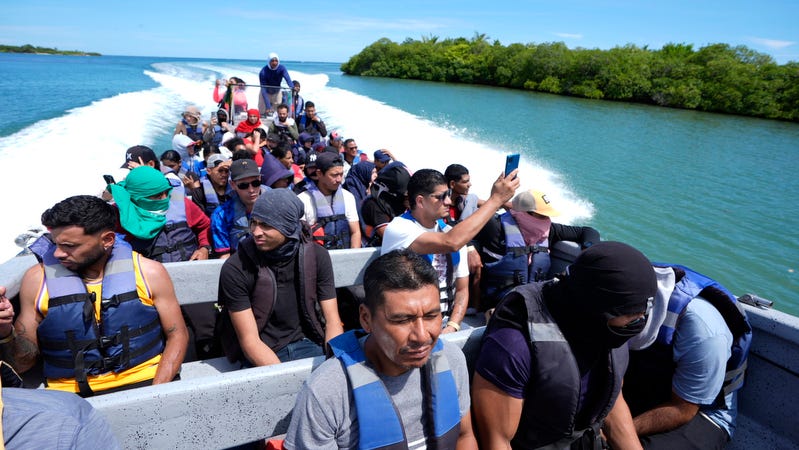
But that also means smuggling rings are becoming more sophisticated and taking on greater risks, Saldívar said. IOM said an increasing number of migrants were crossing the Guatemala-Mexico border on rafts at night or traveling by boat across the Pacific Ocean.
The decline in immigration has reduced the income of criminal smuggling organizations. Mexico’s IOM director Dana Graeber Radek said there was growing concern that kidnappings and other crimes against migrants could rise as criminal organizations look for ways to make up for their losses.
Saldívar said the conditions of poverty, hunger, insecurity, political change and persecution that drove large numbers of migrants from countries such as Venezuela, Haiti and Cuba have not changed.
“The solution is to promote regular and safe migration while respecting the human rights of those who need and want to leave their countries,” Saldívar said. “After all, migration is a right. We all have the right to migrate, but it needs to be done regularly and in a sustainable way.”


