
SCOTUS rules against President Trump’s sweeping tariffs in 6-3 decision
The Supreme Court has ruled that President Donald Trump does not have the power to impose large tariffs at will.
WASHINGTON – The Supreme Court dealt a major blow to President Donald Trump’s economic policies, ruling that the president does not have the power to impose sweeping tariffs with the stroke of a pen.
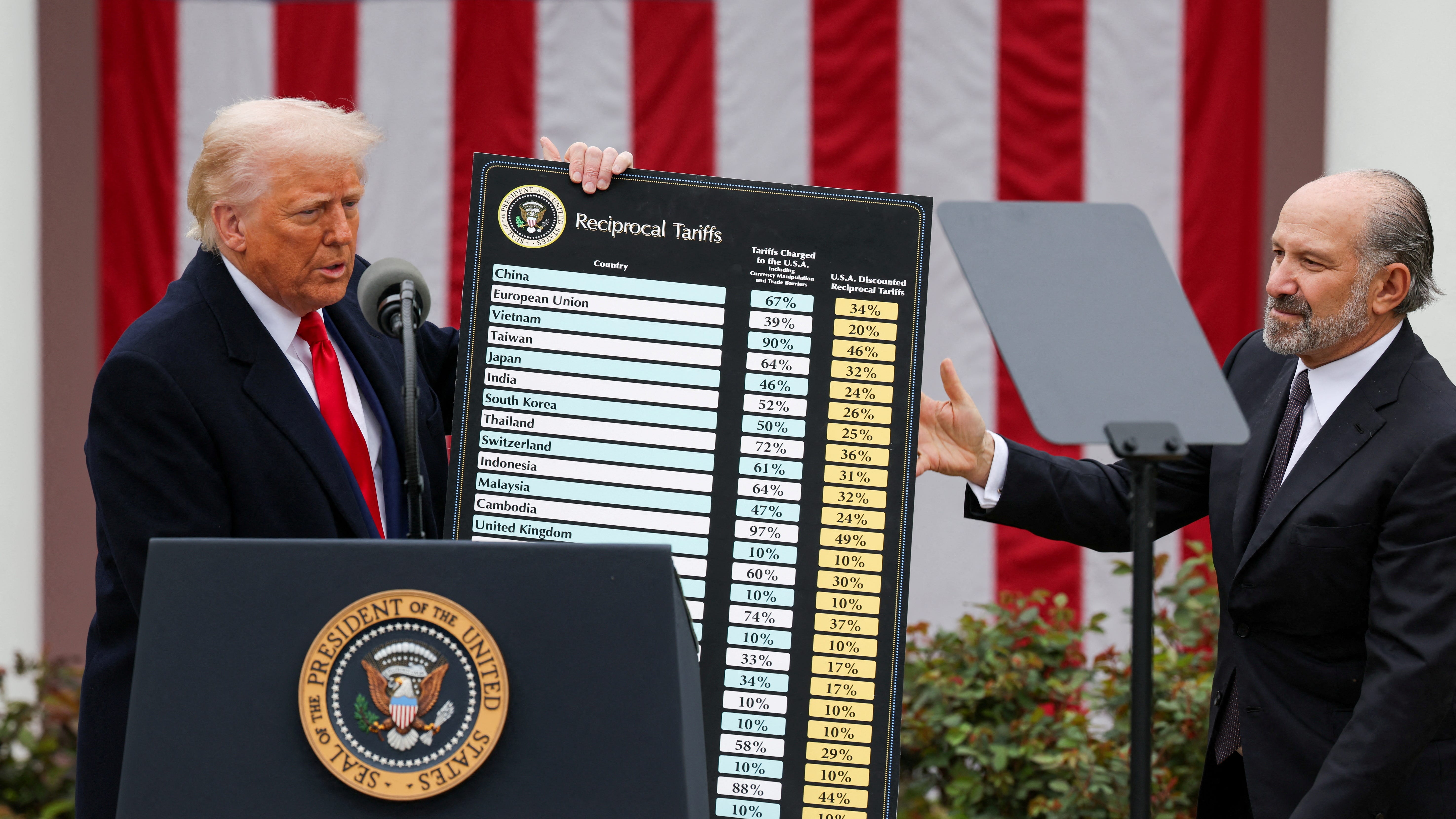
On February 20, the court struck down the tariffs, a centerpiece of his economic policy and a major foreign policy tool, but also rising costs for consumers and businesses. The conservative court’s 6-3 decision was the court’s first major ruling on President Trump’s controversial expansive view of executive powers.
Chief Justice John Roberts wrote: “The president asserts extraordinary authority to unilaterally impose tariffs without limit in amount, duration, or scope.” “Given the breadth, history, and constitutional context of that asserted power, the president must identify clear Congressional authorization to exercise it.”
Mr. Roberts concluded that Mr. Trump cannot do that.
Democrats welcome Supreme Court decision invalidating emergency tariffs
Democratic senators welcomed the high court’s decision to invalidate President Trump’s emergency tariffs.
Dick Durbin, the Illinois Democratic Party’s assistant minority leader, said the “misguided” policy has created a burden on families and businesses.
“Today’s decision is a victory for the American people and a rare example of the Supreme Court’s ability to use its constitutional authority to stop President Trump’s corruption and chaos,” Durbin said in a statement.
Sen. Patty Murray of Washington, the top Democrat on the Appropriations Committee, called the tariffs “nothing short of economic arson,” but said the court’s decision “hangs an important thread” on it.
“The president will upend entire industries on a whim, dramatically raising costs and locking small businesses out of markets they depend on. It’s sheer stupidity that has cost us jobs and raised prices for almost everyone,” Murray said.
–Bert Jansen
In a dissent joined by Justices Clarence Thomas and Samuel Alito, Justice Brett Kavanaugh said that tariffs are the “traditional and common tool” the law gives presidents to use to regulate imports.
“The tariffs at issue here may or may not be wise policy,” Kavanaugh wrote. “But they are clearly legal based on the text, history and precedent.”
He also said the majority’s decision “doesn’t say anything” about whether or how the government must return the billions of dollars it has already collected.
Kavanaugh said the process would likely be “chaotic.”
President Trump called the ruling “shameful” after it came during a meeting with state governors, Reuters reported.
The ruling could calm some critics who complained that the court, which has a 6-3 conservative majority, allowed President Trump to make major policy decisions without Congress’ permission, after blocking a major initiative by Democratic President Joe Biden.
President Trump had hoped the tariffs would boost the federal budget by more than $2 trillion over the next decade and bring manufacturing back to the United States.
The president warned the court that repealing the tariffs would have “devastating national security, foreign policy, and economic consequences.”
However, government officials also noted that there are other means of imposing import fees and vowed to move quickly to take advantage of them.
This means that uncertainty about operating costs will likely continue for retailers and other businesses, even as President Trump welcomes the decision that the Emergency Powers Act of 1977 cannot be used to circumvent the more complex and restrictive tariff procedures set out in other laws.
“We urge the president to refrain from using other authorities to impose tariffs on agricultural inputs because farmers are under cost pressure and agricultural input costs remain high,” Scott Metzger, an Ohio farmer and president of the American Soybean Association, said after the ruling.
Customs duties are paid by companies when they import goods from other countries. Awaiting this ruling, thousands of companies filed lawsuits seeking refunds.
Stock market rejoices over SCOTUS tariff ruling
Major U.S. stock indexes ended early losses after the Supreme Court struck down President Donald Trump’s emergency tariffs.
In a 6-3 decision, the court found that President Trump exceeded his authority by imposing the mandate without explicit authorization from Congress. The ruling does not address whether customs duties already paid must be returned.
Last year, retail stocks such as Nike, Decker’s Outdoors and Abercrombie & Fitch, which were hit hard by rising import and manufacturing costs due to tariffs, rose in value, pushing up the overall index.
As of 10:53 a.m. ET, the S&P 500 index rose 0.62%, or 42.82 points, to 6,904.71, and the blue-chip Dow Jones Industrial Average rose 0.25%, or 122.42 points, to 49,517.58. The tech-heavy Nasdaq rose 1.06% (239.219 points) to 22,921.948. The benchmark 10-year US Treasury yield rose to 4.094%.
Stocks opened lower after data showed economic growth slowed in the final three months of 2025. Gross domestic product (GDP) rose 1.4%, well below the 2.5% increase expected by economists polled by Dow Jones and reflecting the larger-than-expected impact of a record-long government shutdown. The Commerce Department estimates that the shutdowns have shaved about 1 percentage point off economic growth.
—Medora Lee
Foreign business leaders say tariff decisions could bring further uncertainty
Foreign leaders reacted cautiously to the decision, as the Trump administration could impose tariffs other than by declaring a state of emergency. One law authorizes tariffs on imports that threaten national security, and another authorizes retaliatory tariffs on countries that send more goods to the United States than they import.
Candice Lane, president and CEO of the Canadian Chamber of Commerce, said the decision is a legal ruling and not a reset of U.S. trade policy.
“Canada should prepare new and insensitive mechanisms to reassert trade pressure, with potentially broader and more devastating effects,” Raine said in a statement.
William Bain, head of trade policy at the British Chambers of Commerce, said separate legislation was used by the US to impose tariffs on steel and aluminum.
“While this decision clarifies the president’s executive authority to raise tariffs, it does little to clear up the mud in business,” Bain said in a statement.
—bert jansen
Companies asked for refunds even before the Supreme Court’s ruling.
Even before the high court overturned President Trump’s emergency tariffs, thousands of companies were suing to recover the billions of dollars they had already collected. But government officials say government refunds will be issued without litigation.
Costco Wholesale, Revlon and Goodyear Tire are among the companies that have sought refunds through lawsuits in the U.S. Court of International Trade. He said small businesses will need to take out loans, halt expansion plans and freeze hiring to cope with the tariffs.
“Today’s Supreme Court decision is a huge victory for America’s small businesses that have endured the crushing burden of tariffs,” said Dan Anthony, executive director of the advocacy group We Pay the Tariffs.
Treasury Secretary Scott Bessent told Reuters on January 9 that the administration has enough money to refund the tariffs, but the repayments could take weeks or even a year. As of January 8, the Treasury had nearly $774 billion in cash on hand.
–Bert Jansen
The International Emergency Economic Powers Act of 1977, passed after the Watergate scandal when Congress wanted to take control of the executive branch, has historically been used to impose economic sanctions and other penalties on foreign countries. But the administration argued that the law gives the president the power to “regulate” imports in response to “extraordinary and unusual threats,” including the power to impose tariffs.
Starting in early 2025, President Trump used the law to impose tariffs on almost all goods imported into the United States, claiming he was cutting a persistent trade deficit that had hollowed out the nation’s manufacturing base.
President Trump leveraged other tariffs he imposed on imports from Mexico, Canada, and China to force those countries to take further steps to stop fentanyl from entering the United States.
Several small businesses and more than a dozen states with Democratic attorneys general sued the administration.
They argued that President Trump had stretched the word “regulation” beyond its original meaning. If “regulation” means “tax,” they said, the president “can tax everything from cars to zoos,” even though the Constitution gives Congress the power to raise revenue.
During oral arguments in November, the Justice Department said the tariffs were “regulations” imposed for diplomatic and domestic policy reasons, not to increase government coffers. But Trump also boasted that the tariffs would significantly increase revenue.
Still, the administration argued that Congress wanted the president to have greater authority over international trade in emergencies, and that was appropriate because the Constitution gave the president broad authority in foreign affairs.
But Roberts said that when Congress delegates tariff authority, it does so under clear conditions and with strict limits.
“What common sense suggests, Congressional practice confirms,” he wrote.
The court’s three liberal justices, Justices Elena Kagan, Sonia Sotomayor, and Ketanji Brown Jackson, disagreed with the entire reasoning of Roberts’ opinion.
In a separate opinion, Kagan wrote for the trio that the tariffs could be invalidated based solely on the text of the bill. The liberal justices did not support Roberts’ use of the “grave issue” legal doctrine, which prevents the executive branch from taking issues that have a major economic impact or are of major “political importance” without explicit authorization from Congress.
This principle was used by the courts to block Biden’s attempt to forgive $400 billion in student loan debt.
Courts have similarly previously ruled that Biden cannot extend an eviction moratorium related to the coronavirus pandemic and that the Environmental Protection Agency cannot regulate power plant emissions that contribute to climate change.
“We have long expressed a reluctance to read too deeply into ‘vague statutory language’ that specifically delegates Congressional authority,” Roberts wrote, citing past rulings on tariffs.
The U.S. Court of Appeals for the Federal Circuit divided, but lower courts sided with the challengers.
Opinion polls consistently show that tariffs are unpopular.
The cases Learning Resources v. Trump and Trump v. VOS Selection were the first cases in which challenges to policies enacted by Trump during his second term received serious consideration by the Supreme Court. Until these cases were decided, the justices had only made tentative rulings on whether President Trump’s policies could remain in effect during the litigation. In these preliminary rulings, Mr. Trump was overwhelmingly successful.
Contributed by: Reuters


