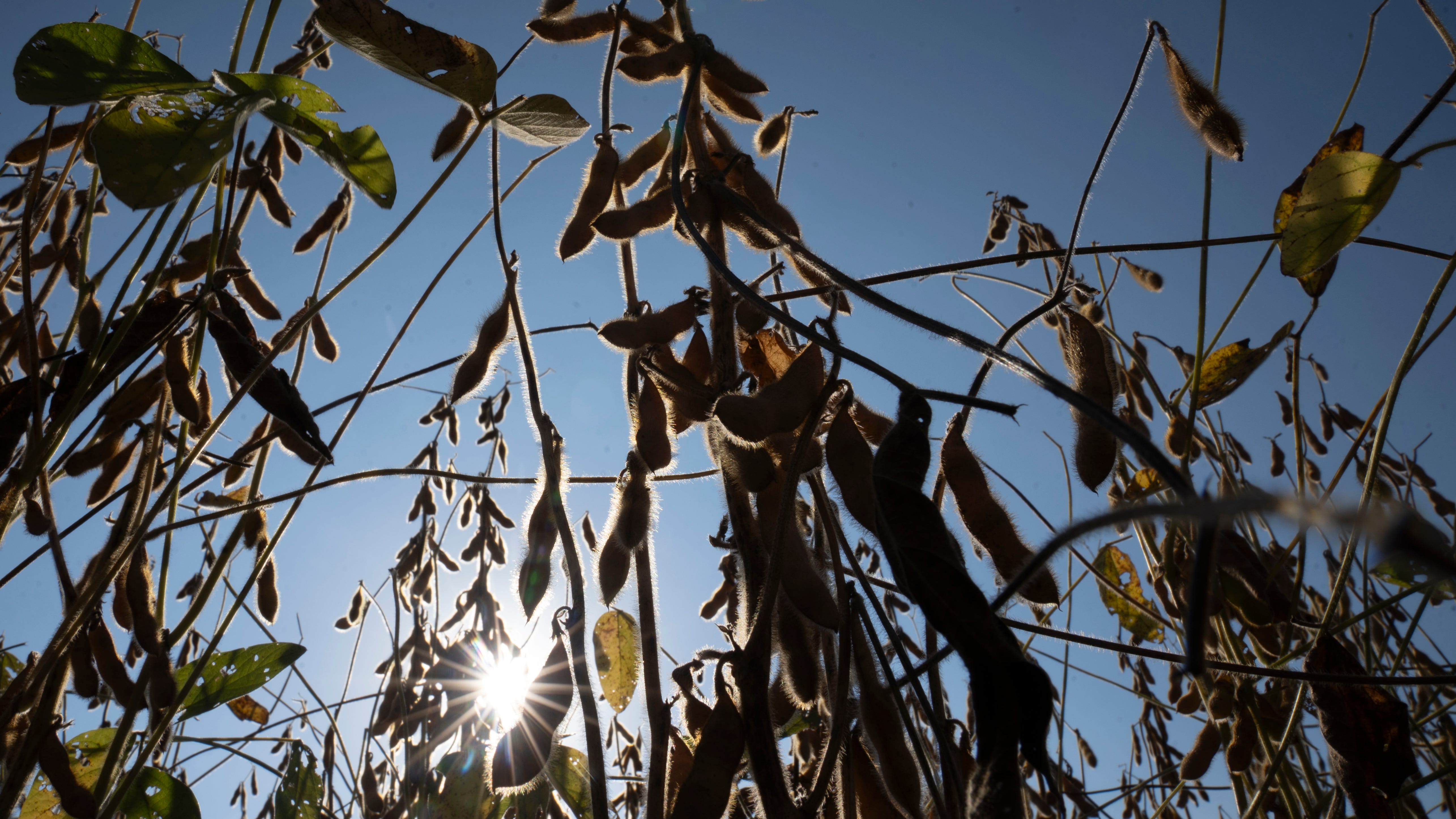

Soybean farmers struggling with the US-China trade war
Soybeans are one of Kansas’ most common crops, but farmers are struggling to sell their product after China refuses to buy U.S. soybeans.
- Farmers, especially soybean producers, are facing significant economic hardship due to trade wars and tariffs.
- Bulk U.S. soybean exports to China have fallen 76% in one year, forcing farmers to reconsider planting.
- The Supreme Court’s decision nullified the president’s ability to impose tariffs through the International Emergency Economic Powers Act.
- Some believe the $12 billion federal aid package for farmers is a “band-aid on a gunshot wound” rather than covering the total losses.
Farmers, particularly soybean producers, are “living with the damage” from tariffs and the resulting trade war as they face decisions about what crops to plant this year.
“What’s really on the minds of most of us in agriculture are the tariffs being imposed on our neighbors, Canada and Mexico, and our largest trading partner, China,” said Nick Levendowski, executive director of the Kansas Farmers Union. “We are seeing the damage and living with the damage of that move, including tariffs and trade wars.”
Levendowski spoke to the Capital Journal, part of the USA TODAY Network, days before the U.S. Supreme Court. StrakOn February 20, most of President Donald Trump’s tariffs were lowered. This case specifically dealt with the use of international emergency economic powers laws to impose tariffs.
“The President asserts independent authority to impose tariffs on imports of any product from any country, at any time and for any period,” Chief Justice John Roberts wrote in a 6-3 opinion.
But the U.S. Constitution gives Congress the power to impose taxes, including tariffs, and “the executive branch is not vested with any part of the power to tax,” Roberts said. The court held that “IEEPA does not authorize the President to impose tariffs.”
Trump trade war hits soybeans
Soybeans have been particularly hard hit by President Trump’s trade war.
“Soybeans are a major commodity grown here in Kansas, and China tends to be a major buyer of soybeans,” Levendowski said. “But now they have a choice, they can go elsewhere, and they have. They are investing their resources in South America, mainly Brazil and Argentina, and they have moved away from us.
“Sure, they’re buying soybeans, but that’s not enough. And no other customer consumes soybeans like China.”
U.S. bulk soybean exports to China have fallen 76% from $12.6 billion in 2024 to $3.1 billion in 2025, according to data from the USDA Foreign Agricultural Service.
“We’re in kind of a predicament right now,” Levendowski said. “A lot of farmers are wondering if it’s worth trying to plant soybeans in the spring. They’re making plans for that right now. I think only time will tell if we’ll see a bigger soybean planting next year.”
He said there are other factors farmers must consider, especially the weather.
Domestic demand for soybeans is insufficient
A year ago, President Trump suggested that American farmers could substitute domestic markets for foreign markets.
“To the great farmers of America: Get ready to start producing tons of produce that can be sold in the United States,” President Trump said in a post on Truth Social on March 3. “Customs duties will be applied to third-party products from April 2nd. Enjoy!”
This was not the case with soybeans.
“The real, honest truth is that we are overproductive,” Levendowski said. “We are so good as farmers that we produce more than we can consume.”
Soybeans are generally not used for human consumption.
“It’s mainly livestock feed and biofuels, but we don’t have enough livestock and there’s not enough demand for biofuels in this country alone,” Levendovsky said. “So what’s really driving all of this is demand. And when you lose that, it becomes a basic economics problem. We have supply and the world needs demand.
He said China has a lot of livestock that provide a lot of protein, but relies mainly on Brazil and Argentina for soybean production.
“We have to think about alternatives because we’re not the only ones playing this game anymore. We have to think about other places we can take this game, other things we can do with soybeans, and other possible markets,” Levendowski said.
Argentine beef, Canada and Mexico tariffs
Agricultural groups have also criticized the Trump administration’s agreement to import beef from Argentina.
“We don’t grow a lot of red beef in this country, so we ship our lean beef from other places around the world,” Levendowski said. “We tend to value more marbled, fatty beef, but that’s only part of the demand in this country. But leaner beef is grown elsewhere, primarily in South America.”
So while the United States was already importing lean beef, “large shipments of lean beef to help the Argentine people” are hurting the U.S. market.
He said, “Announcing about it from Air Force One and posting it on Truth social is detrimental to the market.” “Whether it’s intentional or not, it’s happening and farmers are suffering those consequences.”
Mr. Levendowski also mentioned tariffs with Canada and Mexico.
“The steel and aluminum tariffs are hurting farmers because we get a lot of equipment from Canada and a lot of equipment from Mexico,” he said. “This is just an additional cost on top of what farmers are already paying for the equipment.
“Farmers can’t pass those costs on to customers like business owners can. Farmers can’t raise prices to compensate for the costs and inputs and so on that come with it.”
He said the past year has not been easy, especially since the “Liberation Day” tariffs were announced on April 2.
“We’re hopeful that we can get through all of this and start rebuilding some of these markets,” Levendowski said. “We need to restore relationships because we have done so much damage to those relationships. We need to build new relationships around the world. We need to look at ways to expand our trade with other partners around the world and look at other crops that we might be able to start sending elsewhere.”
“Band-Aid for a bullet wound”
In December, the Trump administration announced a $12 billion one-time payment to U.S. farmers “in response to temporary trade market disruptions and increased production costs.” Kansas farmers are expected to receive $888 million in payments, the third-highest payment of any state, according to the American Farm Bureau Federation.
Mr Levendowski said it was his understanding that the aid would begin the week of February 23rd.
“I don’t see this as a bailout,” Levendowski said. “I think it’s better to keep people quiet and not talk about it as much.
“And, frankly, this isn’t going to bail anyone out. It’s just going to put a Band-Aid on a bullet wound. It’s not going to cover all of the losses that farmers have seen since this trade war started.”
North Dakota State University previously estimated that agricultural losses could reach $44 billion in 2025. Levendowski said it could now be approaching $50 billion.
“The package they released is far from that,” Levendowski said. “It will be a temporary relief.
“While this will help some farmers pay some of their input bills and perhaps relieve some of their debt, it won’t put enough money in their pockets to live on. It won’t put enough money in their pockets to turn around and go buy the seeds they need for spring planting.
“So it won’t really make up for the losses they’ve suffered. But in a way, it will silence them.”
Jason Aratid is a Topeka Capital Journal statehouse reporter. You can reach us by email at jalatidd@usatodayco.com. Follow him on X @Jason_Alatidd.


