Microsoft stock has plunged 16% since the company announced its earnings in late January.
A little more than three years ago, Microsoft invested billions of dollars in ChatGPT developer OpenAI, helping to start the artificial intelligence revolution. Since then, the Windows maker has quickly integrated AI across its large ecosystem, from cloud computing to data analysis, software coding, and more.
Despite Microsoft being one of the most influential leaders of the AI boom, investors have been tough on the company’s stock lately, with shares plummeting 16% since the company reported earnings on January 28th. Let’s dig into the factors currently plaguing Microsoft stock and assess whether the ongoing decline is actually a buying opportunity for smart investors.
Why is Microsoft’s stock price falling?
One of the main use cases for AI is how hyperscalers integrate the technology into their cloud platforms. Amazon Web Services holds the largest market share among the major cloud service providers, with Microsoft Azure close behind.
Every time an earnings report is released, investors focus on Azure’s growth relative to its industry peers. Azure revenue for the quarter ended Dec. 31 increased 39% year-over-year. By comparison, AWS grew by 24% and Google Cloud Platform by 48%. GCP is accelerating at a much faster pace than Azure or AWS, but it’s also a much smaller business.
With this in mind, I don’t think concerns about Azure growth are the only reason for the Microsoft sale. Rather, the company’s rising infrastructure costs are starting to worry investors.
Microsoft CFO Amy Hood said on the earnings call that investors see a “direct correlation” between Microsoft’s capital spending and Azure’s revenue. This is a subtle sign that management recognizes that investors have doubts about the return on investment when it comes to building out Microsoft’s accelerated AI infrastructure.
Is Microsoft a good stock to buy now?
From a valuation perspective, Microsoft stock hasn’t been this cheap since the dawn of the AI revolution. The company’s price-to-earnings (PER) multiple is 25x, which is near the lowest level in about three years.
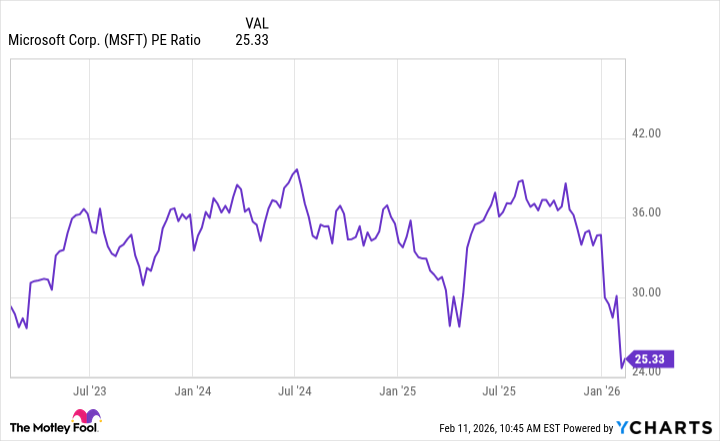
Moreover, the consensus price target for Microsoft stock among sell-side analysts is $596, implying a 48% upside from current levels. To me, this suggests that Wall Street remains bullish on Microsoft’s AI roadmap and has confidence in management’s ability to strategically allocate capital.
Buying Microsoft stock directly may seem like a no-brainer, given its attractive valuation profile and upside potential. That being said, there is still some execution risk in terms of the company’s infrastructure build-out and its ability to deliver results that impact Azure and other parts of Microsoft’s ecosystem over time.
For this reason, I’m cautiously buying Microsoft stock right now, but I’m not going to bet on the farm. I think the sell-off has been overdone and taking advantage of the depressed price trend may prove to be a wise choice in the long run.
Adam Spatacco has held positions at Amazon and Microsoft. The Motley Fool has positions in and recommends Amazon and Microsoft. The Motley Fool has a disclosure policy.
The Motley Fool is a USA TODAY content partner providing financial news, analysis and commentary designed to help people take control of their financial lives. Its content is produced independently of USA TODAY.


