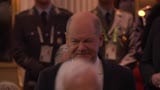

Germany’s Scholz reprimands J.D. Vance for far-right hate speech
German Chancellor Olaf Scholz on Saturday strongly reprimanded JD Vance after the US vice president attacked Europe’s stance on hate speech and the far right. Speaking at the Munich Security Conference, Scholz defended Germany’s political parties’ decision not to cooperate with the far right.
MUNICH, Germany – A year ago, Vice President J.D. Vance stunned European leaders with fact-based bombshell statements at the Munich Security Conference, deeply criticizing policies on immigration, defense and free speech, and warning that the region faced “annihilation of civilization” without immediate action.
At the same forum on February 14, the top US diplomat, Secretary of State Marco Rubio, struck a more conciliatory tone, saying, “The United States and Europe are united.”
“Europe’s destiny is in no way independent of ours,” Rubio said in a 30-minute speech in Munich, in which he detailed some of the ties and historical connections between the United States and Europe, drawing thunderous applause from dozens of world leaders and dignitaries and even a standing ovation from much of the audience.
“At a time when headlines are flying about the end of the transatlantic era, I want everyone to know and be clear that this is not our goal or our desire, because for us Americans, our home may be in the Western Hemisphere, but we will always be children of Europe,” Rubio said. His comments appeared to be partly intended to send a message of unity after Vance, who was on stage with him last year, slammed European leaders for censoring free speech, failing to control immigration and not doing enough to protect the region militarily. “This is unacceptable!” German Defense Minister Boris Pistorius shouted from the audience at the time.
But Rubio also made clear in his speech that the Trump administration wants to change the way European countries work with the United States: “We want allies who can protect us, so no adversary will try to challenge our collective strength.” “We want allies who are proud of their culture and heritage.”
Still, despite the different tones, the end result may not be a major change in the way the two regions do business.
Greenland, Ukraine and President Trump close in on Munich
In a report released ahead of the gathering, Security Council organizers described President Donald Trump as a “wrecking ball” destroying the norms and institutions of the international order. Last month, Danish Prime Minister Mette Frederiksen questioned how long the United States would remain a European ally.
And many senior diplomats and officials here said there was no doubt that a deep and “destructive” foreign policy rift had developed between Europe and Mr. Trump during his action-packed second term.
“The culture war of the MAGA movement is not ours. When that speech goes against human dignity and the constitution, free speech ends with us,” German Chancellor Friedrich Merz said on stage in Munich on February 13, referring to Vance’s speech last year. “We believe in free trade, not tariffs and protectionism,” Merz said last week. “The transatlantic relationship has changed,” he said. “No one in this room is more disappointed than I am.”
“There are some lines that cannot be crossed,” Ursula von der Leyen, president of the European Commission, the European Union’s executive branch, said in Munich.
The security conference, which began in 1963 as a forum for Western defense discussions during the Cold War, is being held against the backdrop of President Trump’s threat to acquire Denmark’s territory in Greenland, a standoff over Trump’s tariffs on imports from European countries, and Europe facing a host of threats from Russia’s war in Ukraine.
Mr. Rubio was absent from a Ukraine-related meeting with European leaders in Munich, but he did speak with Ukrainian President Volodymyr Zelenskiy and separately with Danish Prime Minister Frederiksen and Prime Minister Jensfrederik Nielsen of Denmark’s semi-autonomous territory of Greenland.
“I hope we can find a solution to all of this,” Danish Foreign Minister Lars Lokke Rasmussen told USA TODAY and other reporters on the sidelines of the meeting, referring to the unresolved issue of President Trump’s interest in Greenland. Denmark, Greenland and the United States have begun talks to find a way out of the crisis that has seriously strained relations between the United States and its allies in Europe and the North Atlantic Treaty Organization (NATO).
Greenlandic leader Nielsen said in a social media post that his meeting with Rubio in Munich “underscored that the ongoing dialogue is the right direction to move forward and reaffirmed Greenland’s interests.” However, few other details about the negotiations have been made public.
President Trump told reporters on February 13: “I think Greenland wants us, but we get along very well with Europe. We’ll see how everything goes. We’re negotiating for Greenland right now.”
Democrats gather at the Munich Security Conference
At this year’s Munich conference, Democratic leaders including California Governor Gavin Newsom, Sen. Ruben Gallego (D-Ariz.), Rep. Alexandria Ocasio-Cortez (D-New York) and Michigan Governor Gretchen Whitmer also attended the forum. They are honing their foreign policy credentials, reassuring European allies that they can trust America after Trump leaves office, and raising their profile as they prepare to run for president in 2028.
“The bar is very low and I don’t think it would be much worse than Vance’s speech last year in terms of impact,” Newsom told USA TODAY in Munich ahead of Rubio’s remarks. “I was a little embarrassed on behalf of the country. It was a shock to the establishment. I started to trust Rubio a little bit more. He’s a diplomat, Vance isn’t.”
Matt Das, a foreign policy adviser to Sen. Bernie Sanders (D-Vermont) who was in Munich to help guide Ocasio-Cortez on international issues, said the Trump administration has taken “pretty extreme positions” on U.S.-Europe relations. “Europeans love Rubio. He is considered part of the club. But they should have no illusions about that, even if he can characterize the administration’s policies in a less destructive way.”
A U.S. official, speaking on condition of anonymity, said the calm tone of Rubio’s speech reassured European officials. But the official said in private discussions he remains extremely wary of a U.S. administration he views as erratic, irresponsible and lacking strategic focus.
On a scale of 1 to 10, Europeans hover around a 6, the official said.
Still, U.S. Ambassador to NATO Matthew Whitaker pushed back on criticism of the Trump administration’s foreign policy, saying during a series of panel discussions in Munich that the U.S. is not trying to disband NATO or destroy the world order, but only to steer its European partners toward better allies.


