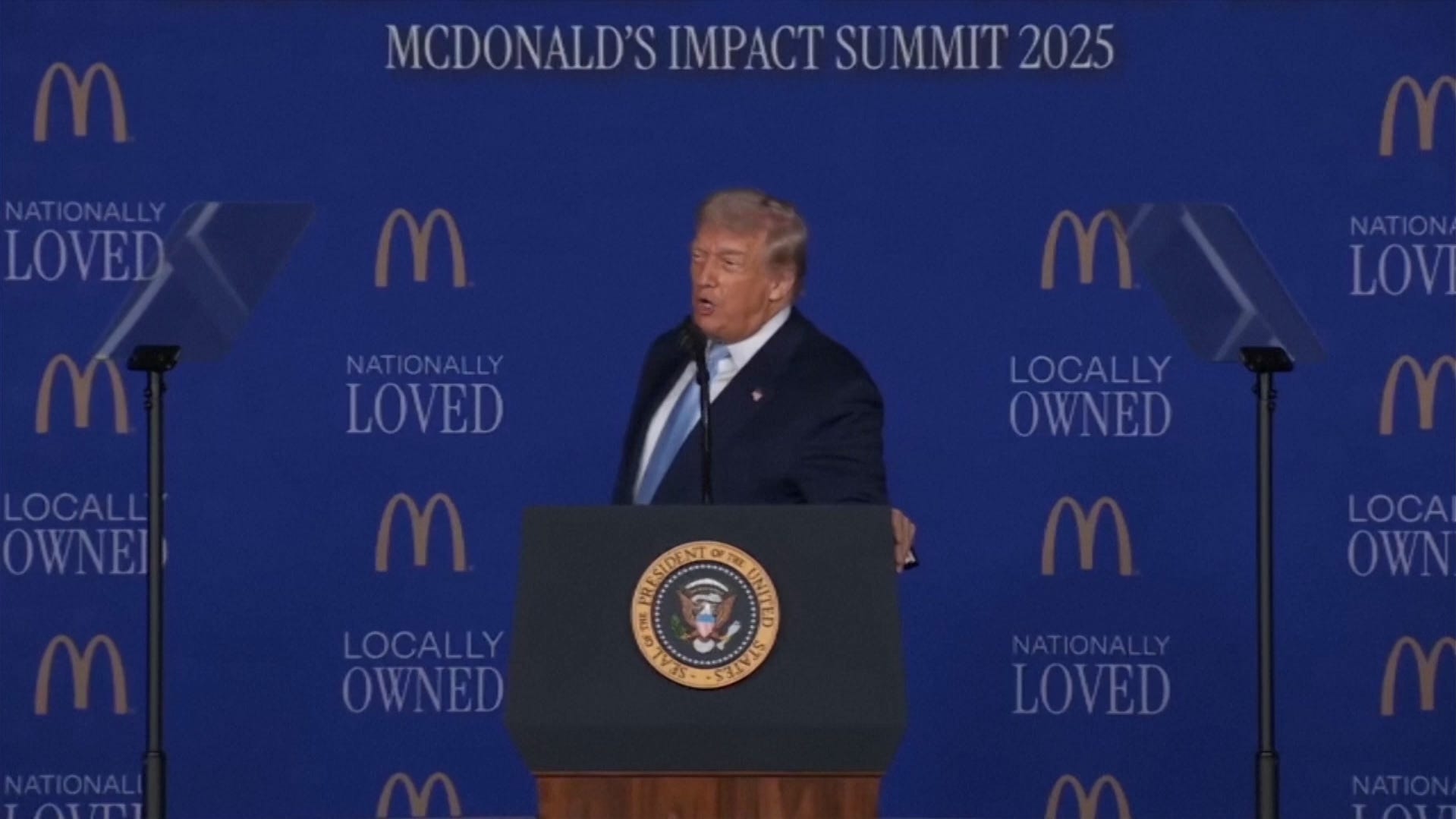

President Trump talks about affordability at McDonald’s forum
Trump joked that he was the “first former McDonald’s fry cook” to become president.
President Donald Trump’s tariffs will not raise enough money to fund the $2,000 “dividend” checks he plans to send to millions of Americans, according to an analysis by the nonpartisan Tax Foundation.
President Trump has repeatedly floated the idea of issuing $2,000 dividend checks to return revenue from import taxes to low- and moderate-income Americans.
In a Nov. 10 post on Truth Social, President Trump suggested that the tariffs would generate enough revenue to fund dividend checks and create enough surplus to “significantly repay the national debt.”
Researchers at the Tax Foundation disagree.
The foundation, which generally supports tax cuts, estimates that President Trump’s tariffs will generate $158.4 billion in revenue in 2025 and $207.5 billion in 2026.
Who exactly is receiving the “tariff dividend” checks?
President Trump has not said who will receive the checks. Treasury Secretary Scott Bessent has suggested an income limit of $100,000.
In a Nov. 18 post, the Tax Foundation calculated the numbers based on three dividend check scenarios, with the most conservative scenario reducing checks only to Americans with incomes of $100,000 or less.
The costs of the various models ranged from $279.8 billion to $606.8 billion. All three exceed the revenue tariffs they will generate this year, according to the foundation’s researchers.
“The math just doesn’t add up,” said Alex Durante, senior economist at the Tax Foundation.
At least two other independent think tanks have reached similar conclusions.
On November 10, the Committee for a Responsible Federal Budget projected that the tariff dividend checks would cost about $600 billion. On November 17, Yale University’s Budget Institute estimated the cost at $450 billion. Both analyzes predict that the cost of dividend checks will exceed the revenue from tariffs.
Is the $2,000 check really a tax dividend?
Some researchers argue that if tariffs don’t generate enough money to cover the checks, it’s inaccurate to call them a “tariff dividend.” As long as the costs exceed customs revenue, the checks become unfunded expenditures and the national deficit increases.
“You can do a dividend check, but it has to match the amount of revenue that the tariffs are actually raising,” said Kyle Pomerleau, a senior fellow at the libertarian group American Enterprise Institute. “So I think they went ahead by committing to $2,000 and went even further by specifying a specific cutoff.”
President Trump has said he wants to send out dividend checks in 2026.
Some in the Trump administration are optimistic that the tariffs will actually generate enough revenue to pay for them.
“If you look at how much tariff revenue is coming in, there’s actually going to be enough room to cover these checks and not put it into the rest of the budget,” National Economic Council Chairman Kevin Hassett recently told reporters.
To test this hypothesis, the Tax Foundation considered various dividend check scenarios.
Under the most conservative model, the $2,000 checks would go only to taxpayers and their spouses, and would be severely limited to those earning more than $100,000. The foundation estimates that this scenario would cost $279.8 billion.
Once checks are sent to taxpayers, spouses and dependents, the cost jumps to $368.3 billion. Add in Americans who don’t file tax returns, and the number rises to $500.8 billion.
In a broader scenario, including phasing out checks for high-income households, the cost of dividend checks could exceed $600 billion.
Tariff dividend checks could ease affordability crisis
President Trump is talking about sending money to Americans as consumers struggle with years of cumulative inflation and talk of a national affordability crisis persists.
Trump won public support during his first term by implementing two economic stimulus measures amid the COVID-19 pandemic. President Joe Biden approved the third round of payments.
Congress gave the green light to these payments. Some observers have questioned whether lawmakers would allow this.
“I’m very skeptical that Congress will appropriate the funds needed for these checks,” said Scott Linthicum, vice president of general economics at the libertarian Cato Institute. “I don’t think there are enough members of Congress to ignore budget calculations.”
Some Republicans in Congress have telegraphed their concerns about writing checks to Americans at a time when the national deficit stands at $1.8 trillion.
“I think it’s strange to send money to people when we have a budget deficit,” Kentucky Republican Sen. Rand Paul said, according to Bloomberg.
Of course, tariffs are one reason why many consumer goods are more expensive than they were a year ago.
Polls show a growing number of Americans believe Trump is contributing to the country’s price problems. These sentiments may have given Democrats a landslide victory in early November polls.
Tariff dividend checks could help Trump address this issue.
“In some ways, the president is creating a problem and then trying to solve his own problem,” said Mr. Durante of the Tax Foundation.
The think tank’s Nov. 18 post suggests an easy alternative to dividend checks.
“A better way to reduce the burden of tariffs would be to eliminate them,” the researchers wrote.


