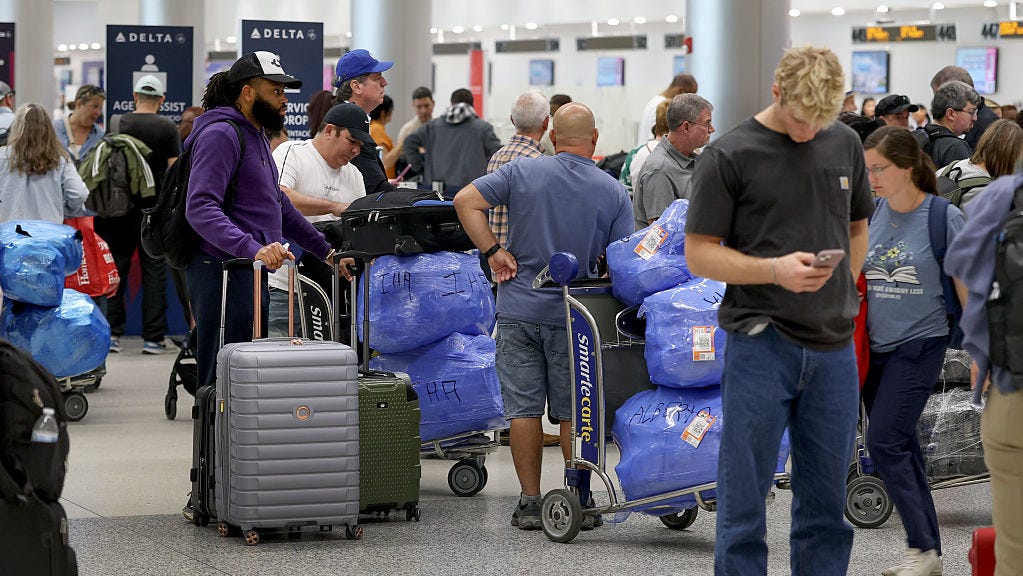

Reporters fly around the country during government shutdown
USA TODAY reporters from around the country chronicled their experiences flying during reduced flights due to the government shutdown.
U.S. travelers saw a glimmer of hope with the federal government’s promise to reopen, but with mandatory flight cancellations and continued severe weather in parts of the country, the coming days could remain dire for travelers.
As of early Tuesday, more than 1,100 flights in and out of the United States had been canceled for the day, according to data tracking firm FlightAware. As of 7 a.m. ET, there were nearly 600 delays.
The percentage of flights mandated by the Federal Aviation Administration to be cut was initially expected to increase from 4% to 6% at 40 major airports on Tuesday, the first increase that will see the cuts fully expand to 10% by Friday. It’s unclear if or when a newly passed Senate budget to reopen the federal government and end weeks of unpaid work for air traffic controllers will impact the planned cancellations.
Thousands of flights have been cut since Transport Secretary Sean Duffy last Friday ordered cancellations to begin Nov. 7. The travel woes worsened on Monday as more flights were grounded due to a winter storm in the Chicago area.
Airports in New York City, Chicago, Atlanta and Washington, D.C. had the most flight cancellations and delays Tuesday morning, according to FlightAware.
By about 9:30 a.m., the airport facing the most problems was Hartsfield-Jackson Atlanta International Airport, Delta’s main hub, with 27 delays and 29 cancellations. A total of 73 delays and 45 cancellations affected travelers at New York’s regional airports.
In addition to government-mandated flight reductions, Chicago has also experienced flight cancellations due to winter weather, with 18 delays and 26 cancellations as of Tuesday morning.
The forced flight reductions affect 40 airports and airlines across the country, but have primarily reduced services through regional partners, meaning flights between large hubs and smaller cities and towns are most likely to be affected, disrupting the entire system. The impact could extend into the Thanksgiving holiday.
“Typically, when a storm occurs, one airline can restore operations within 48 to 72 hours after the weather event ends, and that’s when one hub is affected,” said Tiffany Funk, co-founder and president of travel tech company point.me. “This is unprecedented and it’s storm season. I don’t think we’ll see a similar recovery. Airports will come online at different rates, meaning airlines won’t be affected in the same way.”
Airlines for America, the industry’s main trade group, warned that “more than 3.5 million passengers have experienced delays or cancellations due to air traffic control staffing concerns since the shutdown began,” calling the situation “unsustainable,” with a record 31 million passengers expected from Nov. 21 to Dec. 1.
-Zack Wictor
The House could begin voting as early as 4 p.m. on Nov. 12 to reopen the government and approve the bill for President Donald Trump to sign. The House vote is the next step in reopening the government and begins the process of getting air transportation back on track.
The Senate passed a resolution on November 10th to provide funding through January 30th. House Speaker Mike Johnson (R-Louisiana) told lawmakers to return to the Capitol by Nov. 12, when the chamber reopens at noon. Multiple votes are expected. The House of Representatives often votes on motions, such as whether to postpone or reconsider controversial bills, before voting to finalize them.
-Bert Jansen
The government shutdown is expected to end, but travelers should prepare for delays and cancellations in the coming days.
Tiffany Funk, co-founder and president of point.me, which specializes in points-based travel, said: “We can expect some very bumpy operations and a pretty tough travel experience, at least through this week.” “Even if funding magically came back today, it would take a long time to reset this.”
Experts said the longer flights are canceled or grounded, the longer it will take to recover, and the pace of recovery may vary by airport and airline. Air traffic controller duties may require long working hours and overtime, and it may not be possible to return to work fully immediately.
Meanwhile, Ahmed Abdelghani, associate dean for research at Embry-Riddle Aeronautical University’s David B. O’Malley School of Business, advised travelers to stay informed of flight status through airlines’ mobile apps and websites and to arrive at the airport “well in advance” in case of long waits at security. He said if flyers are able to travel at another time, it’s worth considering rebooking options or taking out travel insurance that will cover some of the cost if something goes wrong. If you don’t need to travel right now, consider postponing your trip.
-Eve Chen
Before the government shutdown, the country’s air traffic control system included just under 11,000 fully certified controllers, 30% fewer than the government needed. This means air traffic controllers are already required to work overtime six days a week, up to 10 hours a day, and vacation time is severely limited.
Nick Daniels, president of the National Association of Air Traffic Controllers union, said in a statement: “This situation is a significant distraction for individuals who already work in an extremely stressful job.” “The economic and emotional strain increases risk within the national airspace system, making it less safe with each continued closure.”
Becoming a certified air traffic controller requires years of training, typically starting at the FAA Academy in Oklahoma City, followed by several years of closely supervised on-the-job training.
Air traffic controller applicants must meet vision and health standards, undergo a mental health evaluation, and undertake a high-stakes, high-stress job physically separated from the travelers they serve each day. They must be prepared to respond to midair fires, hijack reports, or medical emergencies at 36,000 feet or just a few feet from the terminal.
read more.
-Trevor Hughes
President Donald Trump on Monday threatened to cut pay for air traffic controllers who don’t report to work and proposed giving bonuses to air traffic controllers who continued working during the shutdown.
Last week, the FAA reported that between 20% and 40% of air traffic controllers were absent from work on any given day during the shutdown. Some looked for other jobs to earn a living.
“I’m not happy for you,” Trump said of air traffic controllers who stayed home from work.
Contributions: James Powel, Kathryn Palmer, Zachary Schermele, Eve Chen, N’dea Yancey-Bragg, Bart Jansen, Thao Nguyen, USA TODAY


