Election experts told USA TODAY that even a basic national mail-in system would take years, not months. President Trump wants that in the midterm elections.
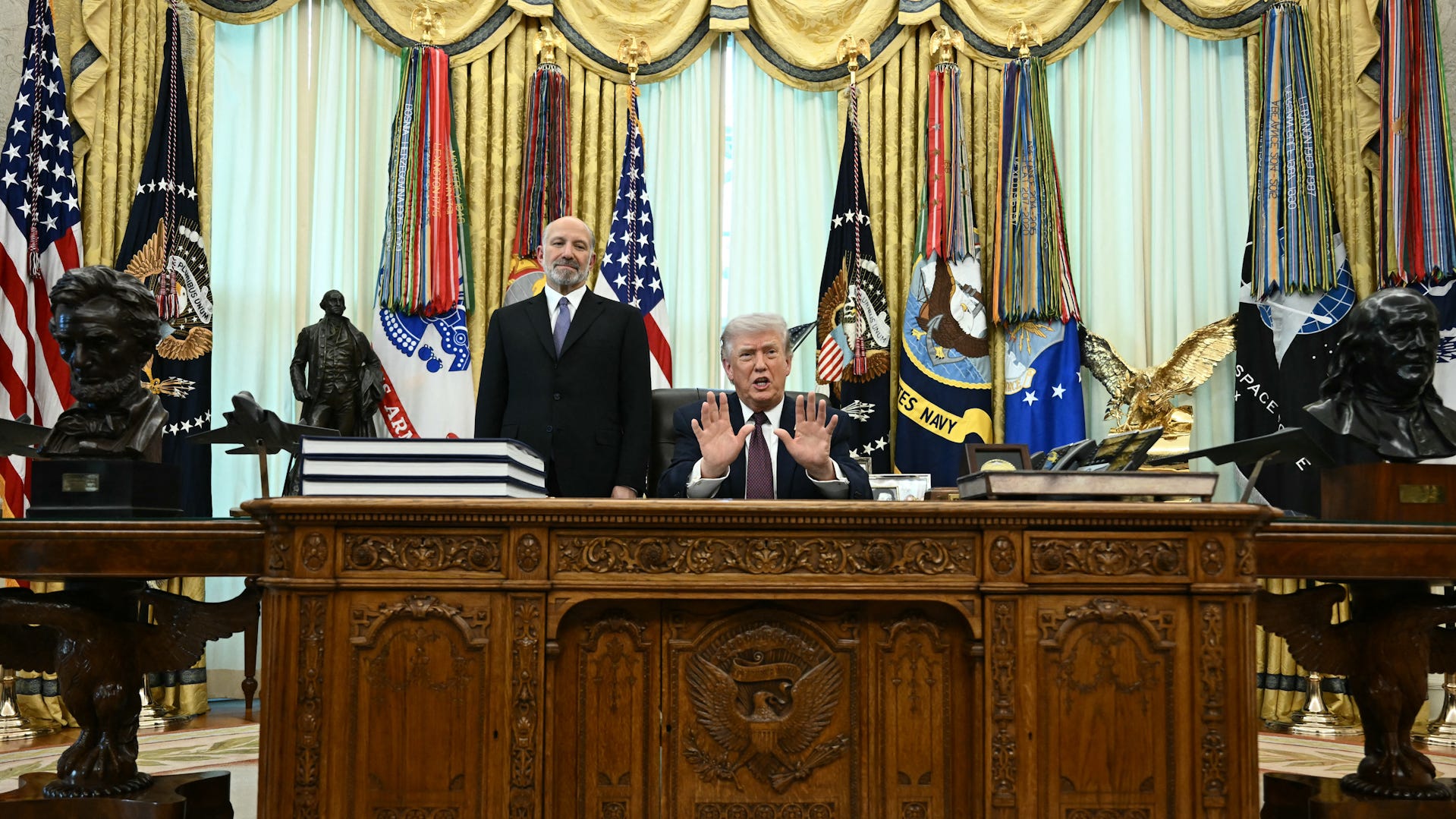

President Trump signs order asserting federal control over mail-in voting
President Donald Trump has moved to assert federal control over mail-in voting with an executive order.
WASHINGTON – President Donald Trump’s new executive order requiring each state to create a federal list of Americans eligible to vote and directing the U.S. Postal Service to send mail-in ballots only to verified voters is already facing significant legal challenges.
But even if he wins in court, election experts say President Trump’s latest effort to take federal control of U.S. elections before November’s midterm elections would be logically impossible to implement.
In signing the March 31 executive order, President Trump directed his administration to create a list of people eligible to vote in each state and find a way for the federal government to mail ballots only to those who meet that criteria.
It also specifies that the Department of Homeland Security, in conjunction with the Social Security Administration, must create a list of U.S. citizens of voting age who are residents of each state and send it to poll officials in each state (which already maintains its own voter rolls) at least 60 days before an election.
At an Oval Office event announcing the order, Trump offered few details other than to say that the new system was “conceived by some great legal minds.”
“They looked at all the different documents and everything that was going on, because mail-in voting fraud is legendary,” Trump said, repeating claims he has often made without providing evidence. “Democratic leaders, corrupt people like (Senate Minority Leader Chuck Schumer) want to use that to cheat,” he added.
The move escalates President Trump’s efforts to place new restrictions on voting ahead of midterm elections that will determine which party controls the House and Senate for the remaining two years of his second term.
But experts said the Trump administration appears to have done little in terms of workshops to actually implement the executive order.
“EO is a logistical nightmare and, constitutional issues aside, clearly represents magical thinking,” said Charles Stewart III, director of the Massachusetts Institute of Technology’s Election Data Science Institute.
“The important thing to note is that the federal system does not have reliable, proprietary information about the people who are on the voter rolls,” Stewart told USA TODAY.
“It’s not something that comes out of the public in the middle of primary season.”
Creating such a vetted list would require merging many existing federal databases, including the Social Security Administration and the notoriously inaccurate Systematic System of Alien Eligibility Verification (SAVE), he said. These databases already have established problems before anyone tries to integrate them.
Stewart said such an effort could take years and would require at least establishing a pilot program, creating and “debugging” an entire new database, getting input from Congress and the public, and, importantly, acquiring and spending significant federal funding.
“If we’re really serious about implementing it, we’re going to need not only rules, but also project management, funding streams, intergovernmental agreements, vendor capabilities, testing cycles, and a hierarchy to resolve conflicts between federal data, state voter files, and local election deadlines,” he said.
“This is a multi-year project, and it’s not something that comes to mind across the country in the middle of primary season,” Stewart said.
The interactive election group True the Vote was among the many Trump supporters who supported the president, saying it was needed to restore trust in mail-in voting.
“Not surprisingly, this administration has taken bold action on issues that the American people overwhelmingly support,” he said in a March 31 post.
“States that do not comply may receive funding from the federal government,” True the Vote said in another X post. “The days of trusting but not verifying are over.”
Some other conservatives were less enthusiastic.
Election law expert Paul Rosenzweig said one of the biggest challenges is building a system that not only works, but also reverses the public perception that the Trump administration is using it as a political tool to help Republican candidates win in November.
When President Trump announced and signed his presidential term papers on March 31, he essentially told the American people: “I want the Postal Service to put in place an unnecessary and unworkable system that will be used to eliminate the votes of people I don’t like,” said Rosenzweig, who served as an official at the Justice Department and the Department of Homeland Security in several Republican administrations.
What does President Trump’s executive order mean?
President Trump has suggested for months that the federal government could and should nationalize the voting process to crack down on fraud and stop Democrats from cheating to win the election.
There is virtually no evidence to support such claims that voter fraud is widespread, and Democrats and voting rights experts say the extremely rare instances of fraud are the result of mistakes and not deliberate efforts to sway elections.
President Trump’s latest move to take control of elections away from the states was quickly denounced by Democrats and voting rights groups as an unconstitutional effort to interfere with state election administration and potentially make it harder for millions of people to vote.
Some have already filed lawsuits, arguing that the U.S. Constitution gives states and Congress, not the president, the power to decide who is eligible to vote by mail.
On April 2, Mr. Trump and other administration officials were sued by the Democratic leadership of the House and Senate, the Democratic National Committee, and other party organizations working on campaigns in the House, Senate, and governor’s offices across the country.
New York Attorney General Letitia James and 23 other states filed a lawsuit on April 3 seeking to block the executive order on similar grounds.
“A new order devised by some great legal minds”‘
President Trump is focused on improving voting laws in the run-up to November’s midterm elections, asking Congress to pass the SAVE America Act, which would require proof of U.S. citizenship to register to vote and a photo ID to vote. The bill has stalled due to strong opposition from opponents.
In announcing the executive order, Secretary of Commerce Howard Lutnick said the proposed new system for voting by mail includes the use of the U.S. Postal Service’s unique barcodes on special envelopes to ensure each vote is traceable and secure.
“What the president is doing today is making sure mail-in voting is safe, secure and accurate, and clearly distinguishing mail-in voting from regular mail,” Lutnick said.
“So if we had a million mail-in ballots, a million envelopes, we would know exactly and accurately what the people voted for,” Lutnick said.
In response to questions from USA TODAY, White House press secretary Abigail Jackson said, “Election integrity has always been a top priority for President Trump, and the American people overwhelmingly supported President Trump’s common-sense election integrity policies, which is why we sent him back to the White House.”
“The President will do everything in his power to protect the safety and security of American elections and to ensure that only Americans can vote,” Jackson said.
USA TODAY reached out to the U.S. Postal Service, Department of Justice, and Department of Homeland Security to learn how the new executive order affects them and how they plan to comply.
“We are reviewing the order,” Postal Service spokeswoman Kathy Purcell told USA TODAY.
A White House official told USA TODAY on condition of anonymity that relevant agencies, including the Postal Service, are working to implement the executive order and that proposed rulemaking will be announced in due course.
“Unrealistic, unnecessary, reckless, expensive”
A spokesperson for the National Association of State Election Officials said in an email to USA TODAY that it is too early to say how President Trump’s order will be implemented, much less whether it will be done in time for the midterm elections.
The order requires the United States Postal Service to issue a notice of proposed regulations. A proposed rule is a formal document published in the Federal Register to announce and explain a new proposed rule and to begin a public comment period during which the public and organizations can provide feedback before the rule is finalized.
In Oregon, the first state in the nation to vote exclusively by mail, Secretary of State Tobias Reed said the state and his secretary of state have been given no information about how the new system will work.
“This is just one example of how disingenuous this whole thing is,” Reed told Oregon Public Broadcasting. “I think it’s not only unrealistic, it’s unnecessary, reckless, expensive and, fundamentally, a massive overreach by a president who is deeply concerned about his unpopularity and the fact that he has to be held accountable electorally.”
Reed said Oregon and other states have successfully fended off the Trump administration’s efforts to obtain state data stored on voters, in part because “states have shown they don’t have the ability to protect that kind of data.”
Not only is the proposal overly politicized, Reed said, but it also seeks to reinvent a system that the state already knows works well.
“The idea that the federal government can decide who can and cannot vote goes against everything we know about how the Constitution works,” Reed said. “This is a fundamental right guaranteed by the Constitution, and it is up to the state to decide.”
In Oregon, Reed said, the state requires people to prove their citizenship before sending in ballots that are individually tracked with barcodes. Ballots must then be placed in signed envelopes, and the signatures are forensically verified by every county election official in the state, he said.
“That’s why our system is the gold standard,” Reed said. “This is another example of why this is opaque, unnecessary and expensive. There is nothing positive to say about this initiative.”
Why are President Trump’s orders so difficult to implement?
Stewart, of the Massachusetts Institute of Technology’s Election Data Science Institute, enumerated to USA TODAY a long list of ways such a system would be nearly impossible to establish on the fly, such as creating a national list of citizens 18 and older living in each state.
He said there are already “a plethora of issues” related to data quality, integrating different systems and databases, how to deal with exceptions and mistakes, wide variation in state laws, how to maintain a national “live list” of approved voters, how to devise a national envelope and tracking system, how to establish privacy controls, how to design and debug the entire system, and more.
Rosenzweig, who now runs Red Branch Consulting, said one of the list of problems, the systematic alien verification database for qualifications alone, has a 20% error rate in verifying citizenship.
Since April 2025, USCIS has identified more than 21,000 cases of potential non-U.S. citizens on the voter rolls, and those cases are referred to DHS Homeland Security Investigators for further investigation, said Matthew Tragesser, a spokesman for U.S. Citizenship and Immigration Services within DHS.
DHS did not respond to USA TODAY’s questions about SAVE’s errors or whether the agency could comply with President Trump’s executive order.
But Tragesser said in a statement that USCIS is “committed to overhauling the SAVE program to ensure it is fully operational, eliminating voter fraud and restoring confidence in American elections by ensuring that only U.S. citizens can vote.”
Rosenzweig said the U.S. Postal Service’s problems also abound, especially when it comes to overcoming organizational dysfunction and implementing “targeted mail withdrawals for specific individuals.”
“The Postal Service is a huge bureaucratic organization,” Rosenzweig told USA TODAY. “Nothing can be implemented in less than six months.”
“I don’t mean that in a bad way,” he said. “I’m just saying that in a realistic way.”


