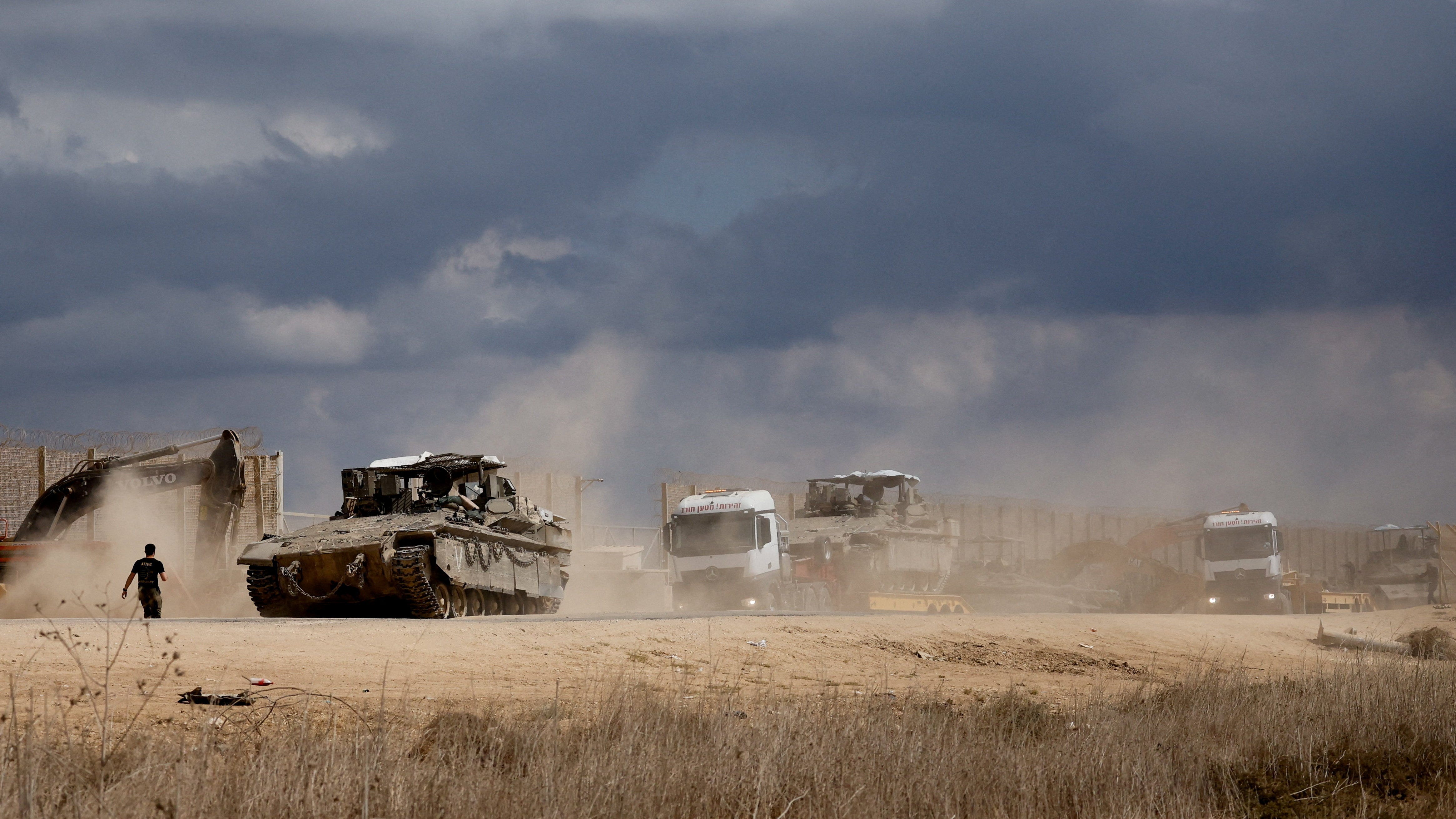

Israel attacks Gaza, accuses Hamas of attacking Israeli forces
Israeli officials said their military carried out airstrikes in southern Gaza after Hamas militants allegedly opened fire on Israeli soldiers.
JERUSALEM/CAIRO/Onboard Air Force One, Oct. 19 (Reuters) – The Israeli military said on Sunday that a ceasefire in Gaza had been resumed after an attack there killed two soldiers and triggered a wave of airstrikes that the Palestinians say killed 26 people. It was the most serious test yet of this month’s ceasefire.
President Donald Trump said the ceasefire he brokered still stands. Hamas leadership may not have been involved in the violations, he said. “I think the leadership is probably not involved in that,” he told reporters aboard Air Force One.
“In any case…it will be dealt with harshly but appropriately.”
President Trump said he did not know whether Israel’s attack was justified. “I’ll get back to you on that,” he said.
Aid to Gaza is scheduled to resume on Monday following pressure from the United States, Israeli security sources said, shortly after Israel announced a suspension of supplies due to “blatant” ceasefire violations by Hamas.
The Israeli military said the militants fired anti-tank missiles at troops, killing soldiers, and then attacked Hamas targets throughout the enclave, including field commanders, armed groups, tunnels and weapons depots.
The airstrike killed at least 26 people, including at least one woman and one child, local residents and health officials said. At least one strike hit a former school sheltering displaced people in the Nouseirat district, residents said.
“We need to watch what’s going on. I want to make sure that our relationship with Hamas is very peaceful,” Trump said.
President Trump’s special envoy Steve Witkoff and son-in-law Jared Kushner are scheduled to visit Israel on Monday, Israeli and U.S. officials said.
Hamas militants said they continue to abide by the ceasefire agreement, are not aware of any clashes in Rafah and have not had contact with groups in Rafah since March.
Vice President J.D. Vance did not mention the Israeli attack in a meeting with reporters, but said Hamas has about 40 different groups and the security infrastructure to ensure disarmament is not yet in place.
“Some of those cells will probably abide by the ceasefire. As we’ve seen some evidence today, many of those cells won’t,” he said.
“Before we can actually ensure the proper disarmament of Hamas, we need some of the Gulf Arab states to commit troops and actually apply law and order and maintain security on the ground.”
Israeli Prime Minister Benjamin Netanyahu said he has ordered the military to respond strongly to Hamas’s alleged ceasefire violations.
The path to peace is unclear
Fearing a possible collapse of the cease-fire agreement, some Palestinians rushed to buy goods in Nuseyrat’s main market, and families were evacuated from their homes further south in Khan Yunis due to nearby airstrikes.
The attack, less than a week after it took effect, was reminiscent of Israel’s reaction to what it deemed a serious violation of Hamas’ ceasefire with its Lebanese ally Hezbollah in late 2024, after days of mutual accusations of ceasefire violations, although the ceasefire has largely remained in place since then.
However, formidable obstacles remain to lasting peace in the Gaza Strip. After nearly two months of relative calm in the Gaza Strip, a ceasefire collapsed in March after Israel launched a series of airstrikes.
Dispute over bodies of deceased hostages
A new ceasefire took effect on October 10, halting two years of war, but the Israeli government and Hamas have continued to accuse each other of ceasefire violations in recent days.
Israeli Defense Minister Israel Katz said the “yellow line” to the point where Israeli troops withdrew under the ceasefire agreement would be physically marked and anyone who violates the ceasefire or attempts to cross the line will be shot at.
Hamas detailed a series of violations by Israel, which it says have killed 46 people and cut off supplies to the enclave.
Israel said on Saturday that the Rafah border crossing between Gaza and Egypt, which was scheduled to reopen this week, remained closed and its reopening depended on Hamas fulfilling its obligations under the ceasefire.
Israel claims Hamas has been too slow in handing over the bodies of the deceased hostages. Last week, Hamas released all 20 living hostages it was holding, and handed over 12 of the 28 prisoners who died in the following days.
more help needed
Hamas has no interest in preserving the bodies of the remaining hostages, arguing that special equipment is needed to retrieve bodies buried under the rubble.
The Rafah border has been largely closed since May 2024. The ceasefire agreement also includes increased aid to Gaza, where hundreds of thousands of people were found to be affected by famine in August, according to the IPC World Hunger Monitoring Agency.
In previous ceasefires, the crossing has served as a key conduit for humanitarian aid flowing into the enclave. Until Sunday’s decision to suspend aid, the flow of aid through the other crossing had increased significantly since the start of the ceasefire, but the United Nations said more support was needed.
Important issues remain unresolved, including the disarmament of Hamas, the future governance of Gaza, the composition of an international “stabilization force,” and the move toward establishing a Palestinian state.
Andrew Mills’s Nidal al-Mughrabi, Hey Rubel, Taha Ta, Taha the Foryu. Edited by Philippa Fletcher and David Holmes.


