Recent polls have shown that while Trump and Republican leaders’ control over rank-and-file Republicans remains strong, it has declined in a noticeable way.
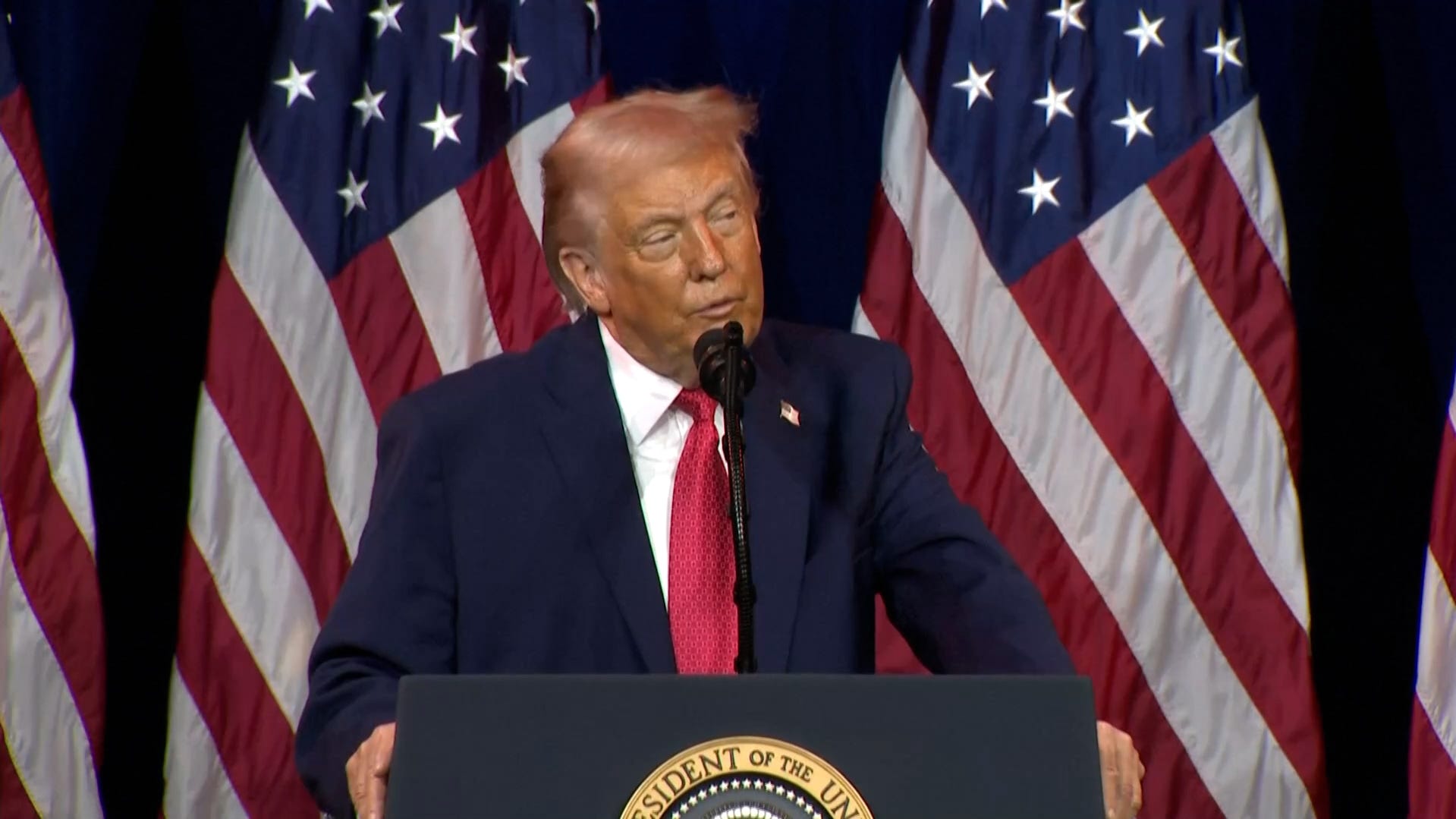

President Trump: If Republicans lose in the midterm elections, they will be impeached
In a lengthy speech to the House Republican training camp on January 6, the president referred to himself as “the king” and twice mentioned reelection.
WASHINGTON – President Donald Trump’s Republicans control Congress.
Well, it depends on the day.
The ever-shrinking margin in the House poses a bigger problem for the White House and House Speaker Mike Johnson. Mavericks in the Senate have also voiced growing dissatisfaction with the party leadership on issues such as foreign policy and health care.
The changing political dynamics are revealing rifts in the Republican Party and threaten to derail President Trump’s last chance to pass major legislation if Democrats win a majority in at least one chamber of Congress in November.
The president rallied Republican lawmakers for a rally in Washington during the first week of January, kicking off a critical year leading up to the midterm elections. In a speech to a crowd of House Republicans, he emphasized that there is “so much good material” to campaign for this year. In particular, he highlighted revenue from tariffs and White House negotiations to lower prescription drug prices.
“If you can sell them, we will win,” he said.
But Republicans’ chances of retaining control of the House in the midterm elections, which are set to go against the grain of history, are getting worse. A YouGov/Yahoo News poll of more than 1,100 voters in January showed Democrats with a 5-point lead.
President Trump has already acknowledged that Congress’ vote counting is becoming less forgiving.
Several unexpected vacancies, including one created by the sudden resignation of Georgia Representative Marjorie Taylor Greene and the tragic death of California Representative Doug LaMalfa, have reduced the Republican majority to two votes, including members who left the party due to family emergencies or other attendance issues.
Republicans can now barely get even a single defector on the ballot.
“You can’t be tough when you have a three-member majority,” Trump said at the retreat. “And now, sadly, it’s a little bit lower than that.”
a house divided
At the start of President Trump’s second term last year, House Republicans led by Speaker Johnson remained united to guide major legislation across the finish line. This includes the president’s so-called One Big Beautiful Bill Act, a major piece of domestic policy legislation that is arguably his defining legislative accomplishment since returning to office.
However, cracks are beginning to appear in the coalition government. Several Republican lawmakers rebelled against the White House by joining Democrats in supporting the Epstein File Transparency Act. It also passed an extension of health care subsidies, which Republican leaders do not support. And many of them joined Democrats to protect federal employees’ bargaining rights by supporting repeal of one of President Trump’s executive orders.
During a recent 11-hour battle on the House floor, Republican leaders had to allay the concerns of protesting lawmakers, both moderates and hardliners, in order to pass the bill. For example, a conservative uproar that cost more than $1 million to an organization that provides substance abuse recovery and mental health treatment to East African communities in Minneapolis nearly derailed a government funding plan.
On January 13, the weakness of the House majority was on full display, with a small number of pro-labor Republicans defecting from leadership and voting down a bill that would ease overtime regulations for certain employers.
Some House Republicans have openly expressed the challenges of having such a slim advantage over Democrats. Rep. Tim Burchett (R-Tenn.) told USA TODAY that the party’s moderate and conservative wings are at odds.
“They just want to move up the ladder,” he said of his centrist Republican colleagues. “And they don’t care how badly they hurt our great country.”
The situation has given House Speaker Johnson enormous power and severely weakened one of his most important roles: his ability to control what bills come up for a vote.
Some Republicans agree. Pennsylvania Rep. Brian Fitzpatrick, one of the Republicans who left the party on Jan. 13, told USA TODAY that he believes ideas, especially ideas supported by most members and the American people, rather than party leadership, should ultimately control which bills lawmakers vote on.
“It’s going to run the gamut,” he said. “It could be Ukraine. It could be health care. It could be border security. Whoever gets 218 votes should get voting rights. That’s my view.”
One of the clearest examples of political issues overcoming partisan divides was the November vote to require the Justice Department to release all information about the late sex trafficker Jeffrey Epstein.
Many Republicans were initially reluctant to see it pass through the White House (Trump did not initially support the Epstein File Transparency Act). But after a small group of conservatives agreed with the president, the rest of the caucus, and Trump himself, came to support the bill.
Throughout this period, Mr. Johnson (who did not immediately respond to requests for comment from his office) has continued to express confidence in the state of House Republicans. At a recent press conference, he said he had worked with a “razor-thin” majority since he first became speaker in 2023. He said his party had still failed “time and time again.”
“We have complete control of the House,” he told reporters on January 13. “It’s a close call.”
Quiet defiance in the Senate
Republicans have a slightly healthy majority in the Senate, with 53 of the 100 seats. That margin helped Republicans deliver important victories to Trump last year, including confirmation of key presidential appointments.
But two issues have recently highlighted the limits of Trump’s control of the Senate.
The first is healthcare. While Senate Republicans were largely united during last year’s record government shutdown, Democrats used the crisis to draw attention to the lapse in health care subsidies that expired at the beginning of the year and raise premiums for millions of Americans. Four Senate Republicans joined Democrats in December to vote in favor of extending the tax credit (the last resort still failed).
Then there’s foreign policy. Five Senate Republicans on January 8 advanced a bipartisan measure to block President Trump from taking further military action in Venezuela, angering the president. The bill, a war powers resolution, ultimately died after the White House intervened to overturn two Republicans on the next vote, a notable moment of discord within the Republican Party.
The bigger problem is that President Trump is trying to buy Greenland. Senate Republican leaders have suggested that military action to annex territory from Denmark, a NATO ally, would cross a red line for them.
Sen. James Lankford (R-Okla.) said, “We should not threaten peaceful countries that are allies that already have military bases.”
Meanwhile, Democrats are developing a strategy to test Republican dissatisfaction with Greenland. Sen. Tim Kaine, D-Virginia, who authored the bill to curb further military intervention in Venezuela, said he is planning a similar bill aimed at deterring hostilities in Greenland.
Regardless of the bill’s success, Kaine told Punchbowl News on January 15 that the White House is paying a lot of attention to his war powers bill. Kaine noted that Trump administration officials halted a second invasion of Venezuela as the bill passed Congress. (Trump said this was due to increased cooperation among Latin American leaders, not Congressional oversight.) Kaine said senior Trump administration officials have also committed to no more formal implementation domestically without Congressional approval.
“What I learned from this experience is to change your behavior even if you lose,” he said. “Changing behavior is a good thing.”
Zachary Schermele is a Congressional reporter for USA TODAY. You can email us at zschermele@usatoday.com. Follow him at @ZachSchermele on X and @zachschermele.bsky.social on Bluesky..


