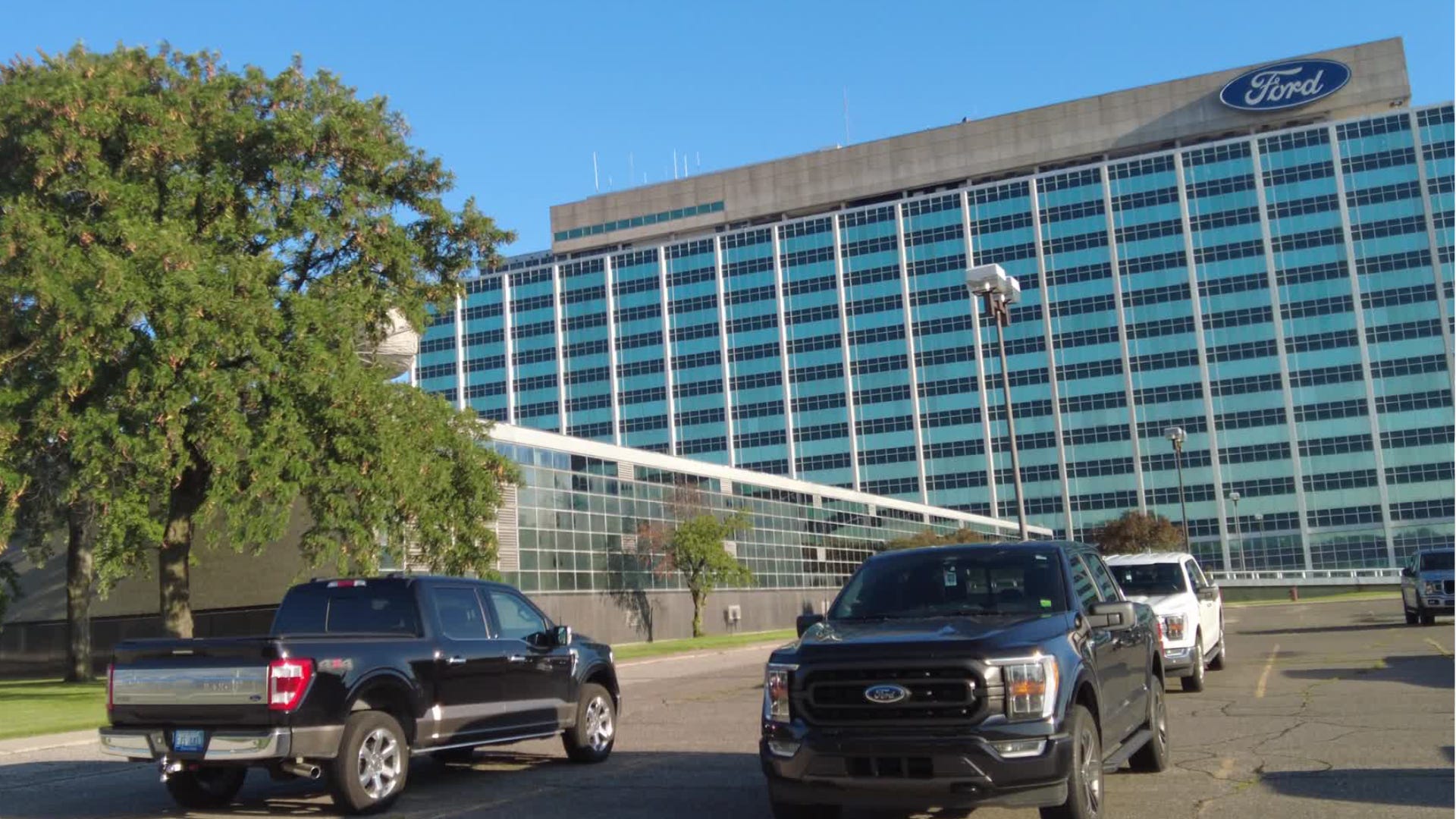

Ford Motor Company: Understanding the automaker’s history and legacy
Explore the rich history of Ford Motor Company, from groundbreaking assembly line innovations to iconic cars like the Model T, Mustang, and F-150.
- Ford is shifting its electric vehicle strategy and incorporating extended range electric vehicle (EREV) technology into the F-150 Lightning.
- The company is expanding its hybrid and gasoline powertrain options and expects them to account for half of its global sales by 2030.
- Ford plans to hire thousands of new employees in the U.S. for roles in vehicle assembly and battery energy storage systems.
Ford Motor Co. has announced a shift in its future electric vehicle strategy, with the company planning to continue producing its all-electric F-150 Lightning pickup, although the restructuring will cost $19.5 billion.
Ford says the pickup will be upgraded to a new model with extended range electric vehicle (EREV) technology, which includes a generator for charging, an estimated range of more than 700 miles, and additional charging capacity.
Ford made this announcement on Monday, Dec. 15, along with several other announcements, including offering a wide range of hybrid and gasoline powertrains in its vehicles to complement the upcoming new universal EV platform that Ford unveiled in August. The company predicts that by 2030, hybrids, long-range EVs and electric vehicles will account for half of all Ford vehicles sold globally, compared with 17% today.
The Dearborn automaker also said it plans to hire “thousands of new employees” in the U.S. over the next few years as it shifts production at various plants and launches a new business building battery energy storage systems at facilities in Kentucky and Marshall, Michigan.
These moves are part of Ford’s plan to launch five new affordable vehicles by the end of this decade, four of which will be assembled in the United States. Ford also said it plans to offer powertrain choices in nearly every vehicle by the end of the decade, expanding gasoline, hybrid and long-range electric vehicle options across its portfolio.
The company also said it plans to assemble an all-new pickup truck in Blue Oval City, Tennessee, and new gasoline-powered and hybrid vans will be produced at the Ohio Assembly Plant in Sheffield, Ohio.
Ford says all of these efforts will lead to higher profit margins, and it expects profits to start improving next year for Ford’s electric vehicle division, Model E, and to reach profitability in 2029. Ford has been bleeding billions of dollars from its Model E division in recent years. Ford lost $5 billion on EVs last year alone.
As a result of all these changes, the company announced a $19.5 billion charge, most of which will be collected in the fourth quarter. Approximately $5.5 billion of this $19.5 billion is cash expense, with the majority paid in 2026 and the remainder paid in 2027.
However, Ford announced that it will raise its 2025 adjusted earnings before interest and taxes forecast from $6 billion to $6.5 billion to $7 billion, based on continued fundamental business strength and cost improvements.
“This is a customer-led transformation that creates a stronger, more resilient and more profitable Ford.” Ford CEO Jim Farley said in a statement. “Operational realities are changing, and we are reallocating capital to more profitable growth opportunities like the Ford Pro, our market-leading trucks and vans, hybrids, and our new battery energy storage business.”
Adding and deleting jobs
These changes are the latest tweaks to Mr. Farley’s “Ford+” restructuring plan, which has undergone several changes since he first outlined it in 2021 as a plan to expand EV sales.
But U.S. EV sales have slumped since President Donald Trump’s administration ended a $7,500 federal tax credit available to EV buyers at the end of September. Farley said on CNBC on Dec. 15 that “the policy change is not the only reason” Ford is making this move, but acknowledged it was a factor.
“We evaluated the market and made a decision,” Farley said on CNBC’s “Closing Bell Overtime” on Dec. 15. “We’re following our customers to where the market is today, not where people expected it to be,” he said.
Ford is currently planning to hire across its plants in Michigan, Tennessee and Ohio as it expands its truck and van lineup, Andrew Frick, president of Ford Blue and Ford Model e Strategy, told reporters.
Frick said Ford will provide an update to the media at the Rouge Electric Vehicle Center about how many new jobs will be created there after production of the new Lightning resumes. Ford plans to share more details about the vehicle and its production and release dates at a later date.
In October, Ford moved about 500 employees from its Rouge Electric Vehicle Center to the Dearborn Truck Plant to help increase production of the F-150 pickup. Ford builds gasoline- and hybrid-powered F-150s at its Dearborn truck plant and said it plans to add another 45,000 next year “with a new third crew of 1,200 employees.”
Ford officially ended production of the 2025 F-150 Lightning built at its Rouge Electric Vehicle Center this year after two fires earlier this fall destroyed part of the Novelis aluminum plant in New York. Novelis supplies Ford with much of the aluminum used in the bodies of its pickups and SUVs. The fire caused an aluminum shortage and caused some disruption to production of the Lightning and Ford SUVs.
Ford announced on December 15 that the Tennessee Electric Vehicle Center, located on the Blue Oval campus in Stanton, Tennessee, near Memphis, has been renamed the Tennessee Truck Plant. The facility will produce “all-new built-in Ford Tough truck models” beginning in 2029.
Frick did not provide details on what kind of new pickup trucks these would be, but said they would be new, affordable gasoline-powered trucks that would expand Ford’s lineup and expand its market leadership, replacing previously planned next-generation electric trucks.
He said Ford plans to hire at least 2,300 people in Tennessee.
Ford will make the Ohio assembly plant the central location for its commercial vehicle division, Ford Pro. So starting in 2029, Ford plans to build new gas- and hybrid-powered commercial vans alongside its Super Duty chassis cabs. Frick said Ford employs 1,700 people in Ohio, but there was no update on how many new jobs the company plans to hire in the state.
New business in Kentucky and Michigan
Ford announced that it will convert the Blue Oval SK Battery Park in Glendale, Kentucky from a facility that produces EV batteries to a facility that manufactures battery energy storage systems, effectively creating a new business unit for Ford. These systems are energy storage solutions for customers such as data centers, utilities, and large industrial and commercial operations, Lisa Drake, Ford’s vice president of technology platform programs and EV systems, told media on Dec. 15.
Drake said Ford could study the industry and apply its manufacturing expertise and licensed advanced battery technology to begin manufacturing energy storage units within 18 months, positioning the company to capture share of the growing U.S. battery energy storage system market. Ford currently plans to deploy at least 20 GWh per year by the end of 2027.
Last week, Ford, SK On, SK Battery America and Blue Oval SK entered into a joint venture transfer agreement under which the Ford subsidiary will independently own and operate a battery plant in Kentucky. SK-On will fully own and operate the battery factory in Tennessee.
The production changes at SK Battery Park will result in the layoffs of approximately 1,600 employees at the plant, but Ford plans to hire 2,100 new workers and former employees are welcome to apply for new jobs.
This move will enable Ford to utilize the facility’s excess EV battery capacity to generate a diverse and profitable new revenue stream. Ford plans to invest about $2 billion over the next two years to expand its operations in the region.
In Michigan, Ford’s Blue Oval Battery Park Michigan in Marshall will produce smaller amp-hour cells for use in residential energy storage solutions. Ford said the facility is on track to be built in 2027 at its Louisville, Kentucky, assembly plant and begin manufacturing LFP prismatic battery cells in 2026 to power Ford’s next medium-duty electric truck, the first model on a new universal EV platform. Ford has announced that pickup prices will start at about $30,000, a bargain in today’s world where the average price of a new car is nearly $50,000.
Ford’s future powertrain plans
Frick said the automaker plans to expand its future hybrid powertrain offering with different executions based on customer needs, including hybrids that offer economy, performance and exportable power. The automaker also plans to build larger trucks and SUVs to further meet customer demand for capacity, towing power and range.
This includes adding long-range electric options to the lineup, one of which will be the aforementioned next-generation F-150 Lightning. Last month, there were reports that Ford executives were considering discontinuing the Lightning due to slowing EV sales in the United States.
In the third quarter, Ford reported selling 10,005 Lightning units. This is a 39.7% increase year-over-year and a record for the company. Sales were largely helped by a rush by buyers to take advantage of the $7,500 federal tax credit when they could, as it expires at the end of September. Ford reported sales of 23,034 Lightning units from January through the end of the quarter, an increase of 1% from a year earlier.
Ford plans to transition the Lightning to an extended-range electric vehicle (EREV).
“The F-150 Lightning is a breakthrough product that proves that electric pickups can still be great in the F-Series,” Doug Field, Ford’s chief EV, digital and design officer, said in a statement. “Our next generation Lightning EREV is revolutionary in every way. It retains everything our customers love, including 100% power delivery, sub-5 second acceleration, and adds an estimated 700-plus miles of range and locomotive-like traction. It will be an incredibly versatile tool delivered in a capital-efficient manner.”
Frick told reporters that for the average customer, the next-generation F-150 Lightning will run for nine to 10 days on electricity alone. He said Ford took time to evaluate the market before making these decisions.
“These are big decisions that we believe will pay off for our customers, our employees, American jobs and manufacturing for years to come,” Frick told reporters. “Ford is following its customers. We’re looking at the market today, not the one anyone predicted five years ago. Customers want the freedom to choose an affordable powertrain that fits their lifestyle and work.”
Ford commercial van killed
Ford said it will not produce a new electric commercial van for Europe as previously planned. However, it plans to maintain a full lineup of electric vans for that market. Ford recently announced some changes to its European operations, including new leadership and offering customers a new generation of multi-energy vehicles. Ford also announced a strategic partnership with Renault to collaborate on commercial and passenger EV development.
In North America, Ford announced that it will replace its planned electric commercial vans with “affordable” hybrid and gasoline models of commercial vans that will be assembled at Ford’s Ohio assembly plant.
Jamie L. Lareau is senior auto writer for USA Today and covers Ford Motor Company for the Detroit Free Press. Contact Jamie at jlareau@freepress.com. Follow her on Twitter @Jalalean. To sign up for our automotive newsletter. become a subscriber.


