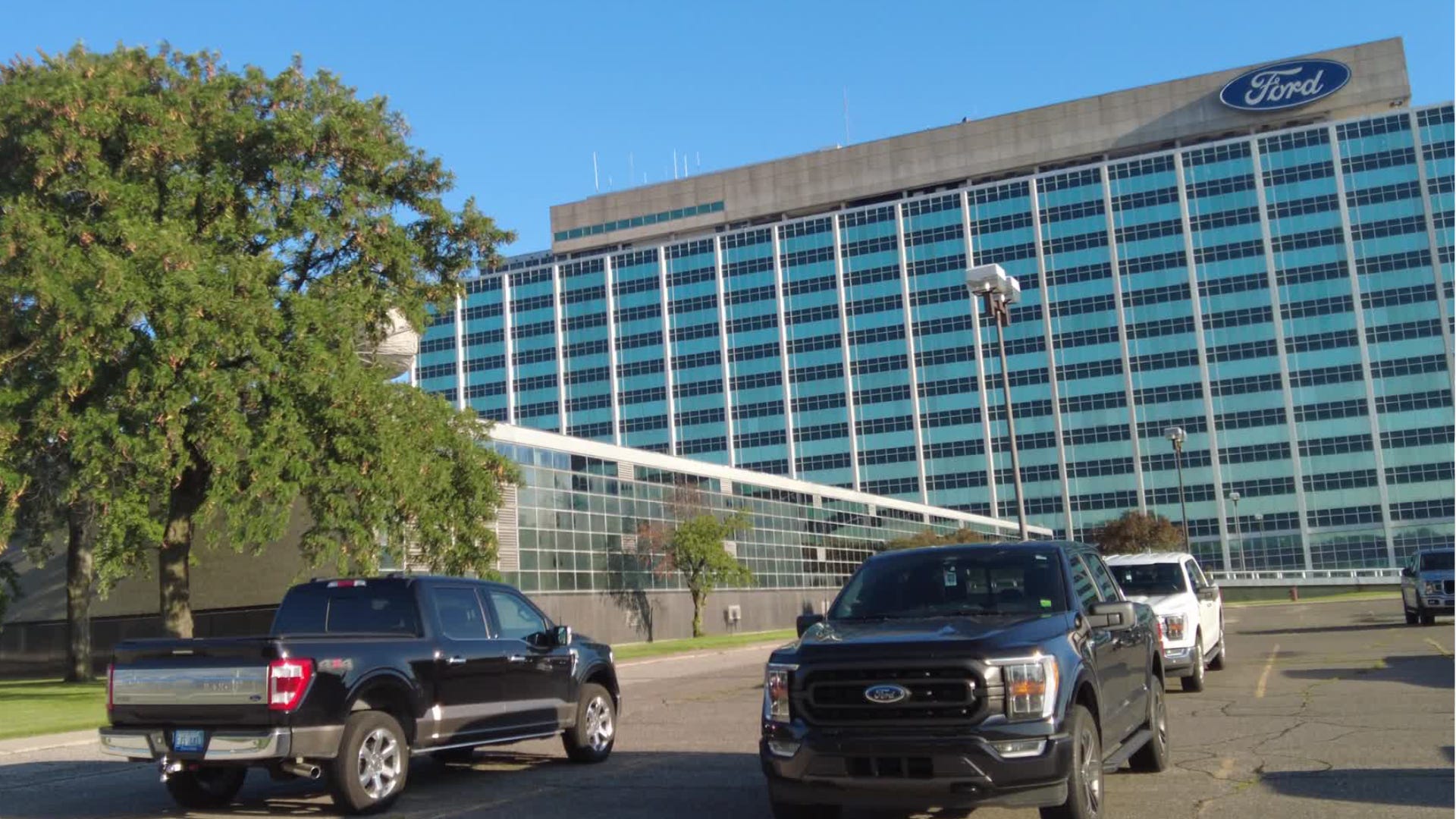

Ford Motor Company: Understanding the automaker’s history and legacy
Explore the rich history of Ford Motor Company, from groundbreaking assembly line innovations to iconic cars like the Model T, Mustang, and F-150.
- President Donald Trump has suggested that U.S. automakers produce smaller, cheaper cars similar to Japanese “kei cars.”
- Ford leaders say vehicle affordability is a top priority and they expect to announce more news on this topic soon.
- Stellantis’ CEO said the automaker aims to bring smaller and cheaper models to market.
Ford Motor Co. leaders have been talking about vehicle affordability for at least a year, and it was a topic that Executive Chairman Bill Ford and CEO Jim Farley addressed at the Detroit Auto Show a year ago — and now the companies say Ford has made it a top priority and is developing a radically new approach to lowering vehicle prices, with the company saying it will announce news soon.
“Affordability is a big issue,” Bill Ford told the media on the sidelines of this year’s Detroit Auto Show on January 13. “It’s something that we’ve talked about a lot internally, and we actually have a lot of plans to address it…some that we haven’t announced yet, but we’ll be announcing soon because I think it’s really important.”
So did President Donald Trump, who on Dec. 3 in the Oval Office with executives from the Detroit Three suggested that automakers start considering building smaller, cheaper cars for the U.S. market similar to those popular in Japan. President Trump said he would make new cars more affordable for Americans.
Farley said these small cars are a topic that Trump won’t let go of. Farley recounted his interactions with the president during his visit to the Ford Rouge Center in Dearborn on January 13.
How the topic of small cars came about
On December 3, President Trump announced a proposal to ease emissions standards set by former President Joe Biden. He later withdrew the small car proposal as Farley, Stellantis CEO Antonio Filosa and General Motors Orion assembly plant manager John Urbanich stood by in defiance.
“When you go to Japan, which I just left, you go to South Korea, you go to Malaysia, you go to other countries, and they have very small cars like the Volkswagen Beetle used to be,” President Trump said. “It’s really small and really cute. So I said, ‘What’s going to happen in this country?’ Everyone seems to be thinking about good things.”
Auto industry analysts said Trump was referring to Japanese “kei” vehicles, which are manufactured by various Japanese automakers primarily for sale in Asia. Kei cars are a special class of vehicles. These are box-shaped vehicles designed specifically for that market, limited to a maximum engine size of 660 cubic centimeters and 64 horsepower. Top speed is typically 87 miles per hour.
And, well, they’re small. The maximum length for light vehicles is 133.9 inches and width 58.3 inches. To put that in perspective, the current Fiat 500e, built by Stellantis, is actually even larger, measuring 143.1 inches long and 74 inches wide.
As previously reported by the Detroit Free Press, part of the USA TODAY network, most industry experts said it’s been proven that American car buyers don’t want such small cars, even if they’re cheap. Case in point: Stellantis sold only 970 models of the Fiat 500e starting at about $32,000 throughout 2024. By comparison, Stellantis sold 587,725 Jeep vehicles and 439,039 Ram pickups in the U.S. in 2024. Ram prices start at $40,275.
But President Trump persisted, saying on Dec. 3, “This program really gives people a chance to get a car. They can get a brand new car instead of a not-so-nice car. So new car companies should start thinking about that.”
Reconsider this subject with a trip to Dearborn
Farley and Filosa nodded politely, and the light car idea hit the brakes on the other side of the Oval Office door.
But Trump is still pushing the idea. He brought this up to Ford executives on Jan. 13 during a factory tour of Rouge Center, where Ford builds full-size F-150 pickup trucks.
“The president asked me today, ‘Can we sell light vehicles here in the United States?'” Farley told the media on the sidelines of the Detroit Auto Show on the evening of January 13. “I think it’s exciting. It’s fun to talk about the possibilities.”
The reporter quickly followed up and asked Farley how he answered Trump’s question.
Mr. Farley paused and said: “I worked for the Scion brand and brought it into the country and loved that little car. But we’ll continue to look at the market. Affordability is a priority for us. But frankly, in the U.S., it’s a small minivan that seats six. I don’t know if it’s going to be expensive.”
Mr. Farley worked for Toyota from 1990 until 2007, when he joined Ford. At Toyota, he was responsible for launching and managing the new Scion brand.
everyone is talking about affordable cars
The affordability of new cars has been a hot topic of interest lately.
On January 15, during a “fireside chat” on the second day of the Detroit Auto Show, Sen. Bernie Moreno said, “I’d like to see more Honda Civics, cars that cost less than $25,000.”
Honda advertises the Civic starting at under $25,000. Moreno, a Republican from Ohio, where Honda has a large auto plant, has challenged the industry to bring more affordable small cars to market.
“Honda is doing that, and Toyota is close to that,” Moreno said. “Other people can also participate.”
Days later, federal officials including Transportation Secretary Sean Duffy and U.S. Trade Representative Jamieson Greer visited the 2026 Detroit Auto Show’s opening day to the public on January 17 to talk about changes in the industry.
Greer said there has been “significant progress toward affordability” due to regulatory reductions and a greater focus on auto manufacturing in the United States.
Duffy said the average age of vehicles on America’s roads is 13 years old, “too old.”
“If we have more affordable cars and more people can put new cars in their driveways, those cars will be safer,” Duffy said. “That’s what we want for American families, and that’s why this affordability push is so important.”
Detroit automakers seem to agree. Stellantis’ Filosa said on January 14 at the Detroit Auto Show that the automaker is aiming to bring smaller, cheaper models to market, including potential options under $30,000.
“I’m sure it’s less than $40,000, right?” Filosa said. “We’ll look at under $30,000 as well. Obviously, all kinds of vehicles are different: pickups, SUVs, cars. But yes, we’d like to go there as well.”
Filosa said the company will offer a combination of “price-competitive value propositions” as well as adjust its product lineup to offer more affordable pickups.
But back to Bill Ford, he told reporters on January 13 that Ford’s plans are a little different.
“You can play around with trim, but there’s a more radical version that’s affordable…because there’s a limit to what you can do with trim. We’ve done that many times in the past,” Ford said. “You can do that right now. Look at the F-series. We have the flexibility to go from entry level all the way up to the very expensive level.”
According to www.ford.com, the 2026 F-150 starts at $37,330 and comes in several trim options, bringing the F-150 Raptor’s price to $79,005.
Bill Ford said the trim mix offered by car companies is ultimately determined by the market and customers. That’s why Ford is considering another solution.
“I think this is a more fundamental version: Can you design a vehicle that is fundamentally lower cost? Then you can pass it on to your customers,” Bill Ford said. “That’s what we’re working on.”
stay tuned.
Staff reporters Liam Rapley and Natalie Davis contributed to this report.
Jamie L. Lareau is senior auto writer for USA Today and covers Ford Motor Company for the Detroit Free Press. Contact Jamie at jlareau@freepress.com. Follow her on Twitter @jalaroan. To sign up for our automotive newsletter. become a subscriber.


