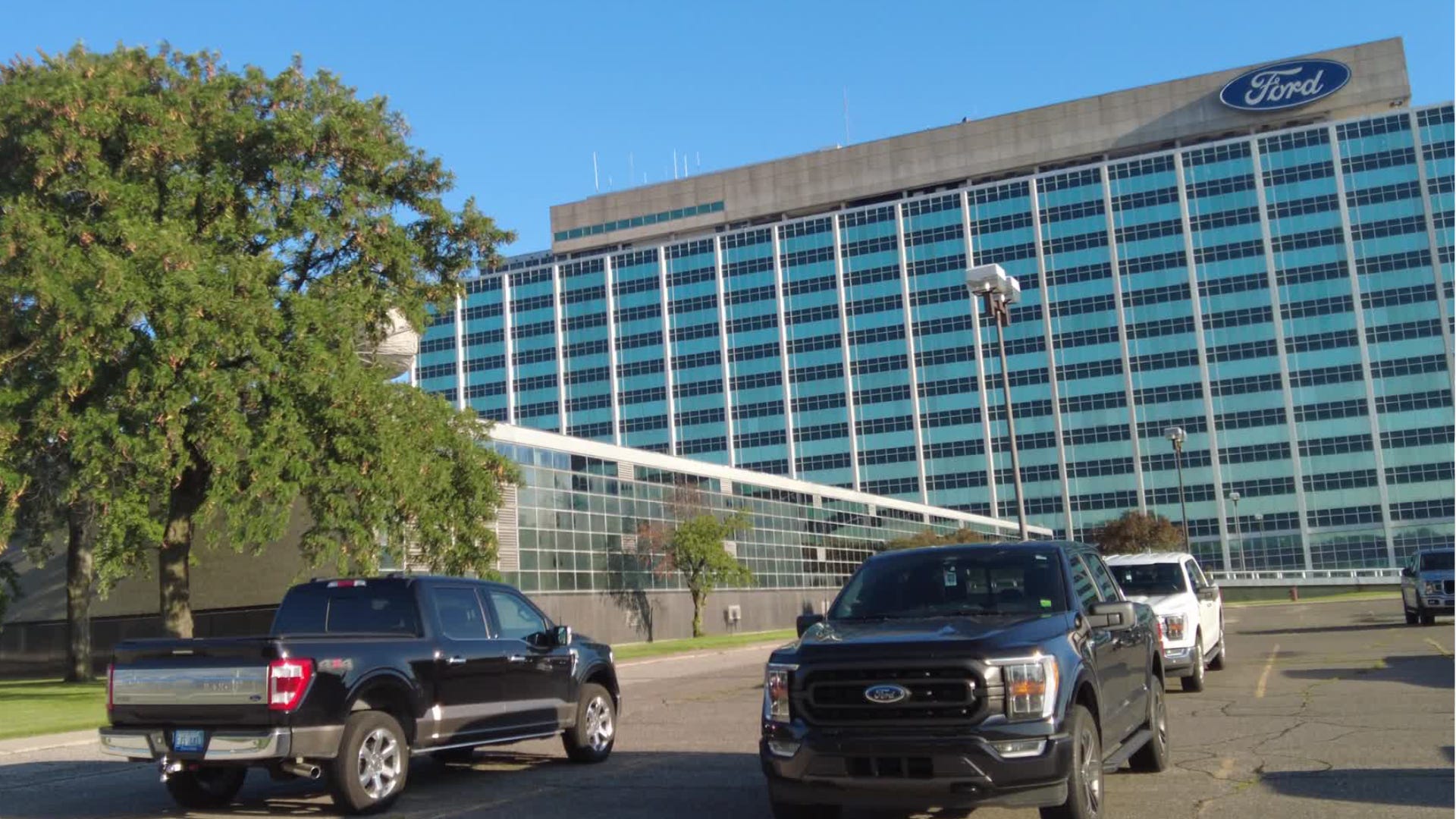

Ford Motor Company: Understanding the automaker’s history and legacy
Explore the rich history of Ford Motor Company, from groundbreaking assembly line innovations to iconic cars like the Model T, Mustang, and F-150.
- Ford is rethinking its U.S. business strategy to put more emphasis on gasoline-powered and hybrid vehicles as demand for electric vehicles slows.
- Automakers will continue to offer a variety of electric vehicles, including more affordable models.
- Executive Chairman Bill Ford noted that changing political policies on emissions and trade pose challenges to long-term planning.
Ford Motor Co. is rethinking its U.S. business strategy this year to focus on gasoline and hybrid vehicles, but executives say they are not considering electric vehicles yet.
Ford Executive Chairman Bill Ford said the company has every intention of continuing to offer a variety of “electrified” vehicles at home and abroad.
“Globally, EVs are doing incredibly well, and we’re a part of that, with more EVs coming out, and very affordable EVs coming out. I think that’s been the big problem with EVs: They simply weren’t affordable,” Bill Ford told reporters on the sidelines of the Detroit Auto Show on Jan. 13.
Ford is spending $2 billion to renovate its Louisville, Kentucky, assembly plant to build a new midsize electric pickup truck that will start at $30,000 when it goes on sale next year. Ford made this announcement in August, saying it had developed a new EV platform that could efficiently bring multiple low-cost EVs to market.
But complicating this plan is that consumer demand for EVs has plummeted after the Sept. 30 expiration of a federal tax credit that allows up to $7,500 off EV purchases. As a result, Ford and other automakers have had to reorient their future product plans.
For example, in December, Ford announced that it would be restructuring its business, a move that would cost billions of dollars. Not only will Ford shift its focus from a future featuring all-electric vehicles to one that offers more hybrid and gasoline powertrains, at least in the short term, but it will also move into new lines of business: manufacturing battery energy storage systems in addition to EV batteries.
As part of this change, consumers will see the all-electric F-150 Lightning pickup transition to the next generation of long-range EVs. This means that it will not only have a battery pack, but also a gasoline generator.
“When people see Lightning, they say, ‘Oh, Lightning’s going to go away.’ No, it’s not,” Bill Ford said. “We have Elev, which we think is great because it has towing capability, has a range of over 700 miles, and has great performance. There are many different types of electrification, and we are working on all of them.”
reality of the situation
But the reality is that Ford isn’t yet making a profit selling EVs. The Model-e division’s losses in 2024 were approximately $5.1 billion, up from a loss of $4.7 billion in 2023. This is all due to high investment costs, price pressure and competition.
Currently, the Dearborn-based automaker must collect $19.5 billion in special fees related to its restructuring. Ford expects to cover most of the costs during the fourth quarter, with results expected in February. That would be followed by a $5.5 billion cash bill through 2027, with Ford paying the bulk of it this year. This charge affects the automaker’s net results, but not its adjusted profits.
When asked about the burden he would have to pay for the change in direction, Bill Ford was realistic but optimistic about it.
“No one likes a writedown like that, but I think it really recognized the reality of the market and the desire that we and the industry as a whole had for EV adoption, and that just wasn’t happening,” Bill Ford told reporters. “So this puts us in a very good position for the future. I think Wall Street believes that, too, because you’ve seen how our stock has reacted.”
Since that announcement, Ford’s stock price has remained stable, finishing in the mid-to-high $13s per share and even reaching the mid-$14s earlier this year.
Ford’s suburban rival General Motors Co. will have to book a $7.6 billion loss in 2025 to pivot away from EV production, but that won’t change the way the company approaches EVs, GM CEO Mary Barra said Monday. But GM will be more realistic in the future, she said.
What politicians don’t understand
It cannot be ignored that many automakers’ changes in plans are in part the result of policy changes in the capital. While former President Joe Biden was a big supporter of EVs and stricter emissions standards for vehicles, President Donald Trump is the exact opposite.
President Trump eliminated federal tax credits for EV purchases and last month proposed a rollback to Biden’s emissions standards, which would ease the need for automakers to offer smaller, more fuel-efficient cars and EVs to meet corporate average fuel efficiency standards.
All the changes in policy are making it difficult for car companies to operate.
“What’s hard for politicians to understand is that our lead time is longer than the political lead time, so we can’t change course on a dime,” Bill Ford said. “But I think our team has done a really good job this past year…and we have to continue to be nimble going forward.”
Mr. Ford said that during his career at the company founded by his great-grandfather Henry Ford, the parties in the White House changed frequently, and that “every time you turned the wheel there was a new political system, new trade policy, new emissions regulations…We’ve been dealing with this for quite some time.”
What future does Ford want from Trump?
On January 13, Ford hosted President Trump at its Dearborn Truck Plant, where the best-selling F-150 pickup truck is built. Bill Ford said the event was to show President Trump the F-150 and some new products and “get workers to appreciate it.”
“(At the time) it was not the time to ask any political questions,” Bill Ford said. “When I heard he was coming, I made that clear to the team. We’re just going to be great hosts. We’re going to give him a great day. And all those questions will come at another time.”
So what are those questions? Bill Ford said the situation is constantly changing, but his first priority is the renegotiated U.S.-Mexico-Canada trade agreement. He also said tariffs remain in flux as automakers await the Supreme Court’s probable ruling on their legality, and they will wait to see what happens with the tariffs. Last year, President Trump imposed a 25% tariff on all imported cars and auto parts, a tax paid by importers when goods cross the border. It also imposed a 50% tariff on imported steel and aluminum used in automobiles. Ford said it expects annual net tariff costs to be about $2 billion.
“We live in a world that is very fluid, both economically and politically,” Bill Ford said. “You see how our world has changed in the last few years. You mentioned electricity…the whole landscape has changed dramatically. We just have to adapt.”
But he said Ford has “great plans” for its $19.5 billion overhaul and strong products planned for the future. Ford has struggled on the quality front, leading the industry in safety recalls, but it is now improving initial quality scores for new cars. Ford also reported on January 6 that its annual and fourth-quarter sales were the highest since 2019. For the full year 2025, Ford reported sales rose 6% to 2.2 million vehicles. Ford’s U.S. market share increased gradually from 0.6% to 13% during the year.
“Right now it’s all about blocking and tackling and making sure every launch is perfect and continuing to improve the quality,” Bill Ford said. “We’re doing very well. Our market share is going up. Last year’s sales were very strong. We’re off to a very good start this year. Now it’s up to us to execute.”
Jamie L. Lareau is senior auto writer for USA Today and covers Ford Motor Company for the Detroit Free Press. Contact Jamie at jlareau@freepress.com. Follow her on Twitter @jalaroan. To sign up for our automotive newsletter. become a subscriber.


