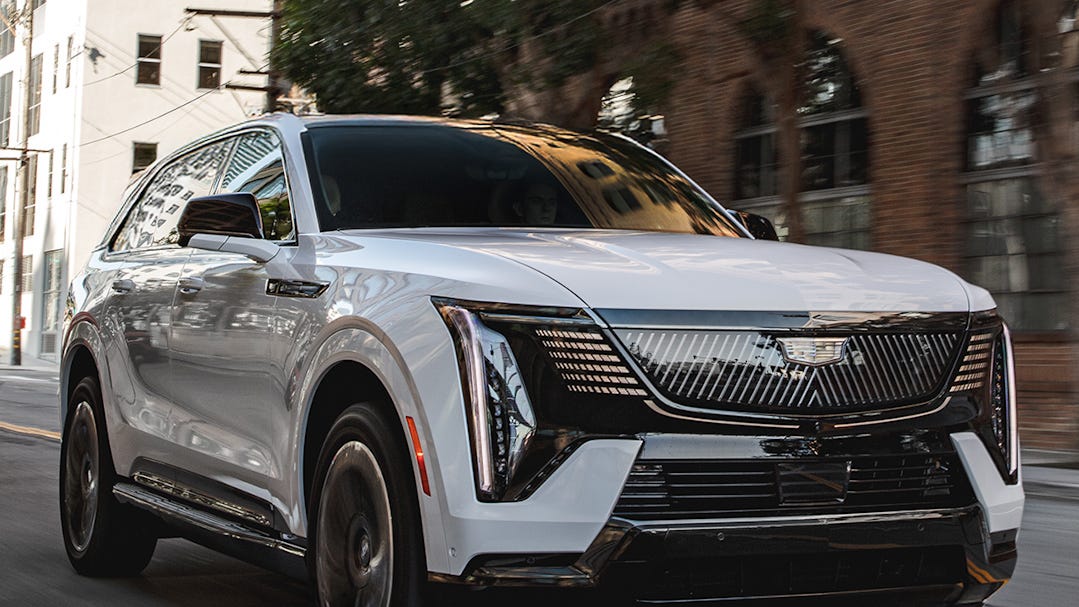

Why are electric cars heavier than gasoline cars?
Electric cars are heavy. Seriously. Automakers are developing new battery technologies to reduce the load.
- EV lease prices may have trended upward since October, especially on models that were previously eligible for the full $7,500 credit, said Stephanie Valdez Streety of Cox Automotive.
- Automakers are approaching the end of the EV tax credit in a variety of ways, including specific incentives for some EVs.
- According to Cloud Theory, as of October 5, Ford dealers had about 21,600 EVs in stock, while GM’s Chevrolet, Cadillac and GMC brand dealerships combined had about 38,800 EVs in stock.
Car buyers can’t expect a tax break because the tax credit for EVs ended on September 30th. But oddly enough, even in mid-October, there’s still talk of favorable lease deals and big incentives for electric cars.
“For every dollar you pay, you won’t find a better deal on a comparable ICE vehicle,” Ivan Drury, director of insights at Edmunds, told the Detroit Free Press, part of the USA TODAY Network.
But Drury cautions that consumers shouldn’t just focus on price. They need to make sure they are buying an electric vehicle now rather than a traditional internal combustion engine based on the features of the car or truck.
Drury says it’s essential that your charging infrastructure works with your lifestyle. Otherwise, he said, consumers who buy an EV on impulse may end up dissatisfied and realize they made a mistake that costs them more in the long run than the money they saved on the initial contract.
General Motors and Ford Motor Co. made headlines early on with a clever plan to use the Internal Revenue Service’s interpretation of deliveries to continue their low-cost EV deals by taking advantage of a $7,500 tax credit after September 30th. However, both companies have since discontinued these plans.
The in-house finance departments of the two car companies had made down payments on EVs on dealer lots by September 30th. Finance companies will now be able to claim the credits, which could be passed on to consumers through attractive lease deals later this year.
Now, automakers will not claim credit due to political pressure, according to reports from the Detroit Free Press, Reuters and other news outlets.
Still, General Motors is currently promising net savings of about $6,000 on EV lease deals through October. Ford has promised to maintain the competitive lease rates the automaker has maintained in the market.
Some EV deals, including 0% financing, remain attractive
Stephanie Valdez Streeti, director of industry insights at Cox Automotive, said overall EV leasing deals in October were a little less aggressive than promotions in September.
But the lease deals proposed in October still offer great value depending on the model and buyer profile, she said.
Back in September, Valdez Streeti said EV buyers were likely to have low down payments and lease deals in the $200-per-month range or less.
He said: “October’s major deals show a move towards premium trim and longer lease terms, with some standout offers as well.” For prospective buyers, some automakers are offering 0% auto financing on select models of EVs.
The Ford F-150 Lightning and Kia EV6 and EV0 are currently promoting 0% annual interest financing and cashback, which Cox Automotive says marks a “transformation into purchase incentives.”
Ford Credit Financing will also offer 0% interest for 72 months to eligible borrowers on the 2025 Mach-E in October.
According to Cox Automotive, one of the best lease deals in October is on the 2026 Chevrolet Blazer EV, with prices down $1,549 for a 24-month lease of $299 per month.
As for Stellantis, the automaker is replicating the federal tax credit for plug-in hybrid electric vehicles and battery electric vehicles with bonus cash on existing dealer inventory. Stellantis spokeswoman Anne-Marie Fortunate said the benefit applies to vehicle leases or purchases.
Hyundai notes online that the $7,500 cash incentive will carry over to the 2025 IONIQ 5 model.
On October 1, Hyundai announced significant price reductions across the 2026 Ioniq 5 lineup, “reinforcing the brand’s commitment to making EVs more accessible and competitive in the rapidly evolving EV market.” The initiative includes reducing the price of the 2026 model from $7,600 to $9,800.
As an example, the standard price for the Hyundai 2026 Ioniq 5 SE rear-wheel drive drops from $42,600 for the 2025 model year to an MSRP of $35,000 for the 2026 model year.
It is unclear what will happen after October.
How long a lease contract lasts will likely depend on how much inventory remains.
Valdez Streaty suggested that lease prices may trend upwards starting in October, especially for models that were previously eligible for the full $7,500 credit.
Undoubtedly, consumers may face additional uncertainty in determining EV lease timing and incentive eligibility.
“Obviously in September there was a lot of interest from people wanting to participate within that deadline,” said Todd Szot, whose family owns a dealership in Michigan. He sells Ford, Chrysler, Jeep, Dodge, Ram and Toyota vehicles through Schott Auto Group in White Lake, Highland Township, Holly, Waterford and New Hudson.
Going forward, Mr. Sott predicts that the EV business will be more than halved in the short term.
He said EV sales at Shot dealerships account for about 8% of business, which is not a significant part of the company’s business.
“For us, it’s really no big deal,” Szotto said.
Other dealers, especially those that built traffic through EV leasing, could face an even bigger impact this year and next.
So far, some attractive deals have lasted until early October. He noted that he has a 36-month Ford Credit Red Carpet Lease agreement for a 2025 Ford Mustang Mach E Select rear-wheel drive standard battery at a rate of $336 per month, with $336 cash due at signing. Deposits are waived, but title, tax, and license fees must be covered.
Prices for the luxury all-wheel-drive 2025 Ford Mustang Mach-E with extended battery will increase. The Red Carpet Lease Agreement was posted online on October 14th for $389 per month for 36 months, with $2,409 cash due at signing. This deal is available to A/Z plan customers and may not be available to all buyers. Deposit is waived, but title, tax, and license fees must be covered.
“EVs aren’t going anywhere,” Schott said. “I think this will create more natural demand as the product gets better and maybe cheaper.”
“I think EV adoption will start to grow again. I think it’s going to be a step back. But with natural demand and natural technology advancements, I think it will continue to grow as a percentage of our business.”
“I don’t know how much of our business that is,” Szotto said. “Ultimately the market will decide that.”
Edmunds’ Drury said automakers are generally approaching the end of the EV tax credit in a variety of ways, including specific incentives for some EVs, removing models from lineups, and halting product launches.
Automakers did not sell out of electric trucks and vehicles by the Sept. 30 deadline when the EV tax credit expires. Automakers also don’t expect EV production to stop completely due to credit expiration.
As of Oct. 5, Ford dealers had just over 21,600 EVs in stock, while GM’s Chevrolet, Cadillac and GMC brand dealerships combined had nearly 38,800 EVs, according to Cloud Theory, an analytics provider for the auto industry.
Hyundai dealers had 12,443 EVs in stock. Dealer inventory under the Stellantis brand (Jeep, Dodge, Ram) totaled nearly 3,100 EVs. Tesla and Rivian don’t have dealer networks, so Cloud Theory doesn’t track them.
Rick Weinschel, vice president of data science and analytics at Cloud Theory, said overall EV inventory has been reduced by nearly half since late June, when it stood at 196,255 vehicles.
As of October 5th, the total number of EVs in stock (again excluding Tesla and Rivian) is 100,568 units.
“The biggest contributors to this trend in terms of absolute supply declines are Hyundai, Honda and Audi, which have halved,” Weinschel said.
Toyota, Lexus, Nissan and Subaru have also seen significant declines, reaching very low levels, he said.
“All of these brands have announced in some way that they are slowing production and making significant shifts in their EV strategies in light of tariffs and the end of federal tax credits,” Weinschel said.
The end of tax credits remains a major challenge for many automakers.
“No automaker can sit back and act as if September 30th didn’t change their outlook and go about business as usual,” Drury said.
“Deals will continue to be offered as sales volumes cannot be sustained without them.”
EV leasing allows drivers to test how new technology works for them
The EV tax credit loophole pertained only to leases.
“Whether by design or coincidence, the loophole naturally corresponded to EV buyers’ preferred purchasing method,” Drury said.
Leasing an electric vehicle allows drivers to first test how an EV fits their driving habits and needs without fully committing to drastic changes.
“Leasing also addresses one of the biggest known negative issues with EVs: depreciation,” Drury said.
Consumers who lease an EV can simply return the vehicle at the end of the lease term, avoiding depreciation issues and knowing how long they can keep the car or how much it will be worth when they sell it.
“If someone buys or finances a car and decides it’s not for them after only a few years of ownership, they’re likely to end up with significant negative equity when they trade it in,” Drury said.
According to data from Edmunds.com, 71% of new electric vehicles sold in September were EV leases rather than outright purchases. The average lease payment was $567 per month, with a down payment of $3,248. The average MSRP of EVs sold was $63,061.
In contrast, let’s look at September sales data for cars and trucks with conventional engines. The average monthly lease payment was $600, slightly more than a leased EV. However, the average MSRP for these vehicles was much lower at $46,438. Only 17% of non-EV vehicles sold in September were leased.
Automakers have made headlines for slowing new product rollouts and canceling future product offerings. Such as when Ram announced in September that it would discontinue development of its all-electric pickup truck, originally called the Ram 1500 REV.
The end of the tax credit coincided with a slowdown in EV sales.
But Drury said there is some growing enthusiasm for EVs among early adopters.
He noted that in the third quarter of 2025, 52.1% of traded-in EVs led to the purchase of another EV.
He said more than half of buyers are generally enthusiastic about EV technology, and more are trying it out every month. And that could mean the EV market continues, especially as lower-cost EVs enter car dealerships over the next few years, he said.
Contact personal finance columnist Susan Tompol: stompor@freepress.com. follow himr X @tompor.


