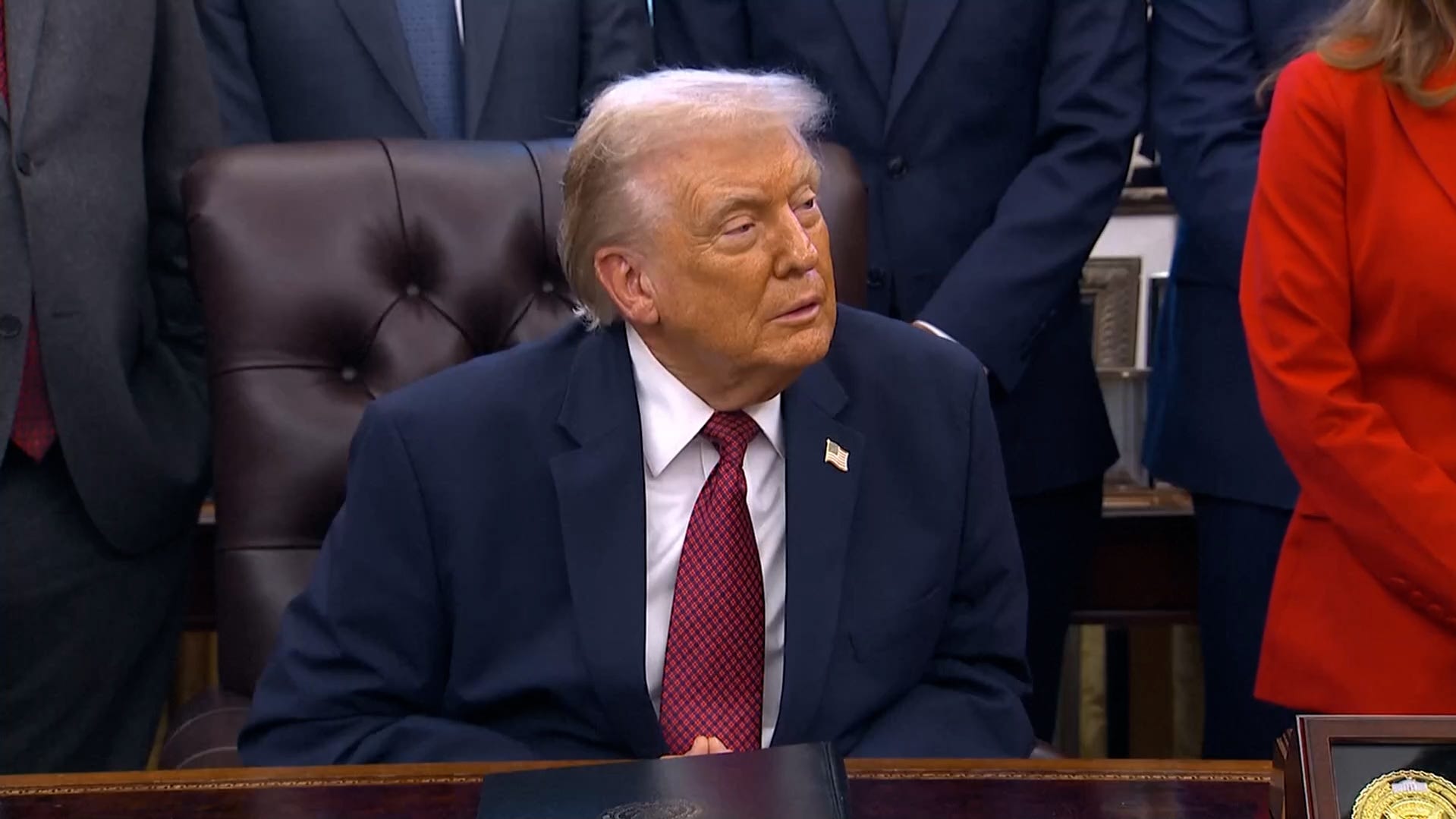

President Trump says automakers won’t recover EV costs
Todd Spangler of the Detroit Free Press asked President Trump whether money spent on automakers to meet Biden-era EV policies would be reimbursed.
The European Commission will move to reverse a plan to effectively ban new internal combustion engine cars from 2035, an EU official said on Friday, in a move that would be a major victory for Germany, which has sought protection for carmakers.
Manfred Weber, leader of the European Parliament’s largest party, EPP, has suggested in previous statements that there may be an alternative to car manufacturers’ fleet targets, which would be to cut CO2 emissions by 90% from 2035 onwards.
The planned ban was a key part of the EU’s strategy to drive the continent’s decarbonization and encourage the development of electric vehicles. But Brussels faces intense lobbying from Germany and its carmakers, which say they face stiff competition from China.
“Next Tuesday, the European Commission will submit a clear proposal to abolish the ban on internal combustion engines,” Weber said at a press conference in Heidelberg, Germany.
Automakers are under pressure
Weber, a German member of the European Parliament and leader of the EPP group, said it should be up to markets and consumers to decide how climate change targets are achieved. This is the same claim made by major European automakers such as Volkswagen VOWG_p.DE, Stellantis STLAM.MI and Mercedes-Benz MBGn.DE.
The European Commission is expected to announce the planned system on December 16, but said it would not comment on any proposals in advance.
Weber did not provide further details, but said late Thursday that under the new plan, automakers’ new vehicle registration targets for 2035 and beyond would require a 90% reduction in CO2 emissions.
“There is no 100% target even after 2040,” he told the tabloid Bild.
German Chancellor Friedrich Merz, who was also present at Friday’s press conference, said electric vehicles remain the main path to carbon neutrality, but other technologies exist, such as synthetic fuels.
“And that’s exactly what we mean by technology openness. This gives the industry real planning security,” Merz said.
Germany is lobbying hard for the planned ban to be overturned, worried that its automakers will come under even more pressure as Asian rivals expand into Europe, taking a heavy hit from U.S. import tariffs.
In a letter to European Commission President Ursula von der Leyen last month, Merz argued that automakers needed more flexibility after demand for electric cars did not meet industry expectations.
“A large part of the European automotive industry, including Germany, and in particular the supplier industry, is in a very difficult economic situation. Therefore, the European framework conditions need to be amended as soon as possible so that this industry can have a future in Europe.”
Reporting by Tilman Blasshofer, Timm Reichert, Ludwig Burger, Christoph Steitz; Additional reporting by Philip Blenkinsop; Editing by Thomas Seythal, Matthias Williams, Andrew Heavens


