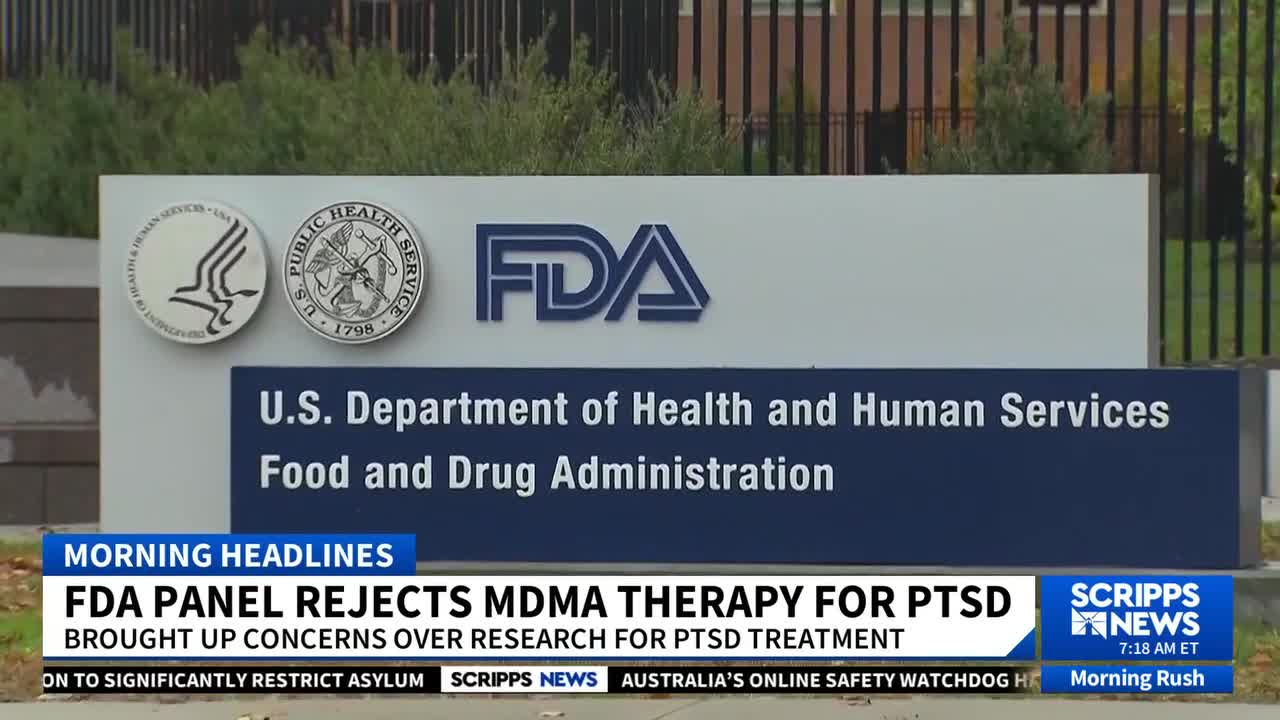

FDA panel rejects use of hallucinogen MDMA in treating PTSD
An FDA advisory committee has voted against using MDMA to treat patients with post-traumatic stress disorder, citing flaws in research and the risk of abuse.
scripps news
Since its rise to prominence on the party scene in the 1980s, ecstasy has become a staple of festival and rave culture. But the drug also carries far more risks now than it did back then, and some are sounding the alarm.
Dr. Leif Fenno, chair of the American Psychiatric Association’s Council on Addiction Psychiatry, says accurate data on how powerful ecstasy has become today is difficult to come by. That’s because there is a lot of variation from pill to pill. Still, he says, some studies suggest that the amount of MDMA, a synthetic psychoactive drug, in ecstasy has increased by about 50% over the past 15 years, so it’s definitely gotten more powerful overall.
“There is wide variation in the composition of individual tablets,” Fenno says. “Some tablets contain no MDMA at all, while others have concentrations two to three times the average tablet concentration.”
Today’s ecstasy is generally much more powerful. We need to talk about it.
Ecstasy began gaining prominence as a street drug in the 80s and peaked in the late 90s and early 2000s. In the 2010s, it was revived under the name moly, which is slang for “molecule.” This drug acts as both a stimulant and a hallucinogen.
The 2021 National Survey on Drug Use and Health conducted by the Substance Abuse and Mental Health Services Administration (SAMHSA) estimates that 7.5 percent of Americans ages 12 and older have tried ecstasy at least once. At the time of the survey, an estimated 586,000 adults in the United States over the age of 18 had used MDMA in the past month.
Fenno said that while the actual chemical composition of MDMA hasn’t changed much over the years, the amount concentrated in ecstasy tablets has increased significantly. People who currently use Ecstasy or Molly are often unaware of how much MDMA they are actually ingesting.
“While the MDMA itself hasn’t changed, the amount of MDMA in each pill and the number of pills you take at once determines how ‘potent’ the dose is,” Fenno says.
Ecstasy, the truth about MDMA
Like any other illegal drug, using MDMA comes with significant risks.
“MDMA can be addictive for some people,” Fenno says. “There are also medical risks, including severe dehydration, overheating, electrolyte abnormalities, and kidney damage, especially when using high-dose tablets, prolonged dancing or exposure to heat, or when mixed with alcohol or other stimulants.”
Not to mention, some tablets are laced with additional substances, which can further exacerbate variability and potency. Those other substances could include caffeine, bath salts, amphetamines and fentanyl, Fenno said.
“MDMA is not manufactured in pristine pharmaceutical factories under controlled conditions,” he added. “It is manufactured in illegal makeshift laboratories, and the final product may contain impurities and may be mixed with other substances. There is no assumption that MDMA tablets or powders will contain the advertised amount of MDMA, or even no MDMA at all.”
The bottom line? There are always risks when it comes to street drugs. And you’ll never know exactly what you’re ingesting.
“The content is unpredictable,” Fenno said. “When using illegal substances, there are steps you can take to reduce but never eliminate the risk of harm: never use it alone, carry naloxone (the overdose drug) and know how to use it, call 911 immediately if you suspect an overdose, and use drug testing services and test strips if they are available in your area.”
For resources and support regarding substance use disorders, visit SAMHSA.gov or call 1-800-662-HELP (4357).


