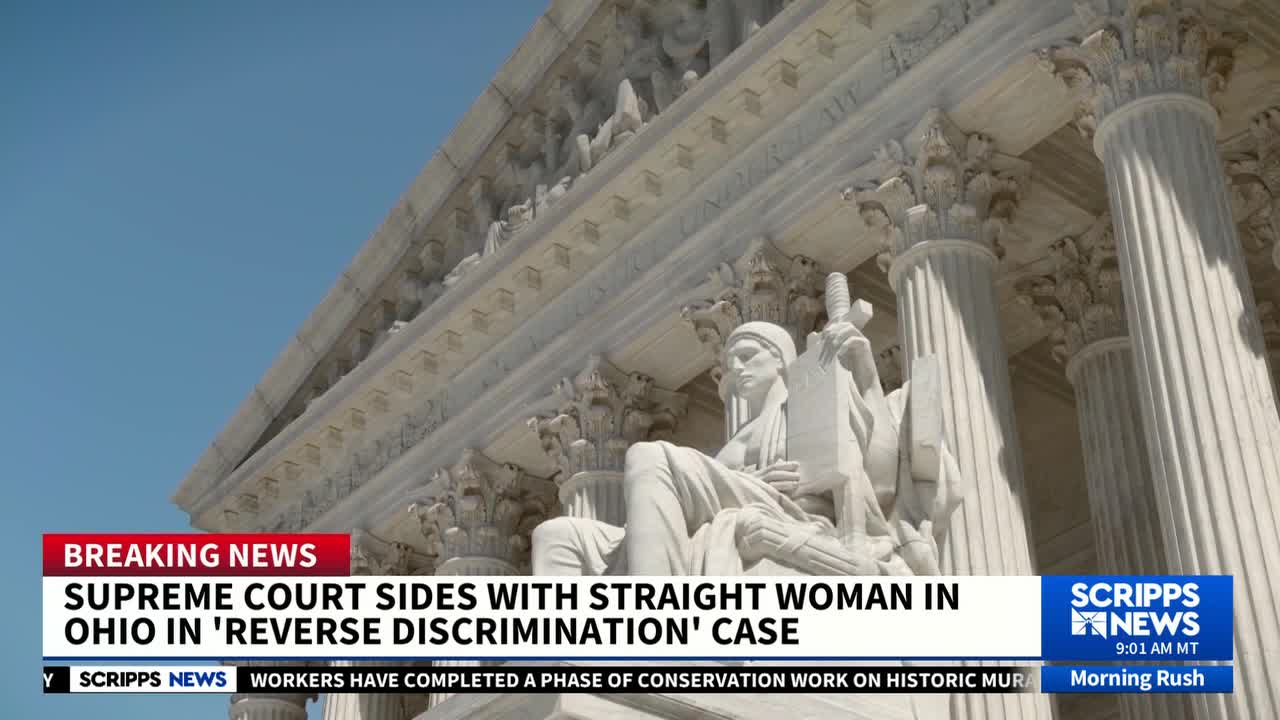

Supreme Court sides with straight women in ‘reverse discrimination’ case
The Supreme Court ruled unanimously in favor of a woman who said she was denied a job and subsequently demoted because she was heterosexual.
scripps news
President Donald Trump claimed in a recent interview that white people were treated “very badly” as a result of civil rights-era policies aimed at correcting historical patterns of racial discrimination.
The president said the Civil Rights Act of 1964, which aimed to end discrimination and segregation based on race and provide black Americans with equal access to education and employment, “achieved some very great things, but it also hurt a lot of people.”
“People who deserve to go to college and people who deserve to get jobs couldn’t get jobs,” Trump told the New York Times. “Yes, it was reverse discrimination.”
President Trump’s references to “reverse discrimination” (that white people are victims of racial oppression) galvanized his presidential campaign and guided his efforts to eradicate diversity, equity, and inclusion policies in the federal government and private sector during his second term.
This has sparked fierce opposition from civil rights leaders.
“All Americans, regardless of their race, color, or creed, are better off as a result of the civil rights movement and our continued commitment to racial justice. Facing the hard truths about systemic and historical racism is undoubtedly uncomfortable, and few have benefited more from capitalizing on that outrage than the current administration,” said Marc Morial, president of the National Urban League, a civil rights group. “Those who make false claims about racial justice may think they are protecting their own historical advantage, but in reality they are impeding progress and limiting opportunity for everyone, including themselves.”
President Trump targets ‘anti-white sentiment’
During his campaign for a second term, President Trump signaled a dramatic shift in America’s approach to civil rights, vowing to target “anti-white” racism rather than focusing on historically marginalized groups.
“There is clear anti-white sentiment in this country, and it cannot be tolerated,” he said at the time.
In anticipation of Trump’s return to power, Republican activists led by the Heritage Foundation, a think tank that has helped shape policy in Republican administrations since the Reagan era, have developed a sweeping plan known as Project 2025. One of the primary goals of the presidential transition plan was to reverse the “DEI revolution” by eliminating policies such as affirmative action, which Project 2025 calls “positive discrimination.”
Within his first hours back in the Oval Office, Trump made good on a campaign promise, sweeping DEI efforts from the federal government and military, threatening to strip billions of dollars in federal funding and grants from universities, and pressuring companies to scale back programs or risk losing federal contracts.
In another recent escalation, the Trump administration is investigating the diversity efforts of major companies under the False Claims Act, a federal law used by the Justice Department to take action against contractors who defraud the government, USA TODAY reported.
What is “reverse discrimination”?
At the heart of the anti-DEI movement is “reverse discrimination.” The concept first took root during the harsh economic climate of the 1970s, when industrial jobs disappeared, wages stagnated, and inflation skyrocketed.
Federal anti-discrimination laws protect all individuals, but for decades white people have often been held to a higher legal standard when claiming workplace bias than groups that have historically faced discrimination.
Last year, the Supreme Court made it easier for whites, straight people and other members of so-called majority groups to sue for discrimination, siding with Marian Ames, an Ohio woman who claims she twice lost jobs to less qualified gay candidates because she is straight.
At the time, legal experts said the decision was closely watched and could lead to more lawsuits alleging “reverse discrimination.”
In December, a money manager at Carl Icahn’s investment firm sued Bausch & Lomb and his employer, alleging he was denied a board seat because he was white. This is the latest in a series of DEI lawsuits.
“Are you a white man who has experienced discrimination?”
Vice President J.D. Vance and other government officials urged white men to file complaints of racial discrimination with the Equal Employment Opportunity Commission, which was established under the Civil Rights Act in 1965 to combat discrimination in the workplace.
“Are you a white male experiencing workplace discrimination based on race or gender? You may have a claim to recover money under federal civil rights law,” EEOC Chairman Andrea Lucas said on social media platform X.
The tweet was further amplified by White House senior adviser Stephen Miller. His organization, America First Legal, broadcasts complaints of reverse discrimination against top companies and other organizations. Vance also backed up the tweet, writing that DEI is an “intentionally discriminatory program against primarily white men.”
Christopher Rufo, DEI critic, senior fellow at the Manhattan Institute, and contributing editor of the Institute’s publication City Journal, praised the move to label the “problem of anti-white racism” as “massive change.”
“If you want to have a government that enforces civil rights laws, you need a government that enforces civil rights laws for everyone. Not just favored groups, but all individuals,” Rufo said last year on a recent New York Times podcast. “So what does that mean? It’s similar to what the Trump administration is doing, which is saying that anti-white bigotry should be subject to the same harsh sanctions as anti-black bigotry.”
Historically, “reverse discrimination” claims have been relatively rare. White workers make up about two-thirds of the U.S. workforce, but their discrimination claims account for only about 10% of race-based claims, according to data obtained by USA TODAY from the EEOC in 2023.
Legal experts say white workers tend to experience lower rates of discrimination than other groups. Higher legal standards have also made it more difficult to pursue claims of “reverse discrimination.”
“President Trump’s comments perfectly encapsulate the old adage, ‘When you’re used to privilege, equality feels like oppression.’ Civil rights laws provide fundamental guarantees of equality for all Americans, regardless of race, including white Americans,” said David Glasgow, executive director of the Meltzer Center on Diversity, Inclusion, and Belonging at New York University School of Law.
“The idea that civil rights protections treat white Americans, who remain the majority among economic, political, and cultural elites, is not only wrong, it’s ridiculous,” said Glasgow, author of “How Equality Wins: A New Vision for an Inclusive America.”
How the DEI backlash is impacting Black Americans
After the killing of George Floyd in 2020 sparked nationwide protests, companies pledged to make their employees and leadership more reflective of the communities they serve.
The backlash was swift, with advocacy groups arguing that white workers were being denied opportunities in order for employers to hire and promote more women and people of color. They also challenged DEI programs tailored to specific minority groups and policies that tied executive compensation to diversity goals.
“If a major company said in its shareholder proxy statement or in the human resources section of its website, ‘We’re going to increase the white makeup of our workforce by 15% this year,’ most people would say, ‘Well, that’s kind of racist, and that seems wrong,'” Gene Hamilton, vice president and general counsel at America First Legal, told USA TODAY in 2023.
President Trump’s anti-DEI criticism is having ripples across corporate America as companies accelerate efforts to reduce or eliminate DEI programs that could be targeted by the president. These rollbacks have a direct impact on the careers of Black Americans and the diversity of executive suites within the largest companies, according to a USA TODAY analysis.
Black Americans outnumber white Americans 12 to 1 in executive positions, according to the latest data from USA TODAY. At the same time, white men have risen to prominence in corporate boardrooms, eroding the gains made by women and people of color.
“A body of empirical research shows that people of color in general, and black people in particular, are at a disadvantage in the labor market when skills and qualifications are equally sought after,” said Victor Ray, an associate professor at the University of Iowa.
“The Civil Rights Act is a relatively small intervention aimed at correcting state-sponsored discrimination and racial segregation,” Wray said. “Racists have been claiming from the time they were enacted that these laws harm white people. It’s shameful and wrong that the president is digging into discredited racist talking points that most Americans want dead.”


