Cryptocurrency has become one of the biggest players in elections. Meanwhile, the average American voter cannot remain indifferent to cryptocurrencies. That’s a problem.
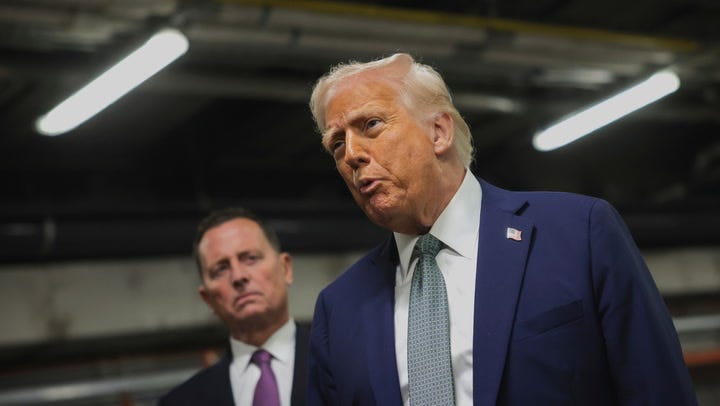

President Trump’s cryptocurrency project announces sale of $550 million in tokens
Donald Trump’s World Liberty Financial cryptocurrency project announced it has raised $250 million in its second token sale, bringing total sales to $550 million.
cheddar
If you follow Congress’s money, you might be surprised to find that on the other side of the coin is cryptocurrencies.
After scoring several recent wins, the crypto-backed super PAC Fairshake started 2026 with more than $193 million on hand to influence elections across the country. Crypto friends are using their war chest to fund candidates willing to work with the industry and target those critical of the industry.
Its first big foray into the 2026 cycle is a pledge to spend $1.5 million against Rep. Al Green (D-Texas) in the March 3 primary. He has previously expressed concerns about cryptocurrencies.
“They’re going to do whatever they can to maintain the advantage they have over some members of Congress, but not against me,” Greene said in a Facebook video following FairShake’s investment announcement.
Meanwhile, a cryptocurrency super PAC is spending $5 million to support Rep. Barry Moore (R-Ala.) as he runs for U.S. Senate.
“Cryptocurrency is not a fad,” Moore said in a December article for X magazine. “It’s part of our future.”
Although completely legal, it is concerning that FairShake and other pro-crypto PACs are able to spend millions of dollars in elections across the United States. By putting more pro-crypto politicians in Congress, we risk further deregulation, which could have serious economic consequences for the United States.
Campaign spending is not the only problem. That’s due to the fact that these companies have a say in messaging. These cryptocurrency interest groups want ordinary people to invest their money in a volatile industry, exposing them to the possibility of loss. Politicians are attempting to close the door to market legislation by accepting funds from crypto PACs.
Who is Cryptocurrency PAC impacting?
Cryptocurrency PACs have been influencing elections for years, but they only really started to proliferate in 2024. All told, FairShake spent nearly $180 million during the 2024 election cycle. More than a third of all corporate donations during that cycle came from cryptocurrency companies. The crypto industry also pretty much got what it wanted. Fair Shake helped win 53 of the 58 parliamentary elections in which it invested money that year.
FairShake targets Democratic politicians who are critical of cryptocurrencies. Cryptocurrency PACs spent $10 million on former U.S. Rep. Katie Porter, who is running for the California Senate in 2024, and a whopping $40 million on former Ohio Sen. Sherrod Brown, who served as chairman of the Senate Banking Committee. But they’re also backed by some Democrats like Sens. Elissa Slotkin and Ruben Gallego, who each received about $10 million last cycle.
Fairshake, on the other hand, did not spend any money against Republicans in the 2024 election cycle. That makes sense, given that no Republican can win without pledging allegiance to President Donald Trump, and Trump is a big supporter of cryptocurrencies. His family earned about $1.4 billion in crypto assets in the past year, according to a Bloomberg analysis.
Needless to say, cryptocurrencies have become one of the biggest players in elections. Meanwhile, the average American voter cannot remain indifferent to cryptocurrencies. A 2025 Gallup poll found that only 14% of US adults own cryptocurrencies. This means that a very small group has great influence over elections.
There is still a lot of uncertainty regarding cryptocurrencies, and there are no uniform regulations across the country. These crypto PACs seek to ensure that this situation remains the same and will provide funding to anyone they can so that business can continue as usual.
Democrats must confront and regulate cryptocurrencies
I’m not saying Democrats should refrain from having opinions on cryptocurrencies. In fact, this will likely help their stance on young American men, as polls show that a quarter of men under 50 own crypto assets. It would be good for the party to be educated about cryptocurrencies, but unfortunately I don’t see it going away anytime soon.
If cryptocurrencies are indeed the future, more regulation will be needed. It would be wise for Democrats to focus on passing legislation that stabilizes the market rather than abolishing cryptocurrencies or pretending they don’t exist. At the very least, he should promise voters that he won’t take money from crypto super PACs like FairShake.
And of course, Republicans need to educate themselves on the pros and cons of cryptocurrencies, rather than blindly supporting them just because the president supports them. It’s true that Republicans want to avoid harming their voters and the U.S. economy, and the last thing they want is a crypto bubble bursting.
As voters, it is important to understand that our opinions do not exist in a vacuum. We are a product of everything we ingest about politicians and elections. We are susceptible to outside influence from super PACs that don’t care about us, and our politicians are much more likely to act on the interests of these PACs rather than ours. We must be wary of outside spending and demand transparency about who is endorsing candidates.
Follow USA TODAY columnist Sara Pequeno on Bluesky: @sarapequeno.bsky.social


