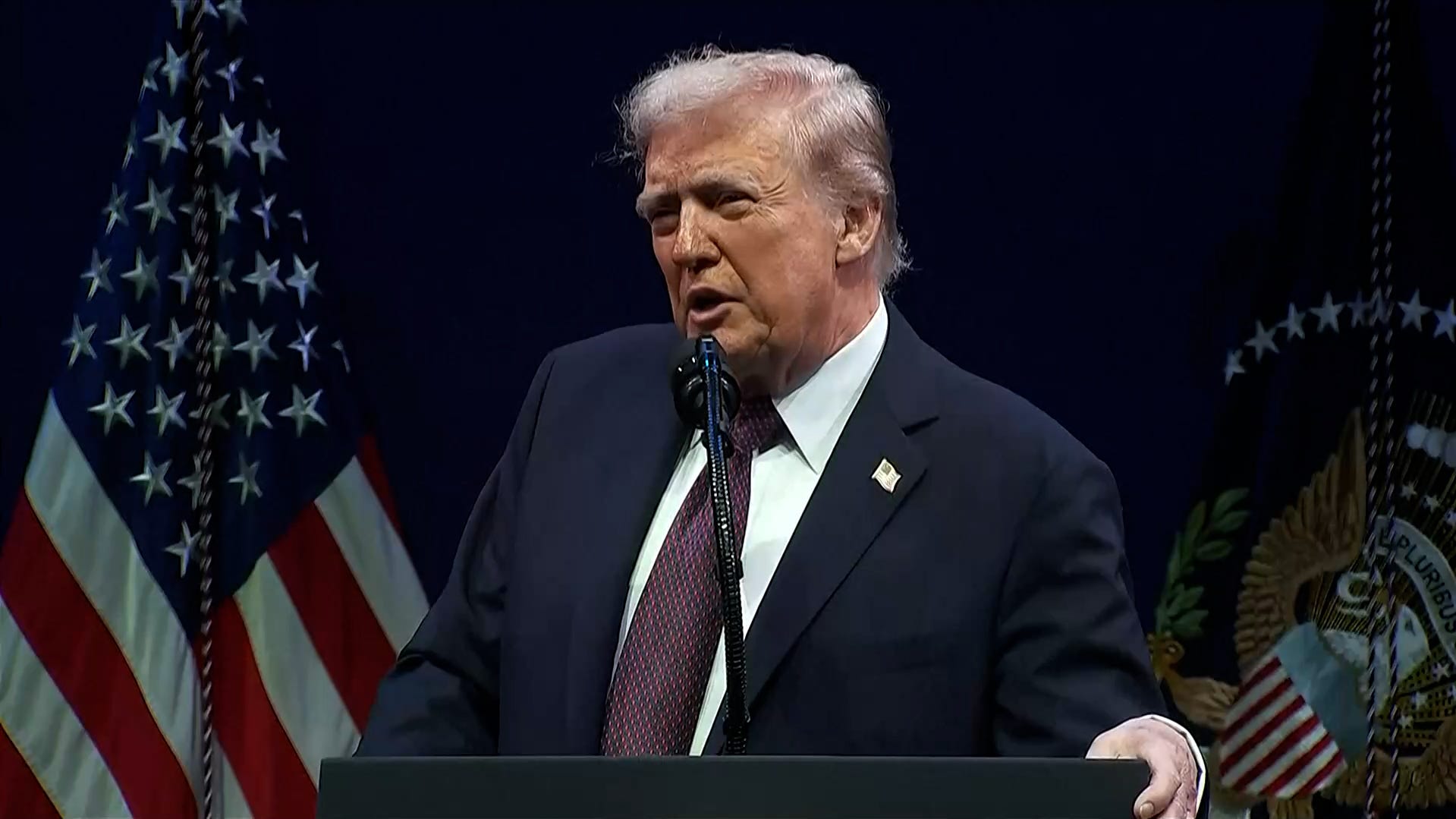

President Trump announces protection of prayer in public schools
President Trump announced new upcoming guidelines to protect prayer in public schools.
- More than a dozen residents of Quincy, Massachusetts, have joined a lawsuit alleging the city violates the state’s constitutional religious neutrality.
- The Beckett Fund, which successfully represented Hobby Lobby in a landmark Supreme Court case a decade ago, is also representing the city in this case.
- The Supreme Court has previously ruled in favor of displaying clearly Christian items when government agencies have identified a secular purpose that outweighs their religious content.
A showdown over Catholic statues on public buildings in Massachusetts represents a new battle in the national debate over the separation of church and state.
Quincy Mayor Thomas Koch commissioned statues of St. Michael and St. Florian, the patron saints of police and firefighters, to decorate the new police headquarters. But more than a dozen residents have accused Koch of violating the state’s constitutional religious neutrality policy.
In mid-October, a judge issued a preliminary injunction preventing the statue from being erected while the lawsuit continues.
Koch told The Patriot Ledger, part of the USA TODAY Network, that the city plans to appeal the ruling.
“We chose the Michael and Florian statues to honor Quincy’s first responders, not to promote religion,” Koch said. “These individuals are recognized as symbols of courage and sacrifice in law enforcement and fire communities around the world.”
The Beckett Fund, a group that claims to defend “religious freedom as a universal right,” is representing the city in the lawsuit. The organization won on behalf of Hobby Lobby in a landmark U.S. Supreme Court case that gave private employers the right to deny contraceptive coverage to employees based on religious beliefs.
The Massachusetts lawsuit comes at the same time as lawsuits over efforts in several states to display the Ten Commandments in public school classrooms. All of this comes as the Trump administration works to put its own stamp on the meaning of religious freedom under the First Amendment.
President Donald Trump himself has vowed to bring religion back to the country, and members of his Religious Liberty Commission say the First Amendment’s Establishment Clause does not prevent the government from promoting religion, which it can and should do.
The commission has been criticized by some who argue that its purpose is to promote conservative Christian views, not religious freedom for all religious groups.
However, conflicts over religious symbols on public land are not new. In a 7-2 decision in 2019, the U.S. Supreme Court allowed a giant Latin cross called the Bladensburg Cross to remain on government land in Maryland. The cross was erected nearly a century ago as a World War I memorial, and the court said the Christian cross symbol “took on secular meaning” when used in such a way.
Justice Samuel Alito wrote in the majority opinion: “While the cross is undoubtedly a symbol of Christianity, that fact should not overshadow everything else the Bladensburg cross symbolizes.”
courtroom However, he noted that maintaining existing religious symbols is “quite different from building or adopting new ones.”
Decades ago, the Supreme Court ruled in 1984 that a Rhode Island city did not violate the Establishment Clause by including a nativity scene as part of its Christmas display. The court said the display’s perceived promotion of Christianity was “indirect, abjective, and incidental” and “is not the promotion or support of a religion,” any more than the government acknowledging the origins of Christmas or sponsoring a museum displaying religious art.
Breanna Frank is USA TODAY’s First Amendment reporter. Please contact bjfrank@usatoday.com..
USA TODAY’s coverage of First Amendment issues is funded by the Freedom Forum in collaboration with our journalism funding partners. Funders do not provide editorial input.


