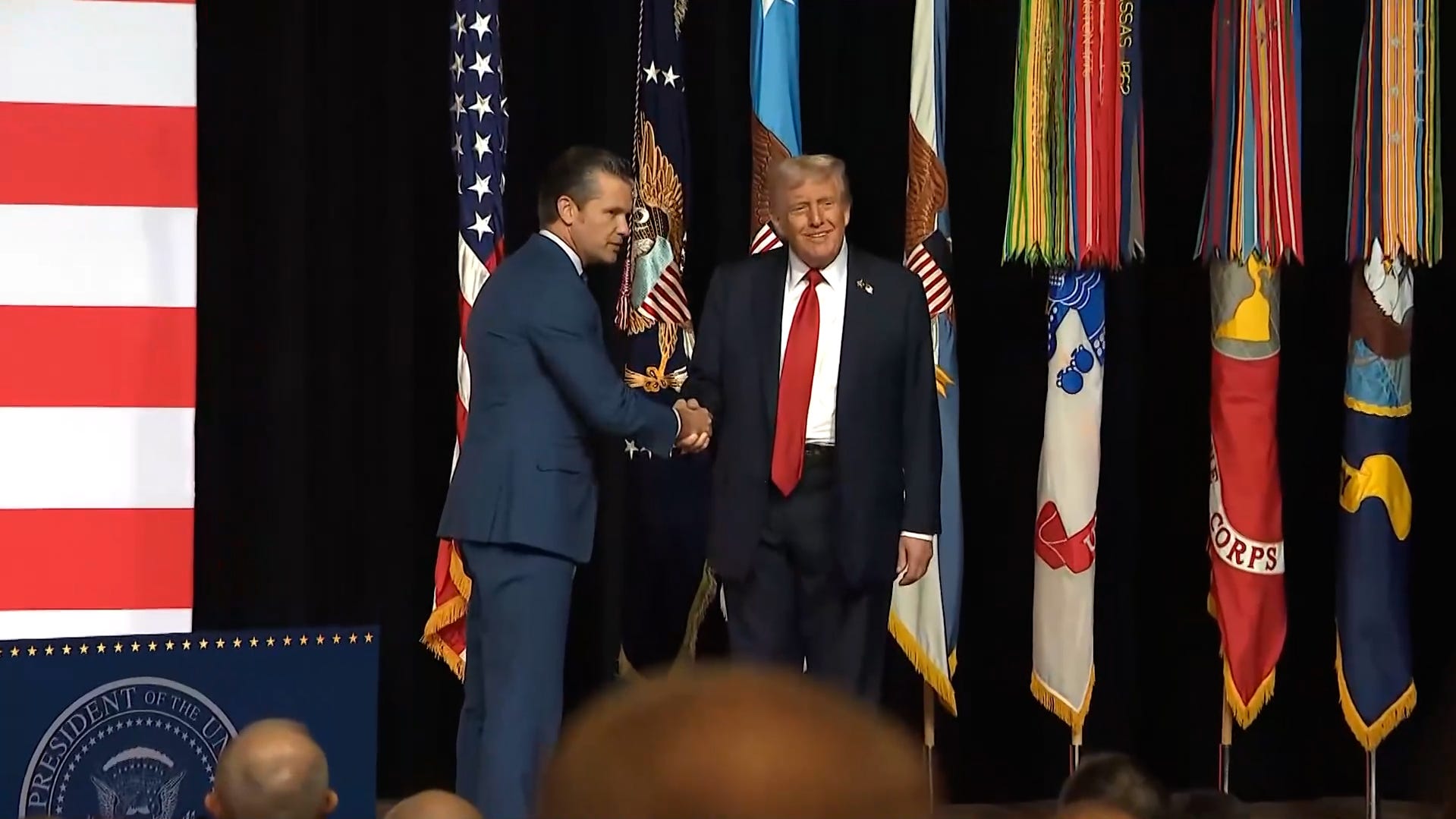

Trump and Hegseth push for military overhaul, calling overstaffing ‘fat shaming’
President Donald Trump and Pete Hegseth have pledged to accept the general’s removal and resignation and have pushed for new policies, including military fitness rules.
When it comes to military fitness standards, Secretary of Defense Pete Hegseth remains mum.
The Pentagon chief issued a curt response after a viral backlash over a photo of a group of overweight Texas National Guard soldiers heading to Chicago.
“Standards are back,” the Pentagon chief posted. He brought his troops home from a mission in Chicago.
Since taking over the Pentagon, Hegseth has made fitness a major focus, pushing initiatives such as gender-neutral standards for combat operations and a new annual “combat field test.”
But the department has long struggled to provide the National Guard and other reservists with fitness resources similar to those available to active-duty military members.
Hegseth’s Sept. 30 memo says that while active-duty soldiers must exercise while on duty, members of the National Guard and other reserve forces must instead “take personal responsibility for maintaining proper physical fitness.”
However, part-time military members lack access to fitness resources, even though they are held to the same standards as active-duty members. These units often balance two or three jobs. Also, unlike full-time members, they cannot receive disability benefits if they are injured during off-duty training.
Alex Morrow, host of a military fitness podcast called “MOPs & MOEs,” told USA TODAY that while staying healthy is ultimately the responsibility of individual service members, he wants to explore “better avenues to provide resources” to troops like the soldiers in Texas.
Army’s approach is evolving, but geography is a barrier
The Army, which has the largest proportion of part-time units of any military branch, is grappling with the challenge of ensuring the combat fitness of its reservists. And the stakes are high. Reserve forces are regularly deployed alongside active-duty soldiers, and the National Guard may be called into a state by the governor or president.
In recent years, the service has introduced more intense fitness tests, including deadlifts, weighted sled drags, kettlebell carries, and calisthenics such as planks, push-ups, and a 2-mile run.
Men and women in the National Guard and Army Reserve generally met the minimum passing standards on early versions of the new exam, with a slightly lower pass rate than the active-duty Army, according to internal data published by Military.com. However, their average scores were significantly lower: Army reservists averaged 452 out of 600, while active-duty men averaged 498 points.
Part of this discrepancy may be due to the recent proliferation of resources to support the diet and exercise habits of active duty soldiers.
The Army’s Holistic Health and Fitness Program, known to military personnel as H2F, provides soldiers with on-site access to an integrated team that includes strength coaches and trainers, athletic trainers, physical therapists, nutritionists and nutritionists, occupational therapists, and “cognitive enhancement experts.”
Army officials tout the H2F program, currently implemented by 71 teams across active-duty units, as a success in producing healthier soldiers.
The service plans to expand H2F to cover the entire Army, including part-time soldiers in the National Guard and Army Reserve.
Private First Class Nicholas Rice, who manages the Army Reserve’s H2F deployment, acknowledged the challenges of providing fitness resources to part-time units in remarks at the Association of the United States Army conference Oct. 15.
Rice said the Guard and Army Reserve will host six pilot teams in fiscal year 2026. The National Guard plans to test the concept in Alaska, Indiana, Wyoming and Kentucky.
But determining what works and what doesn’t can be a difficult task.
Most reservists only see soldiers two or three days a month, and a significant portion of part-time troops live far from their units and commute hundreds of miles in uniform. Even if there were physically centralized fitness resources and equipment at small military installations, colloquially known as armories, many would not be able to take advantage of them.
“You can’t copy and paste an active duty (H2F) team into a reserve formation and expect a similar impact,” said Morrow, an Army veteran and podcast host who continues to serve part-time in the Army Reserve.
Culture and equity issues
Military leaders have been discussing the benefits of offering options such as virtual personal trainers or issuing wearable fitness trackers to support reservists’ fitness activities. Some states employ their own nutritionists.
But Morrow, citing psychological research, argued that the military faces major challenges in motivating part-time troops to truly embrace physical health and fitness.
“In an environment where you can’t force people to do something every day, you have 28 days a month without supervision, and it depends entirely on how much they care about their fitness,” he said. He argued that for full-time troops, it’s a scheduling issue, but for Guard and Reserve units, it’s a matter of “changing identity.”
“Giving people a wearable (fitness tracker) doesn’t change anything,” Morrow said. “For those who aren’t motivated, it’s just a chore.”
Retired Army Maj. Gen. Francis McGinn, president of the U.S. National Guard Association, told USA TODAY that fitness can be a challenge for reservists who juggle multiple careers and family obligations.
“You go to work all day, you come home, you might train (on the weekend), and then you coach the kids. Somewhere in between, you have to find a way to exercise,” he said.
McGinn believes there is an “equity issue” arising from the disparity in resources between part-time and active duty forces.
Active-duty service members who are seriously injured while training off-base over the weekend will receive free medical care and, if their injuries are severe, medical retirement benefits and veterans’ disability benefits.
However, a National Guard or Reserve member who sustains the same injury while training to meet the same physical fitness requirements would not receive such compensation unless the injury occurred during a training weekend or temporary active duty order.
But ultimately, a standard is a standard, and even part-time military personnel must meet the standards, McGinn said.
Disclosure: USA TODAY reporter Davis Winkie is a member of NGAUS.


