What is maternity tourism? President Trump is asking the Supreme Court to uphold his order denying U.S. citizenship to babies born to visiting-only foreign nationals.

SCOTUS Lawsuit Grants Birthright Citizenship to Tourist Babies
The Supreme Court is scheduled to hear arguments on April 1 on whether President Donald Trump can restrict birthright citizenship by executive order.
WASHINGTON – The practice is called “birth tourism.”
Companies with names like USA Happy Baby and Star Baby Care offered to bring pregnant women from China or other countries to the United States and give birth to children who would be recognized as U.S. citizens before returning home.
According to a federal criminal indictment against the companies, women were taught to wear baggy clothing to hide their pregnancies and mislead customs officials about the length of their stay. Star Baby Care said on its website that it has “served 8,000 pregnant women” for 20 years. USA Happy Baby said it charged VIP customers up to $100,000.
However, the scope of birth tourism and its threat to national security is hotly debated. Estimates range from just 2,000 babies per year to a suspected 1.5 million over 15 years. This higher number is reflected in Congressional testimony and arguments that the Supreme Court will hear the case on April 1st.
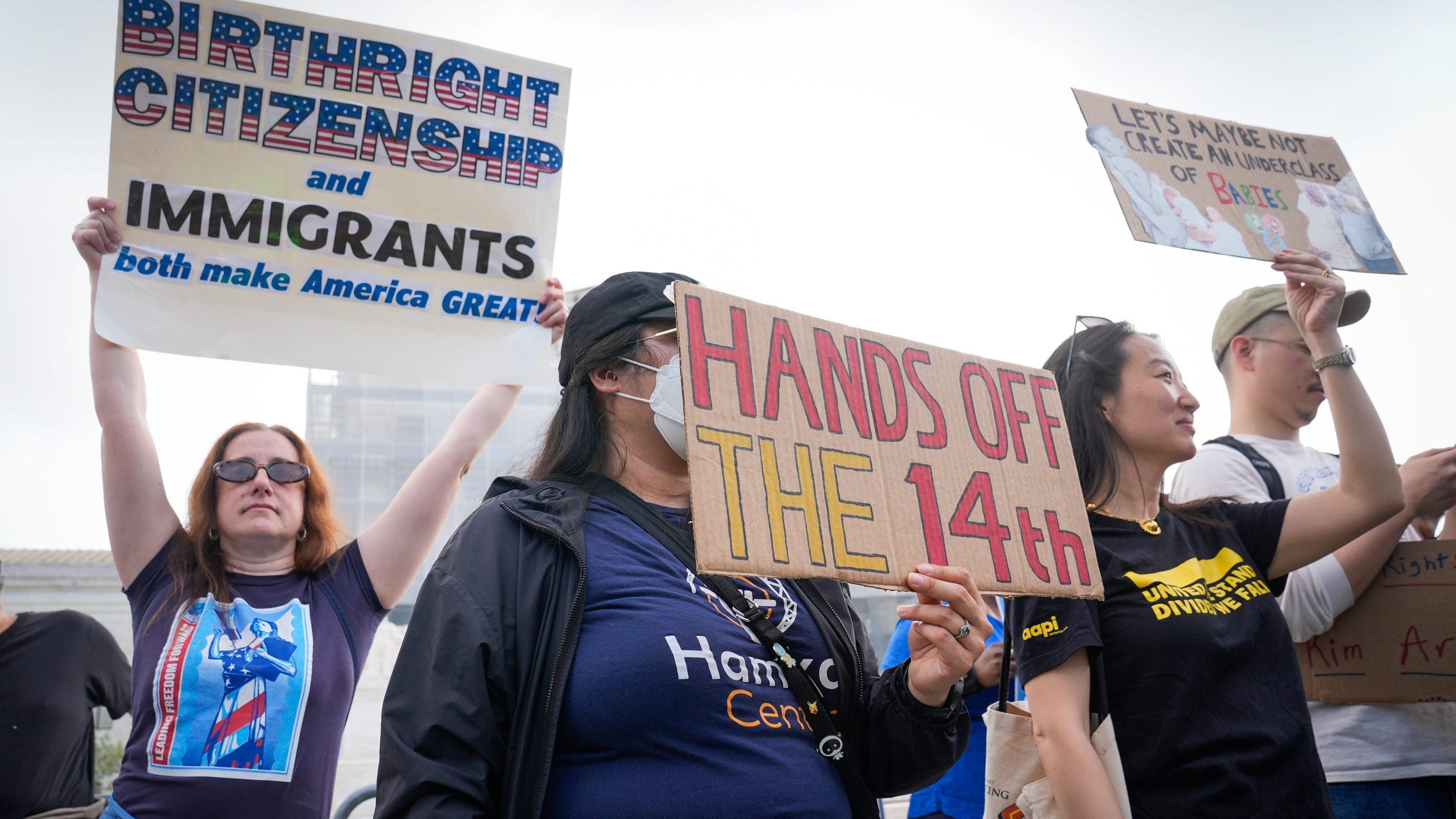
The justices will decide whether President Donald Trump can restrict birthright citizenship by executive order, despite courts’ past interpretations of the 14th Amendment, which was ratified more than 150 years ago. For more than 125 years, the high court has interpreted the amendment to grant citizenship to nearly everyone born in the United States.
Mr. Trump and his allies argue that citizenship does not cover people who give birth to children while on vacation. But opponents of the move, including Congressional Democrats and 140 university professors, argue that the problem is overblown and that laws to combat birth tourism are already in place.
What is the controversy surrounding the 14th Amendment?
The Fourteenth Amendment states, “All persons born or naturalized in the United States, and who are subject to the jurisdiction of the United States, are nationals of the United States and of the state in which they reside.”
The expression “subject to jurisdiction” has traditionally been understood to mean children of diplomats. Native Americans were initially excluded because of their tribal loyalty, but were granted birthright citizenship under a 1924 law.
Federal judges have repeatedly rejected executive orders signed on the first day of President Trump’s second term that aimed to limit birthright citizenship.
“A lot of the government’s policy arguments are beside the point, because this is a constitutional provision that is not a subject of policy discussion at this point,” said Cody Wofsy, an attorney with the American Civil Liberties Union, which is participating in the lawsuit. “The reality is that[birth tourism]is a marginal problem that is already being addressed by federal regulations that make it illegal.”
President Trump’s order denied birthright citizenship to children if their mothers entered the country without legal authorization or if they were in the country temporarily as students, workers, or tourists.
“Birthright citizenship is not meant for people who can take a vacation and become permanent residents of the United States of America, bring their families, and spend all their time laughing at ‘football guys’ like us,” President Trump said on social media on May 15, 2025.
“Amazing numbers” vs. “infinite decimals”: It’s hard to count babies born to tourists
The figures from birth tourism are highly controversial, as the government does not count the number of births resulting from birth tourism.
Peter Schweitzer, president of the Government Accountability Institute, a conservative think tank in Tallahassee, Florida, testified at a March 10 Senate hearing that an estimated 1.5 million people living in China have been U.S. citizens by birth over the past 15 years.
Schweizer argued that these people are educated in Chinese Communist Party schools with a distorted view of American values and culture, but that they can vote in elections and bring their parents in as permanent residents when they turn 21.
“The scale of exploitation is staggering, but the U.S. federal government is not systematically tracking it,” Schweitzer said.
However, Sen. Dick Durbin (D-Ill.) found Mr. Schweitzer’s estimate lacking in legitimacy.
“He didn’t have anything to back it up,” Durbin told USA TODAY. “When I asked for specifics, he gave me generalities.”
The Center for Immigration Studies estimated in 2020 that tourist births result in more than 20,000 to 39,000 babies each year, based on federal statistics on how many foreign-born mothers give birth and how many show up on the census as having stayed longer than tourists.
But Jeremy Neufeld, a researcher at the Niskanen Center think tank in Washington, D.C., sharpened his pencil and said the center’s numbers were a “gross overestimation.” Neufeld argued that a fairer estimate would be that fewer than 2,000 babies are born to tourists each year.
In written arguments before the Supreme Court, a group of 140 university professors said that of the 3.6 million births each year, birth tourism “accounts for a tiny fraction of the children who attain birthright citizenship each year.”
Stephen Camarota, a researcher at the Center for Immigration Studies, told USA TODAY that the government could end the conflict by charting the number of women who entered the country with foreign passports, stayed less than three months, and left the country with their infants using U.S. passports.
Lawmakers disagree on whether birth tourism is a ‘big problem’ or a ‘minor problem’
Republicans and Democrats disagree on the seriousness of the threat posed by birth tourism.
“This is a big problem,” Sen. John Cornyn (R-Texas) told USA TODAY. “We’re being played, so we’re looking forward to seeing what the Supreme Court does.”
Sen. Ted Cruz (R-Texas) told USA TODAY that birth tourism is a “persistent concern.”
“This is a blatant abuse of immigration law,” said Cruz, who took part in written arguments in the Supreme Court case.
Sen. Peter Welch (D-Vermont) told USA TODAY there is an agreement not to allow birth tourism. But he said the impact would be “minor.”
“We don’t want that. It’s illegal. As long as there are steps that can be taken to curb it, there’s a consensus that we should do it,” Welch said. “Fortunately, the facts show that it’s a fairly minor issue, but it’s clearly one of significant concern.”
President Trump changes visa policy to discourage birth travel
Opponents of Trump’s executive order argued that laws already in place could discourage birth tourism.
The State Department changed its visa policy in 2020 during the Trump administration to discourage women from giving birth while visiting.
The change specifically allows the department to deny a visa applicant if consular officials have “reason to believe” that the tourist gave birth while in the country and the primary purpose of the visit was to obtain U.S. citizenship for the child.
“If there is a problem with birth tourism, and I don’t think there is evidence that there is a problem, then the solution is to enforce the law and not strip American families of their citizenship for children born on U.S. soil or force them to prove their parentage or strip their citizenship,” Amanda Frost, a law professor at the University of Virginia, said at a March 10 Senate hearing.
“The American way of life is not for sale,” says an investigator.
A 2019 federal indictment accused 19 people in Southern California of conspiring to help tourists give birth in the United States. At the time, there was no dispute that the children were citizens, so the charges focused on the travel agency educating the parents on how to lie to obtain visas, money laundering, and filing false tax returns.
Dongyuan Lee, then 41, of Irvine, California, was charged with operating Orange County-based You Win USA. The company advertised that it served 500 Chinese women. According to the indictment, she used 20 apartments to house pregnant women and charged each client between $40,000 and $80,000.
Mr. Lee pleaded guilty to visa fraud and conspiracy to commit visa fraud. In December 2019, U.S. District Judge James Serna sentenced her to 10 months in prison, which she had already served while the indictment was pending.
Ms. Lee’s attorney, Thomas O’Brien, said her case is not about birth tourism because the government has confirmed that the State Department issues visas to foreign nationals who give birth in the United States. Mr. O’Brien argued that the lawsuit was in support of his client who lied on his visa application. He also said that You Win USA’s number of fraudulent visas was not “as extensive as the government had publicly advertised.”
Michael Wei Yue Liu, then 53 years old, of Rancho Cucamonga, California, and Jing Dong, then 42 years old, of Fontana, which operated USA Happy Baby, were found guilty of conspiracy and 10 counts of international money laundering. In December 2024, U.S. District Judge Gary Klausner sentenced both men to 41 months in prison.
Prosecutors say Liu and Dong charged clients $20,000 to $40,000 and VIPs up to $100,000 to have their children delivered in the United States. Prosecutors say the company received $3.4 million in international wire transfers over a two-year period.
Prosecutors said Mr. Liu and Mr. Dong helped the Chinese woman submit a false visa application to the State Department by lying about the purpose of her visit and the length of her planned stay. Prosecutors say Liu and Dong taught the women how to pass interviews at the U.S. consulate in China, how to deceive U.S. customs officials, and how to enter the country through ports that are considered less stringent, such as Hawaii instead of Los Angeles.
Prosecutors told the judge in their sentencing memo that Mr. Liu and Mr. Dong “ran a lucrative business that violated American law.” “The defendants assisted numerous clients in defrauding U.S. authorities and purchasing U.S. citizenship for their children for tens of thousands of dollars each.”


