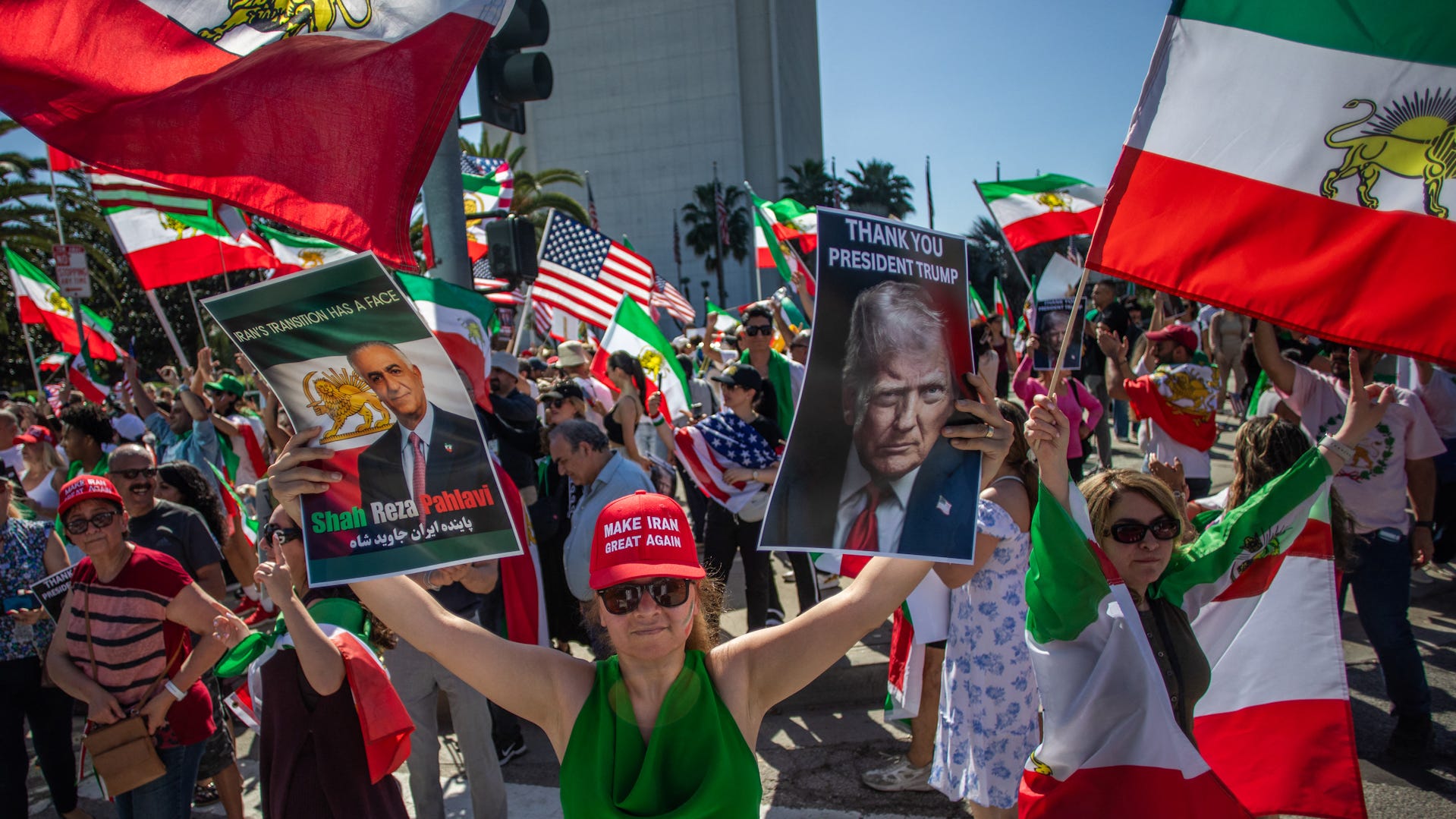

Iranian attack protests and American celebrations
Americans are protesting and celebrating in New York, Washington, D.C., and Los Angeles in the wake of the Iranian attack.
When news broke that the United States had launched a military offensive across Iran, killing Supreme Leader Ayatollah Khamenei, mixed emotions rippled through communities with close ties to the region, with Americans from thousands of miles away flocking to protests across the country.
Demonstrators gathered in cities large and small across the United States, from New York City, Washington, D.C., and Los Angeles to Waynesboro, Virginia, and Worcester, Massachusetts. In Detroit, student groups from various universities had already scheduled a Feb. 28 meeting to focus on U.S. immigration policy, but upon learning of the Iranian attack, they added a protest to their plans.
More than 70 people showed up on Wayne State University’s campus that afternoon in a student-led demonstration, according to the Detroit Free Press, part of the USA TODAY Network. Kathy Anderson, of Plymouth, Michigan, lamented the deterioration of America’s political system, saying, “It’s embarrassing because we’re not getting our act together.”
“There’s no clear purpose given as to why we’re there,” she added. “Are we there to destroy the nuclear program? Are we there to overthrow the regime? Are we there to protect the protesters? Why are we there?”
President Donald Trump and officials in his administration have argued that Iran is taking steps to build nuclear weapons and poses a serious threat to the United States. Experts previously told USA TODAY that such claims are either false or based on vastly exaggerated assumptions.
“You can’t bomb people to liberate them.”
Only one in four Americans supports attacking Iran, according to a Reuters/Ipsos poll released less than 48 hours after the United States and Israel launched a joint military operation. Speakers at a protest at Worcester, Massachusetts, City Hall were skeptical that the airstrikes would improve the lives of Iranians, and decried the economic and psychological costs of further wars in the Middle East.
The strike raised concerns among some that civil unrest could cause further suffering in the country of 92 million people. By midday on February 28, the Iranian Red Crescent reported that at least 200 people had been killed and more than 700 injured, including Iran’s longtime leader Ayatollah Khamenei, known for his repressive rule and anti-Western foreign policy.
Three American soldiers were killed and several others were seriously injured during the operation.
Megan Giulianelli, who left Iran 40 years ago and now lives in New Jersey, cried when she heard about the girls’ elementary school strike that Iranian authorities said killed more than 100 people. He said most Iranians want an end to a regime that has “terrified the people for 47 years” but that a joint attack would be the “worst-case scenario.”
“You can’t bomb people and liberate them,” she said through tears. “What are they thinking?”
Students after strike: “We’ve been waiting for this moment”
Some welcomed the news of the strike with joy.
Some students at the University of Wisconsin-Milwaukee celebrated Khamenei’s death with pastries from the school’s student union. Narges Khodadadi, president of the school’s Iranian Students Association and a doctoral student, acknowledged concerns about the future, but said many people in Iran, including herself and her family, were happy and hopeful for brighter days ahead.
“We’ve been waiting and praying for this help for a long time,” Kodadadi told the Milwaukee Journal Sentinel, part of the USA TODAY Network. “We’ve been through a very difficult and sad two months, but we’ve been waiting for this moment.”
Tehran-born Nafiseh Najafi, owner of a Persian restaurant in Nashville, Tennessee, said the action was a necessary step toward the liberation of the Iranian people.
“Iranians around the world are excited and happy,” she said. “They are celebrating outside.”
“I’m already in tears.”
RA Kashanipour, an Iranian-American based in Arizona with most of his family remaining in Iran, had a different perspective. He told the USA TODAY Network’s Arizona Republic that the conflict has left Iranians “caught between authoritarians.”
He was concerned that the attack could lead to further violence among Iranians.
“There has already been too much bloodshed,” Kashanipour told the outlet in a text message. “Unfortunately, there seems to be more to come. Tears are flowing down my face.”
Brian Costello, a Phoenix resident, spoke to this newspaper at a March for Life rally in the city on February 28, calling on the United States to “strive for peace.”
“We understand that sometimes peace can only be achieved by the sword, but we need to be careful in everything we do,” he said.
contribution: Michael Collins and Francesca Chambers, USA TODAY;Natalie Davis, Detroit Free Press. Alec Johnson, Milwaukee Journal Observer. Meg Trogoro, Telegram & Gazette. Hanan Adely, The Record. Molly Davis, Tennessean. Jose R. Gonzalez, Arizona Republic


