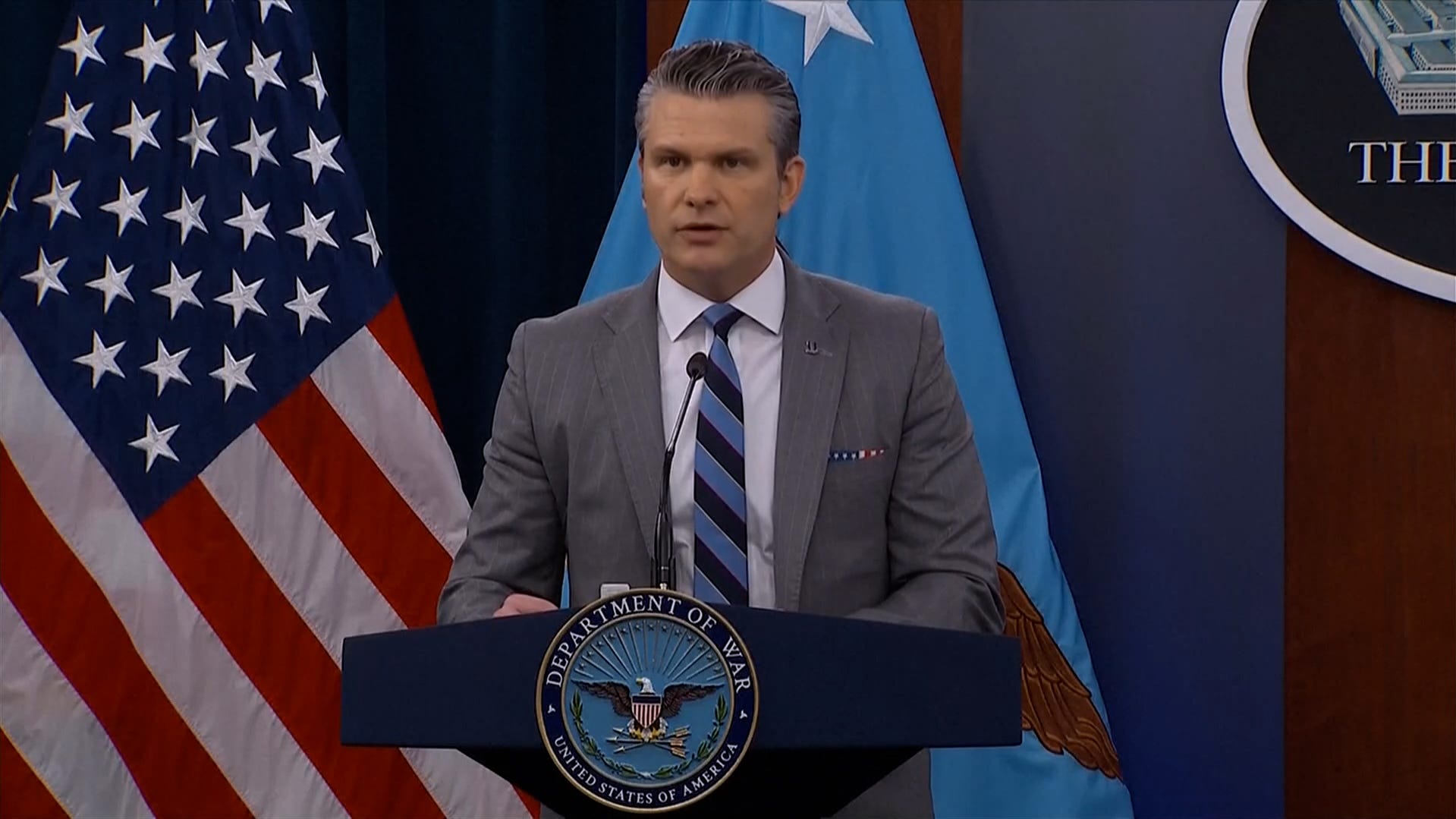

Hegseth says the Strait of Hormuz blockade will last “as long as necessary”
Secretary of State Pete Hegseth has warned that the Strait of Hormuz blockade will remain in place until Iran abandons its nuclear ambitions under pressure from the United States.
- This problem becomes even more concerning when we look overseas, and there are concerns about the impact that fuel shortages there will have on the United States.
- Natural gas and diesel can both be produced by refining crude oil and are used in nearly everything the United States buys or ships.
While pain at the pump is a reality for most Americans, the chances of running out of gasoline in America are pretty slim.
why? Over the past 15 years, the country has become more self-sufficient and less dependent on imports for crude oil, the black gold that comes out of the earth before being refined into the gasoline used in cars.
Still, the Iran war that began on Feb. 28 will have an impact on U.S. car owners, car buyers and automakers, experts said, after Iran began clamping down on crude oil passing through the Strait of Hormuz.
Patrick Anderson, CEO of Anderson Economic Group in East Lansing, said natural gas and diesel, both of which can be produced by refining crude oil, are in nearly everything the United States buys or ships, influencing power prices, food prices, consumer goods and industrial production.
Thus, the chaos caused by the Iran war is “ in fact “It’s an increased cost that will be borne by American consumers,” Anderson told the Detroit Free Press, part of the USA TODAY Network. Although the increase is small so far, consumer anxiety may grow and escalate. That means some people may put big-ticket purchases like cars on ice.
“For Michigan and the auto industry, the immediate economic impacts include higher gasoline prices, which pose a potential for inflation for consumers, and widespread increases in diesel fuel prices, which impose real and immediate costs,” Anderson said. “Both are real concerns. Oil depletion is not.”
America’s 25-day oil supply
According to AAA, the national average price for regular gasoline in the United States as of April 27 was approximately $4.11 per gallon. This is a significant increase from a year ago, when it was about $3.15 per gallon. On February 1, before the Iran war began, it averaged $2.85 to $2.89 per gallon.
The United States had 413 million barrels of crude oil in its strategic stockpile for 2025, according to an April 20 post from the U.S. Energy Information Administration. This was second only to China, which had 1.4 billion barrels in reserves.
From August 25, 2025 to January 26, 2026, U.S. daily crude oil production ranged from 13.2 million barrels to 13.9 million barrels, according to the U.S. Energy Information Administration. The United States exported about 4.8 million barrels of crude oil per day in the week ending April 17, data showed.
Experts say the U.S. fuel supply and demand has remained stable over the past five years, with Americans using about 8 million to 9 million barrels of gasoline per day, despite the Iran war that has been going on since late February.
“Our supply is exactly in line with the past five-year average, which happens to be 25 days worth of supply,” Tony Flanagan, managing director of AlixPartners, told the Detroit Free Press on April 24. “But that’s not the point.”
America’s “price problem”
That’s because the United States can always tap into its oil reserves or reduce its oil exports.
This problem becomes even more concerning when we look overseas, and there are concerns about the impact that fuel shortages there will have on the United States.
Australia gets all of its oil from the Strait of Hormuz, but there is currently a fuel shortage. Ben Kumar, head of equity strategy at UK-based investment management firm 7IM in London, said South Korea has been hit “hugely” because it imports almost all of its crude oil.
“In South Korea, Australia, Japan, you may have all the money in the world, but if there’s nothing on the shelf, the car won’t start. That’s kind of a scary problem,” Kumar said.
Kumar said the world has about 8 billion barrels of oil stored in the Strait of Hormuz or floating on tankers. This means the world has access to 8 billion barrels of oil.
“But to put it into context, the world consumes 100 million barrels a day,” Kumar said. “That’s 80 days worth of oil.”
Of this 8 billion barrels, 3 billion barrels are in strategic stockpiles and 5 billion barrels are commercially available, Kumar said. He said none of that means the world will run out of oil within 80 days.
What that means, Kumar explained, is that “every time you fill up your car with gas, that inventory is depleted and isn’t being filled as quickly as it used to be.” “And every day more and more people want more oil and they’re getting more nervous and they’re watching the news and panicking a little bit. So more and more people are going to fill up for emergencies and that’s what’s causing this whole shortage problem.”
That’s when you’ll see the price go up. Looking at the U.S. and Europe, gas prices in the U.S. have gone up a bit, but they are still relatively reasonable, he said.
If you are in a European country, prices have increased significantly, he said. According to the European Commission Oil Bulletin, the average price of gasoline per gallon in Europe as of April 23 ranged from $5.93 per gallon in US dollars to $10.10 per gallon, depending on the country.
“Even if we want to buy American gas or natural gas, we can’t do that because we can’t export enough from America,” Kumar said. “In fact, we may start to see regional differences in oil, meaning that oil delivered to, say, Texas may end up being much cheaper than oil delivered to Tokyo. This hasn’t really happened before, because the global oil system usually works very smoothly.”
For the United States, continued war and fluctuations in oil prices will pressure prices, but not supply capacity, he said.
“The way we say it in the UK is…you’ll get it, but it’s about price, not empty shelves,” Kumar said. “That’s what I think America is going to face. It’s not an empty shelf issue, it’s a price issue.”
“An enviable position”
Anderson agreed, saying that while Europe’s move to reduce energy production capacity from fossil fuels in favor of relying on renewable energy and Russian natural gas puts the continent at “significant risk,” the current situation in the United States is “not dire.”
“In fact, it’s not even offensive to most Americans yet. It’s very offensive to some people,” Anderson said.
For many Americans who have family members in the military or who are at risk, Anderson said it’s a bigger concern beyond the economy. But he said the United States is in an “enviable position” when it comes to the world’s energy fundamentals.
“If you look at the total energy demand and supply, we’re pretty much self-sufficient,” Anderson said. “The shale oil revolution and the emergence of small but growing solar and wind power have largely saved us from disruptions to oil supplies in the Middle East.”
Jamie L. Lareau is senior auto writer for USA TODAY and covers Ford Motor Co. for the Detroit Free Press. Contact Jamie at jlareau@freepress.com. Follow her on Twitter @Jalalean. To sign up for our automotive newsletter. become a subscriber.


