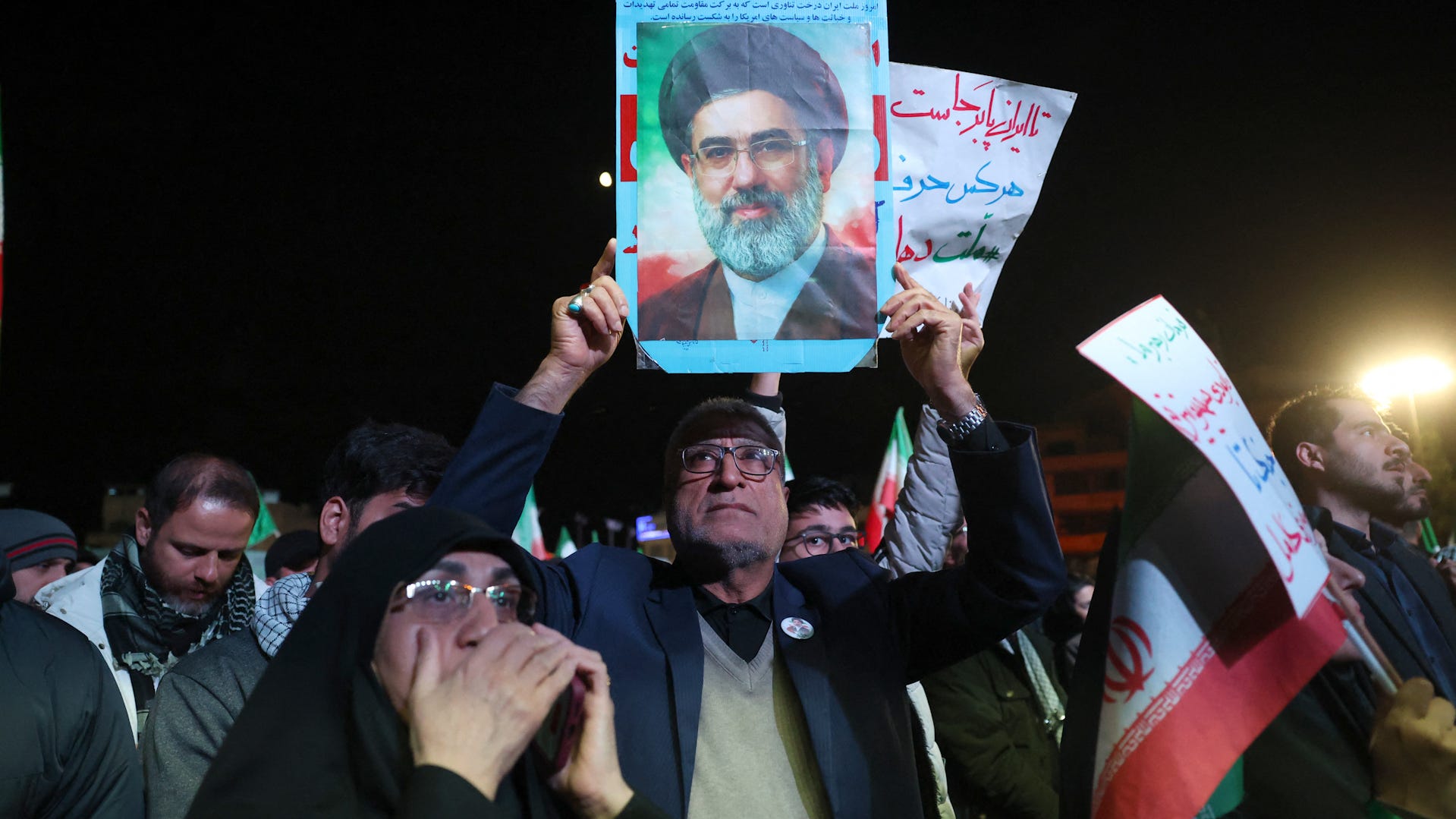

Iranians react to US-Israel ceasefire in war against Iran
Crowds gathered in Tehran as Iranians reacted to a two-week cease-fire in the US and Israel’s war against Iran.
- Iran has taken control of the Strait of Hormuz, a vital waterway that accounts for 20% of the world’s oil supplies.
- Peace talks between the United States and Iran have focused on the reopening of the waterway and a possible toll structure.
- Despite the US bombing campaign, Iran’s military remains operational and the nuclear material situation is uncertain.
Iran will seize control of the Strait of Hormuz this weekend and enter high-stakes peace talks in Pakistan with more influence than it has had so far during six weeks of war.
At 160 miles long, this narrow waterway is a major waterway through which 20% of the world’s oil and natural gas supplies must pass. By deciding which ships can and cannot pass through this passage, Iran has the power to disrupt global energy markets and inflict pain on adversaries around the world.
The United States has called on Iran to reopen the waterway, making it one of the focuses of peace talks that began on Saturday, April 11. Negotiators from both countries are trying to turn a fragile two-week ceasefire into a permanent peace plan.
Here we take a closer look at how the US-Israel war with Iran reshaped the world, and in some cases how it didn’t.
It is not possible to pass straight through the Strait of Hormuz
Before the war, oil tankers and cargo ships moved freely through the Strait of Hormuz, which connects the Persian Gulf, the Gulf of Oman, and the Arabian Sea. However, in the first few days of the war, Iran effectively closed the strait, limiting the number of ships that could pass through it and reportedly charging up to $2 million per ship to pass through.
Iran’s blockade of the corridor caused major disruption to global energy markets, causing oil and gas prices to soar.
Reopening the shipping lanes was one of the United States’ key conditions in the two-week ceasefire announced on April 7. However, Iran has only allowed a small number of ships to pass through the strait since the cessation of fighting. Iran wants the right to collect tolls from ships passing through the strait as a condition of ending the war.
President Donald Trump has sent mixed signals regarding tolls. He said these were illegal and violations of the ceasefire, and that Iran should stop pressing charges against them. But in an interview with ABC News, he suggested the tolls could continue as part of a joint venture between Iran and the United States. He said tolling could be a way to secure passage.
Iran’s blockade of the strait has shifted the focus of peace talks from ending its nuclear program, one of President Trump’s justifications for the war, to the need to allow ships to pass through the strait unimpeded again.
Brent crude oil, the global benchmark, was trading at about $72 per barrel on February 28th. Prices soared to nearly $120 per barrel in late March, but fell to just under $100 per barrel on April 10 after the United States and Iran reached a conditional two-week ceasefire agreement.
Although the United States is far less dependent on foreign oil than Europe and other countries, rising global prices are impacting domestic gasoline prices. The average price of a gallon of regular gasoline in the U.S. was $4.15 in April, according to AAA Gas Prices, which tracks retail gasoline prices. That’s up from $3.45 a month ago and is less than $3 at the beginning of the year, according to AAA Gas Prices.
Has the Iranian regime changed?
The war severely weakened Iran’s clerical, military, and political leadership. Many of the country’s top intelligence and security officials, as well as longtime supreme leader Ayatollah Khamenei, were killed in a U.S. and Israeli bombing campaign.
President Trump claimed that Iran’s new rulers are more moderate. There is little evidence of that. Iran’s newly appointed supreme leader, Mojtaba Khamenei, has not been seen in public since taking over from his father, and many analysts believe the country could be headed for ideological tightening and greater control by hardline military forces within the government.
Iran’s military has deteriorated but is still functional
The US military inflicted severe damage on Iranian forces during a six-week bombing campaign. President Trump boasted that Iran’s navy has disappeared and is “lying at the bottom of the ocean.” According to the White House, Iran’s ability to manufacture and stockpile ballistic missiles and long-range drones has been in decline for years. Defense Secretary Pete Hegseth also told reporters that Iran’s military, severely degraded by more than 13,000 attacks by U.S. forces, is virtually decimated and will be powerless for years.
Defense analysts say there is no doubt that the US attack has weakened Iran’s military. However, it continues to operate using short- and medium-range missiles to attack Israel and neighboring Arab states such as Saudi Arabia and the United Arab Emirates.
Iranian forces shot down two U.S. military aircraft (an F-15E fighter jet and an A-10 Warthog) on April 3, sparking a massive search and rescue operation for weapons systems officers aboard the F-15E. Both pilots ejected from the aircraft and were quickly rescued. President Trump said the F-15E was shot down by a shoulder-mounted heat-seeking missile.
Description of Iranian nuclear material
According to the International Atomic Energy Agency, the United Nations’ nuclear watchdog, Iran had about 440 kg of 60% enriched uranium before the war began. According to the IAEA, the material is technically within reach of 90% of weapons-grade levels. Although Iran claims its nuclear program is only for civilian energy purposes, few in the West believe this.
Highly enriched uranium can be used in nuclear bombs and missiles. Most of Iran’s enriched uranium is believed to be stored in nuclear facilities deep underground near the city of Isfahan. The nuclear facility was one of three targeted by US bombers last year.
There is speculation that President Trump is considering sending U.S. troops or special forces to seize enriched uranium from Iran as part of his pledge to stop Iran from developing nuclear weapons.
Trita Parsi, an Iran expert and co-founder of the Washington, D.C.-based Quincy Institute for Responsible State Planning, said there are conflicting reports about the current state of Iran’s nuclear materials. “The U.S. government appears to believe that it knows its location and that the Iranians have not accessed it,” he said.
Ali Baez, an Iranian security expert at the Brussels-based think tank Crisis Group, said Iran’s nuclear material was missing, likely buried in deep tunnels. As it stands, he said, the war has “rolled back Iran’s nuclear program, but it has not completely stopped it on the path to nuclear weapons.”
Iran’s huge MAGA influence
Although polls show that most Republicans support a war with Iran, President Trump is facing backlash from an unexpected place: MAGA supporters.
Grassroots MAGA activists and prominent media figures have publicly denounced the war as contradicting his “America First” campaign promise. They also take issue with everything from Trump’s use of profanity in wartime social media posts, his apocalyptic threats to wipe out Iranian civilization, and the conflict’s enormous cost. (The current price tag is $29 billion, according to the nonprofit Center for Strategic and International Studies.)
“He’s gone insane,” former Georgia congresswoman Marjorie Taylor Greene, a Trump supporter turned critic, wrote in a message to the X show.
Trump fired back, calling his critics “losers” and accusing conservative media influencers like Tucker Carlson, Candace Owens and Alex Jones of seeking cheap publicity.
But the MAGA rift could have serious consequences for Mr. Trump and the Republican Party ahead of this fall’s midterm elections, when Republicans will seek to maintain slim majorities in both chambers of Congress.
Reluctant allies and the future of NATO
The war appears to have deepened the rift between the United States and some traditional allies. France, Spain, Germany, and the United Kingdom, in particular, have always been reluctant to heed the Trump administration’s calls for air support and the use of military bases. With Iran effectively closing the Strait of Hormuz, other NATO allies have resisted supporting the United States militarily.
Meanwhile, President Trump called America’s allies “cowards.” He characterized NATO as a “paper tiger” and renewed his threat to leave the military alliance formed after World War II. He also likened British Prime Minister Keir Starmer to Neville Chamberlain, now widely known as the British leader who promoted appeasement with Nazi Germany.
While U.S. allies agree with Trump that the Iranian regime is a threat to the entire region and should not be allowed to pursue its nuclear program, they struggle to understand Trump’s regularly contradictory statements about strategy, motives and reasons for war.
“This war violates international law,” German President Frank-Walter Steinmeier said in late March, echoing comments from other European leaders. “In any case, there is little doubt that the justification for an imminent attack on the United States is baseless,” he said.


