The right strategy can help protect your investments from volatility.


Gasoline prices soar due to US-Israel war with Iran
The jury is still out on whether we are headed for a recession, but the risks are very real.
Recession fears are rising again, with Moody’s top economists predicting a 49% chance of a recession in the United States within the next 12 months. Analysts at Goldman Sachs are slightly more optimistic, pegging the recession risk at 25%, but both numbers could change quickly depending on oil prices.
Let’s be clear: no one can accurately predict what the market will do in the short term. Predictions of economic recession are not always correct, and much of the future will depend on how the Iran war unfolds. But for now, it’s wise to keep your investments ready for a potential downturn, just in case. The steps I’m taking are:
1. Strengthening your emergency fund
One of the best things you can do during times of economic uncertainty is to build a strong emergency fund with enough savings to last you at least three to six months.
A downturn in the stock market is a particularly bad time to withdraw your funds, as you risk locking in large losses by selling your investments for less than you paid for them. To avoid losses, it’s generally best to stay in the market until prices eventually recover.
2. Developing a purchasing strategy
A recession is not a bad time to buy stocks. In fact, quite the opposite is true. The market has been incredibly expensive for many years, with investors paying record high prices for many stocks. If the market takes a turn for the worse, it can be a great opportunity to pick up blue-chip stocks at a discount.
However, it is wise to think about where you will buy it in advance. Impulse buying can be very risky, and just because a stock is more affordable doesn’t necessarily mean it’s a wise investment.
A move you should definitely avoid
What I would never do is sell stocks in a panic. You may be tempted to sell your investment now for fear of falling prices. In theory, this seems like a smart strategy to avoid losses. But in reality, the market is often too unpredictable for that strategy to work.
Many top economists predict that a recession may be on the horizon, but that doesn’t necessarily mean a recession will occur.
For example, going back to 2023, Deutsche Bank analysts predicted that there was a “nearly 100% chance” that the U.S. would enter a recession within the next year, noting that avoiding a hard landing would be “historically unprecedented.” That recession never materialized, and the S&P 500 (SNPINDEX: ^GSPC) In fact, it jumped about 23% the year after that prediction.
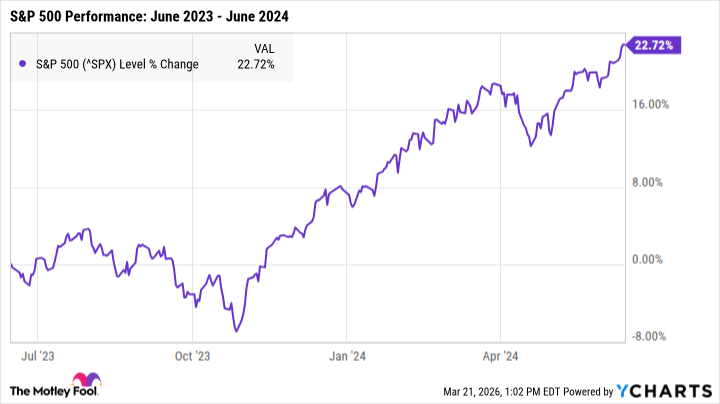
^SPX data by YCharts
This is not to say that these economists did not have enough information to make their predictions, but rather to highlight the fact that markets do not always play by the rules. No matter how strong the likelihood of a recession, there is no guarantee that a recession will occur.
If you sell your stocks and a recession doesn’t happen right away, you risk missing out on the potential for big profits. Also, if you decide to reinvest after the price spikes, you will have to pay a higher price to buy back the shares you just sold.
Uncertainty about the future can be unbearable, but preparing to invest now can make it a little more bearable. No matter what the economic future holds, the more steps you can take to protect your portfolio, the more protected you will be.
Katie Brockman has no position in any stocks mentioned. The Motley Fool has no position in any stocks mentioned. The Motley Fool has a disclosure policy.
The Motley Fool is a USA TODAY content partner providing financial news, analysis and commentary designed to help people take control of their financial lives. Its content is produced independently of USA TODAY.


