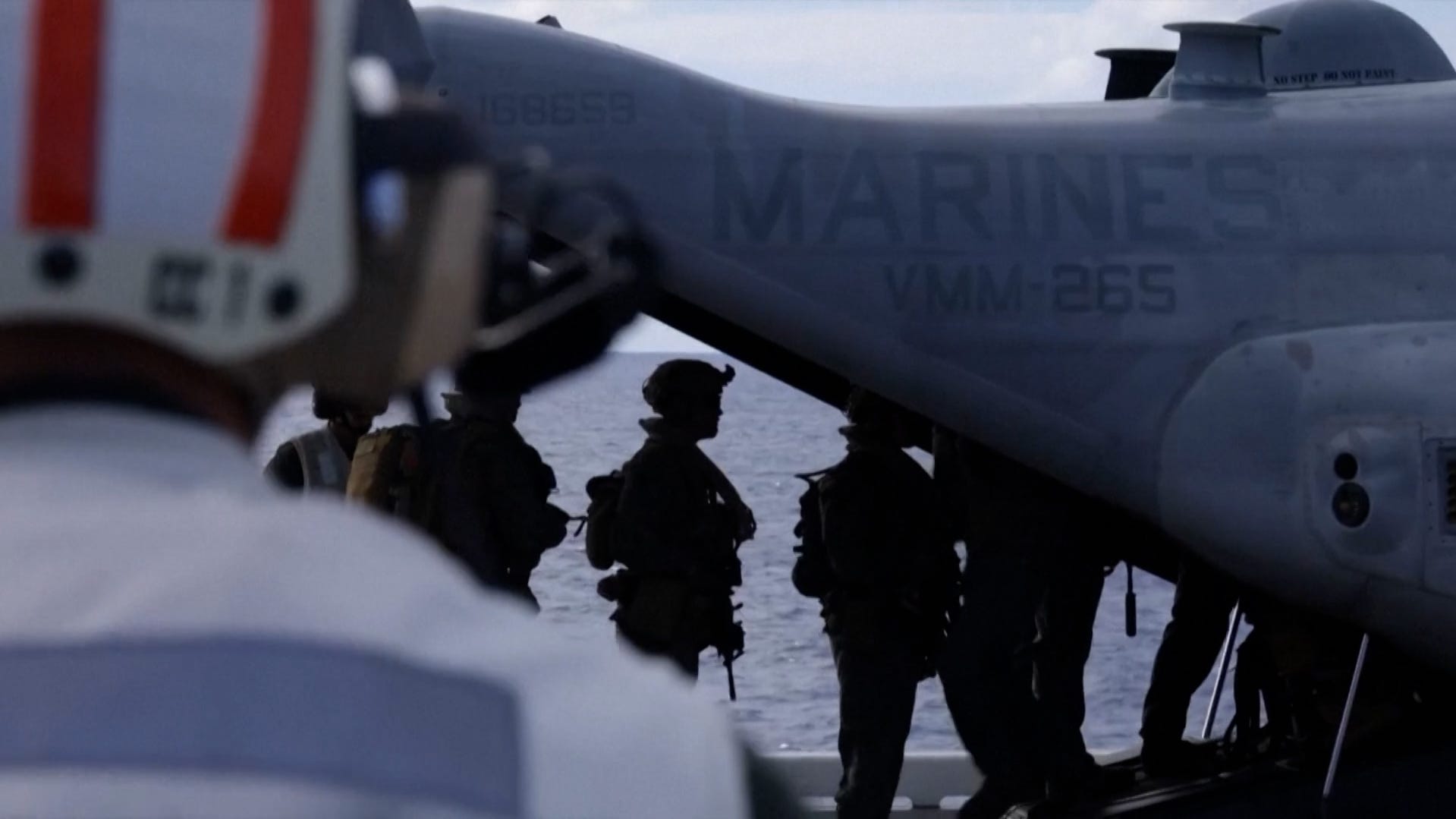

US attacks Iranian oil export base, sends Marines to Middle East
The United States attacked several military targets on Kharg Island, a major hub for Iranian oil exports, and ordered 2,500 Marines to deploy to the Middle East.
Hard truth for presidents: It’s easier to get into a war than get out of one.
Ask Harry Truman about Korea, Lyndon Johnson about Vietnam, and George W. Bush about Iraq.
And now Donald Trump talks about Iran.
When President Trump announced in a social media video on February 28 that the United States and Israel were attacking Iran, he vowed that the overwhelming military superiority of both countries would shatter the Islamic republic’s naval, missile capabilities, and nuclear potential, and possibly overthrow the government itself, in a war he suggested could last four to five weeks.
Now in its third week, the US has destroyed most of Iran’s military and missile stores. Its supreme leader Ayatollah Khamenei was killed.
But the ayatollah’s son took over, and Tehran managed to effectively paralyze the vital Strait of Hormuz through the threat of mines and small boat attacks. This has led to higher energy costs around the world and across the United States, including at gas pumps.
For Trump, that will not only make it harder to declare victory, but also make it increasingly costly to continue the fight.
“Frankly, I think the president is stuck,” State Department veteran Aaron David Miller told MSNOW.
All of his options have drawbacks.
Ask your allies for help – and hear “no”
First, President Trump found himself in the unfamiliar role of asking allies to help send warships that could escort ships safely through the Strait of Hormuz. This may be the clearest message yet that he sees troops now deployed in the region as a long-term operation, not one that will end within a few weeks.
Also unfamiliar: many allies declined.
Some pointed out that President Trump started the war without seeking their advice or support. “This is not our war,” German Defense Minister Boris Pistorius said. Prime Minister Keir Starmer said Britain would not be “drawn into a wider war”. The European Union refused. Japan said it would consider the request.
Their illegal actions prompted a rebuke from an enraged President Trump. “We don’t need anyone. We are the strongest nation in the world,” he told reporters at the White House on March 16.
Meanwhile, he rejected the idea that the United States had underestimated Iran’s ability to toy with a more powerful enemy. “I knew about this strait. I predicted for a long time that it could be used as a weapon,” he shrugged.
He reiterated the importance of halting nuclear ambitions once and for all. “We cannot afford to allow the most violent and vicious country in the last 50 years to have nuclear weapons, because the Middle East will disappear,” he said.
But he did not explain how or if the United States could control the uranium that Iran had processed to near-bomb quality and is now buried deep underground near Isfahan. That could include deploying special operations teams and ground forces, a dangerous mission that carries the risk of higher casualties and serious complications.
He ordered an additional expeditionary force of 2,500 Marines to the Middle East. When a reporter on Air Force One asked Trump to explain the deployment, Trump responded, “Shh, you’re a very obnoxious person,” and asked another reporter to ask a question.
Most Americans do not believe that the first attack was a good idea or that the war would make America safer.
A Quinnipiac poll conducted March 6-8 found that 53% of voters opposed a U.S. attack, and three in four (74%) opposed sending in ground troops. Nearly two-thirds (62%) said the White House did not provide a clear explanation of military actions.
The poll of 1,002 registered voters had a margin of error of plus or minus 3.8 percentage points.
Only one in five predicted the war would last days or weeks. More than seven in 10 people expected this situation to last for months, a year or more.
What defines the presidency?
Another history lesson: Big wars tend to displace presidents.
LBJ is remembered more for his misadventures in Vietnam than for the Great Society Act, which created Medicare and Medicaid. George W. Bush’s presidency was defined by America’s two longest wars, in Iraq and Afghanistan, which lasted longer than his tenure.
During his second term, President Trump has focused on his accomplishments, claiming he solved wars from Armenia to Rwanda, campaigning for a Nobel Peace Prize, and adding his name to the U.S. Institute of Peace and the Kennedy Center.
But peace now seems far away in Iran.


