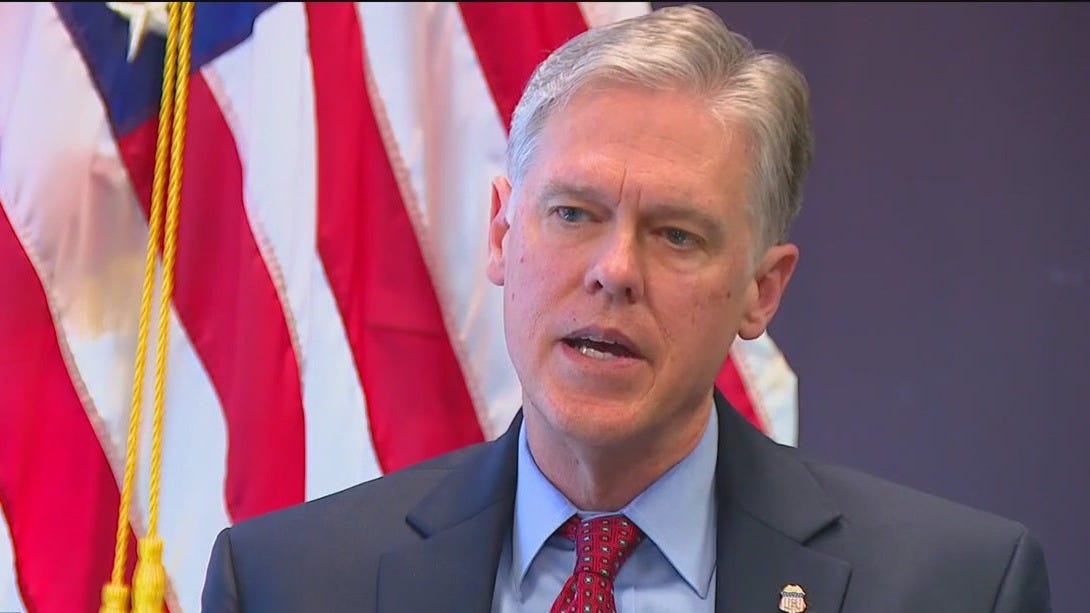

New coronavirus fraud cases continue to increase
During the darkest days of the COVID-19 pandemic, economic relief came in the form of government programs, and some took advantage of it.
Fox – 13 News
Prosecutors announced Monday, March 9, that a former Missouri House speaker was sentenced to 21 months in prison after pleading guilty to misusing federal COVID-19 relief loans for personal expenses.
U.S. District Judge Sarah E. Pitlik also fined John J. Diehl Jr. $50,000, according to the U.S. Attorney’s Office for the Eastern District of Missouri. Deal, 60, confessed to defrauding the U.S. Small Business Administration of hundreds of thousands of dollars by fraudulently obtaining COVID-19 pandemic loans and pleaded guilty to wire fraud charges in September 2025, prosecutors announced.
Prosecutors said Diehl previously served as an alderman for Town and County, an affluent suburb west of downtown St. Louis, and was chairman of the St. Louis County Board of Elections. He resigned as speaker of the Missouri House of Representatives in 2015 after the Kansas City Star reported that he exchanged sexually suggestive text messages with a college intern.
Prosecutors said in a plea agreement last September that Deal admitted to obtaining federal loans totaling $379,900 for his law firm from 2020 to 2022. In applying for the Economic Injury Disaster Loan, a program created to help small businesses struggling during the coronavirus pandemic, Deal promised his law firm would use the funds to “reduce the economic injury caused by the disaster,” prosecutors said.
Instead, prosecutors argued, Mr. Deal used the funds for personal benefits, including car payments, bills and paying civil settlements related to his time as speaker of the state House of Representatives. His lawyer previously acknowledged that Mr. Deal later repaid the money to the U.S. Treasury.
“This defendant’s practice of law was not affected in any way during the COVID-19 pandemic,” Assistant U.S. Attorney Hal Goldsmith said in court, according to a news release from the U.S. Attorney’s Office for the Eastern District of Missouri.
Mr Goldsmith said Mr Deal never used loans for his law firm, adding that Mr Deal was “looking at easy and cheap ways to make money”.
FBI: John Deal ‘misappropriated those funds for personal use’
Prosecutors said Diehl applied for a federal loan in March 2020 and received $94,900. About two years later, he applied for a loan modification and received $285,000 from his second loan.
In those applications, prosecutors said Mr. Diehl signed an agreement that falsely certified that his law firm would “use all proceeds of this loan solely as working capital to alleviate the economic harm caused by the disaster that occurred on January 31, 2020 and continues thereafter.”
Chris Crocker, special agent in charge of the FBI’s St. Louis division, said in a statement that “Mr. Deal legitimately obtained pandemic relief loans for his law practice, but he diverted the funds to his personal use rather than the purpose intended by Congress.” “Relief programs like this were created to help small businesses survive the COVID-19 pandemic, not to line anyone’s pockets.”
After the proceeds of the federal loan were transferred to his law firm’s bank account, prosecutors said Deal would transfer some of the funds to his personal bank account. Prosecutors said Deal paid $1,320.15 in personal dues and fees to the country club in April 2020 after receiving a $1,000 advance from the loan.
Deal then received the remaining approximately $93,900 from the original loan in June 2020 and “illicitly used” the funds for fraudulent personal use, prosecutors said. He paid for Tesla, Audi, and Jeep cars. personal credit card. Mortgage loan. Family college tuition. Pool maintenance. Additional Country Club Dues and Fees. and cash withdrawal.
Prosecutors said Diehl also transferred $50,039.55 from the loan in September 2020 to a law firm retirement plan in which Diehl was the sole participant.
Prosecutors said Diehl received the funds from the second loan in April 2022 and continued to use the funds for personal payments, including fees paid to a St. Louis law firm for personal legal matters and another $150,000 transfer to a retirement plan.
Deal was later fined $47,392 after entering into a consent order with the Missouri Ethics Commission in 2023. Prosecutors said Deal was charged with misusing $6,762.70 in campaign committee funds for personal expenses and “failing to report additional expenditures of campaign committee funds, including at least $28,700 in personal expenses.”
Former Missouri House speaker resigns in 2015 amid sexting scandal
Court documents say Mr. Deal used some of the loan funds to repay “civil settlements related to his time as Speaker of the House.”
Mr. Deal was first elected to the Missouri House of Representatives in 2008, but announced in 2015 that he would resign as speaker after the Kansas City Star revealed that he had exchanged sexually suggestive text messages with a college freshman who was participating in an internship program at the state Capitol.
At the time, Deal acknowledged in a written statement that he had made a “significant error in judgment.”
“I take full responsibility for my actions and am truly sorry to those I let down. I apologize for my poor judgment in putting me and those closest to me in this situation,” Deal said in a statement. “I also regret that a woman was involved in this situation. The responsibility ends here. I ask for your patience. I will immediately work to restore the trust of those close to me and return to the important work required on the last day of the session.”
Following news of the text message, local newspapers reported that Missouri Southern State University had decided to end its internship program at the Capitol a month early.
Richard Miller, dean of Missouri Southern University’s College of Arts and Sciences at the time, told the Star that the university pulled four interns from the state Capitol building after an unspecified incident.


