The two people being held at the South Texas Family Residence Center have “active measles infections,” DHS spokeswoman Tricia McLaughlin told USA TODAY.

Measles cases surge in US as vaccine changes considered
Health experts say measles cases are increasing in the United States and around the world, coinciding with declining vaccination rates and discussions about changing vaccine schedules. There’s more to Alex Cohen.
The Department of Homeland Security announced that U.S. Immigration and Customs Enforcement has suspended “all movement” at a family detention facility in Texas after two cases of measles were confirmed at the facility.
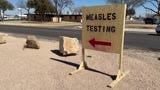
Two people detained at the South Texas Family Residential Center have “active measles infections,” Department of Homeland Security spokeswoman Tricia McLaughlin told USA TODAY on Sunday, Feb. 1. South Texas Family Residential Center is an ICE detention center located in Dilley, a small town more than 110 miles southwest of San Antonio.
The Texas Department of State Health Services confirmed the measles case on Saturday, Jan. 31, and ICE isolated two detainees and a suspected detainee exposure, McLaughlin said.
“The ICE Health Services Corps immediately took isolation and control measures to prevent further spread and infection, halting all movement within the facility and isolating all individuals suspected of having had contact with the infected person,” McLaughlin said in a statement.
McLaughlin added that the detainees are being monitored by medical personnel and that “appropriate and proactive measures are being taken to prevent further infection.”
The measles outbreak in Texas comes after three measles cases were confirmed last week among immigrant detainees in Arizona. The spread of the virus is also a possibility, as human rights groups and immigrants in detention centers across the country report sick children, a lack of medical resources and other poor conditions in the facilities.
Increased oversight of Texas detention facilities
The South Texas Family Residential Center is under increased scrutiny for housing immigrant families with children. The facility also faces numerous allegations of unsafe and unsanitary conditions.
DHS denied allegations of poor conditions at the facility and defended its operations.
“The Dilley Detention Center is being renovated to accommodate families. Adults with children are housed in a facility that provides safety, security and medical needs,” the agency previously told USA TODAY. “ICE undergoes regular audits and inspections by outside agencies to ensure that all ICE facilities comply with performance-based national detention standards.”
Those held at the facility have no criminal history, and many include family members who were in the process of legally entering the country at the time of their detention. The detention center made national headlines in January, drawing further criticism after five-year-old Liam Conejo Ramos and his father, asylum seeker Adrian Conejo Arias, were sent to the facility.
Conejo and his son were taken into custody by immigration officials in Minnesota on January 20th. Liam became one of the symbols of the Trump administration’s immigration raids after a photo of his 5-year-old son, wearing a blue bunny hat, being held in his driveway went viral on social media.
A judge ordered the release of Conejo and his son on Saturday, January 31st, and they were returned to Minnesota on Sunday, February 1st, USA TODAY reported.
Last year, the number of measles cases hit a record high in the United States.
The number of measles cases, one of the most contagious infectious diseases, will exceed 2,000 in 2025, the highest number of cases in 30 years, according to the Centers for Disease Control and Prevention.
A total of 2,255 confirmed measles cases were reported nationwide last year, according to CDC data. Of those, 2,230 cases were recorded in 44 states, and 25 cases were reported among foreign travelers visiting the United States.
West Texas became the epicenter of measles cases in the United States in 2025, with more than 760 confirmed cases through August. Later that month, state health officials declared the outbreak over. The outbreak killed three people, including two children.
Health officials also continue to respond to outbreaks in parts of Utah and Arizona. On January 27, South Carolina health officials reported that the number of measles cases had reached nearly 800, surpassing the outbreak in West Texas.
Contributors: Rick Jervis, Lauren Villagran, Amanda Lee Myers, Kate Perez, USA TODAY. Stephanie Innes, Arizona Republic


