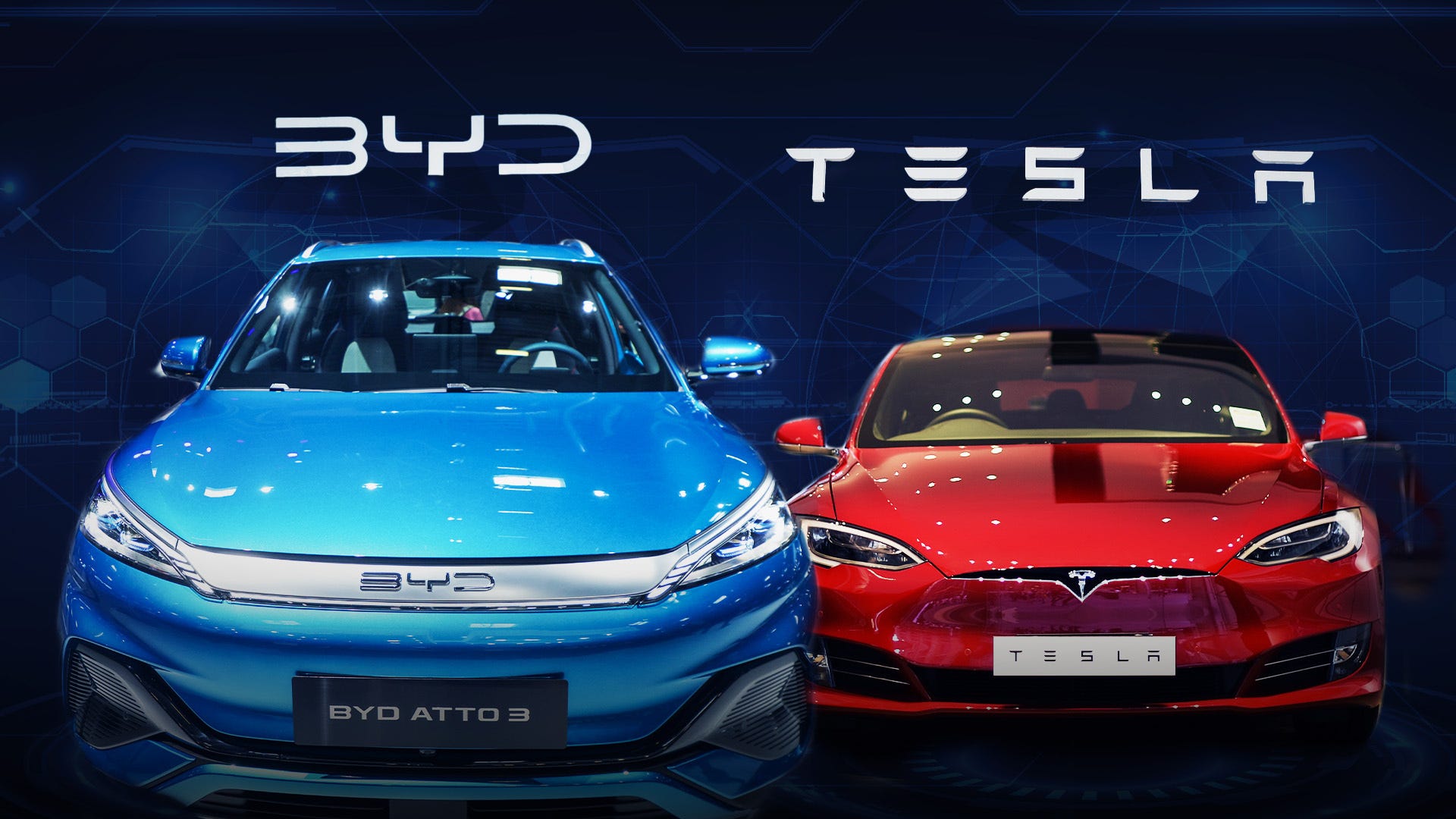

China’s BYD defeats Tesla and becomes EV king
BYD is now the world’s top electric car seller, overtaking Tesla, which Elon Musk’s company has dominated for a decade. Bloomberg analyzes how the world’s richest person came in second place.
bloomberg
- According to the company’s website, BYD vehicles are sold in more than 112 cities in 102 countries on six continents.
- According to AlixPartners, Chinese car brands are expected to account for 30% of the global new car market by 2030.
Chinese automaker BYD is rapidly growing to become the world’s largest electric vehicle manufacturer, surpassing Tesla on a global scale in 2025.
The company, founded in 1995 as a secondary battery manufacturer and headquartered in Shenzhen, China, has recently attracted attention as an existential threat to automakers in the United States, Europe, and Japan.
BYD vehicles are sold in more than 112 cities in 102 countries on six continents and will soon enter the Canadian market as part of a new deal signed by Canadian Prime Minister Mark Carney, according to the company’s website.
Canada’s northern neighbor recently opened its doors slightly to Chinese automakers, saying Canada would allow up to 49,000 Chinese-made electric vehicles into its market at a most-favored-nation tariff of 6.1%. This represents less than 3% of Canada’s new car market based on market size in 2023-24.
While other brands are manufacturing EVs in China, the number of BYDs powered around the world is increasing every year. According to data released by the China Passenger Vehicle Association on January 9, overall car exports from China in 2025 increased by 19% to 5.79 million units, while exports of pure battery electric vehicles increased by 49% to 1.52 million units.
According to AlixPartners, Chinese car brands are expected to account for 30% of the global new car market by 2030.
How is BYD able to manufacture EVs so cheaply?
The Chinese government provides subsidies for standard development of standard parts across automakers through the China Automotive Technology Research Center. This is just one step of many to reduce costs and speed up production for Chinese automakers. Competing Western companies rely on proprietary, expensive, or difficult-to-source sources for vehicle manufacturing.
The government-controlled system has given China’s emerging auto industry several strategic advantages over foreign automakers by reducing manufacturing and labor costs.
Additionally, experts say China has a high proportion of trained engineers among its workforce and is introducing artificial intelligence and connected software into vehicle design and execution processes much faster than its competitors.
Another big advantage of the Chinese system is the process by which companies like BYD develop battery technology. They control the entire process from mining lithium to assembling battery packs.
The Chinese system results in a selection of attractive, high-quality, and affordable vehicles that can be sold in large quantities at a fraction of the price the same vehicles would cost if manufactured in the United States or other countries.
For example, BYD models range in price from $20,000 for the Dolphin compact hatchback and Atto 3 compact SUV to $180,000 for the luxury Yanwan U8L, a long-wheelbase version of the off-road SUV.
Some of BYD’s popular models
BYD only produces electric and hybrid models. According to BYDAC, a manufacturer and retailer of aftermarket auto accessories, here are some examples of popular models.
- Seal, premium electric sedan
- dolphin compact hatchback
- Tang, a 7-seater SUV with a luxurious interior
- Compact SUV “Atto 3”
- Han EV and Han L, their flagship executive sedan and high-performance versions
- Song Plus, mid-size electric SUV with hybrid option
- Plug-in hybrid sedan “Qin Plus”
According to the company’s website, Han’s flagship EV has a range of 375 miles and can run from 0-60 mph in 3.9 seconds. It is equipped with all-wheel drive and the complete BYD Intelligent Driving System.
Despite the affordable price tag, BYD claims that its vehicles exude a premium feel.
According to Han’s product description, “The interior features solid wood panels, high-quality Nappa leather seats, aluminum trim, and rare materials not commonly found in other luxury cars.”
Another model you may have heard of is the Shark 6 pickup that BYD sells in Mexico.
Hybrid models include the Han DM-i and its upgraded version Han L DM-i, BYD Destroyer 05.
In addition to automobiles, BYD’s products also include freight, rail, transportation, battery energy storage systems, and electronics.
Is it possible to bring BYD to the US?
Purchasing a BYD electric vehicle in Canada and crossing the border into the United States is complicated, but not completely precluded by U.S. safety laws required for imported vehicles.
Under the Imported Vehicle Safety Compliance Act of 1988, U.S. citizens can import “nonconforming foreign motor vehicles” for personal use if they can prove that they are not intended for resale.
The process could still be costly enough to deter most would-be buyers of BYD. According to the law, anyone importing a nonconforming foreign vehicle must also pay a bond and comply with other conditions established by the U.S. Secretary of Transportation.
According to the law, why is BYD unsafe?
One of the big hurdles to overcome is the autonomous capabilities of BYD electric vehicles. There is no existing federal framework for determining what is safe in autonomous vehicles (AVs), but perhaps one is in the works.
A more pressing safety concern is the vast amount of data self-driving cars need to collect and utilize to operate effectively: precise location data, driver behavior data, and vehicle data from sensors and cameras. In other words, the U.S. government is wary of sharing this kind of data directly with foreign automakers with strong ties to the Chinese government.
Perceived national security risks are part of the reason President Donald Trump’s administration has imposed 100% tariffs on all Chinese-made cars.
USA Today automotive writer Keith Laing contributed to this report. Jackie Charniga covers General Motors for the Free Press. Contact me at jcharniga@freepress.com.


