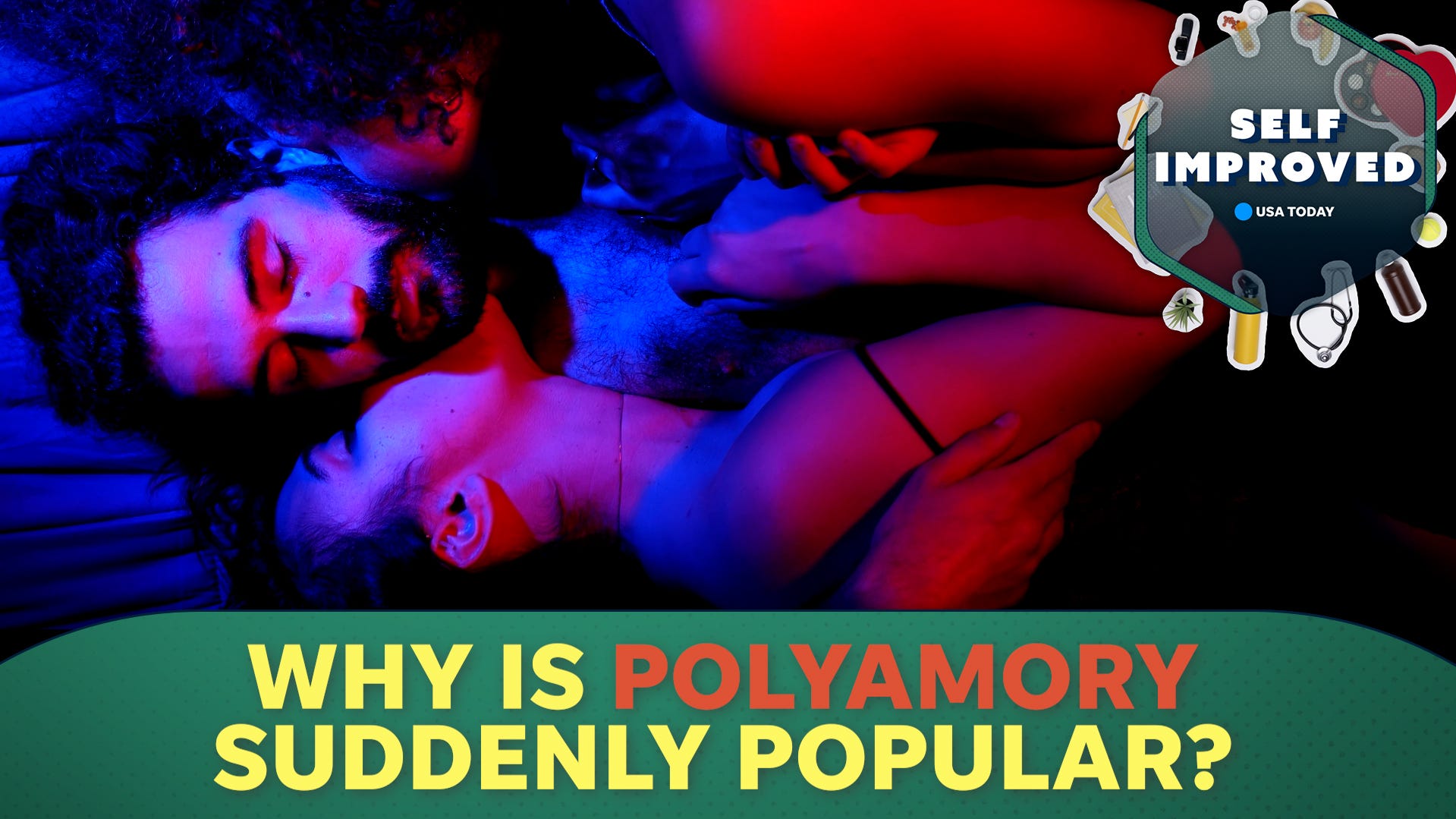

Experts explain why polyamory is gaining popularity in pop culture
Dating expert Dr. Ramani explains why interest in polyamory is surging online and in popular culture.
Ashley Ashbourne was in a polyamorous threesome until her life fell apart when her two partners kicked her out of it.
“Unfortunately, looking back at the relationship itself, I noticed a lot of red flags that I wasn’t consciously aware of,” the 30-year-old Kansas native says now. With her bubblegum pink hair bouncing across the screen, she’s been keeping her TikTok followers updated on the ups and downs of her love life since then.
Like all types of relationships, not all polyamorous relationships are the same. For example, breaking up with your primary or second partner may not uproot your life enough to end a casual relationship. But polyamory and non-monogamy experts say people in these relationships grieve, heal and grow just like anyone else.
“Breakups in polyamorous and monogamous relationships are more similar than different,” says Manije Badi, a licensed psychologist and professor whose research focuses on polyamorous, queer, and BIPOC communities. “In both cases, people’s ability to heal is determined by how important that relationship was, the coping tools they have, and the support they receive.”
The aftermath of a polyamorous breakup
As with monogamy, if you’ve been with someone for a long time, have financial resources, and share children, “obviously the breakup is going to be more heartbreaking and probably more complicated and life-changing,” says Sarah Stroh, 37, of Berlin, Germany. She chronicles her non-monogamy journey in her “Monogamy” newsletter.
Ashbourne had a husband, a mutual girlfriend, and three of her four children. When she and her husband of more than seven years decided to divorce in the summer of 2024, she entered a period of ambiguity with her other partner. They all lived in the same house and took care of the children, but later kicked her out. The grief began with a joint custody plan for Ashbourne and his ex-girlfriend’s children, who are almost 6 and 2 years old.
“I compartmentalized both relationships completely separately and processed and grieved them in completely different ways,” she says. “And the breakup itself becomes more difficult, especially from the perspective of three people. It can feel very lonely because you’re losing two people instead of one.”
Breaking up can also be difficult if you have other partners who require your attention. “In non-monogamous relationships, if you’re in other relationships while going through a breakup, you need to talk to them,” says Leanne Yau of @polyphiliablog. As with any relationship, communication is paramount.
“All other relationships can’t fall apart like dominoes or completely fall apart in the same way, unless you want the fallout of the relationship to have a significant negative impact on the rest of Polycule,” she added.
Not to mention, “you also have to deal with the fact that your monogamous friends and family don’t understand your grieving process,” says Chanie Jackson Kendall, a polyamorous educator and founder of Intentional Relating.
“It may be best for everyone involved to end the relationship.”
Relationships, whether monogamous or non-monogamous, end and survive for similar reasons. The type of relationship does not determine its length or overall success.
“Non-monogamous people don’t break up because they’re not monogamous,” Yau says. “They break up for the standard reasons people break up. For example, in a monogamous relationship, they probably want different things or have different conflict styles.”
“Overall, non-monogamous people tend to accept that breakups can occur if harmony is lost,” Jackson-Kendall added. “That doesn’t mean we’re immune to the trap of staying in a relationship past its expiration date. But when faced with constant conflict or serious disagreements, we start to think it might be best for everyone involved to end the relationship.”
Polyamory, breakups, and ripple effects
Non-monogamous relationships can be more flexible or fluid in nature. It doesn’t have to be a high-stakes decision, as is often the case with monogamous divorces. “Polyamory doesn’t have to be this binary,” Stroh says. “When you break up, it doesn’t mean, ‘Okay, there’s nothing left.’ You can decide to keep the parts you want and keep the parts you don’t want.”
“Just as monogamy includes everything from casual dating to a lifelong partnership, non-monogamy can range from casual forms like swinging to deeply committed forms like polyamory,” Badie says. “Many polyamorous people date with the goal of a long-term relationship.” That doesn’t mean there aren’t complications.
Evita Sawyers’ long-distance partner of just over a year told her he wanted to change the contours of their relationship. “You might think of it as a comet-like relationship rather than a partnership.” The 43-year-old from Fontana, California, was surprised by the proposal after the two spent the holidays together. She broke up with him and removed herself from his orbit.
The experience left her shaken. “If it has any effect on my non-monogamy, going through something like this has always made me very gun shy,” she says. “So connections feel scary in general.”
A misconception that persists during polyamory and non-monogamous breakups is that because someone has multiple partners, it’s no big deal to be separated from or lose one person. Why not spend more time with other connections? But it’s not that simple. The more relationships there are, the greater the results. What if you were close to your partner’s other partner, even as platonic friends? “It’s going to cause ripples,” Sawyers said.
More love means more loss – but beautiful
Relationships can be difficult, but they can also be beautiful, including polyamory. But while it opens you up to more love, it also opens you up to more loss, Sawyers adds.
Ashbourne hasn’t ruled out exploring polyamory again. “I still believe that you can love more than one person at the same time, and I think that’s incredibly beautiful and eye-opening,” she says.
But for now, she’s just taking it one day at a time and focusing on the relationship that matters most: the one with herself.


